This article was automatically translated from the original Turkish version.
Location | left bank of the Çoruh River İspir Erzurum | ||||||||
|---|---|---|---|---|---|---|---|---|---|
Strategic Detail | Hidden water channel descending to the Çoruh River | ||||||||
Church Remnant | Byzantine period; 13.80 x 24.00 m; wall thickness 90 cm | ||||||||
Çilehane | Dimensions 9.00 x 2.30 m, five-bay vaulted area with 12 steps | ||||||||
Minaret Function | Both a call to prayer platform and an observation tower | ||||||||
Kale Mescidi | 12th century Saltuklu structure; wall thickness 115 cm | ||||||||
Main Materials | Basement made of river stones, upper walls constructed with cut stone blocks | ||||||||
Area Width | Approximately 125 x 135 | ||||||||
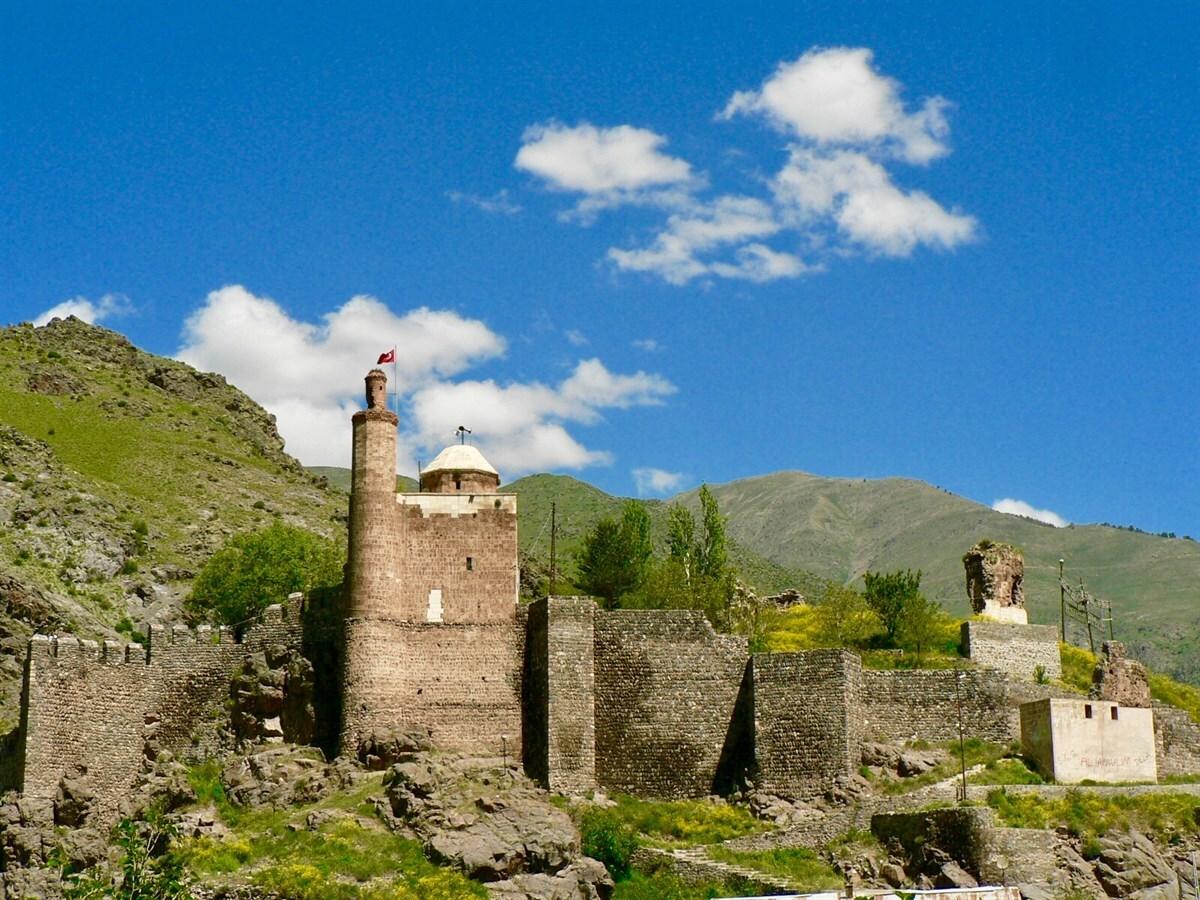
İspir Castle is a historical structure situated on a dominant hill on the left bank of the Çoruh River in the İspir district of Erzurum Province. Although there is no definitive information regarding who originally built the castle, its geographical location, strategic features, and the presence of a secret water channel descending to the Çoruh River suggest it may have been established by the Urartians. Some sources attribute its construction to the Ilkhanids who ruled the region in the 12th century. Since no inscriptions from the period of construction have survived, the exact date of its origin remains uncertain. The structure was restored in the 16th century by Ottoman Sultan Kanuni Sultan Süleyman【1】.

İspir Kalesi (T.C. İspir Kaymakamlığı)
İspir Castle consists of an inner citadel planned according to the shape of the main rock formation, covering an area of approximately 125 by 135 metres, and outer walls enclosing the settlement. Coloured stones collected from the Çoruh River were used for the lower sections and foundations, while regularly cut stones were preferred for the upper walls.
Access to the inner citadel is via a stepped path from the east. The castle’s curtain walls and towers are constructed using ashlar stone and horasan mortar. The walls facing the town on the outer castle have been largely destroyed, leaving few traces today. On the steep cliffs to the west of the castle, remnants of a secret water channel descending to the Çoruh River still exist.

Kilisenin Duvarları (T.C. İspir Kaymakamlığı)
Within the inner citadel, various structures and remains serve religious and administrative purposes.
Although its exact construction date is uncertain, it is generally believed to have been built by the Saltukids in the 12th century. It is likely that Alp İnanç Bey, who also commissioned the Kale Mescidi and Kesik Minare in Erzurum, ordered its construction around 1124. The thickness of the mosque’s walls is 115 centimetres.【2】
At the highest point of the inner citadel, aligned east-west, lies the remains of a basilica-style church occupying an area of approximately 13.80 by 24 metres. The walls of this ruined structure are about 90 centimetres thick. The building, believed to date from the Byzantine period, was constructed using regularly cut stone and rubble stone.【4】
Erzurum İl Kültür ve Turizm Müdürlüğü. "İspir Kalesi Restorasyonu için çalışmalara başlandı." Accessed February 7, 2026. https://erzurum.ktb.gov.tr/TR-298019/ispir-kalesi-restorasyonu-icin-calismalara-baslandi.html
Karabudak Ertem, Zeynep, and Hilal Turgut. "Kültürel Peyzaj Planlaması Kapsamında Tarihi Çevrelere Yönelik Kentsel Tasarım Önerileri: Tarihi İspir Kalesi ve İspir Evleri." *Iğdır Üniversitesi Fen Bilimleri Enstitüsü Dergisi* 10, no. 3 (2020): 2076-2089. Accessed February 7, 2026. https://dergipark.org.tr/en/download/article-file/1124697
Kuzeydoğu Anadolu Kalkınma Ajansı (KUDAKA). "İspir Kalesi." Accessed February 7, 2026. https://kudaka.gov.tr/bolgemiz/erzurum/erzurum-gezilecek-yerler/ispir-kalesi
Türkiye Kültür Portalı. "İspir Kalesi - Erzurum." *T.C. Kültür ve Turizm Bakanlığı*. Accessed February 7, 2026. https://www.kulturportali.gov.tr/turkiye/erzurum/gezilecekyer/spir-kalesi
İspir Kaymakamlığı. "İspir Kalesi." Accessed February 7, 2026. https://www.ispir.gov.tr/ispir-kalesi
İspir Kaymakamlığı. "İspir Merkezindeki Tarihi Kalıntılar." Accessed February 7, 2026. https://www.ispir.gov.tr/ispir-merkezindeki-tarihi-kalintilar
[1]
Kuzeydoğu Anadolu Kalkınma Ajansı (KUDAKA). "İspir Kalesi." Erişim 7 Şubat 2026. https://kudaka.gov.tr/bolgemiz/erzurum/erzurum-gezilecek-yerler/ispir-kalesi
[2]
Zeynep Karabudak Ertem ve Hilal Turgut. "Kültürel Peyzaj Planlaması Kapsamında Tarihi Çevrelere Yönelik Kentsel Tasarım Önerileri: Tarihi İspir Kalesi ve İspir Evleri." Iğdır Üniversitesi Fen Bilimleri Enstitüsü Dergisi 10, no. 3 (2020): 2076-2089. doi: 10.21597/jist.710340. Erişim 6 Şubat 2026. https://dergipark.org.tr/en/download/article-file/1124697
[3]
İspir Kaymakamlığı, "İspir Kalesi," erişim 7 Şubat 2026, https://www.ispir.gov.tr/ispir-kalesi
[4]
Kuzeydoğu Anadolu Kalkınma Ajansı (KUDAKA), "İspir Kalesi," erişim 7 Şubat 2026, https://kudaka.gov.tr/bolgemiz/erzurum/erzurum-gezilecek-yerler/ispir-kalesi

Location | left bank of the Çoruh River İspir Erzurum | ||||||||
|---|---|---|---|---|---|---|---|---|---|
Strategic Detail | Hidden water channel descending to the Çoruh River | ||||||||
Church Remnant | Byzantine period; 13.80 x 24.00 m; wall thickness 90 cm | ||||||||
Çilehane | Dimensions 9.00 x 2.30 m, five-bay vaulted area with 12 steps | ||||||||
Minaret Function | Both a call to prayer platform and an observation tower | ||||||||
Kale Mescidi | 12th century Saltuklu structure; wall thickness 115 cm | ||||||||
Main Materials | Basement made of river stones, upper walls constructed with cut stone blocks | ||||||||
Area Width | Approximately 125 x 135 | ||||||||
Architectural Features
Structures Within the Castle
Castle Mosque
Church Remains