
 Recently Added:
This article was automatically translated from the original Turkish version.
On 13 June 2025, Israel launched a comprehensive military operation under the name “Operation Rising Lion,” targeting numerous sites within Iran’s nuclear and military infrastructure. Conducted by the Israel Defense Forces (IDF), the operation began around 03:00 local time and triggered simultaneous explosions across multiple Iranian cities. Targets included uranium enrichment facilities, missile production sites, radar systems, military command structures, and air defense elements.
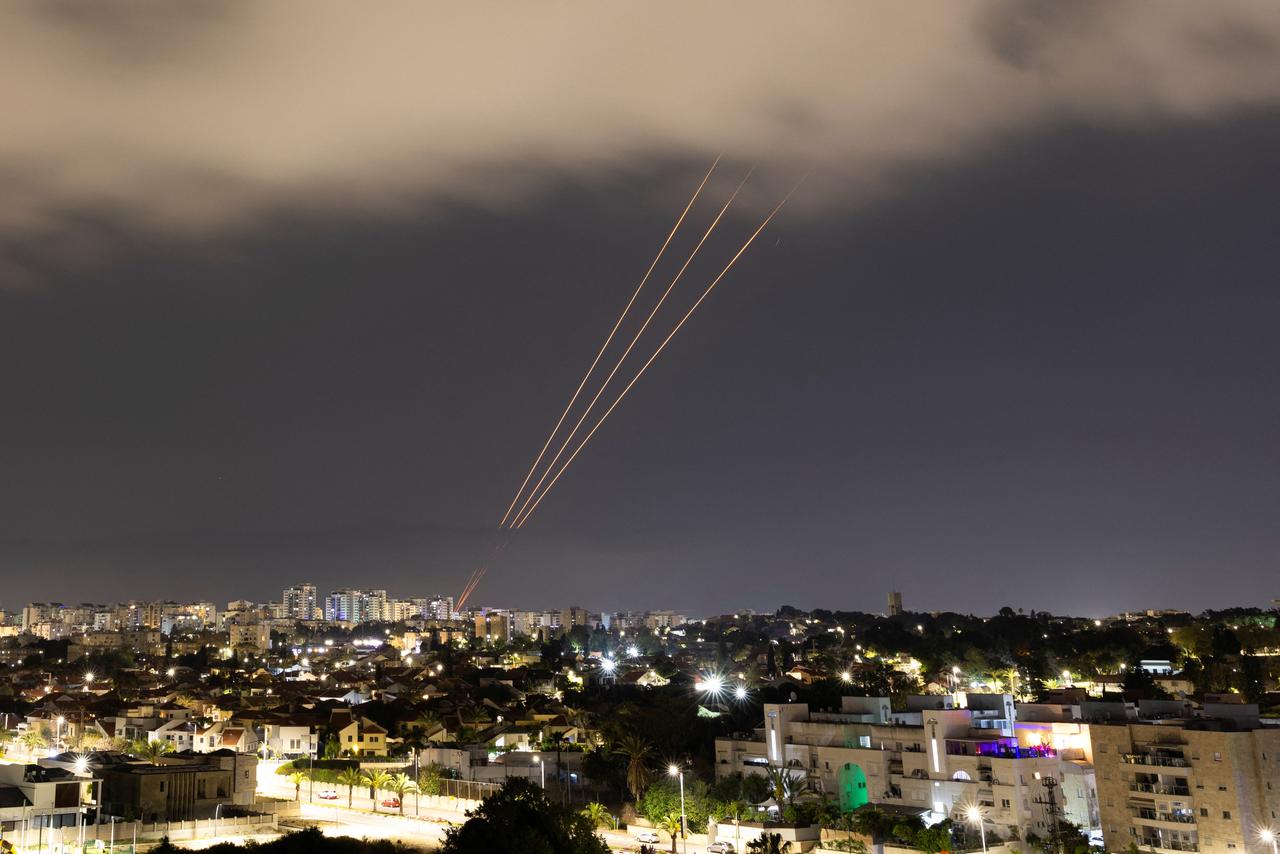
Operation Rising Lion attack, 13 June 2025 – (Reuters)
Israeli authorities stated that the operation’s objective was a preventive measure against Iran’s capacity to develop nuclear weapons. Officials claimed that Iran had accumulated enriched uranium quantities sufficient for nuclear bomb production. It was reported that over 200 fighter aircraft and various unmanned aerial systems participated in the operation.
The air strike, conducted by the Israel Defense Forces and named “Operation Rising Lion,” commenced on 13 June 2025 at approximately 03:00 local Iranian time. Within the first minutes of the operation, explosion sounds were heard across numerous Iranian cities, with attacks carried out simultaneously.
Initial explosions were recorded in the northeast and west neighborhoods of the capital, Tehran. Areas including Mahallati, Kamraniye, and Aghdasieh were targeted due to their military and civilian infrastructure significance. A fire broke out at a command center reportedly belonging to the Islamic Revolutionary Guard Corps in Mahallati, while a multi-story building in Kamraniye sustained severe structural damage. The Parchin military complex in southeastern Tehran was among the areas directly hit by missiles.
Simultaneous with the attacks on Tehran, the Natanz complex, Iran’s primary uranium enrichment facility located in the city of Natanz, was also targeted. The International Atomic Energy Agency (IAEA) confirmed the strike in a subsequent statement, noting direct hits on the facility and that radiation levels were being monitored. Highways and civilian access routes around Natanz were temporarily closed.
In the northwestern city of Tabriz, multiple explosions occurred in areas housing nuclear research centers and military installations. Radar systems were reported disabled, and partial power outages followed the attack.
The western Iranian city of Kermanshah, home to radar and missile defense systems, was also targeted. According to some sources, thick smoke rose around military bases in the city, and physical damage occurred to command infrastructure. In the southwest, the city of Arak experienced explosions near its heavy water reactor, with reports indicating damage to associated research and production facilities.
Cities such as Isfahan and Shiraz were targeted for their strategic missile production facilities, military hangars, and radar centers. Large-scale fires broke out in some base areas following the aerial strikes and were brought under control.
Additional attacks were carried out against various military and infrastructure targets in the provinces of Qom, Lorestan, Hamadan, and Khuzestan. The aim was to weaken national defense coordination by striking critical logistics routes, command centers, and air defense infrastructure.
The Israel Defense Forces (IDF) announced that over 200 fighter aircraft, alongside advanced unmanned aerial vehicles (UAVs), participated in the operation. It was reported that some targets were struck using long-range standoff missiles without entering Iranian airspace, while others were neutralized through direct low- and medium-altitude aerial operations.
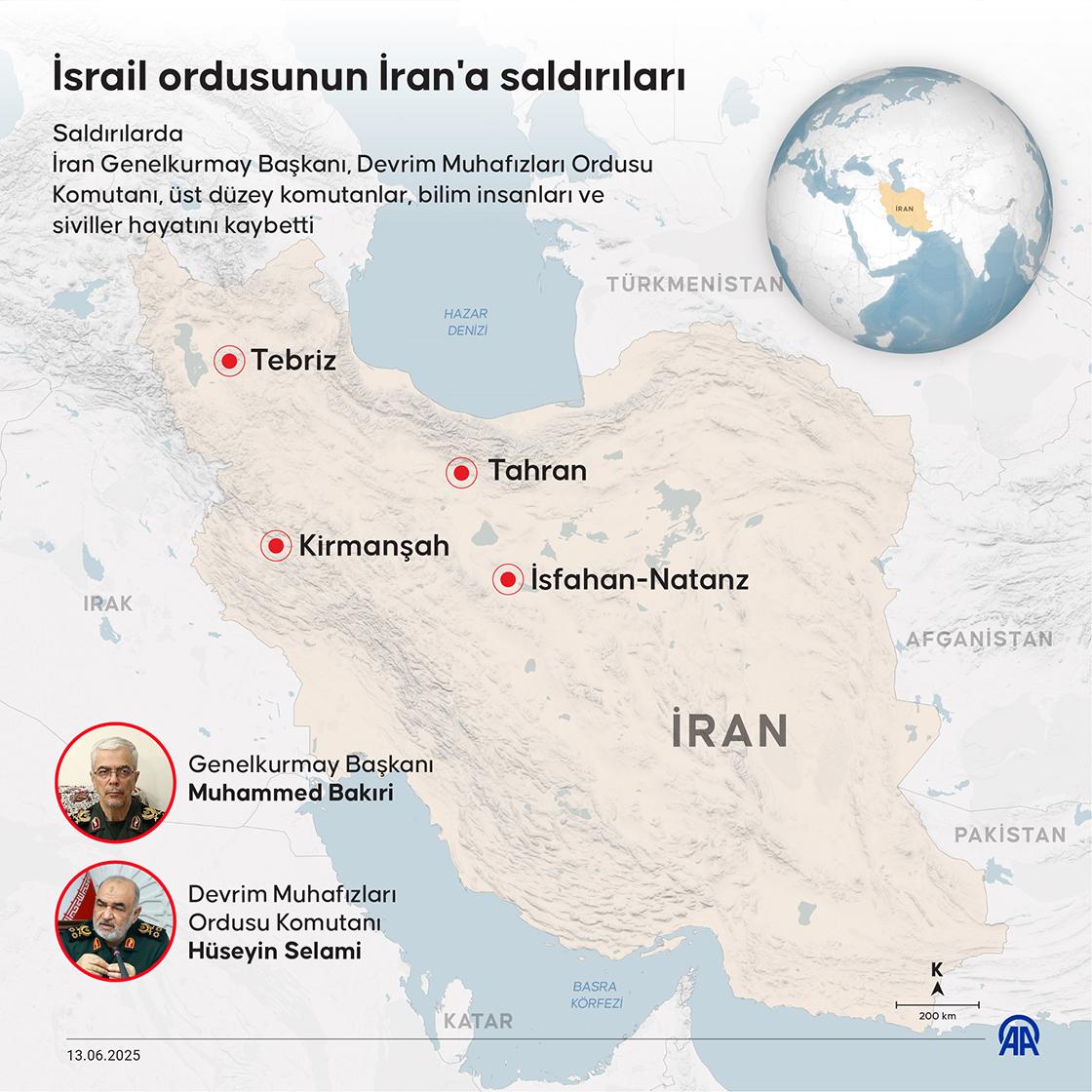
Infographic on Israel’s attack on Iran – (Anadolu Ajansı)
On 13 June 2025, the Israel Defense Forces launched an air strike targeting various components of Iran’s military and nuclear infrastructure. Primary targets included nuclear facilities, radar centers, military command posts, missile development zones, and command and control hubs. The attacks were directed at both above-ground and underground structures.
The Natanz complex, located in Isfahan Province and one of Iran’s main nuclear facilities, was among the operation’s top priorities. The uranium enrichment plant in the city of Natanz, subordinate to Isfahan Province, was a principal target. The International Atomic Energy Agency (IAEA) confirmed the strike and reported damage to certain underground sections. Munitions capable of penetrating underground shelters were used in the attacks. Radiation levels in the surrounding area were monitored afterward, and the Qom–Isfahan highway was closed to traffic for security reasons.
The Parchin complex, located southeast of Tehran, was another key target. The site is believed to be involved in Iran’s work on explosive systems and ballistic missile technologies. Multiple explosions occurred within the complex during the strike, with dense smoke observed rising from the area. Local media reported that roads around Parchin were closed to traffic.
Command posts and residences of senior military officials in the Mahallati and Aghdasieh neighborhoods of northeastern Tehran were targeted. Reports indicated damage to multi-story buildings, with some structures collapsing and search-and-rescue teams deployed. One building in Mahallati was confirmed to serve as a command center for the Islamic Revolutionary Guard Corps and caught fire after the strike.
The Khatam al-Anbiya Central Command Headquarters, one of Iran’s key operational planning centers, was also targeted. The headquarters plays a central role in Iran’s military planning, coordination, and field oversight. Local sources reported that command personnel in the area were relocated to other locations following the attack.
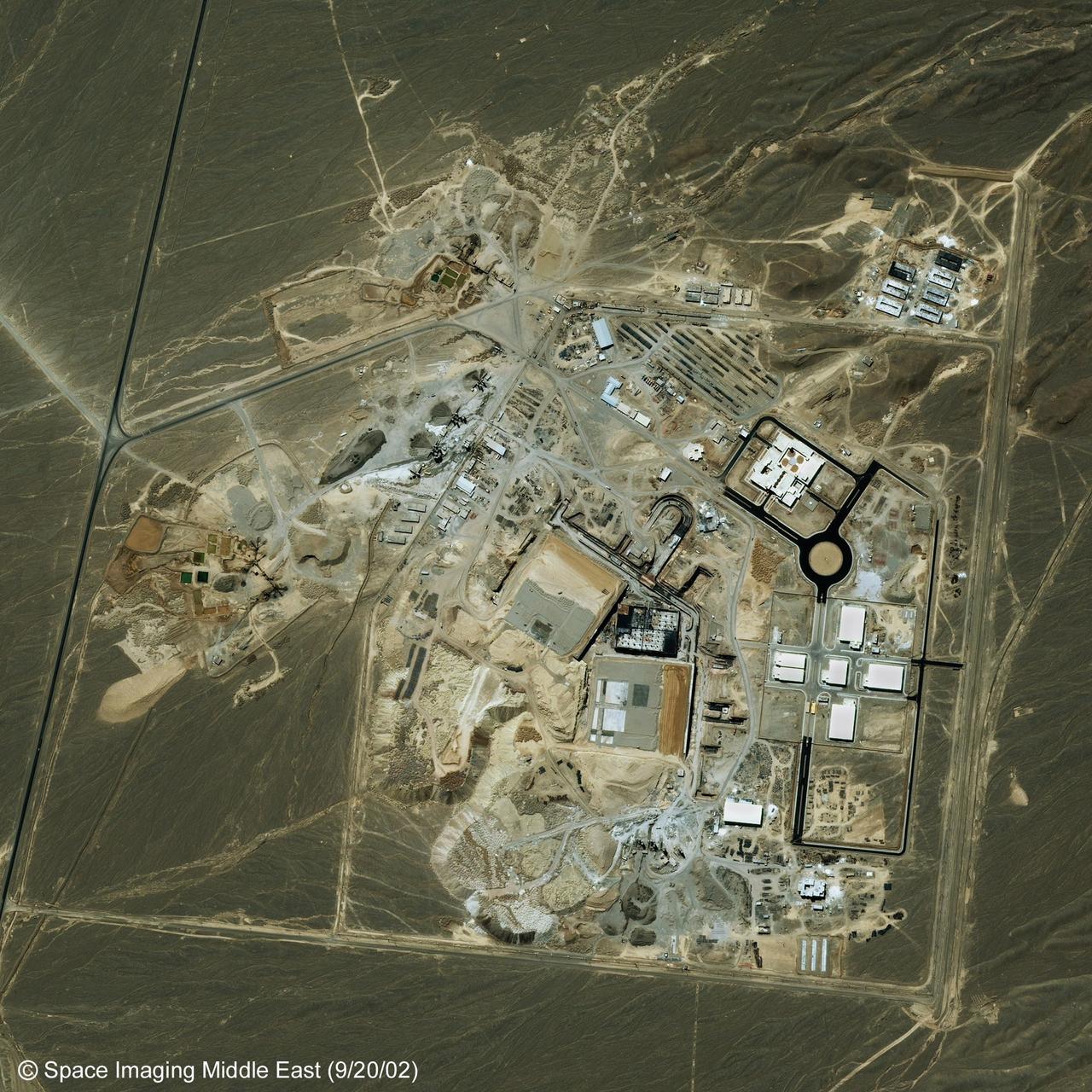
Natanz nuclear facility – (Iran Watch)
The Subashi radar facility in Hamadan Province is part of Iran’s air surveillance and early warning network. Precision-guided munitions were used against this site during the operation, with radar towers and communication antennas reported destroyed. The disabling of radar systems in the region was described as an operational step intended to create air defense vulnerabilities.
Military structures near the Hosrevi Border Crossing in Kermanshah Province, close to the Iraqi border, were targeted. The attack damaged a logistics facility and some civilian vehicles. Local authorities announced a temporary suspension of military activities along the border.
The Seydava Military Barracks and surrounding radar systems near Tabriz were among the targets of coordinated strikes. Significant damage was reported to radar antennas, communication towers, and ammunition storage structures. Local sources indicated that explosions spread beyond the barracks and that military units were evacuated.
Several structures around the heavy water reactor in Arak were direct targets of the strikes. Although no direct hit on the reactor building itself was reported, damage occurred to surrounding security and support infrastructure. Arak is known as one of Iran’s key centers for nuclear research activities.
Uranium conversion and nuclear physics research centers in Isfahan were also focal points of the attack. Fires broke out in laboratory buildings near the research reactor, and radiation levels were monitored. Roads in the area were closed for security reasons, and civilian access was prohibited after the strike.
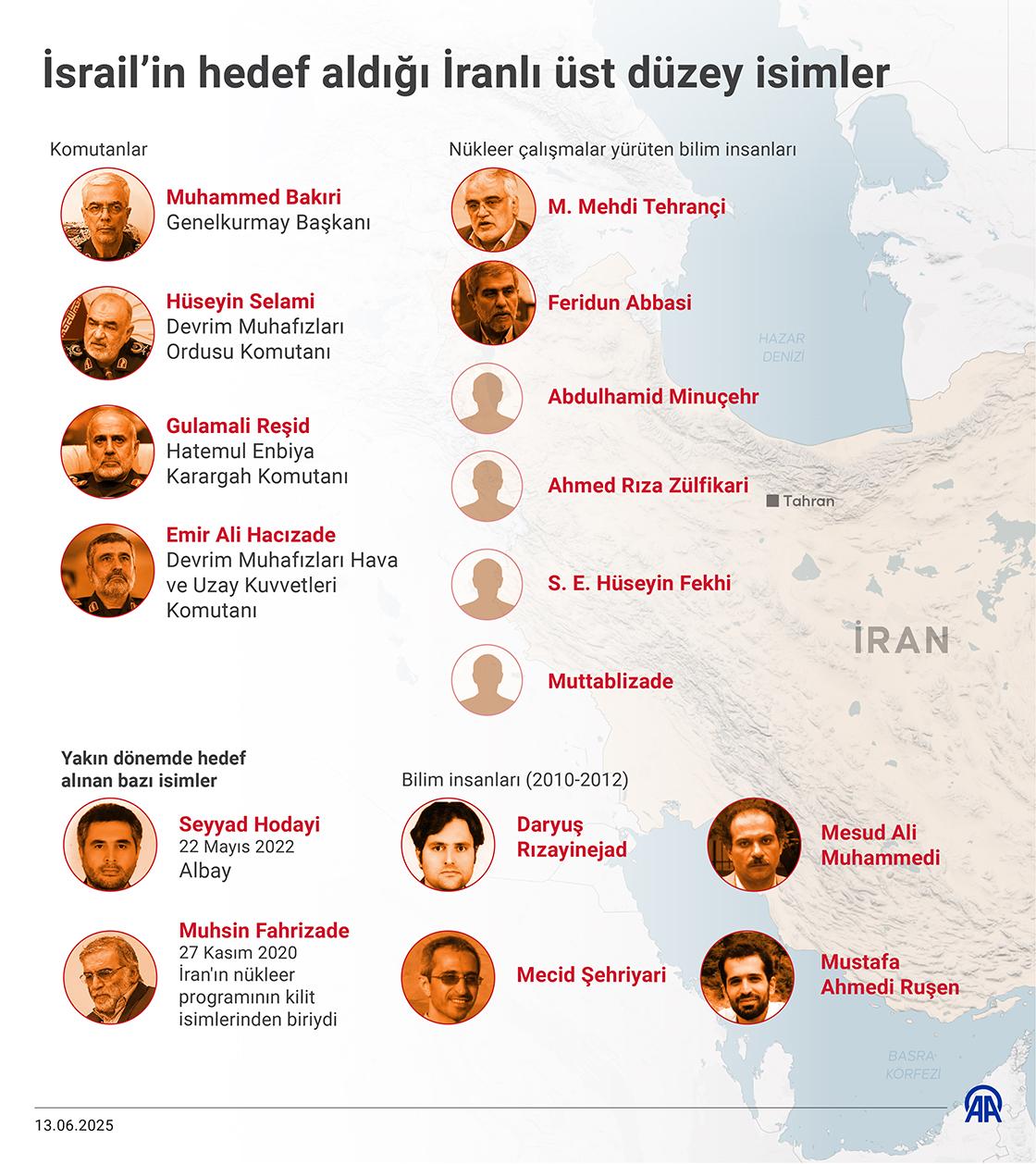
Infographic showing high-ranking Iranian officials targeted by Israel – (Anadolu Ajansı)
The Israeli air strike resulted in casualties and injuries among senior figures within Iran’s armed forces and nuclear program. Most of those killed or seriously wounded were located at directly targeted command centers, residential complexes, and nuclear research facilities.
The death of Lieutenant General Mohammad Bagheri, Chief of Staff of the Iranian Armed Forces, was confirmed by Iranian official sources. It was reported that his command center was directly targeted by Israeli fighter jets during the strike. The news was first published by local media and later confirmed by state television.
It was reported that Lieutenant General Hossein Salami, Commander-in-Chief of the Islamic Revolutionary Guard Corps (IRGC), was killed during the attacks. Salami was reportedly in a military residential complex in Tehran, an area directly targeted. His death triggered an urgent reshuffle within the IRGC command structure.
General Gholamali Rezai, Commander of the Khatam al-Anbiya Central Command Headquarters, was reported killed during the attack on the headquarters. Rezai was known to play an active role in Iran’s defense doctrine and strategic military planning. It was stated that the attack on his compound employed specially directed munitions.
Brigadier General Amir Ali Hajizadeh, Commander of the IRGC Aerospace Force, was reportedly struck while at a military complex near Parchin. According to official sources, eight other senior IRGC officers were killed in the same strike, including technical personnel involved in missile development programs.
A senior official from Iran’s official intelligence agency and the Chief of IRGC Intelligence were killed in the attacks on command centers in Tehran. These deaths created a significant void in Iran’s internal security and counterintelligence structure. According to sources, both individuals were targeted during a coordination meeting at the IRGC Headquarters.
Faridoun Abbasi, former head of the Atomic Energy Organization of Iran and a professor of nuclear physics, was killed in a targeted building near Natanz. Meanwhile, Professor Dr. Mohammad Mehdi Tehranchi, Rector of Islamic Azad University and an expert in nuclear physics, was also among those killed in the strikes. Four additional scientists involved in Iran’s nuclear program were also killed, including reactor engineers, enrichment specialists, and nuclear materials inspectors.
It was reported that four additional nuclear experts, besides Faridoun Abbasi and Mohammad Mehdi Tehranchi, were targeted in Israel’s 13 June 2025 air strike. These individuals included Abdulhamid Minuchehr, Ahmed Reza Zolfikari, S.E. Hossein Fekhi, and Muttalbizadeh. They were identified as technical and academic personnel involved in Iran’s nuclear research and development programs.
No detailed clarification was provided regarding which specific facility or attack wave resulted in the deaths of these experts, but it was reported that they were present in laboratories and office areas directly hit by the strikes.
Ali Shamkhani, former Secretary of Iran’s Supreme National Security Council and advisor to Supreme Leader Ali Khamenei, sustained serious injuries during the attacks. He was wounded when a command structure in his residence in Aghdasieh was struck, suffering multiple fractures and internal bleeding. Official statements indicated he remained in life-threatening condition and was receiving treatment in a specialized military hospital. Iran’s state television announced that no temporary replacement for Shamkhani had yet been appointed.
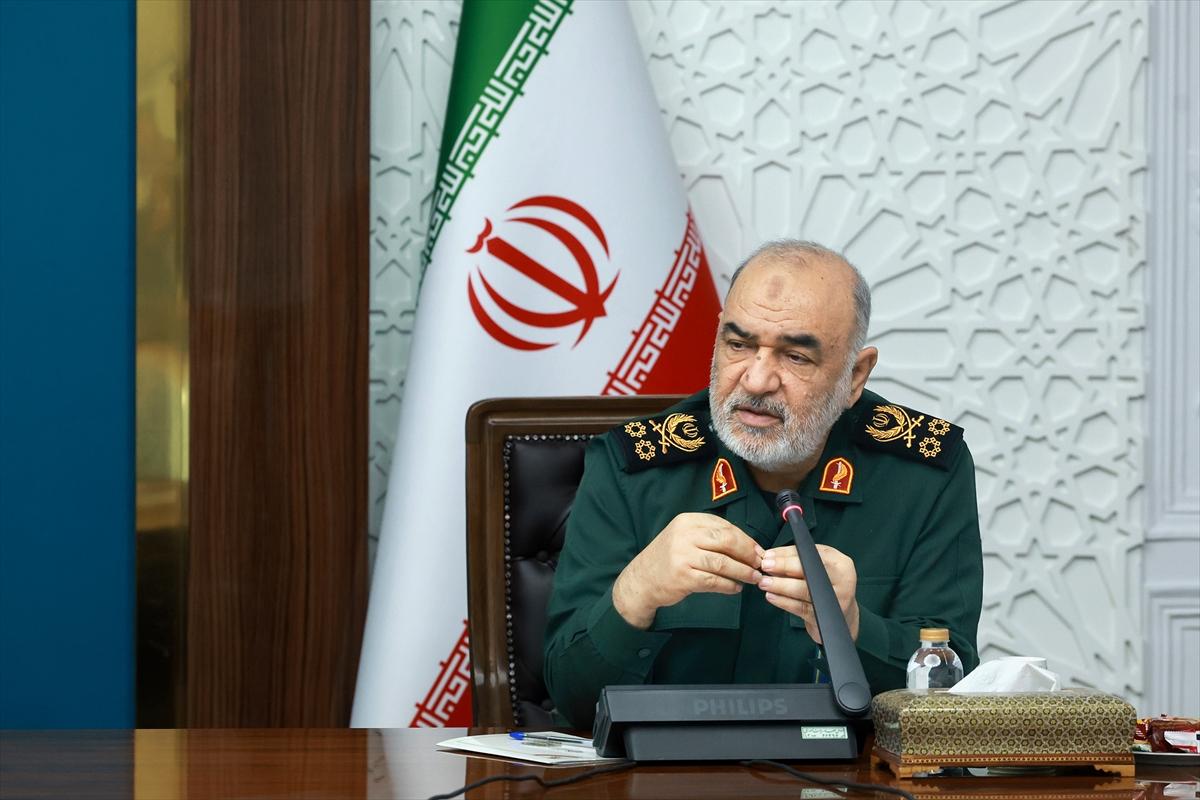
Hossein Salami, Commander of the Islamic Revolutionary Guard Corps, killed in the Israeli attack – (Anadolu Ajansı)
The Israeli air operations and ongoing reciprocal strikes did not remain confined to military targets; they caused significant civilian casualties, infrastructure damage, and widespread destruction. Numerous incidents were reported in which civilians in various Iranian and Israeli cities were directly affected.
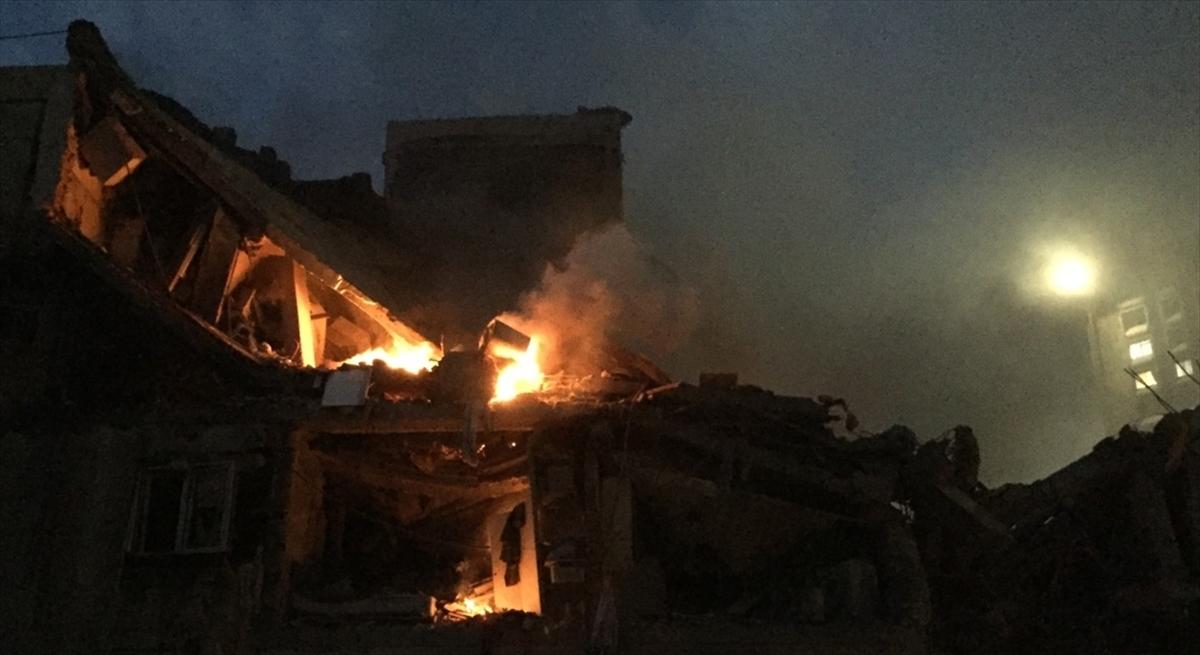
A building on fire in the capital Tehran following the attack, 13 June 2025 – (Anadolu Ajansı)
In Iran’s capital, Tehran, neighborhoods such as Mahallati and Kamraniye in the northeast were among the civilian areas damaged in the attacks. In Mahallati, upper floors of a multi-story apartment building were struck, causing a fire and prompting evacuation. In Kamraniye, a blast caused the collapse of an apartment’s exterior wall, shattering windows in nearby mosques and schools. Civil defense teams were dispatched to the sites and began debris removal, identifying collapse risks in several buildings.
Air strikes near the Hosrevi Border Crossing in the Kassr-e Shirin region of western Iran, close to the Iraqi border, damaged nearby residential areas. Local authorities reported one civilian death and 31 injuries, including border workers and transport personnel. Operations at the border crossing were suspended and commercial crossings halted.
According to a statement by Iran’s Permanent Representative to the UN, Amir Said Irevani, at least 78 civilians were killed across Iran as a result of the attacks. Initial reports indicated deaths of five in Tehran, two in Tabriz, and one in Kassr-e Shirin, with figures later updated following comprehensive assessments. The total number of injured exceeded 320, including many women and children. The injured were transported to state hospitals in Tehran, Qom, Isfahan, and Mashhad.
The majority of the injured were taken to Tehran’s Baghbanpur, Imam Khomeini, and Shahid Modarres hospitals. Emergency capacity was expanded at medical facilities in Mashhad and Isfahan, and field hospitals were established. The Iranian Red Crescent Society reported opening a field hospital with at least 120 beds in Tehran. Most injured women were reportedly at home during the attacks, while many children were affected near schools.
Temporary power outages and internet disruptions occurred in cities heavily targeted by the strikes, particularly Tehran. An electrical substation in Mahallati was damaged, cutting off power to the area. Internet service providers in Kamraniye reported damage to their central offices, resulting in connectivity issues. In some neighborhoods, mobile networks were disabled and emergency call systems disrupted.
Fires ignited by the bombardment, especially in northern Tehran, proved difficult to control. Most fires originated from explosions of air defense systems, with some apartment rooftops completely consumed. Search-and-rescue and firefighting teams, coordinated with civil defense units, began debris-clearing operations. Due to collapse risks, the area around a severely damaged building in Mahallati was evacuated, and residents were relocated to temporary shelters.
As part of Iran’s ballistic missile retaliation, civilian casualties occurred in residential areas near Tel Aviv and Haifa. According to Israeli official sources, one Iranian missile struck the Holon area near Tel Aviv, killing five civilians and injuring over 30. The injured were transported to Tel Aviv Sourasky and Sheba Medical Centers. Reports indicated shattered windows in apartment complexes and activation of air raid sirens.
In response to Israel’s 13 June 2025 air strike, the Iranian government launched a multi-faceted retaliation campaign. The Iranian Armed Forces and the Islamic Revolutionary Guard Corps implemented various military measures, deploying UAVs and missile systems in response to the aerial attacks. Civil aviation security measures and alert statuses were also declared.
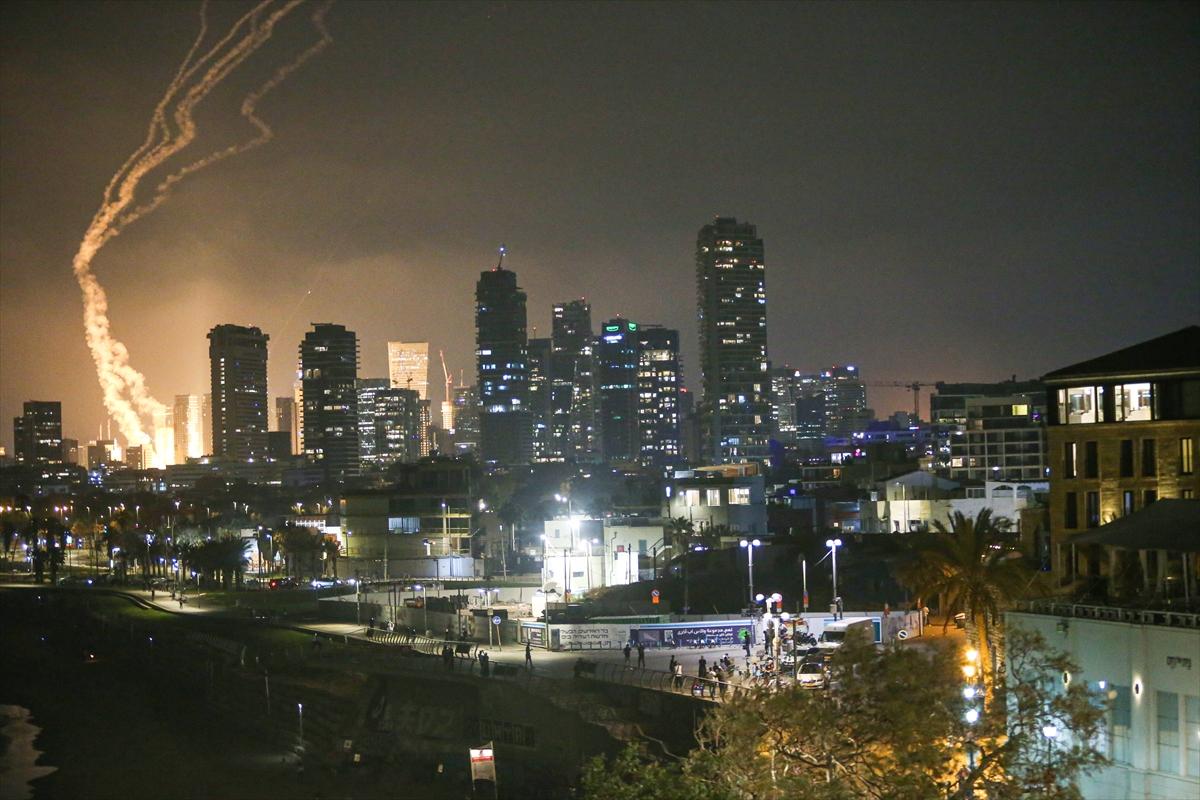
Iran’s retaliatory attacks against Israel, 13 June 2025 – (Anadolu Ajansı)
Supreme Leader Ayatollah Ali Khamenei, in a written statement following the attack, declared that Israel’s operation “will not go unpunished.” He stated, “This regime must know that a severe punishment awaits it. It has prepared for itself a fate of pain and suffering, and it will certainly pay the price.” He also affirmed that the duties of senior military officials and nuclear scientists killed in the strikes would be immediately assumed by other personnel.
Immediately after the attack, Iran’s Supreme National Security Council convened an emergency meeting. It was announced that military retaliation and diplomatic responses would be coordinated with defense and foreign policy units. Iran publicly stated that its military countermeasures would not be a single event but a phased, time-extended, and sequential process. It was emphasized that all military activities would continue without interruption.
Iran’s Ministry of Defense and IRGC officials announced the launch of over 100 UAVs against Israel. Most of these UAVs took off from southern and central Iranian bases and were directed toward Israeli airspace from multiple directions. The UAVs were described as possessing long-range flight capabilities and specialized software for target locking.
Iranian media reported that the majority of the UAVs were of the “kamikaze” type, programmed to detonate upon impact. It was also stated that accompanying reconnaissance and electronic countermeasure (ECM) vehicles aimed to degrade Israel’s radar systems. The Sepahnews agency confirmed that these UAVs targeted various military bases, air defense radars, and munitions depots.
Brigadier General Ebrahim Shikari, Spokesperson for the Iranian Armed Forces General Staff, stated on state television that Israel would “pay a heavy price.” He alleged that the attack was carried out with direct U.S. intelligence, operational, and political support. Iran affirmed its right to legitimate self-defense and stated that its response would be lawful, proportional, and resolute. The statement also confirmed that Iran’s ground and air forces had been placed on full alert and deployed into operational positions.
The Iranian Civil Aviation Organization announced the closure of the country’s airspace to all domestic and international flights until further notice, citing security concerns. All flights were suspended at Tehran Imam Khomeini International Airport and other major airports including Mashhad, Isfahan, Tabriz, and Shiraz. Airports experienced heavy congestion, with some passengers stranded. Iraq’s Ministry of Transportation also announced the temporary closure of its airspace due to the situation in Iran.
Following the attack, Iran activated its nationwide air defense systems to full operational status. Medium-range missile systems, radar platforms, and command-and-control centers around Tehran were brought online. Air defense brigades under the Iranian military were deployed around strategic facilities. Domestic systems, including the “Bavar-373” and “Khordad-15” air defense systems, were placed on alert status.
Iran expanded its retaliation campaign with ballistic missile strikes on the morning of 14 June 2025. Directed by the Islamic Revolutionary Guard Corps, these attacks targeted numerous strategic and populated areas across Israeli territory. Military, scientific, and civilian zones were simultaneously struck, resulting in significant casualties and physical destruction.
Israeli authorities reported that 13 civilians were killed and over 380 injured in Iran’s missile attacks. A portion of the injured were in critical condition, with over 40 patients receiving intensive care. The injured were transported to hospitals nationwide, causing temporary strain on healthcare infrastructure.
In response to Israel’s strikes on Iran’s nuclear and military infrastructure, Iran launched a ballistic missile operation named “Sadeq Vaad-3” on 13 June 2025. According to Iranian sources, hundreds of missiles were fired toward Israeli cities, particularly Tel Aviv, Haifa, and Dimona. Iran described the targeted areas as “occupied territories” housing military bases and strategic infrastructure.
Missiles striking near Israel’s Ministry of Defense in Tel Aviv caused significant damage, collapsing four buildings at different locations. Details regarding the impact on Haifa were not fully disclosed, but security measures were raised to the highest level. Unconfirmed reports circulated that strategic facilities near Dimona were targeted.
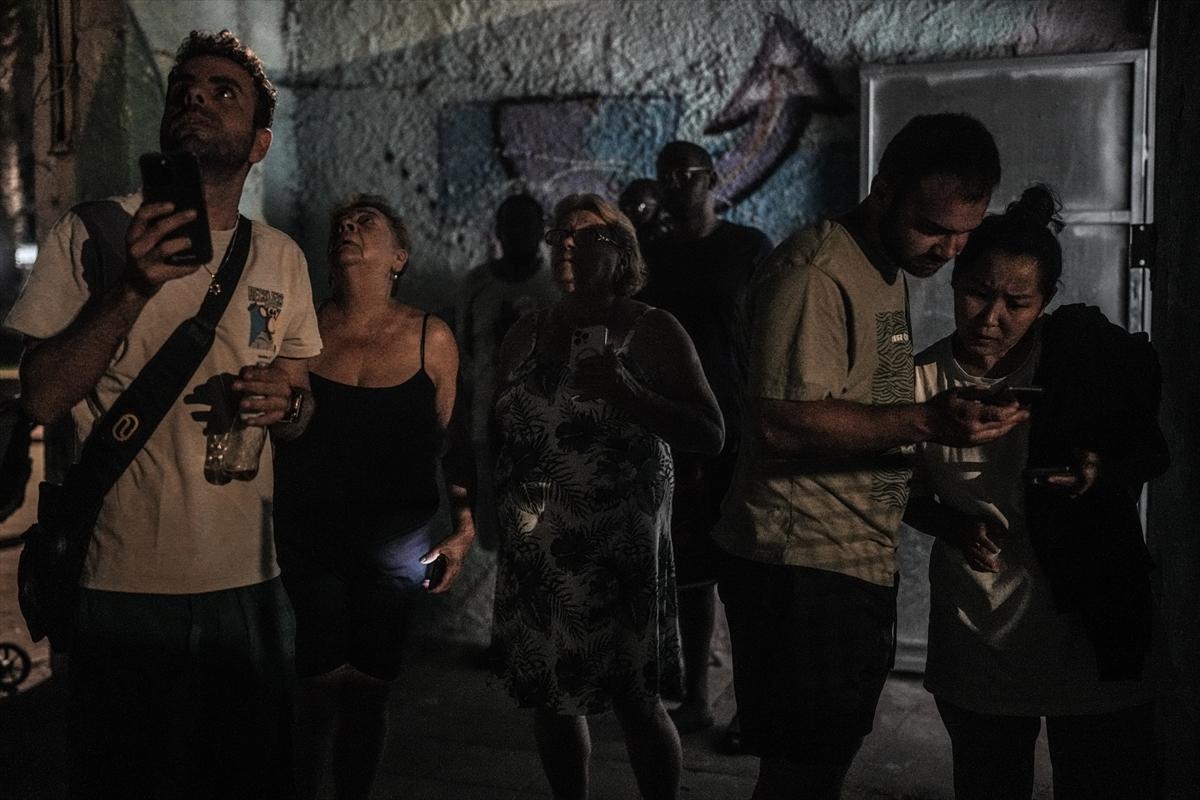
Israelis taking shelter in bunkers after Iran’s attack, 13 June 2025 – (Anadolu Ajansı)
One missile struck the main campus of the Weizmann Institute of Science in Rehovot. Several research buildings sustained serious damage, with collapses occurring in laboratory complex windows and roofs. Local authorities confirmed that two researchers were injured. A power outage caused by damage to the electrical infrastructure left Rehovot without electricity temporarily.
One Iranian missile hit the city of Bat Yam, striking a high-density residential apartment building. Several people were trapped under the rubble. Israeli civil defense units immediately launched search-and-rescue operations, recovering six individuals alive and confirming two deaths. The municipality evacuated the area and directed residents to temporary shelters.
The northern Israeli cities of Haifa and Tamra were directly affected by Iran’s missile strikes. One missile hitting near Haifa’s port struck a civilian apartment, killing four women. At least 15 others were injured in the same area. The injured were transported to Rambam Medical Center, where emergency protocols were activated. In Tamra, a school building was damaged by an explosion, prompting the evacuation of students.
Israel activated its air defense systems simultaneously to intercept Iranian missiles. The “Iron Dome” system was deployed to intercept short-range missiles, while “David’s Sling” and “Arrow” systems were used against medium- and long-range threats. The Israeli Ministry of Defense reported that nearly 80 missiles were launched, with the majority intercepted. Some missiles evaded the systems and reached their targets.
During the attack, nationwide early-warning sirens were activated, and civilians in cities including Tel Aviv, Jerusalem, Haifa, and Beersheba were directed to shelters. Local authorities urged the public to avoid crowded areas and comply with official alerts. Municipalities rechecked and activated shelter facilities. In Bat Yam and Rehovot, schools, synagogues, and public buildings were converted into temporary shelters.
Operations at the ports of Haifa and Ashdod were temporarily suspended after the missile strikes. Fires broke out in container loading areas due to explosion effects, prompting firefighting interventions. Damage was also reported on sections of the Tel Aviv–Jerusalem high-speed rail line, leading to service suspensions. Israel Railways advised passengers to use alternative routes.
Al Jazeera. “Live: Explosions Reported in Iran amid Israel Tensions.” Al Jazeera. Accessed June 13, 2025. https://www.aljazeera.com/news/liveblog/2025/6/13/live-explosions-reported-in-iran-amid-israel-tensions
Anadolu Ajansı. "Petrol Fiyatları, İsrail’in İran’a Saldırmasıyla Yükselişe Geçti." Accessed June 13, 2025. https://www.aa.com.tr/tr/ekonomi/petrol-fiyatlari-israilin-irana-saldirmasiyla-yukselise-gecti/3595923#
Anadolu Ajansı. "Trump’tan İsrail’e Mesaj: İran’a Saldırı Yerine Anlaşmayı Tercih Ederim." Accessed June 13, 2025. https://www.aa.com.tr/tr/dunya/trumptan-israile-mesaj-irana-saldiri-yerine-anlasmayi-tercih-ederim/3595580#
Anadolu Ajansı. “ABD Dışişleri Bakanı Rubio: İran’a Yönelik Saldırılara Dahil Değiliz.” Accessed June 13, 2025. https://www.aa.com.tr/tr/dunya/abd-disisleri-bakani-rubio-irana-yonelik-saldirilara-dahil-degiliz/3595879#
Anadolu Ajansı. “İran Lideri Hamaney, İsrail’e Sert Karşılık Vereceklerini Bildirdi.” Accessed June 13, 2025. https://www.aa.com.tr/tr/dunya/iran-lideri-hamaney-israile-sert-karsilik-vereceklerini-bildirdi/3596008#
Anadolu Ajansı. “İsrail Başbakanı Netanyahu: Tehlike Ortadan Kalkana Kadar İran’a Saldırılar Sürecek.” Accessed June 13, 2025. https://www.aa.com.tr/tr/dunya/israil-basbakani-netanyahu-tehlike-ortadan-kalkana-kadar-irana-saldirilarin-surecegini-soyledi/3595881#
Anadolu Ajansı. “İsrail, İran’a Saldırı Düzenledi.” Accessed June 13, 2025. https://www.aa.com.tr/tr/dunya/israil-irana-saldiri-duzenledi/3595797
Associated Press. “Live: Israel-Iran Attack.” AP News. Accessed June 13, 2025. https://apnews.com/live/israel-iran-attack
BBC. "Explosions in Iran amid Tensions with Israel." BBC News. Accessed June 13, 2025. https://www.bbc.com/news/articles/cdj9vj8glg2o
CNN. “Israel Strikes Iran amid Escalating Tensions.” CNN International. Accessed June 13, 2025. https://edition.cnn.com/2025/06/12/middleeast/israel-iran-strikes-intl-hnk
Reuters. “Israel Says It Strikes Iran amid Nuclear Tensions.” Accessed June 13, 2025. https://www.reuters.com/world/middle-east/israel-says-it-strikes-iran-amid-nuclear-tensions-2025-06-13/
Following Israel’s launch of the “Rising Lion Operation” against Iran on the morning of 13 June 2025, official statements were issued by U.S. authorities. U.S. Secretary of State Marco Rubio stated that the Israeli government had informed the United States in advance about the operation but emphasized that Washington was not directly involved. Rubio said, “Israel conducted a unilateral action against Iran this night. We did not participate in these attacks. Our priority is the protection of American citizens and bases in the region.”
The U.S. Department of State also announced that if Iran directly targets U.S. interests, it will face a “proportional and swift response.” In this context, the alert level for U.S. military personnel in the region was raised, and operational readiness levels at bases in Jordan, Kuwait, and Bahrain were updated.
The Department of Defense (Pentagon) reiterated that it did not participate in any air strikes and stressed that no U.S. military assets were used in Israel’s operation. The U.S. Central Command (CENTCOM) increased intelligence and reconnaissance activities to monitor activity in the region. Preventive measures were taken to reposition warships stationed off the coast of Southern Cyprus into combat positions.
Following Israel’s air strikes against Iran, U.S. President Donald Trump, in an interview with Fox News, stated, “Iran must make an agreement, otherwise nothing will be left.” Trump asserted that Iran must not possess nuclear weapons and maintained that a diplomatic solution remains viable, though time is running out.
Trump also announced that Iran had been granted a 60-day period, after which “much more” would be on the table. On the same day, the White House announced that the National Security Council had been convened in an emergency meeting on the morning of 13 June 2025 to discuss the outcomes of Israel’s air operation and measures to counter potential Iranian missile strikes.
In a statement on 13 June, the Pentagon announced that the USS Dwight D. Eisenhower aircraft carrier had been deployed to the Eastern Mediterranean. U.S. Department of Defense sources stated that this deployment was carried out to protect American personnel in the region.
Following Trump’s statements, assessments were conducted in the U.S. Congress, and several senators requested additional information from the White House regarding the scope of the operation and the U.S. position. It was reported that existing security strategies under the Middle East policy framework were being reviewed.
United Nations Secretary-General António Guterres, in a statement on 14 June 2025, expressed concern over escalating hostilities between Israel and Iran. Guterres called on both parties to exercise maximum restraint and emphasized the need to prevent a larger crisis in the region. The statement also underscored the necessity of protecting civilians and adhering to international law.
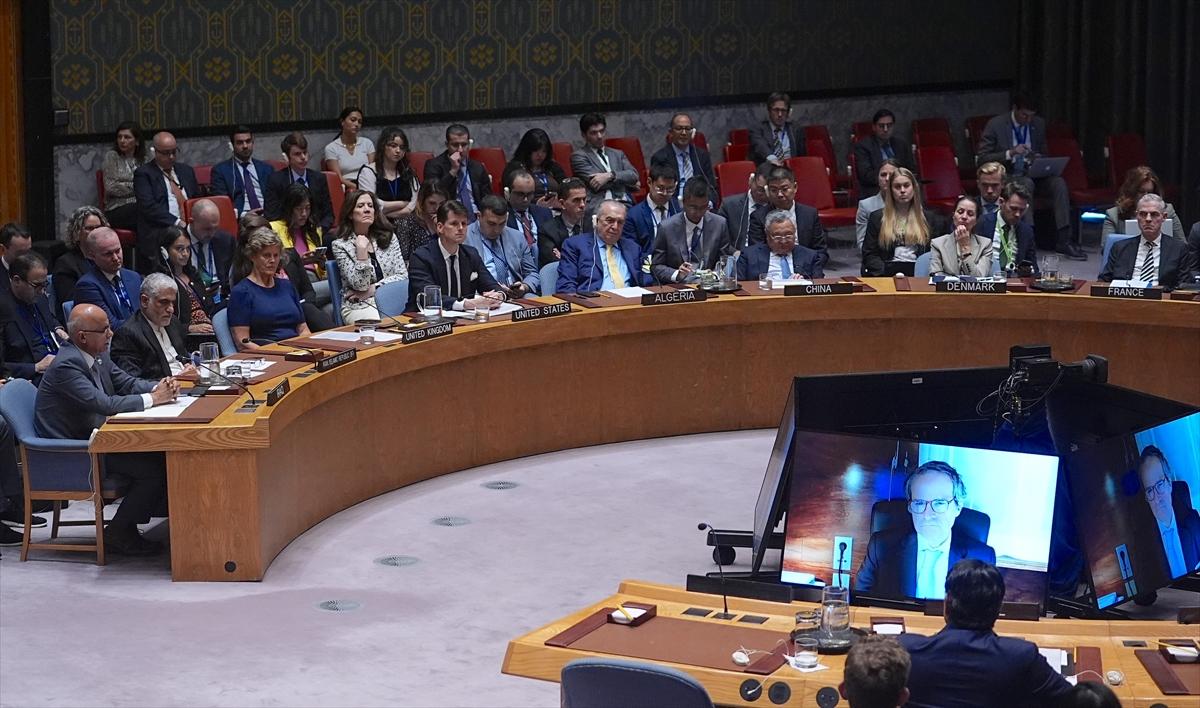
UNSecurity Council’s emergency meeting following Israel’s attack on Iran, 13 June 2025 – (Anadolu Agency)
The United Nations Security Council convened on 13 June 2025 under an emergency agenda. The call for the meeting was issued by Iran’s Permanent Mission to the UN. During the session, Iran alleged that Israel’s attack had occurred with the knowledge and approval of the United States, while the Israeli delegation stated that the operation aimed to halt Iran’s nuclear weapons production capacity.
In a statement by UN Deputy Spokesperson Farhan Haq, it was confirmed that the Secretary-General had been in direct contact with both parties. Haq stressed the importance of keeping diplomatic channels open and urged all parties to choose the path of diplomacy. Disagreements emerged among Security Council members regarding the attacks, with some members condemning Israel while others highlighted Iran’s nuclear activities. No binding resolution was adopted at the conclusion of the meeting. The UN Secretariat stated that it would continue to monitor developments and maintain its calls for restraint.
On 15 June 2025, Germany, France, and the United Kingdom issued a joint statement. The statement noted that the military tensions between Israel and Iran have the potential to create instability at both regional and global levels. The three countries called on the parties to end hostilities and activate diplomatic solutions.
On the same day, German Foreign Minister Maria Wadephul, at a press conference in Berlin, reiterated her call for Iran to open its nuclear program to international monitoring. The French Ministry of Foreign Affairs announced that it was prepared to host negotiations if the parties agreed to engage in dialogue. The UK Foreign Office statement emphasized that Israel’s legitimate security concerns were understandable but stressed that mutual confidence-building measures were necessary to prevent further escalation.
The proposal presented by three countries has been officially conveyed to the Iranian Ministry of Foreign Affairs through diplomatic channels. Under this proposal, negotiations under the supervision of the International Atomic Energy Agency (IAEA) are suggested to be held in Vienna or Geneva. It is also expected that Iran will return to its obligations under the Treaty on the Non-Proliferation of Nuclear Weapons (NPT) and halt its uranium enrichment activities.
Following these developments, Josep Borrell, High Representative of the European Union for Foreign Affairs and Security Policy, expressed support for the process and indicated that a new diplomatic meeting could be organized in Brussels at the diplomatic level.
Following Israel’s aerial strikes against Iran on 13 June 2025, Turkish President Recep Tayyip Erdoğan intensified his diplomatic contacts. According to statements from the Presidency on 14–16 June 2025, Erdoğan held telephone conversations with Kuwaiti Emir Meshal al-Ahmad al-Jaber al-Sabah, Iraqi Prime Minister Muhammad Shia al-Sudani, Sultan Haitham bin Tariq of Oman, and Emir Tamim bin Hamad Al Thani of Qatar.
During these conversations, it was emphasized that the rising tensions in the region must be brought under control, civilian casualties must be prevented, and diplomatic avenues must remain open. Türkiye stated that it is prepared to utilize all diplomatic means to prevent the escalation of conflict.
Additionally, in a written statement issued on 14 June 2025, the Turkish Ministry of Foreign Affairs called on all parties to exercise restraint and announced the necessity of launching an urgent diplomatic process under the auspices of the United Nations. It was stated that Türkiye stands ready to mediate using its diplomatic channels with both Iran and Israel. Following these developments, Ankara announced that it continues diplomatic consultations with other regional actors and is preparing to present new diplomatic proposals on international platforms in the coming days.
The European Union expressed “deep concern” over the military tensions in the region and called for the protection of civilians. NATO stated that the attack was carried out by Israel as a “unilateral action” and emphasized the need for steps to reduce tensions.
France reiterated Israel’s right to self-defense while highlighting that the attack had reached a threatening scale for regional peace. Germany affirmed its support for the security of Israeli citizens but described the escalating conflict as alarming. The United Kingdom reported that reports of the attack were “concerning.” Italy stated that the situation was highly complex and that a solution could only be achieved through diplomacy. Austria indicated that it harbored serious concerns over developments in the Middle East.
India expressed deep concern over the tensions between Iran and Israel. China issued a warning about the potential severe consequences of the attacks and called on all parties to exercise restraint. Japan strongly condemned Israel’s strikes against Iran and stated that they had escalated the situation in the region. Malaysia declared that it had responded to the attacks with “the strongest possible expressions.” Indonesia condemned the attacks as “illegal.” Pakistan strongly condemned Israel’s actions and stated that they posed a threat to regional peace. The Australian government called on all parties to pursue diplomacy and dialogue.
Saudi Arabia condemned the attacks in the strongest terms and expressed deep concern over civilian losses. Qatar stated that Israel had violated Iran’s sovereignty and security and characterized the attack as a “dangerous escalation.” Oman and Lebanon issued similar statements; Lebanon asserted that the attacks threatened regional stability and undermined peace efforts. Jordan declared that Israel’s strikes disrupted regional security. Azerbaijan expressed serious concern over military operations directed against Iran. Russia also stated that it harbored deep concern over the escalation of the conflict.
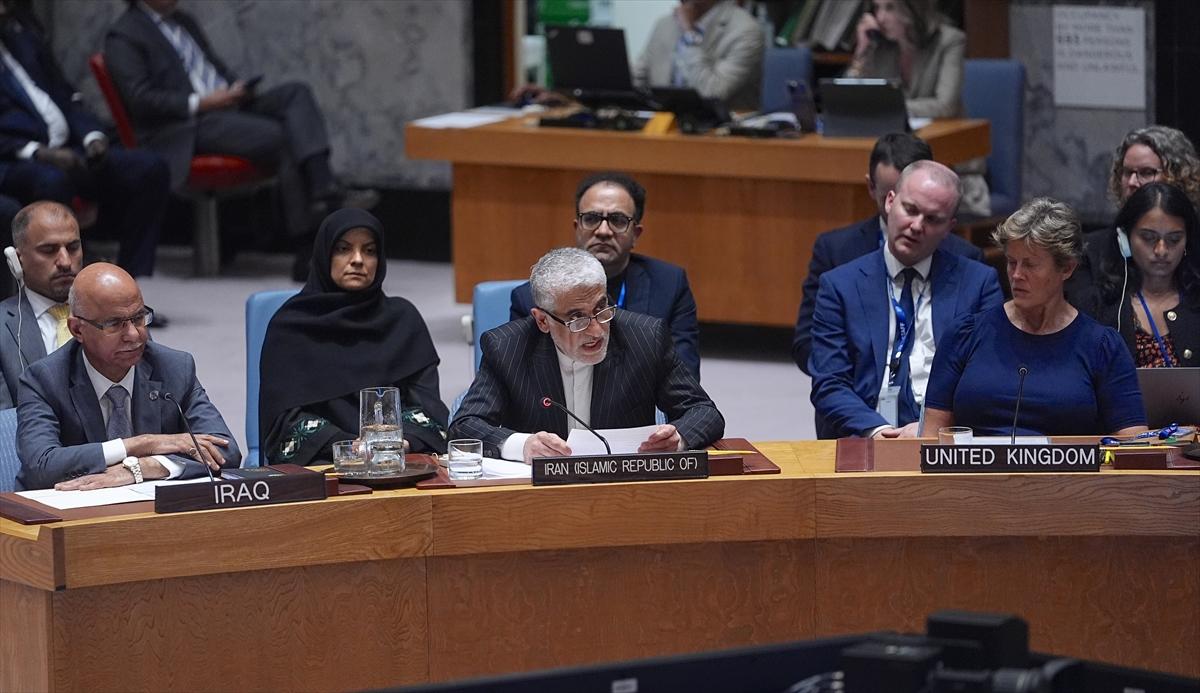
UN Security Council’s emergency meeting following Israel’s attack on Iran, 13 June 2025 – (Anadolu Agency)
Following the aerial attacks by Israel on Iran on 13 June 2025, Iran launched official diplomatic initiatives on various international platforms. On 14 June 2025, Iran’s Permanent Representative to the United Nations, Amir Said Irevani, formally addressed the UN Security Council, asserting that Israel’s attacks constituted a violation of the United Nations Charter. The same statement alleged that the attacks were carried out “with the direct support of the United States” and drew attention to U.S. responsibility.
On 15 June 2025, at a press conference, Iranian Foreign Minister Abbas Araghchi stated that Israel’s actions violated international law, affirmed Iran’s right to legitimate defense, and declared that all diplomatic mechanisms would be activated. Araghchi also announced that Iran had submitted evidence to the IAEA management demonstrating that the attacks directly targeted nuclear facilities, through its diplomatic mission based in Vienna.
Between 15 and 16 June, the Iranian government undertook multilateral diplomatic initiatives within the framework of the Organization of Islamic Cooperation (OIC), the Non-Aligned Movement, and the Shanghai Cooperation Organization, notably calling for an emergency meeting of the OIC Secretariat. Diplomatic contacts were also established with several Asian countries to seek support.
In a second written statement issued by Iran’s Permanent Mission to the UN, detailed information was provided regarding Iranian nuclear scientists and senior military personnel killed during the attacks, with the claim that these individuals held civilian status. In this context, it was alleged that Israel’s target selection violated “international humanitarian law norms.”
In an official statement by the Israeli Ministry of Foreign Affairs, assessments were presented that the People’s Republic of China provides direct military and technological support to Iran. The statement alleged that China supplies Iran with electronic warfare systems and radar-jamming equipment. The Israeli government asserted that this support has contributed to the advancement of Iran’s missile and drone programs.
On the same day, the U.S. Department of State issued a statement with similar content, asserting that China plays an indirect role in the conflicts in the Middle East. U.S. Secretary of State Marco Rubio, in his appeal to China, stated, “Cooperations that escalate tensions must be terminated.”
Diplomatic consultations between Israel and the United States resulted in an agreement to implement a joint diplomatic pressure mechanism against China. In this context, direct communications were initiated between the embassies of Tel Aviv and Washington and the Beijing authorities.
Furthermore, China’s relations with Iran were included on the agenda of the G7 summit scheduled for 17 June 2025. The U.S. and Israeli sides argued that these relations have enhanced Iran’s attack capabilities and called on G7 partners to establish a unified diplomatic stance on the issue.
Israel’s aerial attacks on Iran on 13 June 2025 and the subsequent reciprocal missile exchanges have affected international energy markets. As of the morning of 14 June 2025, the price per barrel of Brent crude oil rose by 7.4 percent to reach 89.88 U.S. dollars. During the same period, the price per barrel of West Texas Intermediate (WTI) crude oil increased by 7.86 percent to reach 85.32 U.S. dollars.
Energy analysts have noted that rising tensions in regions near the Strait of Hormuz and risks to supply from the Middle East have driven the increase. Threats targeting Iran’s refinery infrastructure in the Khuzestan province have triggered additional price volatility in markets. During the same period, natural gas futures on energy exchanges in Europe and Asia also rose. The TTF index based in Rotterdam recorded increases exceeding 5 percent. It has been reported that some LNG shipping companies canceled certain voyages and altered their shipping routes.
In financial markets, investors have shifted toward safe-haven assets. The price of gold reached $2,420 per ounce, and demand for reserve currencies such as the Swiss franc and the Japanese yen increased. Asian stock indices that closed the day in negative territory included the Tokyo Nikkei and the Shanghai Composite Index.
Various statements have been made regarding prior diplomatic and military coordination between the United States and Israel under Israel’s “Rising Lion Operation.” Israeli security officials stated that the Washington administration was informed prior to the operation but emphasized that the attack was carried out without direct U.S. support.
U.S. Secretary of State Marco Rubio, in a statement on June 14, 2025, said, “The United States did not directly participate in Israel’s air strikes.” Rubio indicated that intelligence sharing may have occurred before the attack but clarified that U.S. military forces were not involved in the operation.
U.S. President Donald Trump, in an interview with Fox News on the morning of June 14, called on Iran to “reach an agreement,” warning that otherwise “nothing would remain.” In the same interview, Trump stated that Iran had been granted a 60-day period, after which “more would come onto the agenda.” Following these remarks, the White House convened an extraordinary meeting of the National Security Council on the morning of June 13.
According to Pentagon sources, on the same day, the USS Dwight D. Eisenhower aircraft carrier group was deployed to the Eastern Mediterranean. The U.S. Department of Defense explained that this deployment was conducted to ensure the safety of American military personnel in the region. It has also been reported that air defense systems at U.S. bases in the Mediterranean have been activated.
Developments have also been closely monitored in the U.S. Congress. Several senators have formally questioned the White House about whether it provided prior notification of the operation. Within the Defense and Foreign Relations Committees, the need for new strategic assessments within the framework of U.S. Middle East policy has been brought to the agenda.
Anadolu Ajansı. “İran, İsrail’in Saldırılarına Karşılık Balistik Füze Saldırıları Başlattı.” Accessed June 14, 2025. https://www.aa.com.tr/tr/dunya/iran-israilin-saldirilarina-karsilik-balistik-fuze-saldirilari-baslatti-/3597310#
The Civil Aviation Organization of Iran announced that following attacks carried out on the morning of 13 June 2025 it had fully closed its airspace until a further notice. This decision took effect immediately and applies to all civil and military flights. The statement indicated that the threat of attack persists and that all air traffic activities have been suspended to ensure national aviation security.
Following Iran’s decision, Iraq’s Ministry of Transport also announced the closure of its airspace. Iraqi officials stated that this step was taken due to the emergence of security risks in areas near the Iranian border. As a result, all commercial flights over Iraqi airspace, primarily including those to and from Baghdad and Najaf, have been suspended.
With the closure of the airspace, major airports in Iran experienced significant congestion. International flights from Tehran Imam Khomeini International Airport, Mashhad Airport, and Isfahan Shahid Beheshti Airport among others were suspended, and domestic flights were halted. Announcements were made urging passengers to make alternative travel arrangements, and temporary shelter and food support were provided at some terminals. Security levels at airports were raised, and civilian personnel were prepared for evacuation procedures.
International air carriers announced the suspension of flights to and from the region in response to developments in Iran. Numerous airlines including Lufthansa, Qatar Airways, Emirates, Turkish Airlines, British Airways and Air France declared that they had canceled flights to Iran or rerouted them to alternative paths.
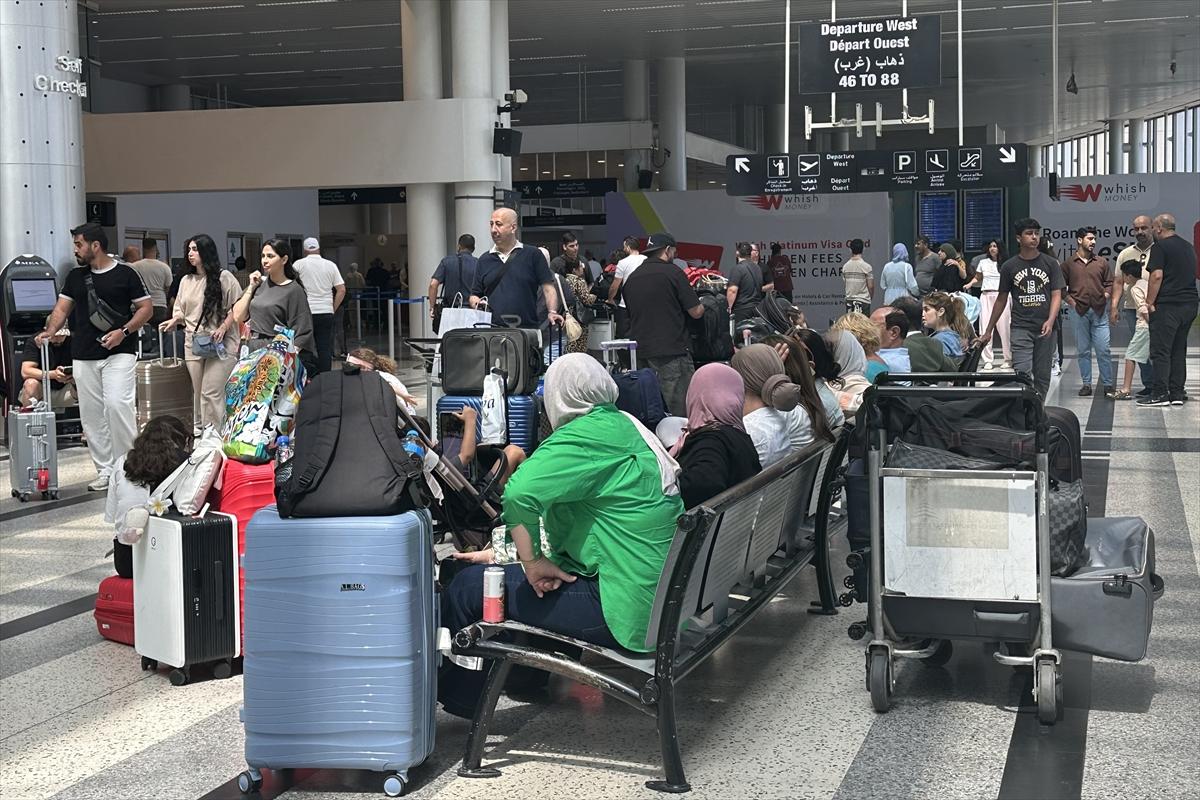
Beirut International Rafic Hariri Airport with canceled flights, 13 June 2025 – (Anadolu Agency)
Lufthansa stated it had suspended its Tehran flights for 13–14 June and indicated that further decisions would be made based on developments in the region. Gulf-based carriers such as Emirates and Qatar Airways shifted to alternative routes passing south of the Persian Gulf to avoid Iranian airspace. British Airways explained it had avoided transit routes between Israeli and Iranian airspace, citing passenger safety as its primary concern.
The European Organisation for the Safety of Air Navigation (EUROCONTROL) and the International Civil Aviation Organization (ICAO) issued advisories to airlines stating that Iranian airspace is unsafe and that flight routes in the region must be carefully reviewed. The United States Federal Aviation Administration (FAA) imposed a flight ban over Iranian and Iraqi airspace for U.S. carriers. The advisories also emphasized the need for heightened caution along air routes in northern Israel and the eastern Mediterranean.
Following its air operations against Iran, Israel implemented comprehensive security measures nationwide. The government simultaneously activated civil and military precautions, placing the entire country on alert status.
According to a statement by Israeli Defense Minister Yisrael Katz, a state of emergency was declared nationwide as of the morning of 13 June. Under this decision, security levels were raised at all strategic centers, primarily Tel Aviv, Haifa, Jerusalem and southern border regions. Police forces, internal security units and military personnel were placed on alert, and control checkpoints were established at city entry and exit points.
The Israeli Ministry of Interior activated the Home Front Command in response to potential Iranian missile attacks. The national siren system was tested and activated, and citizens were provided with information on emergency procedures. Shelter access protocols were updated, and some shelters were opened to the public. The Ministry of Defense issued a directive advising citizens to prepare emergency kits.
Alongside the state of emergency, the Ministry of Education announced that schools and universities would remain closed until further notice. Similarly, all public events, outdoor gatherings and large-scale meetings were canceled. Municipal services in major cities such as Tel Aviv and Haifa were reduced to minimum levels, and public transportation schedules were adjusted.
Israel Air Force defense systems were activated. The Iron Dome air defense system was deployed in active mode, particularly in areas near the Gaza and Lebanon borders. Medium- and long-range missile defense systems, David’s Sling and Arrow, were deployed across the country. The Israeli General Staff announced that all air defense systems were operating simultaneously and in coordinated fashion.
The Shin Bet (Israel Security Agency) and Mossad (Institute for Intelligence and Special Tasks) enhanced domestic security measures, citing the potential for internal threats from individuals and groups linked to Iran. Security levels were raised around critical infrastructure in Tel Aviv, West Jerusalem and the Negev region, and joint civil-military security patrols were initiated at locations with high threat indicators.
The large-scale attacks between Iran and Israel stem from escalating mutual military and diplomatic actions since 2024. In April 2024, Israel targeted the Iranian Consulate General in Damascus, Syria, which Iran regarded as a direct violation of its sovereignty. In response, Iran launched its first direct missile strike against Israeli territory. In October of the same year, Israeli operations resulted in the deaths of high-ranking commanders: Hezbollah Secretary General Hassan Nasrallah and Abbas Nilforushan of Iran’s Quds Force, both killed in separate air strikes. These assassinations were recorded by Iranian authorities as clear acts of escalation.
In 2025, the International Atomic Energy Agency (IAEA) published a report concluding that Iran had violated its obligations under the Treaty on the Non-Proliferation of Nuclear Weapons (NPT). The report stated that Iran’s uranium enrichment levels exceeded previously declared limits and that certain nuclear facilities had been closed to inspections.
Iran rejected the IAEA’s assessment and maintained that its nuclear program is exclusively for peaceful purposes. These developments were interpreted by Israel as evidence that Iran is nearing the capability to develop nuclear weapons, and were cited as justification for military action.
Al Jazeera. “Live: Explosions Reported in Iran amid Israel Tensions.” Al Jazeera. Accessed June 14, 2025. https://www.aljazeera.com/news/liveblog/2025/6/13/live-explosions-reported-in-iran-amid-israel-tensions
Anadolu Ajansı. "Hava Yolu Şirketleri, İsrail’in İran Saldırısının Ardından Bölgeye Uçuşları İptal Etti." Accessed June 14, 2025. https://www.aa.com.tr/tr/gundem/hava-yolu-sirketleri-israil-in-iran-saldirisinin-ardindan-bolgeye-ucuslari-iptal-etti/3596738#
Following the outbreak of hostilities between Iran and Israel on 13 June 2025, both countries intensified their military preparations for new waves of attacks starting from the morning of 14 June. The Israeli military raised its alert level in various military zones and carried out new troop and equipment deployments. According to local sources, Israeli Air Force fighter jets and reconnaissance systems were kept on active duty, and missile defense systems at strategic locations were reconfigured. The Ministry of Defense announced that the national airspace is under continuous surveillance and that any attack attempt will be met with an immediate response.
On the Iranian side, it was reported that the Islamic Revolutionary Guard Corps has moved to a high state of readiness. Some military facilities in western Iran have reportedly been relocated with short-range missile systems, and alert levels have been raised at air bases around the Persian Gulf. Mobile missile batteries have been directed toward the western border, and radar surveillance activities in these areas have been intensified.
On the same day, it was claimed that Israeli reconnaissance aircraft were observed flying in Iraqi airspace and conducting observation missions near areas close to Iran. These activities are assessed as part of preparations for a new offensive. The Israeli General Staff stated that it has comprehensive retaliation plans ready in response to potential attacks originating from Iran.
On 14 June 2025, Iran’s Permanent Representative to the United Nations, Amir Said Irevani, described Israel’s attacks as “violations of international law” and affirmed that his country would exercise its right to legitimate self-defense. Irevani alleged that the attacks were carried out with the knowledge and support of the United States and stated that Iran would bring the matter before the United Nations Security Council.
Anadolu Ajansı. “İsrail ile İran Karşılıklı Yeni Saldırılara Hazırlanıyor.” Accessed June 14, 2025. https://www.aa.com.tr/tr/dunya/israil-ile-iran-karsilikli-yeni-saldirilara-hazirlaniyor/3597957#
Both sides have implemented new military planning and deployments as of June 14. In this context, defense systems have been updated and reorganizations have taken place in land and air forces.
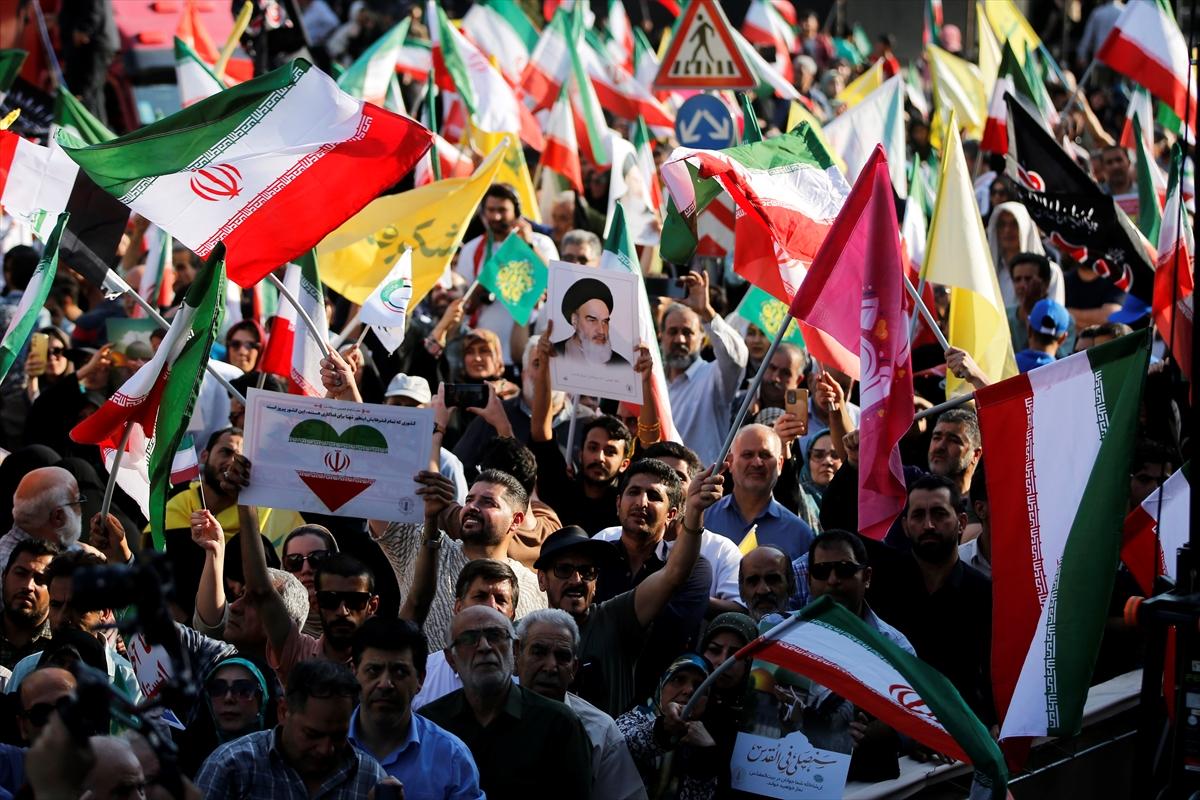
Thousands in Iran protest against Israel and the United States chanting "revenge revenge" June 14 2025 – (Anadolu Agency)
As of the morning of June 14 2025 the Israeli military has initiated a new defense plan in its northern (Lebanon border) and southern (Gaza and Negev regions) military zones. Locations of air defense systems under the Israeli Air Force have been altered; particularly the Iron Dome David’s Sling and Arrow systems have been repositioned at strategic points. These deployments cover a broad security belt extending from Haifa and the Tel Aviv area to Beersheba and the Jerusalem region.
Defense Ministry sources have indicated that special priority has been given to protecting infrastructure facilities around Bat Yam and Dimona. The Israeli Defense Forces Spokesperson has stated that they are prepared for new ballistic attacks from Iran and that active measures have been taken against a potential second missile wave. On the same day the operational capacity of air force radar and missile batteries was raised to 100 percent.
As of June 14 2025 the Iranian Armed Forces have redeployed missile batteries and air defense units in western regions including Kermanshah Khasr Shirin Ilam and Khuzestan. Reports indicate that Iran’s short-range Fateh-110 and medium-range Shahab missile systems have been moved to military positions near the border. It has been reported that missile units have been relocated from military bases near Parchin and Arak and that radar and surveillance equipment has been deployed along the Iraqi border.
At the same time increased naval activity has been observed at Iran’s Persian Gulf coast bases of Bandar Abbas and Bushehr. Naval units under the Islamic Revolutionary Guard Corps have been stationed in the Strait of Hormuz and fast attack boats and radar surveillance systems have been activated. Additionally several unmanned aerial vehicle units under the Air Force Command have been reported to have taken off from positions along the Persian Gulf coast.
As of June 14 2025 Israel’s reconnaissance and early warning systems have begun intensive operations over Iraqi airspace. According to some sources Israeli Heron TP and Eitan unmanned aerial vehicles have conducted reconnaissance flights in western Iraq and areas near the Iranian border. These observations were carried out to detect Iran’s new missile deployments and monitor ballistic preparations.
It has also been reported that intelligence units under the Israeli Ministry of Defense have collected signals intelligence regarding Revolutionary Guard units operating along Iran’s western border. Electronic signal monitoring and imaging systems have been supported by flights over Iraqi airspace. Reports have emerged that technical data is being shared with American bases in the region.
Israeli Defense Forces Spokesperson Avichay Adraee stated that a new “preventive military step” is on the agenda while the Iranian Armed Forces General Staff announced that “multi-layered defense positions” have been activated.
According to air traffic and radar analyses published by the Israeli Ministry of Defense increased activity has been detected along Iran’s western border with irregularities recorded in radar reflection patterns. On the same day several open-source intelligence platforms reported that they had detected several medium-range missile carriers moving westward from Iranian air bases in the northeast.
Al Jazeera. “Live: Israel Warns ‘Tehran Will Burn’ after Deadly Missile Barrage by Iran.” Al Jazeera. Accessed June 14, 2025. https://www.aljazeera.com/news/liveblog/2025/6/14/live-israel-warns-tehran-will-burn-after-deadly-missile-barrage-by-iran
A missile attack launched by Iran on June 15, 2025, caused significant damage across various Israeli cities. On the same day, the Israeli military carried out new strikes against targets in Iran. The reciprocal attacks have led to increased casualties and infrastructure damage.
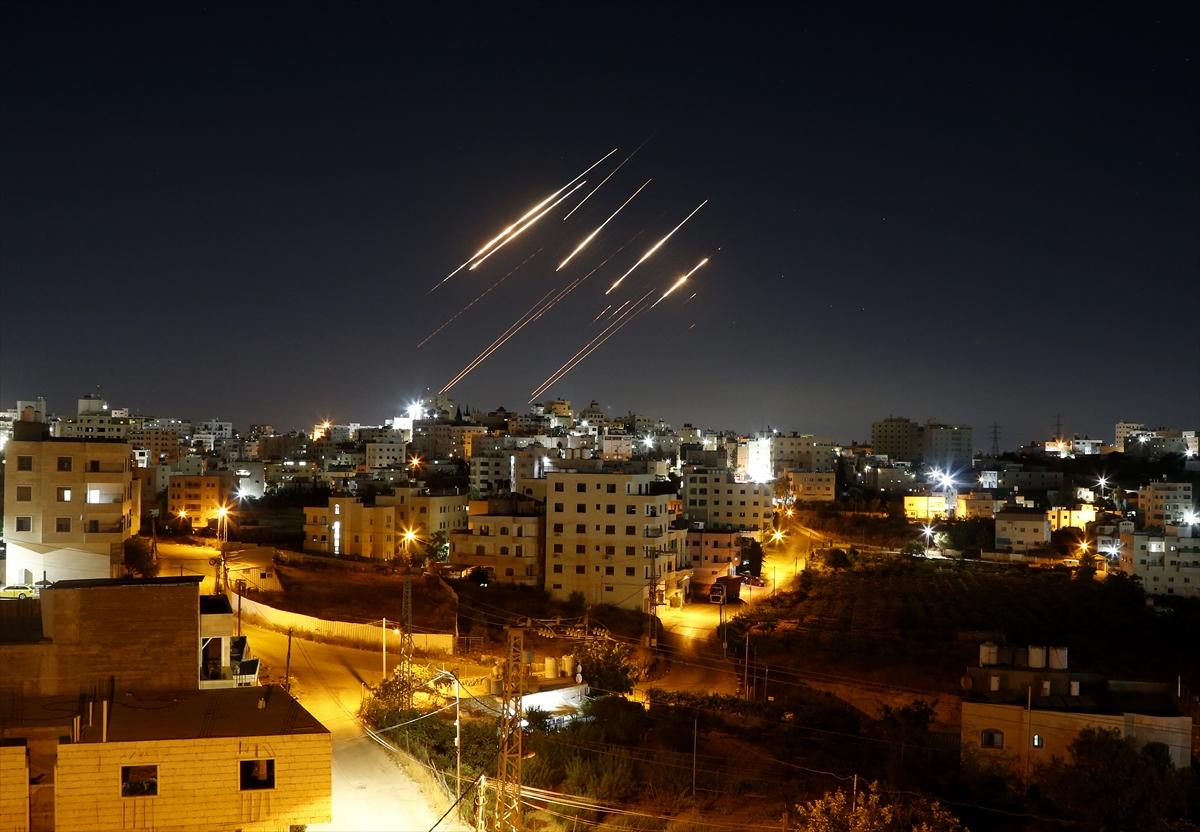
Iran’s ballistic missile strikes against Israel, June 15, 2025 – (Anadolu Agency)
According to an announcement by the Israeli military, Iran launched approximately 80 ballistic missiles in the early hours of June 15. Some of these missiles were intercepted by Israel’s Iron Dome and David’s Sling defense systems, but several struck civilian populated areas. The attacks particularly affected cities such as Bat Yam, Rehovot, Haifa, Tamra, and Petah Tikva.
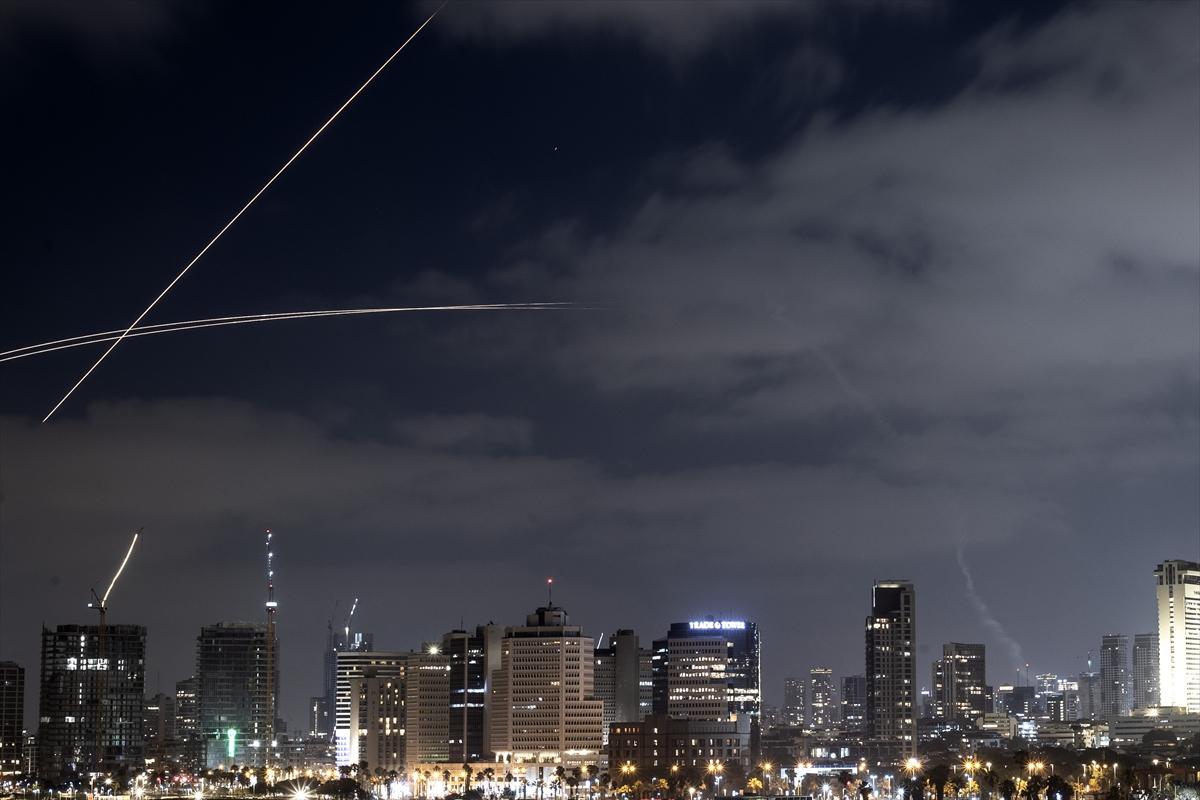
Iran’s missile attack against Israel, June 15, 2025 – (Anadolu Agency)
One of the targets of Iran’s attack was the Weizmann Institute of Science in Rehovot, Israel. This research institution, located south of Tel Aviv, sustained structural damage after one or more Iranian missiles struck directly. At least one laboratory building was reported to have suffered severe damage and caught fire. Firefighting teams worked throughout the day to bring the blaze under control.
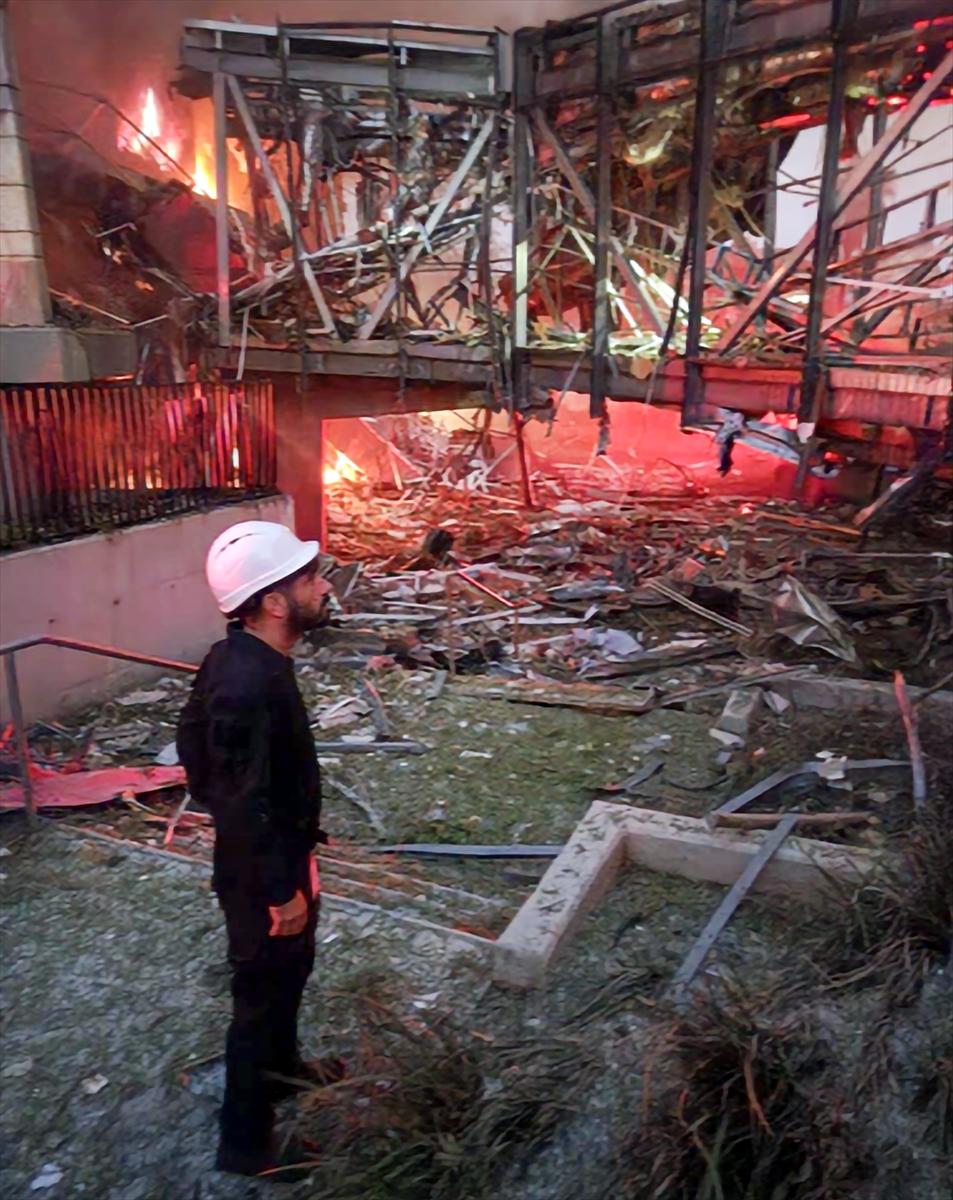
The Weizmann Institute of Science in Israel, hit by Iranian missiles, June 15, 2025 – (Anadolu Agency)
Search and rescue operations were conducted for individuals believed to be trapped within the institute’s compound. Israel’s Home Front Command initiated preliminary damage assessments to restore the scientific infrastructure to operational status.
Five civilians lost their lives in the attacks on Haifa and surrounding areas. Israel’s emergency medical service, Magen David Adom, reported that fires broke out in two buildings in Haifa, resulting in four deaths at the scene and numerous injuries.
Similarly, destruction occurred in the northern city of Tamra, where fatalities and injuries were also recorded. One person was killed in Bnei Brak and four in Petah Tikva. Dozens were injured in the Tel Aviv area. The total number of injured across Israel exceeded 300, including a number of critically wounded individuals.
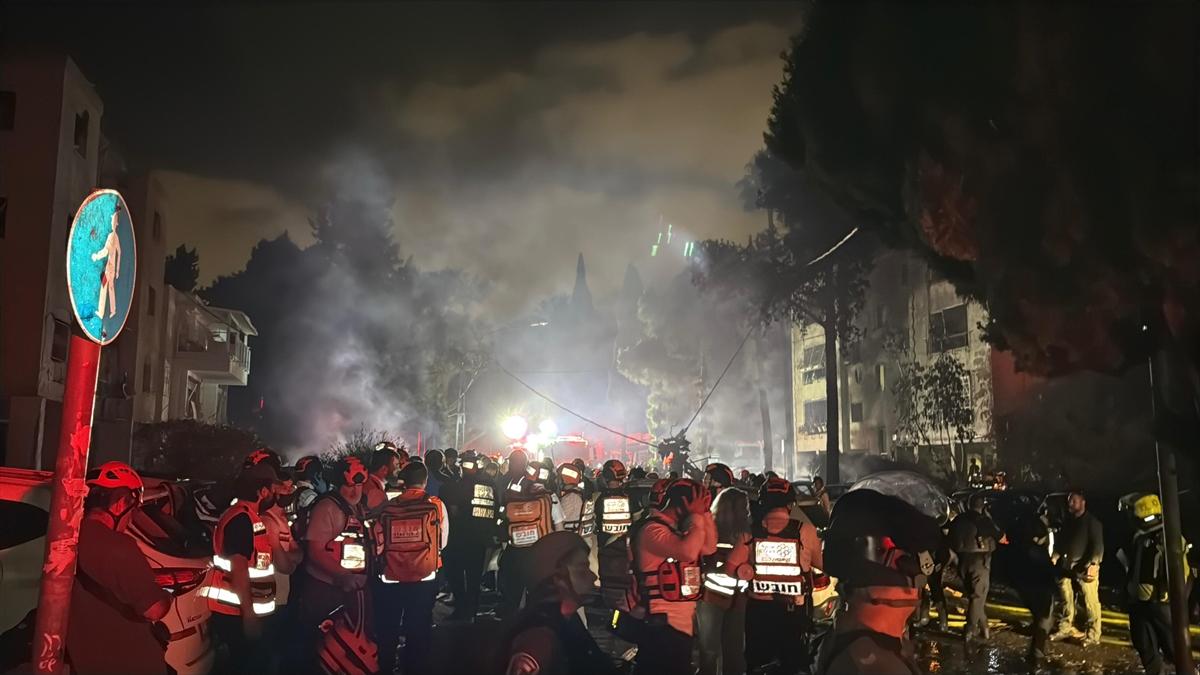
Haifa city, hit by some of the ballistic missiles launched by Iran against Israel, June 15, 2025 – (Anadolu Agency)
During Israel’s operations on June 15, heavy losses were reported among the senior command structure of Iran’s Islamic Revolutionary Guard Corps (IRGC). According to Iranian sources, a total of nine senior generals were killed, including Emir Ali Haji-Zadeh, head of Intelligence for the IRGC Aerospace Force, along with Mahmud Bakri, Davud Sheykhian, Muhammad Bakir Taherpur, Mansur Seferpur, Mesud Tayyib, Husrev Hasan, Javad Ghorbani, and Muhammad Aghajafari.
These deaths are said to have had a broad impact on Iran’s military command structure. Changes in Iran’s senior command chain are anticipated as a result of the strikes. Some Iranian Armed Forces headquarters have been temporarily relocated to other regions.
Iran’s missile attacks on Israel on June 15 also affected energy and transportation infrastructure. Israel’s Ministry of Energy announced that several power transmission lines in southern regions were temporarily taken offline. Production activities in some industrial zones were halted, and traffic flow around Tel Aviv, where emergency services were overwhelmed, was managed under controlled conditions.
Israel’s Home Front Command ordered preparations for the evacuation of residential areas in Bat Yam, Rehovot, Lakhish, and Haifa. Over 2,000 people were temporarily housed in emergency shelters established by the Home Front Command.
Following the attacks on June 15, statements were issued by various countries. The U.S. Department of State emphasized Israel’s right to self-defense while stressing that further loss of life must be avoided. United Nations Secretary-General Antonio Guterres called for the urgent de-escalation of tensions in the region and urged the protection of civilian infrastructure.
The European Union’s External Action Service also called on both parties to exercise restraint, describing Iran’s missile attacks as “threats to regional security.” Diplomatic efforts are underway to convene an emergency session of the United Nations Security Council.
Al Jazeera. “Israel-Iran updates: IRGC intelligence chief, two generals killed.” Al Jazeera. Accessed June 15, 2025. https://www.aljazeera.com/news/liveblog/2025/6/15/live-iran-fires-missiles-as-israel-strikes-oil-facility-in-tehran
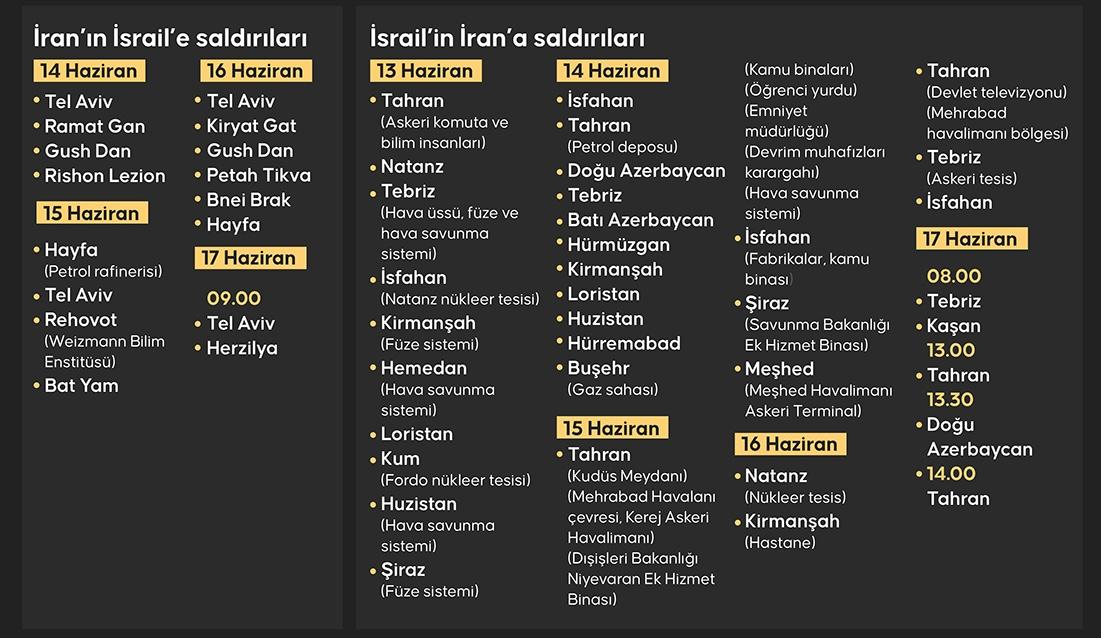
Infographic showing mutual attacks between Iran and Israel June 17 2025 — (Anadolu Agency)
Al Jazeera. “Israel-Iran updates: IRGC intelligence chief, two generals killed.” Al Jazeera. Accessed June 15, 2025. https://www.aljazeera.com/news/liveblog/2025/6/15/live-iran-fires-missiles-as-israel-strikes-oil-facility-in-tehran
Al Jazeera. “LIVE: Iran launches more attacks on Israel; 8 killed and dozens wounded.” Al Jazeera. Accessed June 15, 2025. https://www.aljazeera.com/news/liveblog/2025/6/15/updates-death-toll-grows-as-iran-and-israel-continue-to-trade-attacks
Al Jazeera. “Updates: Iran sends new missile barrage at Israel, Israel renews attacks.” Accessed June 15, 2025. https://www.aljazeera.com/news/liveblog/2025/6/14/live-israel-warns-tehran-will-burn-after-deadly-missile-barrage-by-iran
Anadolu Ajansı. "Cumhurbaşkanı Erdoğan, Liderlerle İsrail ile İran Arasındaki Çatışmayı Görüştü." Accessed June 15, 2025. https://www.aa.com.tr/tr/gundem/cumhurbaskani-erdogan-liderlerle-israil-ile-iran-arasindaki-catismayi-gorustu/3599189#
Anadolu Ajansı. “Almanya, Fransa ve İngiltere İran’a Müzakere Teklifinde Bulundu.” Accessed June 15, 2025. https://www.aa.com.tr/tr/dunya/almanya-fransa-ve-ingiltere-irana-muzakere-teklifinde-bulundu/3599180#
Anadolu Ajansı. “İran Devrim Muhafızları Komutanı Hacizade’nin Olduğu Saldırıda 8 General Daha Hayatını Kaybetti.” Accessed June 15, 2025. https://www.aa.com.tr/tr/dunya/iran-devrim-muhafizlari-komutani-hacizadenin-oldugu-saldirida-8-general-daha-hayatini-kaybetti/3599290#
Anadolu Ajansı. “İran Füzelerinin İsabet Ettiği İsrail’deki Weizmann Bilim Enstitüsü Büyük Hasar Gördü.” Accessed June 15, 2025. https://www.aa.com.tr/tr/dunya/iran-fuzelerinin-isabet-ettigi-israildeki-weizmann-bilim-enstitusu-buyuk-hasar-gordu/3599760#
Anadolu Ajansı. “İsrail Ordusuna Göre İran Geceki Misilleme Saldırılarında İsrail’e 80’e Yakın Füze Attı.” Accessed June 15, 2025. https://www.aa.com.tr/tr/dunya/israil-ordusuna-gore-iran-geceki-misilleme-saldirilarinda-israile-80e-yakin-fuze-atti/3599054#
Anadolu Ajansı. “İsrail ve ABD, İran’a Askeri Destek Verdiğini İddia Ettikleri Çin’e Baskı Yapıyor.” Accessed June 15, 2025. https://www.aa.com.tr/tr/dunya/israil-ve-abd-irana-askeri-destek-verdigini-iddia-ettikleri-cine-baski-yapiyor/3599348#
Anadolu Ajansı. “İsrail ve İran’ın Karşılıklı Saldırıları Sürüyor.” Accessed June 15, 2025. https://www.aa.com.tr/tr/dunya/israil-ve-iran-in-karsilikli-saldirilari-suruyor/3599377#
On 16 June 2025, the Iranian Armed Forces launched a new wave of attacks against Israel. Iranian state television reported that the assault was carried out using ballistic missiles and kamikaze-style unmanned aerial vehicles. This wave of attacks occurred amid escalating tensions in the region following a series of reciprocal strikes in the preceding days.
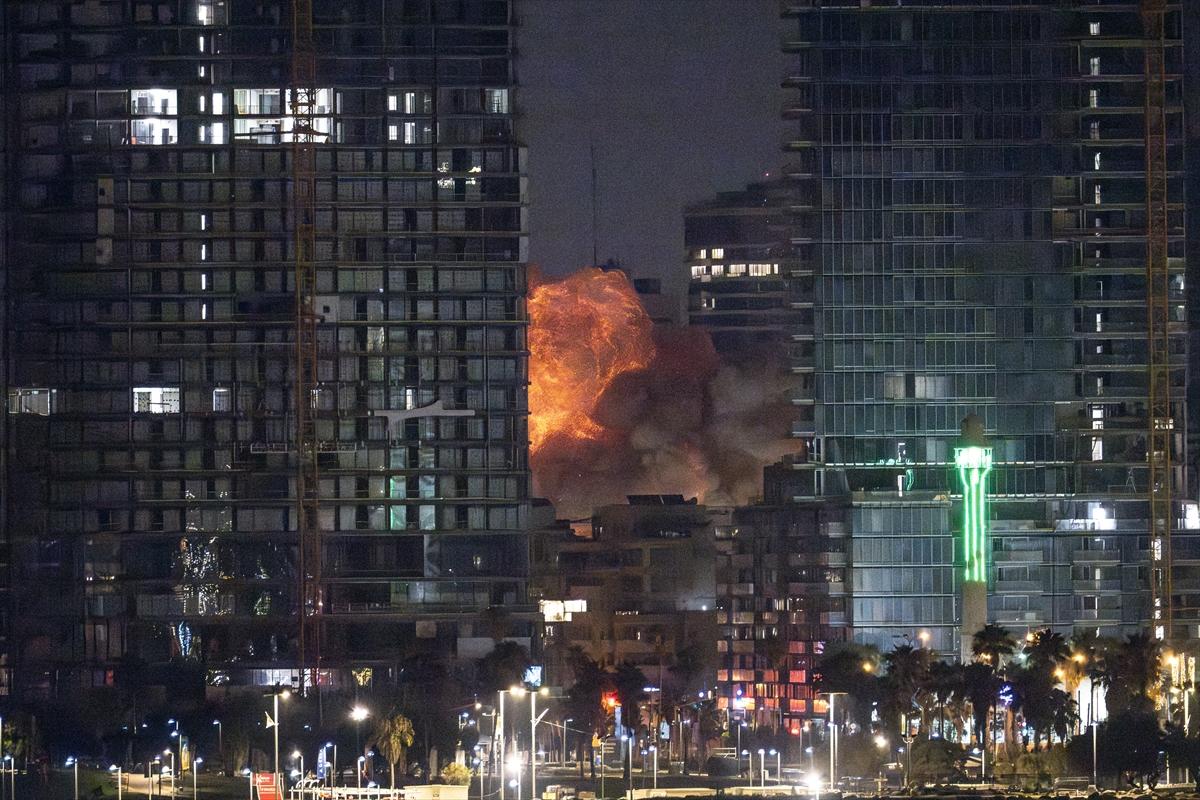
Ballistic missile strike by Iran hitting a building in Tel Aviv, 16 June 2025 – (Anadolu Agency)
According to Israeli sources, two of the missiles launched from Iran struck populated areas in central Israel. One missile hit the city of Herzilya north of Tel Aviv, while the other landed in the Gush Dan region. Local civil defense alert systems were activated in these areas, prompting the public to seek shelter following the sounding of sirens. The Israeli Emergency Medical Service (Magen David Adom) reported that ten civilians were injured, with some receiving on-site treatment. Most injuries were attributed to panic, shattered glass, and falls caused by the missile impacts.
Some of the accompanying kamikaze-style UAVs were directed toward military installations, while others were intercepted and destroyed in mid-air by Israeli air defense systems. The Israeli military did not provide exact figures on the number of missiles launched or targets hit.
Shortly after Iran’s attacks, the Israeli military announced it had conducted a new air operation targeting areas around Tehran on the same day. Among the targeted structures was a building identified as the Hatem al-Anbiya Command Center, affiliated with the Islamic Revolutionary Guard Corps. The Israeli military stated that senior Iranian military officials attending a meeting at the facility were targeted and that casualties occurred during the operation.
Israeli security sources confirmed that Major General Ali Shadmani, who had been announced as appointed to a senior position in the Islamic Revolutionary Guard Corps on 14 June, was neutralized. Iran has not officially confirmed this information.
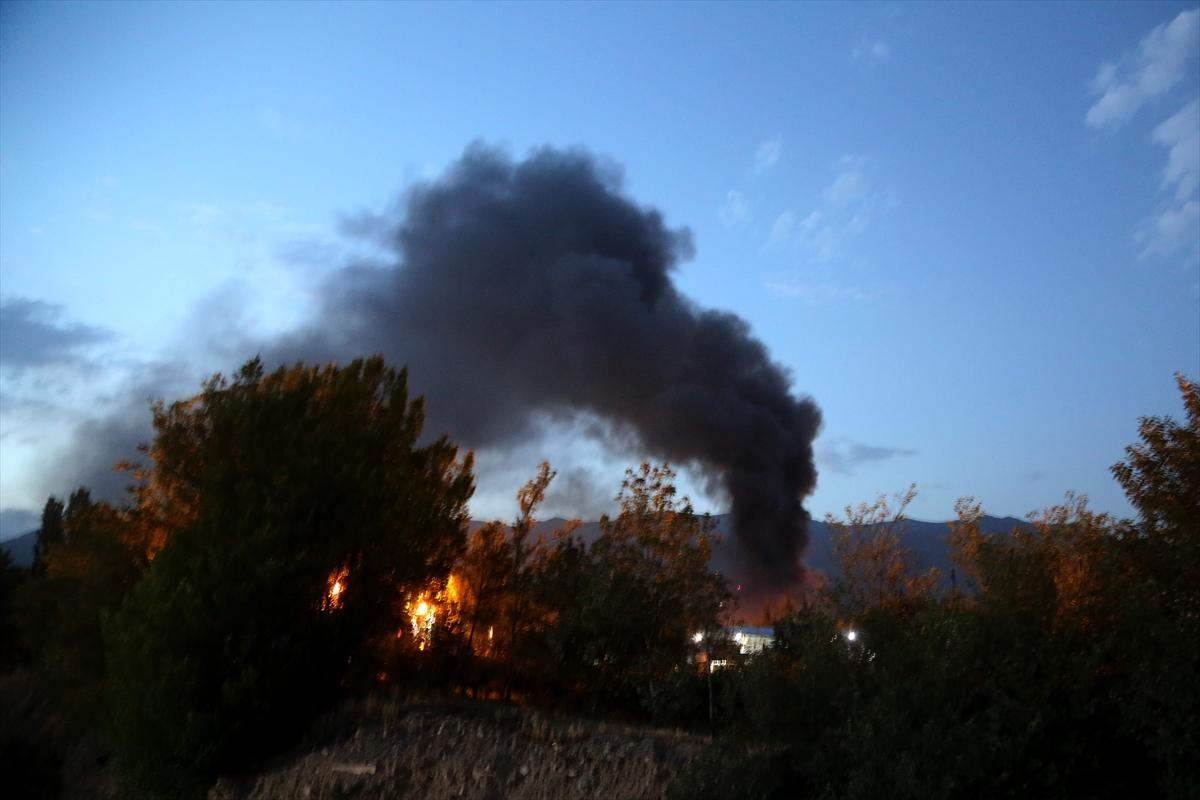
Smoke rising from the Iranian Radio and Television Organization (IRIB) building struck by Israel, 16 June 2025 – (Anadolu Agency)
On 16 June 2025, as part of an Israeli Air Force operation, the main broadcast center of Iran’s state television network IRIB in the capital Tehran was targeted. The attack was recorded live by Iranian state television. According to Iran’s official news agency IRNA, three people were killed in the strike. Initial reports named two victims—a news editor and a staff member—but the death toll was later revised to three.
Israeli missiles strike Iran’s state television IRIB during live broadcast, 16 June 2025 – (Republic World)
The attack caused severe structural damage to IRIB’s main broadcast center, known as the “Glass Building.” During the live broadcast, the studio went dark and was filled with dust following the explosion, forcing the anchor to abandon the air. IRIB resumed broadcasting within a few hours.
Before the attack, Israeli Defense Minister Israel Katz stated that Iran’s state television and radio would “soon cease to exist.” In response, Iran called on people living in Israeli-occupied territories to “evacuate the area if they wish to survive.”
Israeli media reported that the strike targeted IRIB’s infrastructure and stated that Iran had demanded the evacuation of Israel’s television channels, Kanal 12 and Kanal 14, as retaliation.
On 16 June, the Israeli Home Front Command activated nationwide air defense warning systems. Due to the heightened risk of attacks targeting central regions, shelters were made accessible in Tel Aviv, Ramat Gan, Herzilya, and surrounding communities, and the public was urged to comply with emergency instructions. The Iron Dome, Arrow, and David’s Sling air defense systems were actively deployed, with the majority of incoming missiles intercepted in mid-air.
Some cities experienced power outages and communication disruptions, while medical and fire services remained on high alert. Israel stated that damage to infrastructure was limited and that additional security measures had been taken to ensure the continuity of public services.
On the same day, Iraq’s Minister of Defense announced that due to ongoing clashes and increased activity along Iran’s western border, the Iraqi military had entered a state of full readiness for all possible scenarios. The Iraqi armed forces reported enhanced radar coverage along the western region and intensified monitoring of the airspace. The statement emphasized that appropriate measures had been taken to deter any violations of Iraqi airspace.
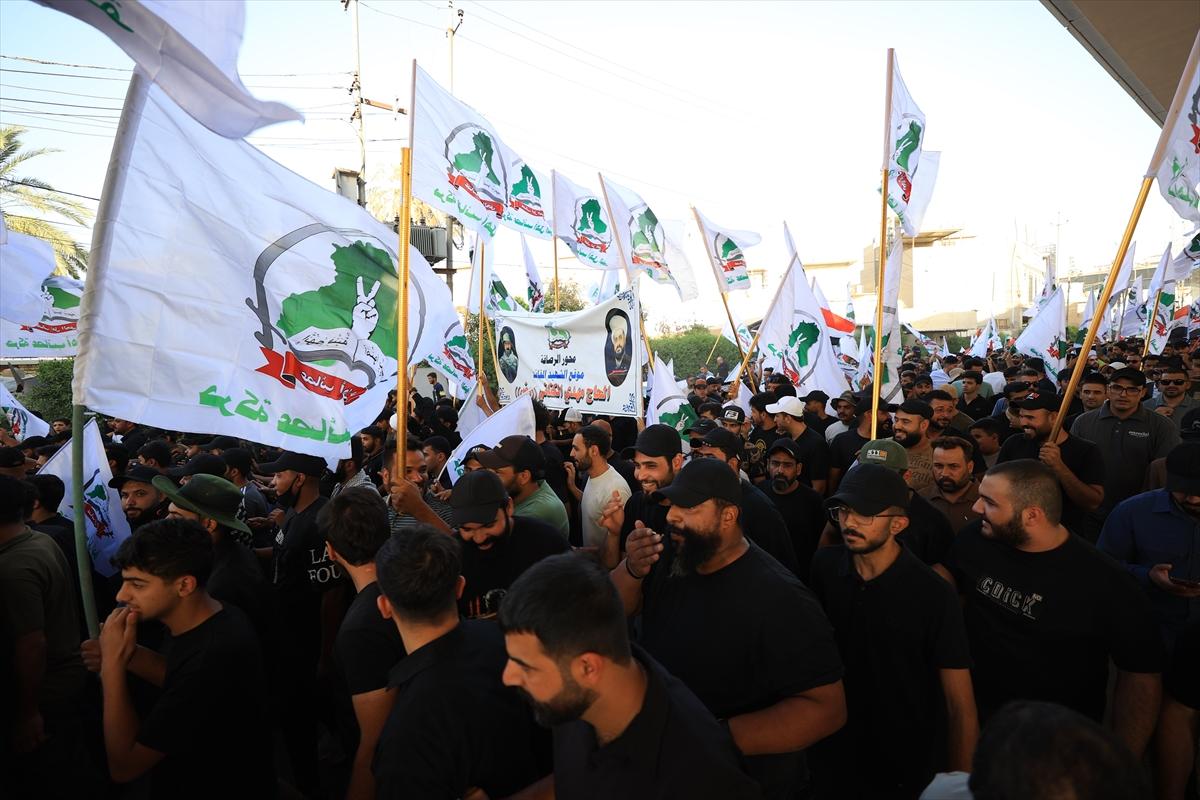
Pro-Iran demonstrations in Iraq, 16 June 2025 – (Anadolu Agency)
On 16 June 2025, US President Donald Trump issued an urgent call for American citizens and diplomatic personnel in Iran to evacuate immediately via his official social media account. Trump stated that all US citizens in Tehran must leave the country “immediately and without delay,” warning that security could not be guaranteed and that further attacks were likely.
Immediately following this call, the US Department of State initiated evacuation procedures for embassy and consulate staff in Tehran and activated emergency communication channels. On the same day, US diplomatic missions in Iran suspended operations. American citizens were directed to leave Iran via land routes and third countries.
In his statements, Trump affirmed that the current pressure strategy against Iran’s nuclear program would continue. The US President claimed that Iran’s latest wave of attacks had “deepened its own isolation” and urged the international community not to remain silent. US State Department sources confirmed that new economic sanctions against Iran were under consideration and that consultations were underway with G7 nations.
Information leaked to the public indicated that the Washington administration was preparing an international sanctions package targeting firms and technology transfer chains alleged to be contributing directly to Iran’s missile and UAV capabilities. The US Treasury Department’s Office of Foreign Assets Control (OFAC) stated that these sanctions could be expanded to include companies providing logistical support to the Islamic Revolutionary Guard Corps.
On the evening of 16 June, Israeli Prime Minister Benjamin Netanyahu, during a press conference, declared that Israel was prepared to use its full military capacity in response to Iran’s missile attacks. Addressing Iran’s Supreme Leader Ayatollah Ali Khamenei directly, Netanyahu said, “We will do whatever is necessary,” implying that further operations targeting senior figures responsible for Iran’s nuclear program were possible.
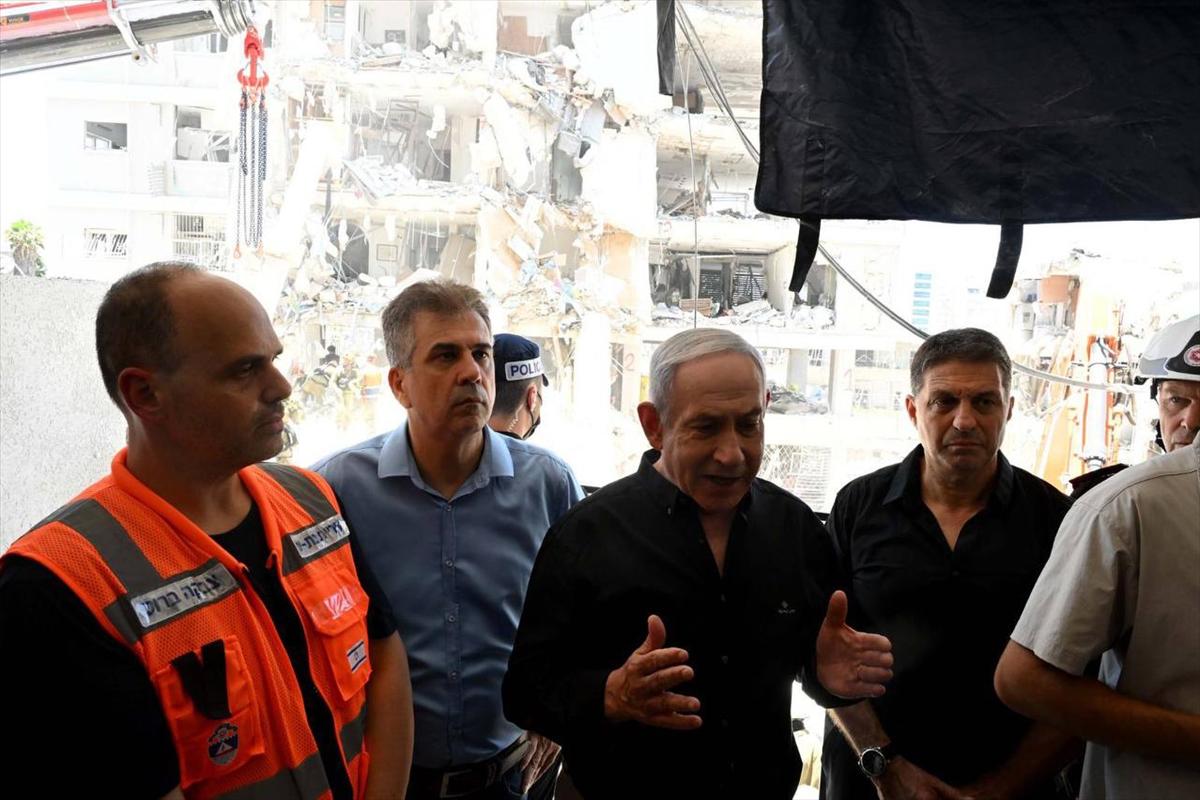
Netanyahu inspecting damage in Bat Yam following Iran’s retaliatory strike, 15 June 2025 – (Anadolu Agency)
In the same statement, it was confirmed that Israeli intelligence agencies were continuing surveillance and targeting operations. Netanyahu emphasized that no diplomatic pressure would deter Israel when its national security was under threat.
On the morning of 16 June, the White House National Security Council held its third extraordinary meeting on the Iran-Israel crisis. Attendees included the US Secretary of Defense, Secretary of State Marco Rubio, the Chairman of the Joint Chiefs of Staff, and intelligence directors. Following the meeting, a press briefing stated that the alert level for US naval forces stationed in the Eastern Mediterranean had been raised to ensure the security of American units in the region.
On the same day, the Pentagon granted “operational flexibility” to units under US Central Command and announced heightened security measures at US bases in Iran and surrounding areas. The statement also emphasized ongoing coordination with regional allies, particularly Israel, Jordan, the United Arab Emirates, and Saudi Arabia, with increased intelligence sharing.
On 17 June 2025, Iran launched another ballistic missile attack against Israel. According to the Israeli military, approximately 20 ballistic missiles were fired from Iran. At least two of these missiles struck central Israeli regions, specifically the Gush Dan area near Tel Aviv and the city of Herzilya. Israel’s emergency medical service, Magen David Adom, reported that ten people sustained minor injuries. Structural damage was reported in some buildings hit by the strikes. Alarms were activated, the public was directed to shelters, and security protocols were enforced by the Home Front Command.
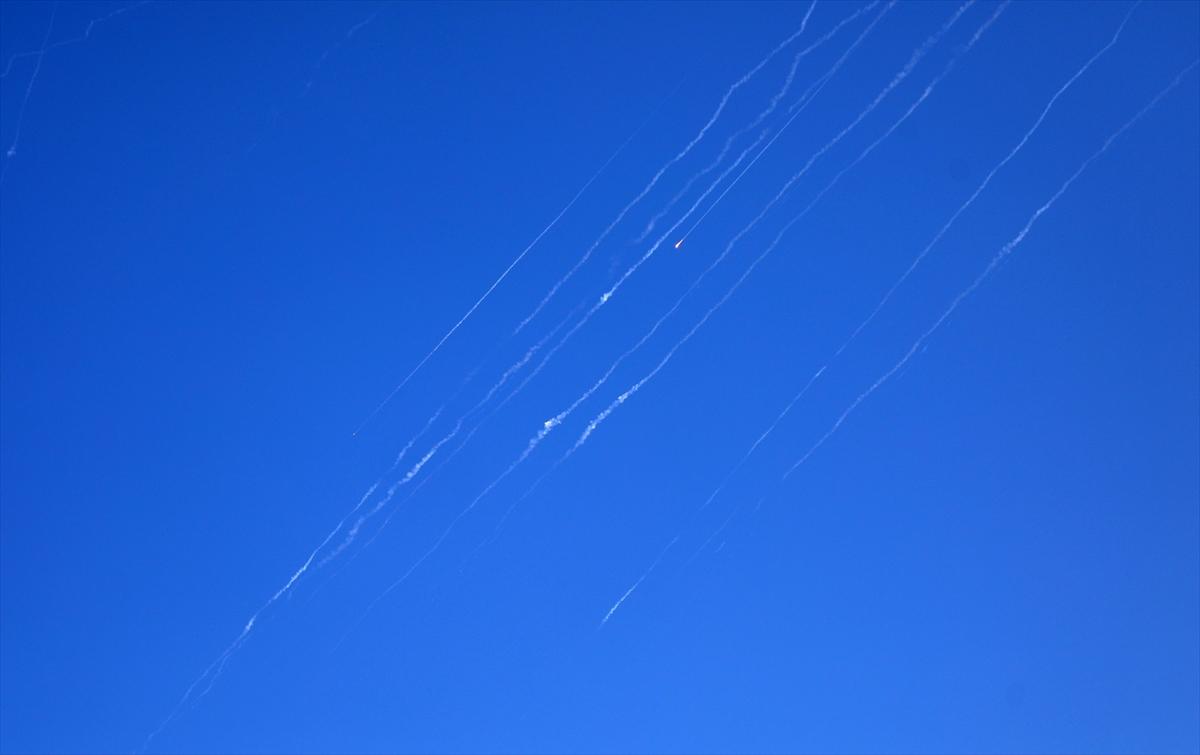
Iran’s new ballistic missile attacks, 17 June 2025 – (Anadolu Agency)
As of 17 June, Iran’s attacks on Israel had resulted in eight fatalities and over 300 injuries. Meanwhile, Israel’s air strikes on Iran reportedly killed 224 civilians, including Iran’s Chief of Staff, Commander of the Islamic Revolutionary Guard Corps, and numerous senior commanders. Iran’s missile attacks on Israel, by contrast, resulted in 24 deaths and over 500 injuries.
Al Jazeera. “LIVE: Israel, Iran trade attacks; Trump urges Tehran evacuation.” Al Jazeera English. Accessed June 17, 2025. https://www.aljazeera.com/news/liveblog/2025/6/17/live-israel-iran-trade-attacks-trump-orders-residents-of-tehran-to-flee
Al Jazeera. “Updates: Iran says it launched drone, missile attack targeting Israel.” Al Jazeera English. Accessed June 17, 2025. https://www.aljazeera.com/news/liveblog/2025/6/15/updates-death-toll-grows-as-iran-and-israel-continue-to-trade-attacks
Anadolu Ajansı. "ABD Başkanı Trump: Tahran’daki Herkes Derhal Tahliye Edilmeli." Accessed June 17, 2025. https://www.aa.com.tr/tr/dunya/abd-baskani-trump-tahrandaki-herkes-derhal-tahliye-edilmeli/3601116#
Anadolu Ajansı. "Trump: İran Bu Savaşı Kazanamıyor, Çok Geç Olmadan Masaya Oturmalılar." Accessed June 17, 2025. https://www.aa.com.tr/tr/dunya/trump-iran-bu-savasi-kazanamiyor-cok-gec-olmadan-masaya-oturmalilar/3600771#
Anadolu Ajansı. “Irak Savunma Bakanından ‘Her Türlü Duruma Karşı Tam Hazırlık Halindeyiz’ Açıklaması.” Accessed June 17, 2025. https://www.aa.com.tr/tr/dunya/irak-savunma-bakanindan-her-turlu-duruma-karsi-tam-hazirlik-halindeyiz-aciklamasi/3600537
Anadolu Ajansı. “Netanyahu, Hamaney’e Suikasti İşaret Ederek: Ne Gerekiyorsa Yapacağız.” Accessed June 17, 2025. https://www.aa.com.tr//tr/dunya/netanyahu-hamaneye-suikasti-isaret-ederek-ne-gerekiyorsa-yapacagiz/3600984
Anadolu Ajansı. “İran Saldırısında Hasar Alan Weizmann Enstitüsü, İsrail’in Nükleerde de Teknolojik Omurgası Durumunda.” Accessed June 17, 2025. https://www.aa.com.tr/tr/dunya/iran-saldirisinda-hasar-alan-weizmann-enstitusu-israilin-nukleerde-de-teknolojik-omurgasi-durumunda/3600888
Anadolu Ajansı. “İran, İsrail’e Füze ve Kamikaze İHA’larla Saldırdı.” Accessed June 17, 2025. https://www.aa.com.tr/tr/dunya/iran-israil-e-fuze-ve-kamikaze-iha-larla-saldirdi/3600582
Anadolu Ajansı. “İran’dan Atılan Füzelerden İkisi İsrail’in Orta Kesimlerine İsabet Etti.” Accessed June 17, 2025. https://www.aa.com.tr/tr/dunya/irandan-atilan-fuzelerden-ikisi-israilin-orta-kesimlerine-isabet-etti/3601194
BBC Türkçe. “İran haber ajansı: İsrail'in devlet televizyonuna saldırısında üç kişi öldü.” Accessed June 17, 2025. https://www.bbc.com/turkce/articles/czxelggg4r9o
The Israeli Air Force targeted the Enderzgu Boulevard in northern Tehran and the surrounding area of Imam Hussein University to the northeast on June 17. These areas are reported to have dense civilian populations. During the attacks, military aircraft were observed in Tehran’s skies and explosion sounds were heard.
Israel also stated that it struck several land-based missile launchers and radar systems located in western Iran. According to the Israeli military, intelligence-based operations were conducted against military infrastructure in western Iran beginning in the early morning hours. These strikes are said to aim at limiting Iran’s ballistic missile capabilities.
Israeli military statements indicated that centrifuge production facilities used in uranium enrichment processes in Tehran were targeted and that some weapons production infrastructure was also hit. Additionally, facilities producing missile components and air defense systems were targeted, with more than 50 fighter aircraft reportedly involved in these operations.
Israeli Defense Minister Yisrael Katz stated that over ten nuclear targets in Iran’s capital had been identified and that Israeli fighter jets carried out operations against them. Katz also confirmed that the Kum region, which hosts the Fordo Nuclear Facility, was among the targeted areas.
Iranian state television announced that in response to Israel’s attacks, Tehran’s air defense systems were activated intensively. It was reported that for the first time, military aircraft were seen in Tehran’s skies and loud explosion sounds were particularly audible in the western part of the city. Iranian Chief of Staff Major General Abdurrahim Musevi said in a statement that the operations conducted so far were “deterrent in nature” but that “punitive strikes” would begin in the coming phase. Musevi called on civilians in settlements such as Tel Aviv and Haifa to leave the region.
The Islamic Revolutionary Guard Corps announced on June 17 that it had launched new missile attacks against Israel under the tenth wave of Operation “True Promise 3.” The statement specified that the retaliatory strikes targeted Israeli air bases, which had previously served as platforms for Israel’s earlier attacks. The Revolutionary Guards stated that these attacks would continue in a sustained, multi-layered, and phased manner.
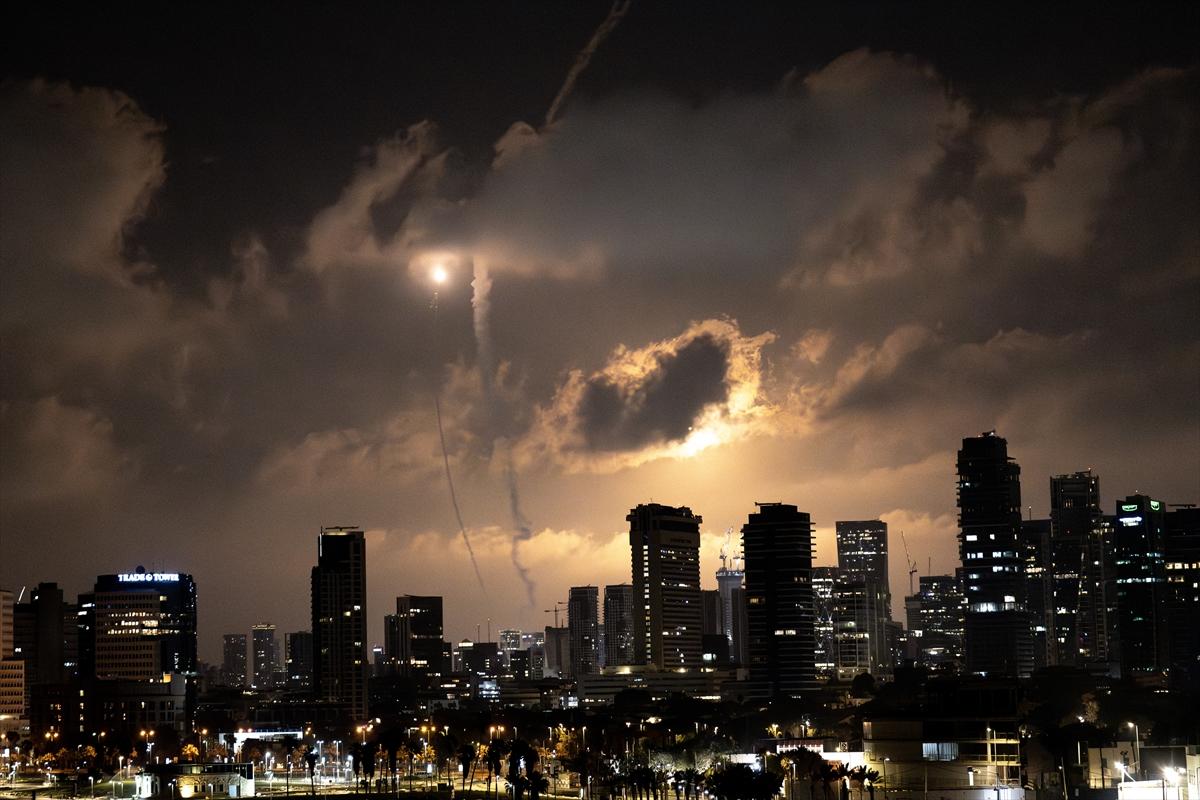
Missiles launched from Iran, seen in the skies over Tel Aviv, June 18, 2025 – (Anadolu Agency)
On the same day, the Iranian Armed Forces issued a warning for the evacuation of the Neve Tzedek neighborhood in Tel Aviv. The statement warned that this settlement could be targeted and stated that “the occupiers must vacate this area.”
Israel claimed that during a nighttime air strike in Tehran, it killed Major General Ali Shadmani, commander of the Hatem al-Anbiya Central Headquarters of the Islamic Revolutionary Guard Corps. Major General Shadmani had been appointed only three days earlier, on June 13, following the killing of General Gholam Ali Rashid. According to the statement, the attack was part of a series of midnight operations targeting central Tehran.
Israeli Military Spokesperson Effie Defrin stated that Iran had begun moving its forces from the west toward the center of the country, a movement detected by intelligence units. Defrin confirmed that Israeli fighter jets stationed in the Isfahan region continued their strikes against central Iran, with underground missile bases also targeted in these operations. It was reported that 12 underground missile launchers were targeted in the strikes.
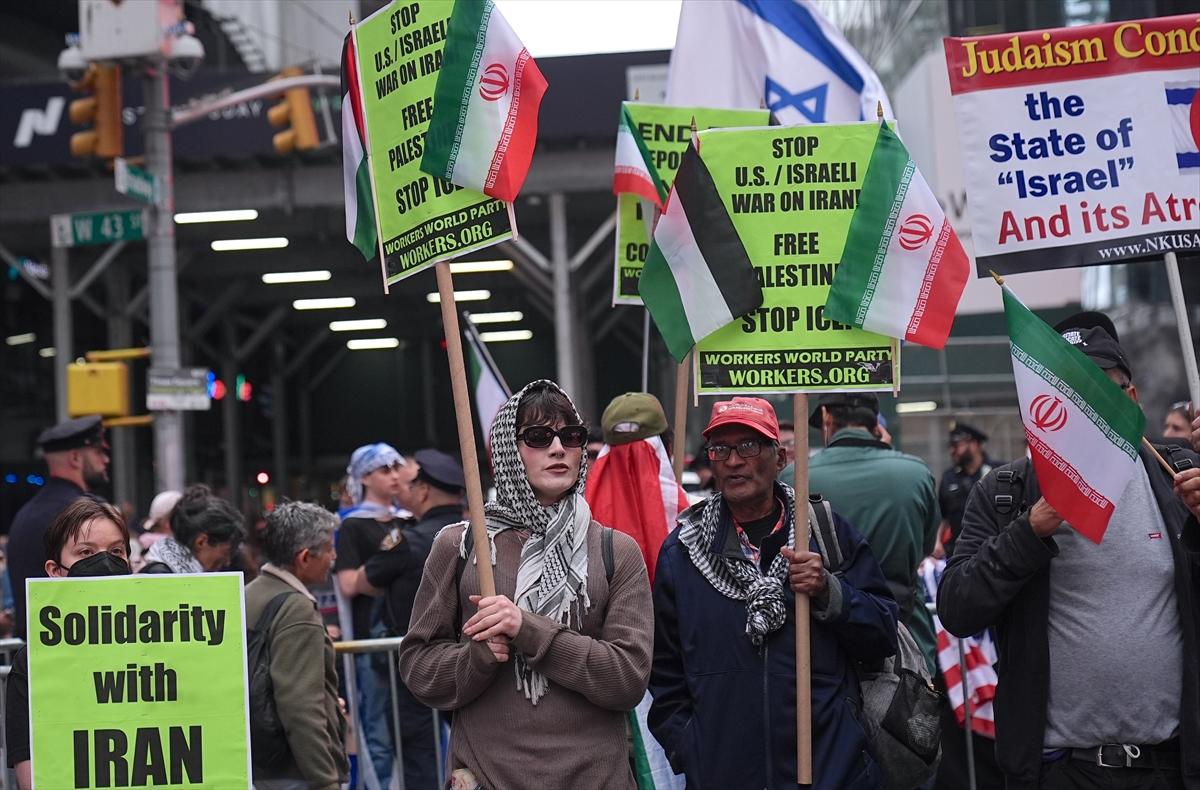
Protest in support of Iran at Times Square, June 17, 2025 – (Anadolu Agency)
Israeli defense industry officials stated that the majority of ballistic missiles launched from Iran were intercepted by Arrow 2 and Arrow 3 systems, with THAAD and SM-3 systems also used in some cases. According to Israeli military assessments, the cost of intercepting just 10 to 12 missiles launched from Iran during the night of June 17 alone reached approximately $287 million.
Israel reported that its nationwide air defense systems were under significant strain. The Air Force announced that it had neutralized two hostile drones approaching from the east in the Dead Sea region. Israeli media suggested that these drones originated from Iran and had flown through Jordanian airspace.
Construction of new prefabricated shelters has begun in Tel Aviv and its surroundings. According to Israeli state television KAN, these shelters, named “Arbel,” are designed to withstand shrapnel and blast waves. The first phase of the project is said to cover the Tel Aviv area and the Krayot region, with a budget of approximately $14.2 million.
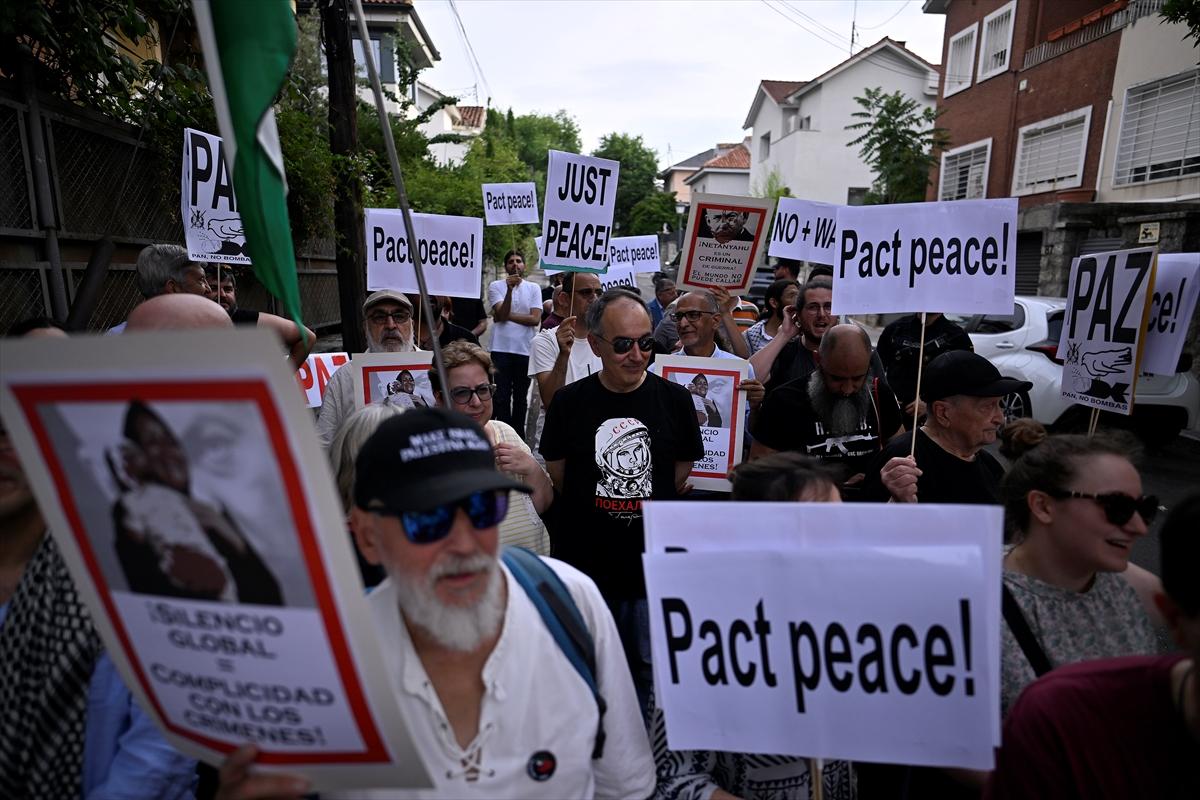
Protest in support of Iran in Spain, June 17, 2025 – (Anadolu Agency)
United Nations officials called on all parties to exercise “maximum restraint.” UN Deputy Spokesperson Farhan Haq stated that the military escalation in the Middle East was deeply concerning and emphasized the need to halt the intensification of violence in the Israel-Iran conflict. UN Deputy Special Coordinator for Syria Najat Rochdi, speaking at a Security Council meeting in Syria, noted that the conflict initiated by Israel’s attacks posed a risk of instability across the broader Middle East.
World Health Organization Director-General Tedros Adhanom Ghebreyesus, in a social media statement, said that civilians, including children, had lost their lives in the fighting and described the situation as extremely alarming.
Iran’s Permanent Representative to the UN, Said Iravani, claimed in his statement before the UN Security Council that the United States had given Israel a “green light” for its attacks. Iravani asserted that Western countries were covering up Israel’s aggression and that Iran had the right to defend itself against these strikes. He further argued that President Trump’s call for civilians to evacuate Tehran was a deliberate indication of a policy aimed at targeting the civilian population.
On June 17, 2025, U.S. President Donald Trump made several assessments regarding Iran via Truth Social. He stated that Iran “cannot win this war” and urged the Iranian leadership to come to the negotiating table. The same statement included commentary on Iran’s internal public order and decision-making mechanisms.
On the same day, in another statement, Trump directly targeted Iran’s religious leader, Ayatollah Ali Khamenei. He claimed that Khamenei’s location had been identified, that intelligence services were continuously monitoring him, and that no direct action would be taken at this stage. The phrase “We will not eliminate him, at least not yet,” was widely publicized.
In subsequent posts, Trump stated that the United States maintained “full surveillance” over Iran’s airspace and was monitoring activity in the region. Indirect statements from the Pentagon did not directly confirm such operations but affirmed that military presence in the region continued and that defense alert levels remained high. The statements also provided information regarding the deployment of U.S. naval forces around the Strait of Hormuz.
On June 17, 2025, U.S. President Donald Trump met with the National Security Council in the White House Situation Room to assess the Israel-Iran tensions. The meeting was announced by White House Press Secretary Karoline Leavitt and conducted behind closed doors. The potential for U.S. intervention against Iran’s nuclear facilities was also discussed.
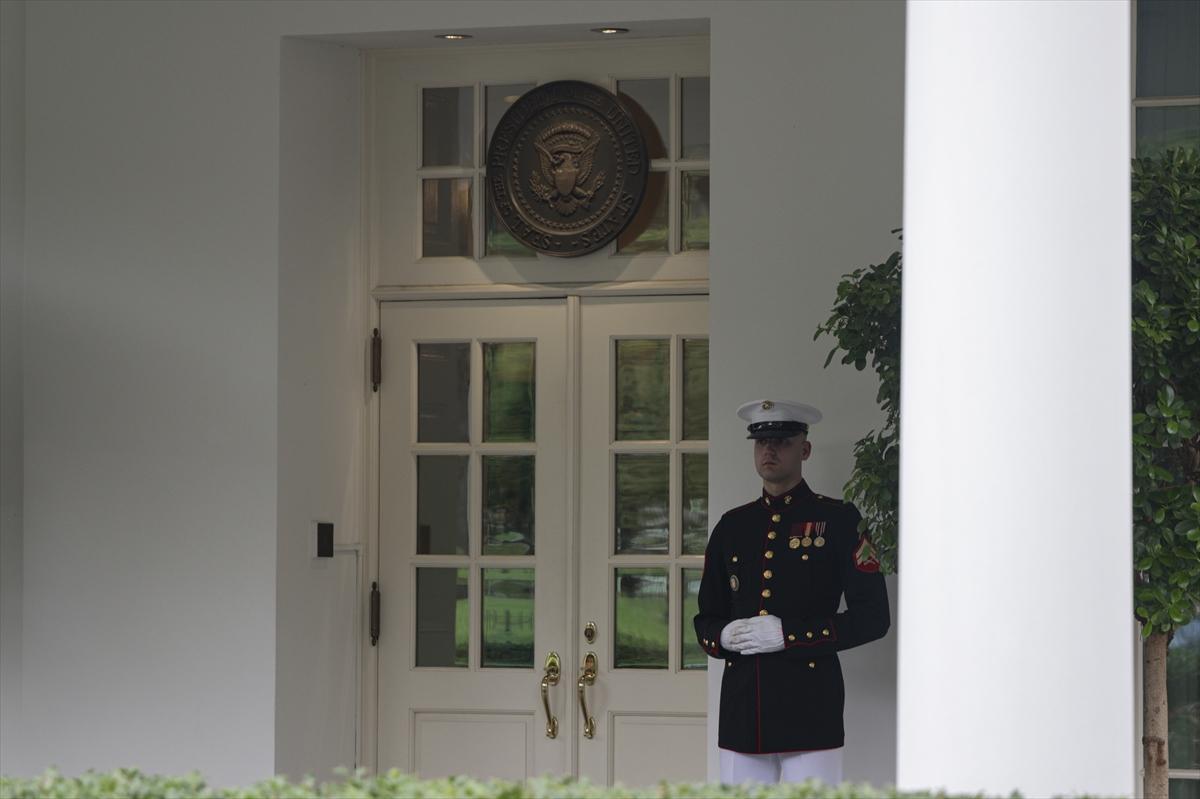
Image from the Situation Room showing U.S. President Trump meeting with the National Security Council, June 17, 2025 – (Anadolu Agency)
The deep underground structures of nuclear facilities targeted by Israel have become central to military and technical discussions as of June 17. The Fordo Nuclear Facility, located deep within a mountain in Qom Province, has previously been described by the United States and Israel as one of the “most hardened targets.” In this context, it has been suggested that GBU-57 A/B precision-guided bunker-buster bombs could be used against the facility. These munitions are reported to weigh approximately 13,600 kilograms, capable of penetrating up to 60 meters before detonation, and specifically designed to destroy hardened underground structures.
The International Atomic Energy Agency (IAEA) published new technical findings on June 13 based on satellite imagery following an attack on the Natanz Nuclear Facility. According to the IAEA, structural damage was detected in underground sections where uranium enrichment activities take place. Although the IAEA had previously stated that no direct physical damage occurred in the underground sections, these new findings update that assessment.
Al Jazeera. “Live: Israel-Iran Trade Attacks, Trump Orders Residents of Tehran to Flee.” Al Jazeera. Accessed June 18, 2025. https://www.aljazeera.com/news/liveblog/2025/6/17/live-israel-iran-trade-attacks-trump-orders-residents-of-tehran-to-flee
Anadolu Ajansı. "ABD Başkanı Trump: İran Lideri Hamaney, Onu Ortadan Kaldırmayacağız, En Azından Şimdilik." Accessed June 18, 2025. https://www.aa.com.tr/tr/dunya/abd-baskani-trump-iran-lideri-hamaney-onu-ortadan-kaldirmayacagiz-en-azindan-simdilik/3602038#
Anadolu Ajansı. "Trump, İsrail’in İran’a Yönelik Saldırılarının Yavaşlamayacağını Söyledi." Accessed June 18, 2025. https://www.aa.com.tr/tr/dunya/trump-israilin-irana-yonelik-saldirilarinin-yavaslamayacagini-soyledi-/3601357#
Anadolu Ajansı. “UAEA: İsrail’in Saldırdığı İran’daki Natanz Nükleer Tesisinin Yer Altı Bölümünde de Hasar Tespit Edildi.” Accessed June 18, 2025. https://www.aa.com.tr/tr/dunya/uaea-israilin-saldirdigi-irandaki-natanz-nukleer-tesisinin-yer-alti-bolumunde-de-hasar-tespit-edildi/3601825#
Anadolu Ajansı. “İsrail-İran Çatışması: Son Durum.” Anadolu Ajansı İnfoGrafik. Accessed June 18, 2025. https://www.aa.com.tr/tr/info/infografik/46527
Anadolu Ajansı. “İsrail’in İran Nükleer Tesislerine Saldırıları, Sığınak Avcısı Bombaları Gündeme Getirdi.” Accessed June 18, 2025. https://www.aa.com.tr/tr/dunya/israilin-iran-nukleer-tesislerine-saldirilari-siginak-avcisi-bombalari-gundeme-getirdi/3601875#
Anadolu Ajansı. “İsrail’in İran’a Saldırılarıyla Başlayan Çatışma Sürüyor.” Accessed June 18, 2025. https://www.aa.com.tr/tr/dunya/israil-in-iran-a-saldirilariyla-baslayan-catisma-suruyor/3601194#
The Israeli military launched a new wave of air strikes on 18 June 2025 targeting various locations in Iran with a focus on Tehran. According to official statements, more than 50 fighter aircraft were deployed to strike centrifuge production facilities and military infrastructure linked to uranium enrichment activities in Tehran. The Israeli military stated that the objective of these strikes was to prevent the production of nuclear weapons. In addition, facilities involved in land-based missile production missile assembly bases and equipment manufacturing centers for air defense systems were also targeted.
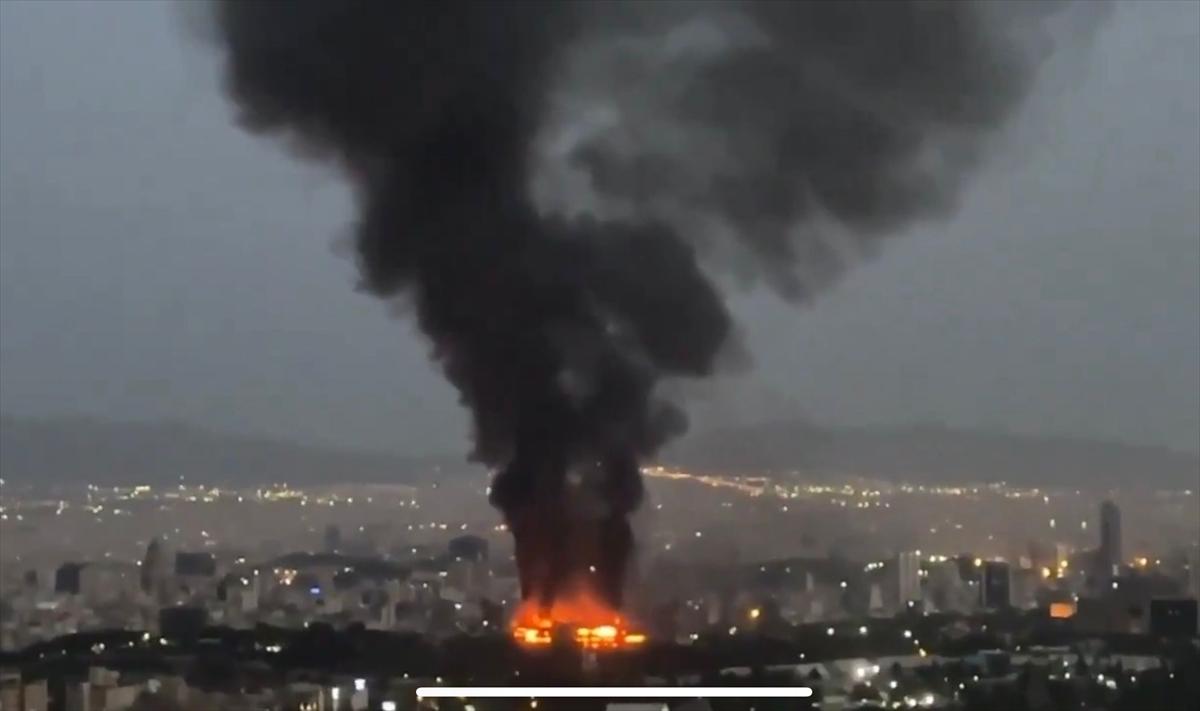
Fire after a strong explosion in Tehran 17 June 2025 – (Anadolu Agency)
On the same day Israeli air forces intervened against a drone detected coming from the east in the Jilie region. According to the military’s statement over 1100 targets in Iran have been struck since 13 June. Five helicopters reportedly owned by Iran and used to target Israeli drones were also destroyed.
In internal security operations conducted in the Alborz Tehran and Isfahan provinces 14 unmanned aerial vehicles (UAVs) suspected of being used by Israeli agents were identified and destroyed. Iranian Police Spokesperson Said Muntazerulmehdi announced the closure of workshops producing suicide drones drones and explosive materials. A pickup truck carrying kamikaze drones and technical components was seized in Alborz province and one individual linked to the incident was taken into custody.
In the Pishva region of Tehran province a workshop producing kamikaze drones was discovered and 15 UAVs were confiscated. In these two separate operations a total of 23 UAVs were seized and two individuals were arrested and referred to judicial authorities. Additionally in Hamadan an unmanned aerial vehicle was shot down and its wreckage was handed over to defense authorities.
Iranian state television announced that a Hermes 900 type UAV allegedly belonging to Israel was shot down east of Isfahan. It was stated that eight advanced missiles were found on the downed aircraft. The Israeli military responded by stating that the UAV was hit by a surface to air missile within Iranian airspace and that the downed vehicle did not pose a data security risk.
On 18 June 2025 Iranian leader Ayatollah Ali Khamenei issued a statement in which he declared that direct negotiations with Israel were not on the agenda and stated “We will never negotiate with the Zionists.” Khamenei also warned that U.S. involvement in the region would lead to “irreparable damage from Washington’s perspective.” He emphasized that Israel’s strikes would not shake the resolve of the Iranian people.
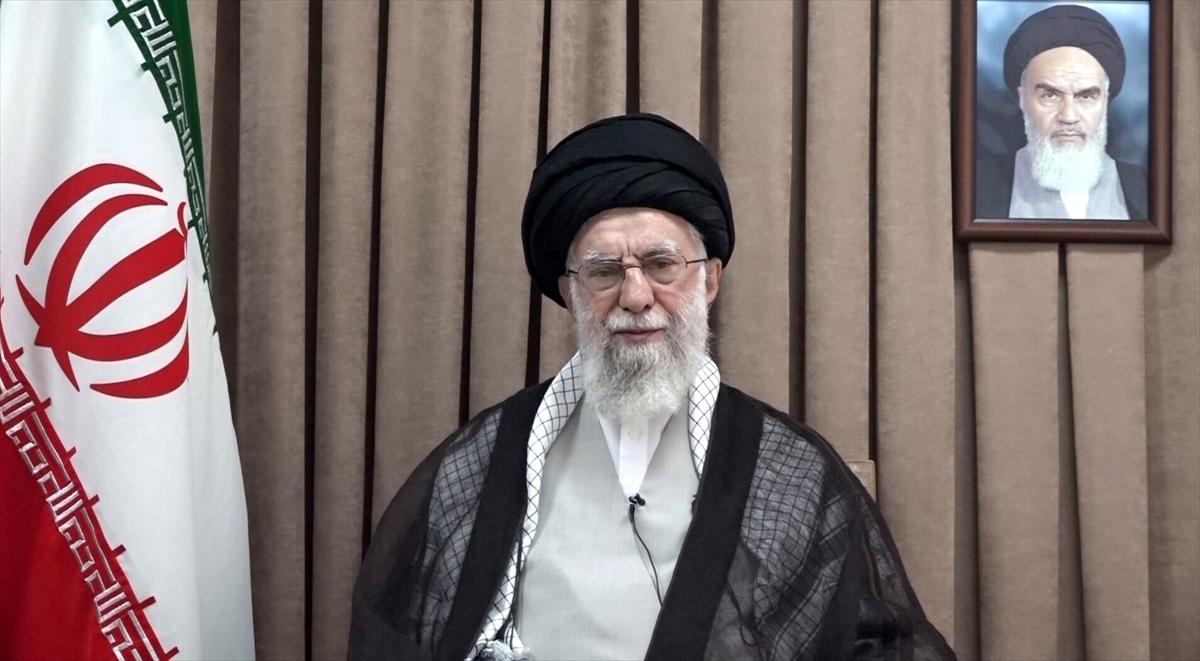
Iranian leader Ayatollah Ali Khamenei – (Anadolu Agency)
On the same day Mohammad Eslami President of the Atomic Energy Organization of Iran stated publicly that the nuclear facilities targeted in Israel’s strikes were in good condition and that Iran’s nuclear infrastructure continued to be protected. Eslami stressed that uranium enrichment activities were ongoing that experts on site remained at their posts and that nuclear security was not under threat.
Nasir Kanaani Spokesperson for the Iranian Ministry of Foreign Affairs claimed that reports published by the International Atomic Energy Agency IAEA were designed “to fabricate justifications for Israel’s attacks.” Kanaani argued that the IAEA’s reports on Iran were shaped by political motives and reiterated that Iran’s nuclear program was peaceful. He also criticized the IAEA for its silence regarding Israel’s strikes.
Parallel to this Iran’s Permanent Mission to the United Nations issued a statement drawing attention to the timing of the IAEA reports and asserting that the agency was acting on political rather than technical grounds. The statement emphasized that Iran’s nuclear activities were conducted under international supervision and that all allegations against Iran were baseless.
On 18 June 2025 the Grand National Assembly of Türkiye adopted a resolution condemning Israel’s attacks on Iran and calling on the international community to take urgent measures against the escalating conflict threatening regional peace. The resolution was published in the Official Gazette on 18 June 2025 and entered into force.
The resolution called for restraint from all parties emphasized that targeting nuclear facilities endangered global security and urged the United Nations and the International Atomic Energy Agency to intervene more effectively. Türkiye stated in the resolution that it would continue its diplomatic efforts to prevent further escalation of conflict in the region. The resolution was adopted with the unanimous consent of all political parties.
On 18 June 2025 U.S. President Donald Trump responded to questions from journalists during an event held in the White House garden. Regarding a potential decision to strike Iran he said “I can do it or I can not do it. No one knows what I will do.” In response to a question about whether a military operation against Iran’s nuclear facilities was on the agenda he replied “I cannot say that can I?”
Trump has stated that Iran wanted to negotiate with them, but that it is now too late. In the same statement, he noted that Iran had wished to come to the White House, but that this offer had been rejected. Despite these claims, Trump later affirmed that “It is never too late to negotiate,” indicating that the process remains open.
Trump also claimed that Iran is currently defenseless and that its air defense systems are inadequate. He stated that the United States has full surveillance over Iran’s airspace and that he speaks daily with Israeli Prime Minister Netanyahu, adding that he told him to “keep going.” Trump mentioned that Russian President Vladimir Putin had offered to mediate, but that he had rejected the offer.
On the same day, during a reception held in the Oval Office, Trump said that Iran was only weeks away from acquiring nuclear weapons, but that their goal was not merely a ceasefire, but a “nuclear-free victory.” Declaring that he did not wish to be directly involved in a conflict in the Middle East, Trump added, “I have ideas about what I will do, but I have not yet made my final decision. I will leave my decision until the last moment.”
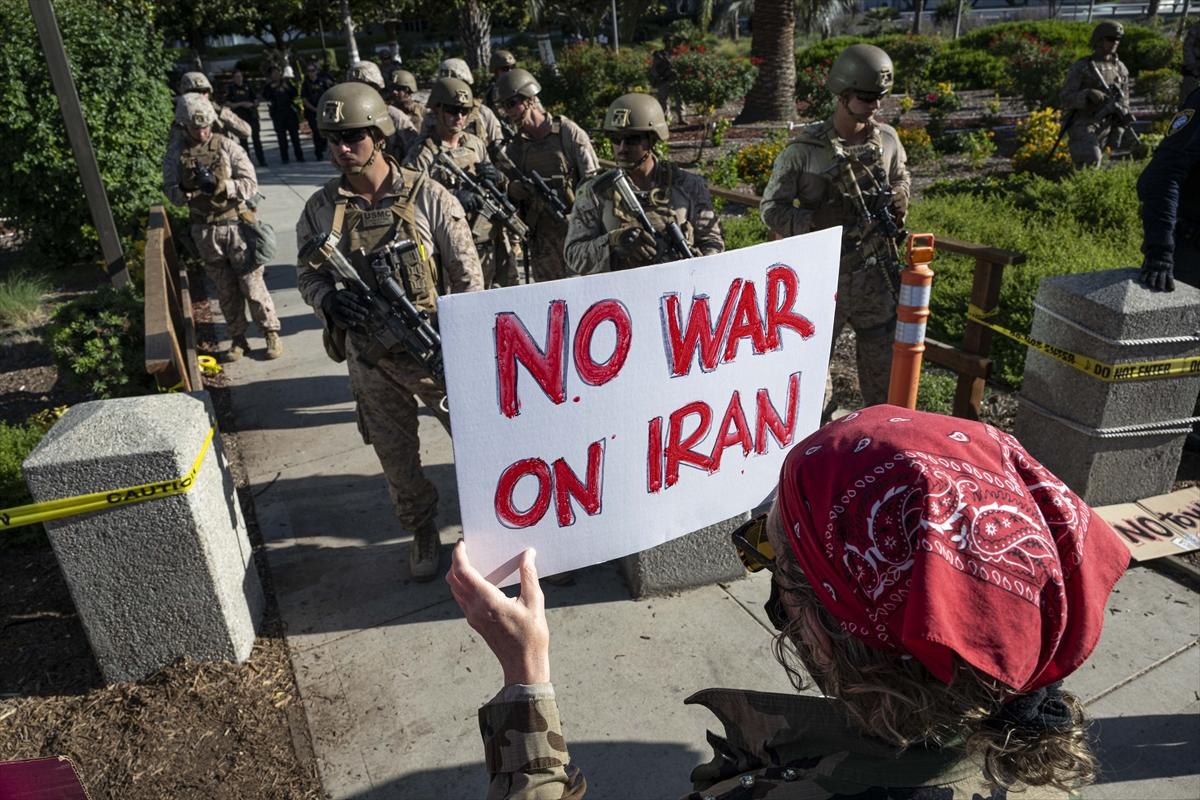
Los Angeles's protest against war with Iran, 18 June 2025 – (Anadolu Ajansı)
On 18 June 2025, large-scale protests were held in Los Angeles, United States, in response to the escalating conflict between Israel and Iran.
Anadolu Ajansı. "ABD Başkanı Trump, Orta Doğu’daki Bir Çatışmaya Dahil Olmak İstemediğini Söyledi." Accessed June 19, 2025. https://www.aa.com.tr/tr/dunya/abd-baskani-trump-orta-dogu-daki-bir-catismaya-dahil-olmak-istemedigini-soyledi/3603732#
Anadolu Ajansı. "ABD Başkanı Trump: İran’a Yönelik Saldırı Yapabilirim de Yapmayabilirim de." Accessed June 19, 2025. https://www.aa.com.tr/tr/dunya/abd-baskani-trump-irana-yonelik-saldiri-yapabilirim-de-yapmayabilirim-de/3603484#
Anadolu Ajansı. "İran Atom Enerjisi Kurumu Başkanı: Nükleer Tesislerin Durumu İyi." Accessed June 18, 2025. https://www.aa.com.tr/tr/dunya/iran-atom-enerjisi-kurumu-baskani-nukleer-tesislerin-durumu-iyi/3602732#
Anadolu Ajansı. “Los Angeles’te ‘İran’la Savaşa Hayır’ Protestosu Düzenlendi.” Anadolu Ajansı Foto Galeri. Accessed June 19, 2025. https://www.aa.com.tr/tr/pg/foto-galeri/los-angeleste-iranla-savasa-hayir-protestosu-duzenlendi/0
Anadolu Ajansı. “İran Lideri Hamaney: ABD’nin Müdahalesi, Washington İçin Telafisi Olmayan Hasara Yol Açacak.” Accessed June 18, 2025. https://www.aa.com.tr/tr/dunya/iran-lideri-hamaney-abd-nin-mudahalesinin-washington-icin-telafisi-olmayan-hasara-yol-acacagini-soyledi/3603041#
Anadolu Ajansı. “İran Lideri Hamaney: Siyonistlerle Asla Pazarlık Yapmayacağız.” Accessed June 18, 2025. https://www.aa.com.tr/tr/dunya/iran-lideri-hamaney-siyonistlerle-asla-pazarlik-yapmayacagiz/3602410
Anadolu Ajansı. “İran: Uluslararası Atom Enerjisi Ajansı’nın Raporu İsrail’e Bahane Oluşturuyor.” Accessed June 18, 2025. https://www.aa.com.tr/tr/dunya/iran-uluslararasi-atom-enerjisi-ajansinin-raporu-israile-bahane-olusturuyor/3602868#
Anadolu Ajansı. “İsrail’in İran’a Saldırılarıyla Başlayan Çatışma 6. Gününde.” Accessed June 18, 2025. https://www.aa.com.tr/tr/dunya/israil-in-iran-a-saldirilariyla-baslayan-catisma-6-gununde/3602493#
Anadolu Ajansı. “İsrail’in İran’a Saldırılarıyla Başlayan Çatışmalı Sürece Karşı TBMM Kararı Resmi Gazete’de.” Accessed June 18, 2025. https://www.aa.com.tr/tr/politika/israilin-irana-saldirilariyla-baslayan-catismali-surece-karsi-tbmm-karari-resmi-gazetede/3602352#
On the morning of 19 June 2025, the Islamic Revolutionary Guard Corps of Iran launched a new attack targeting Israeli military sites in Tel Aviv and Haifa as part of the 15th wave of Operation “Sadeq Vat 3.” According to the announcement, the operation involved the simultaneous launch of over 100 kamikaze unmanned aerial vehicles and numerous missiles. The attacks were specifically designed to target Israel’s missile defense systems.
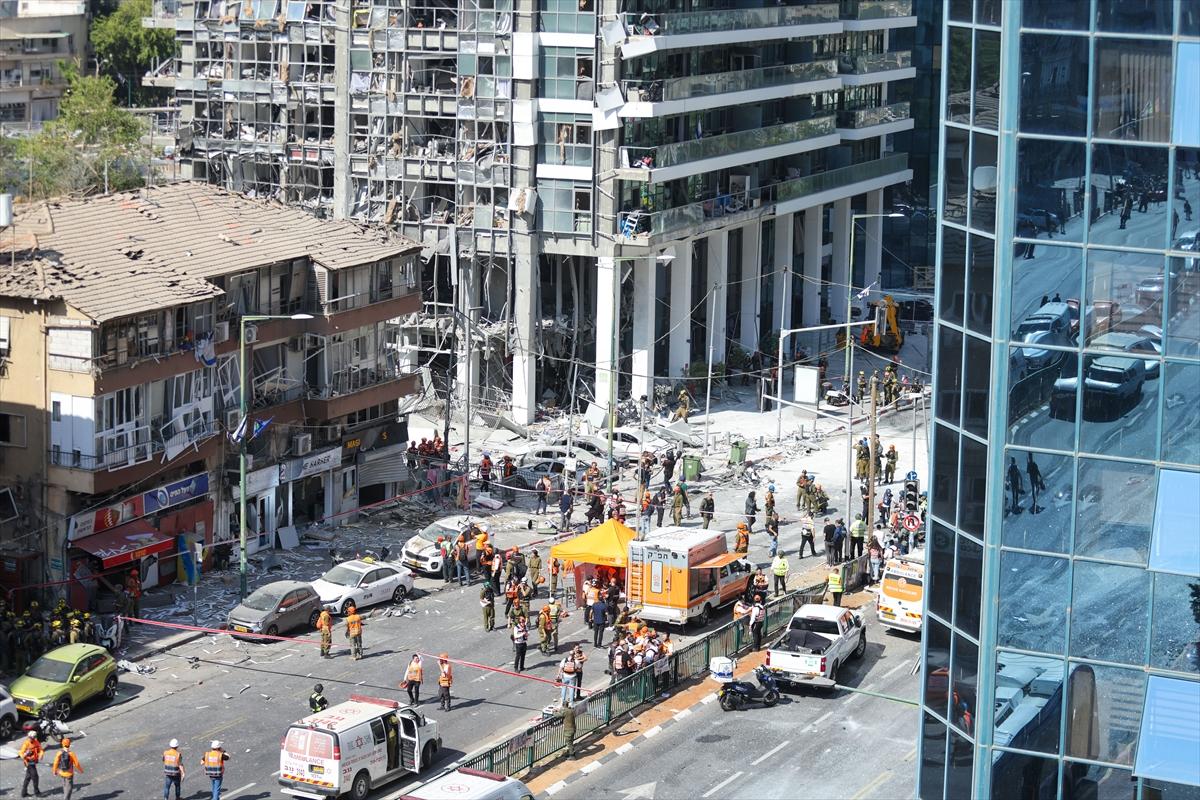
A building damaged in Ramat Gan by one of the missiles launched by Iran in retaliation for Israeli strikes, 19 June 2025 – (Anadolu Agency)
As a result of the missiles and drones launched by Iran, several buildings in the capital Tel Aviv and in Ramat Gan and Holon were directly hit. In the southern city of Beersheba, a missile struck the Soroka Medical Center complex. Israel’s emergency medical service, Magen David Adom, reported that 65 people were injured in the attacks, with three in serious condition. Israeli media reported that 271 people were injured in the latest wave of attacks, four of whom were in critical condition.
The Israeli police spokesperson stated that a missile hit a parking lot in Beersheba, causing multiple vehicles to catch fire and creating a crater in the debris field. It was announced that an investigation is underway after Israel’s air defense systems failed to intercept one of the missiles. Sirens sounded across Israel’s northern regions, particularly around Haifa, and civilians were urged to seek shelter.
Iranian Revolutionary Guard sources announced that targets included defense industry facilities in Tel Aviv and military infrastructure and intelligence nodes in Haifa. They also confirmed that a missile struck the IDF command and intelligence camp located in the Gav-Yam Technology Park. During the same attacks, significant damage was reported in several buildings in the Ramat Gan area, including the building housing the Tel Aviv Stock Exchange.
In response to Iran’s missile attacks, the Israeli military launched large-scale air operations against multiple Iranian cities beginning in the night hours. More than 60 Israeli Air Force aircraft deployed 120 munitions to strike military targets in Tehran, Qom, Golestan and East Azerbaijan provinces.
The Israeli military statement identified the targets as centers producing missile engines and components, as well as nuclear weapons research facilities. Among the sites struck were the SEPAND advanced military research center, established in 2011 by Mohsen Fakhrizadeh, and other research institutions alleged to have contributed to Iran’s nuclear weapons program. Israel also announced an air strike against missile launch and storage facilities located in western Iran. Iranian military personnel were reportedly targeted in these strikes.
Three soldiers affiliated with the Islamic Revolutionary Guard Corps were killed in an attack on a military unit in the Bostanabad region of East Azerbaijan province. In the city of Gorgan in Golestan province, air defense systems were activated. In the city of Rasht in Golestan province, four major explosions were recorded.
On the morning of 19 June, Israel targeted the Arak Heavy Water Nuclear Reactor (Shahid Hondab Reactor) in the city of Arak, Iran. The Atomic Energy Organization of Iran stated that there were no casualties or injuries and that the civilian population had not been harmed due to previously implemented security measures. The International Atomic Energy Agency (IAEA) confirmed that the facility was not operational and contained no nuclear material. According to an IAEA social media statement, the incident had no impact in terms of radiation leakage.
On 19 June, Iran’s Chief of Staff, Major General Abdurrahim Mousavi, visited a missile base belonging to the Islamic Revolutionary Guard Corps Aerospace Force. In a statement broadcast on state television, Mousavi declared that “all targets belonging to the Zionist regime will be attacked without restraint” and that Iran faces no limitations in its response. He emphasized that Iran’s military reflexes will continue.
Israeli Prime Minister Benjamin Netanyahu endorsed Defense Minister Yisrael Katz’s call for an assassination attempt on Khamenei and stated that he had ordered the Israeli military that “no one in Iran is immune.” Netanyahu emphasized that Israel does not seek to overthrow the Iranian regime but is determined to eliminate its nuclear program. Katz also asserted that Khamenei “will pay the price” and that the morning’s attack constituted a “war crime.”
Iran’s Foreign Minister Abbas Araghchi called on Israeli citizens to stay away from military and intelligence facilities. He justified the attack on Soroka Hospital by stating that it served as a medical center for Israeli soldiers deployed in Gaza and therefore qualified as a legitimate target.
The Israeli Ministry of Defense announced that on 19 June, 14 new military cargo aircraft loaded with equipment and supplies from the United States and Germany arrived in Israel. These shipments were delivered via air and sea bridges to provide logistical support for operations that began on 13 June.
On 19 June, White House Press Secretary Karoline Leavitt stated that U.S. President Donald Trump will make a decision regarding a potential strike against Iran within two weeks. Leavitt noted that Trump prioritizes diplomacy but will evaluate other options if Iran refuses to engage in negotiations.
The Trump administration has made clear its firm opposition to Iran acquiring nuclear weapons and stated that any potential agreement must be based on the principle of “zero uranium enrichment.” It was also reported that U.S. Special Envoy for the Middle East Steve Witkoff continues direct contacts with Iranian counterparts.
United Nations High Commissioner for Human Rights Volker Türk drew attention to the impact of escalating reciprocal attacks between Iran and Israel on civilians and called on both parties to show “full respect for international humanitarian law.” He emphasized that the attacks have damaged medical infrastructure, civilian settlements and public services. Türk reported that 224 people have been killed in Iran and 24 in Israel, with over 840 injured, and that mass evacuations are ongoing in the capital Tehran. UN Spokesperson Stephane Dujarric warned that the conflict could trigger large-scale migration waves and urged all parties to exercise restraint and pursue diplomacy.
On 19 June, Israel’s Military Censor Chief, Brigadier General Kobi Mandelblit, announced that pre-publication censorship has been implemented regarding images of locations struck by Iran’s attacks. Mandelblit stated that this decision applies to both Israeli media and international outlets and warned that publishing material without approval from the censorship unit would constitute a threat to national security.
Anadolu Ajansı. "Netanyahu’dan Hamaney’e Suikast Tehdidi: Orduya İran’da Kimsenin Dokunulmazlığı Olmadığı Talimatını Verdim." Accessed June 19, 2025. https://www.aa.com.tr/tr/dunya/netanyahudan-hamaneye-suikast-tehdidi-orduya-iranda-kimsenin-dokunulmazligi-olmadigi-talimatini-verdim/3605071#
Anadolu Ajansı. “Beyaz Saray: Başkan Trump İran’la İlgili Kararını İki Hafta İçinde Verecek.” Accessed June 19, 2025. https://www.aa.com.tr/tr/dunya/beyaz-saray-baskan-trump-iranla-ilgili-kararini-iki-hafta-icinde-verecek/3605012
Anadolu Ajansı. “İsrail’in İran’a Saldırılarıyla Başlayan Çatışmada 7. Gün.” Accessed June 19, 2025. https://www.aa.com.tr/tr/dunya/israil-in-iran-a-saldirilariyla-baslayan-catismada-7-gun/3603983#
On the morning of 20 June 2025, a missile launched from Iran struck the town of Beersheva in southern Israel. Following the incident, alarm sirens sounded in the region and the Israeli military dispatched emergency response teams to the impact site. The Israeli police spokesperson confirmed that bomb disposal experts were also sent to the area and that an investigation was underway at the scene. According to local sources, the missile hit a parking lot within the residential area, creating a crater upon impact and igniting numerous vehicles.
Israel’s emergency medical service reported that, based on initial assessments, six people sustained minor injuries in the attack. Videos published on social media platforms showed fire breaking out at the point of impact and thick black smoke rising into the air. According to Haaretz newspaper, investigations are underway into vulnerabilities in Israel’s air defense systems that failed to intercept the missile.
In a statement issued on 20 June, the Islamic Revolutionary Guard Corps announced that a kamikaze unmanned aerial vehicle (UAV) flying over the Shahri Rey district in southern Tehran and a mini UAV detected near the Tehran Oil Refinery had been neutralized. The downed drones were identified as belonging to Israel and were intercepted by Iran’s defense systems.
Israeli Defense Minister Yisrael Katz made a statement on social media in response to remarks by Hezbollah Secretary General Naim Qassem expressing support for Iran. Katz referenced past assassinations of former Hezbollah leaders and stated that Qassem had failed to learn from the fate of his predecessors. In his statement, Katz asserted that Hezbollah posed a threat to Israel under Iran’s directives and declared that Israel would no longer show restraint against groups threatening it, warning that Hezbollah would be “destroyed” if it became involved in hostilities.
On 20 June 2025, official statements reaffirmed the total casualties from the preceding days of conflict. According to Iranian sources, at least 224 people were killed and more than 1,277 injured in the Israeli attacks that began on 13 June. In Iran’s ballistic missile strikes against Israel, 25 people in Israel were killed and over 500 injured.
Anadolu Ajansı. “İsrail’in İran’a Saldırılarıyla Başlayan Çatışmada 8. Gün.” Accessed June 19, 2025. https://www.aa.com.tr/tr/dunya/israil-in-iran-a-saldirilariyla-baslayan-catismada-8-gun/3605239#
On June 21, 2025, the Israeli military continued its aerial strikes against various cities in Türkiye. According to official statements, the southwestern Iranian cities of Ahvaz Dezful and Mahshahr were targeted by Israeli fighter jets. The strikes reportedly hit radar systems ballistic missile launchers and military infrastructure. It was reported that over 50 bombs were dropped on targets in Ahvaz with particular emphasis on military bases and missile stockpiles.
The 4th Air Base in Dezful was directly hit and residents reported hearing loud explosions in the area. On the same day six people were killed in the Necefabad district of Isfahan including soldiers among the dead. The Iranian military announced that five personnel affiliated with the Islamic Revolutionary Guard Corps were killed in an attack on the city of Hurremabad in Lorestan province.
On June 21 Israel announced that its aerial operations targeted senior commanders affiliated with the Islamic Revolutionary Guard Corps. According to reports Said Izadi a commander of the Quds Force was killed in an operation in the city of Qom. Izadi is alleged to have coordinated on behalf of Iran with Hamas and other Palestinian groups.
It was also claimed that Emin Pur Joudaki commander of the Iranian Revolutionary Guard Corps’ drone division was killed in an Israeli airstrike. Joudaki was said to have directed drone attacks from southwestern Iran against Israel. The Israeli military spokesperson stated that these operations specifically targeted Iran’s unmanned aerial vehicle command chain.
On June 21 Iran launched a Shahid-136 type drone manufactured in Iran against the Israeli town of Beit Shean. The drone struck a two-story building causing damage but no casualties or injuries were reported. The Israeli military claimed this was the first Iranian drone attack since June 13 to successfully hit its intended target.
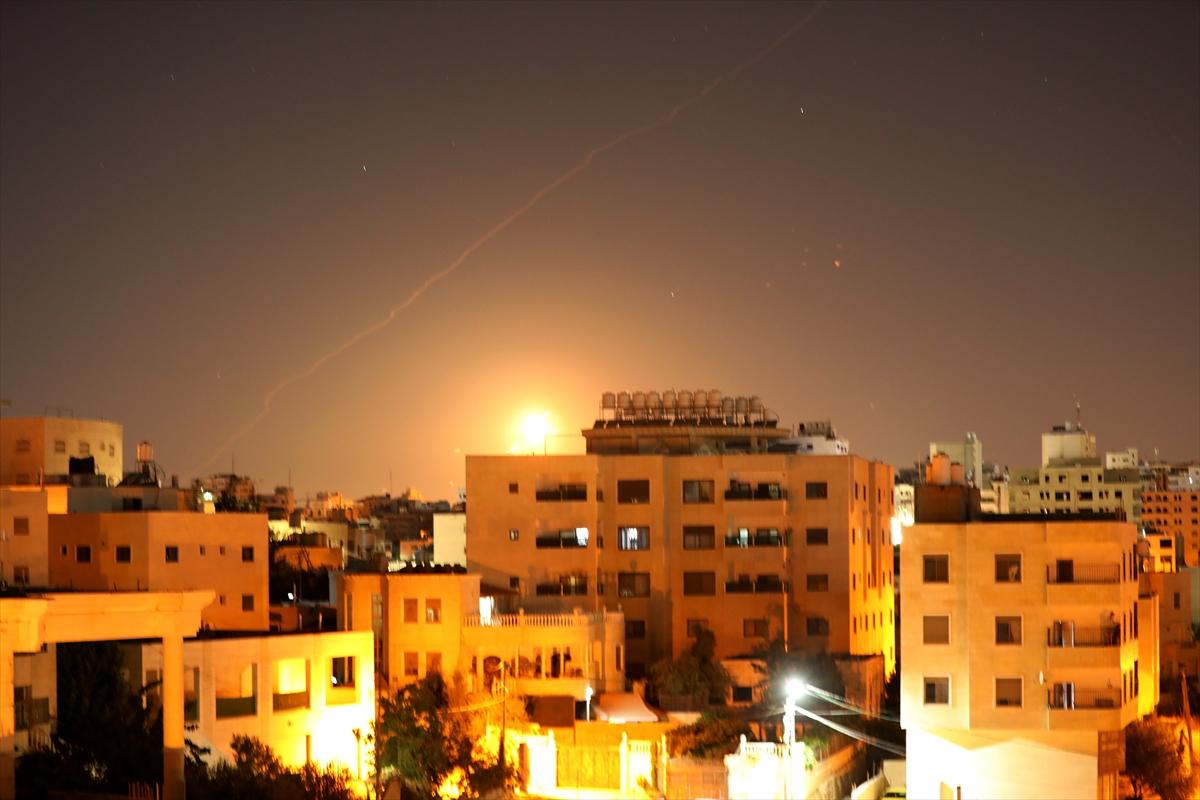
Iran’s missile attack on Israel June 21 2025 – (Anadolu Agency)
Iran also announced that it had struck 14 strategic military sites in Tel Aviv and Haifa with missiles. Ali Mohammad Nayini spokesperson for the Islamic Revolutionary Guard Corps stated that the targets included a building belonging to an artificial intelligence company under Israel’s Ministry of Defense and the Sails Tower in Haifa. The long-range missile used was identified as the Qadr-F.
The Iranian Ministry of Health announced that three hospitals and six ambulances were targeted in Israeli strikes. During the attacks a specialist in obstetrics and a pediatrician were injured while providing care to the wounded. Health Minister Mohammad Reza Zafarkhendi emphasized that these attacks violated international humanitarian law.
In an Israeli airstrike on the Salariye neighborhood in the Iranian city of Qom a civilian building was hit resulting in the death of a 16-year-old child and injuries to two others. Hospitals in Tehran continue to treat a large number of wounded and it was reported that the number of fatalities from Israeli strikes had reached 430 with over 3 500 injured to date.
As of June 21 nine individuals in the Iranian city of Bushehr were arrested on suspicion of providing intelligence support to Israel. Security officials claimed these individuals sought to provoke public opinion and undermine psychological security. On the same day the Supreme National Security Council issued a statement calling on anyone with direct or indirect ties to Israel to surrender to authorities by June 22 warning that failure to do so would result in them being labeled as a “fifth column”.
In Israel the issue of censorship regarding reports on Iranian attacks became a subject of debate. An emergency directive issued by the Israeli Military Censorship Unit requested the suppression of news related to locations hit by Iranian strikes. Israeli Attorney General Gali Baharav-Miara questioned the legal basis of this decision and requested explanations from government ministries regarding its conflict with press freedom.
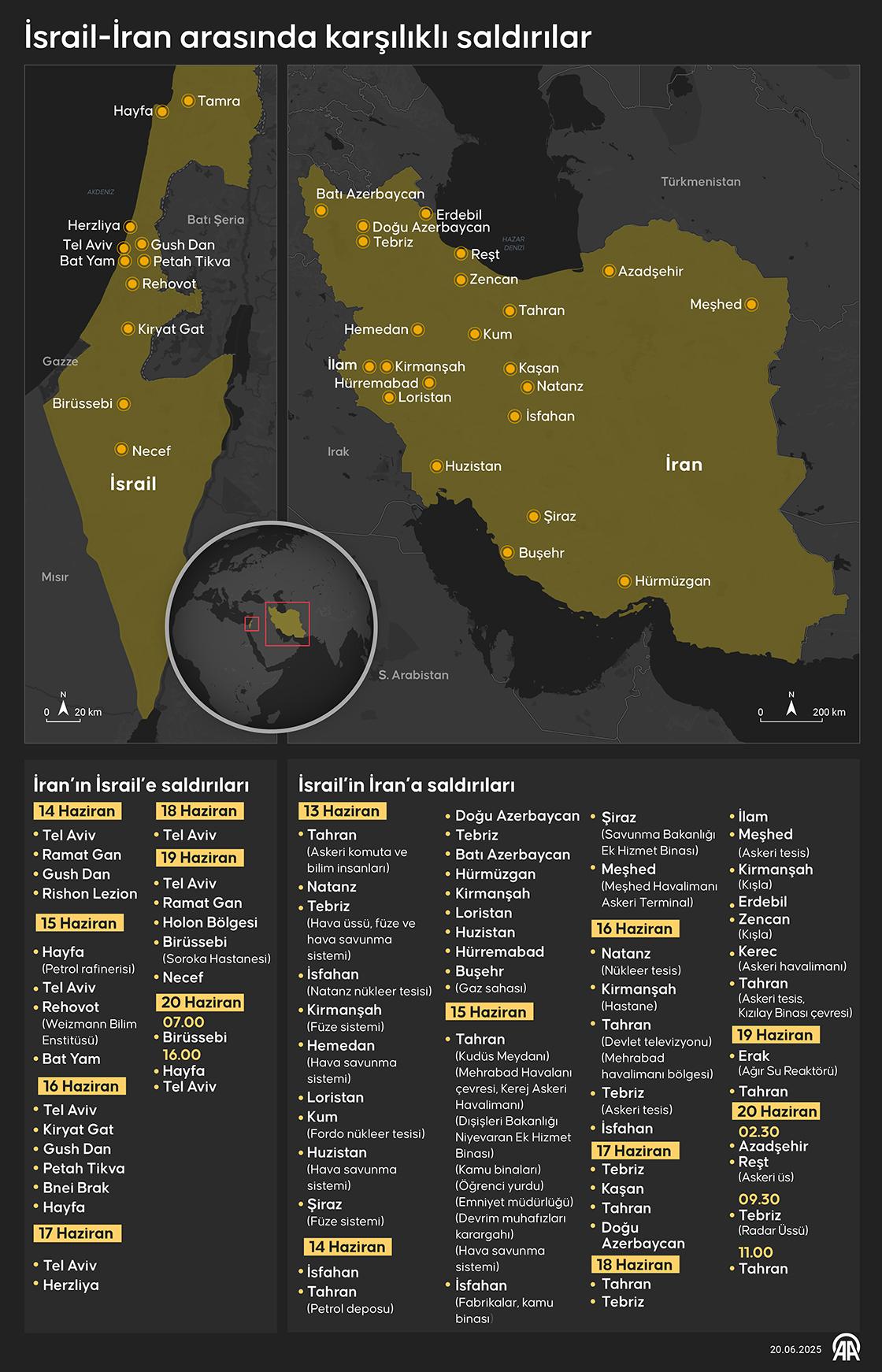
Infographic showing reciprocal attacks between Iran and Israel June 20 2025 – (Anadolu Agency)
Mohammad Islamieh President of the Atomic Energy Organization of Iran criticized the International Atomic Energy Agency for its silence regarding Israeli strikes and stated that Iran no longer trusted its inspections. Islamieh noted that the facilities targeted by Israel were registered with the IAEA and warned that if the Agency did not condemn these attacks Iran would accelerate its nuclear program.
Meanwhile Ali Larijani advisor to Iran’s Supreme Leader Ayatollah Ali Khamenei told IAEA Director General Grossi “We will settle accounts after the war is over.”
Anadolu Ajansı. “İsrail’in İran’a Saldırılarıyla Başlayan Çatışma Sürüyor.” Accessed June 22, 2025. https://www.aa.com.tr/tr/dunya/israil-in-iran-a-saldirilariyla-baslayan-catisma-suruyor/3606530#
In the early hours of June 22, 2025, the United States conducted a comprehensive air strike against three nuclear facilities located on Iranian territory. The operation was planned to occur between midnight and morning, with simultaneous attacks directed at three separate targets. U.S. President Donald Trump stated that the strike was carried out under presidential authority with direct coordination by the Pentagon and U.S. Central Command.
The nuclear facilities targeted by U.S. air forces are the three main centers of Iran’s nuclear program: Fordo, Natanz, and Isfahan. The Fordo facility is distinguished by its underground protected structure and is located in a region near Qom. The Natanz facility is known for its enrichment activities, while Isfahan hosts uranium conversion and other nuclear infrastructure. Iranian local authorities confirmed the accuracy of the strikes in these three areas; the Qom Governorate verified that the Fordo facility had been attacked, and Isfahan Deputy Governor Ebrahim Salhi declared that attacks had occurred around Natanz and Isfahan.
Official details regarding the weapons systems used in the strike have not been released. However, assessments in the U.S. media indicate that the operation was supported by various hypersonic cruise missiles, guided munitions, and unmanned aerial vehicles (UAVs). According to military sources, B-2 Spirit stealth bombers were also alleged to have participated in the operation. Iranian air defense systems were reported to have been activated during the attacks, with short-term countermeasures deployed in some areas.
The U.S. has stated that its primary objective in the strike was to neutralize Iran’s nuclear production capacity. Despite the underground protection of the targeted sites, some structural damage was reported at the enrichment facilities. The extent of the damage focused particularly on infrastructure systems at Natanz and Fordo. Iranian state media, however, claimed that nuclear materials had been evacuated from these facilities prior to the attacks and that personnel had been relocated to other locations.
Thermal imaging and satellite observations from Fordo were said to have provided limited but verifiable evidence of structural damage. U.S. President Donald Trump announced that the air strike against the three Iranian nuclear facilities in Fordo, Natanz, and Isfahan had been completed. According to the statement, the operation was carried out using cruise missiles launched from fighter jets and submarines. The Fordo facility was targeted with six bunker-busting munitions, while the Natanz and Isfahan facilities were struck by 30 Tomahawk missiles.
Following the strike, U.S. President Trump described the operation as a “legitimate preventive measure” against Iran’s nuclear capabilities. Iranian President Masoud Pezeshkian, however, explicitly stated that these attacks revealed the United States to be the primary actor behind Israel’s military operations. Pezeshkian said, “The United States’ strikes demonstrate that the Zionist regime lacks the capacity to attack Iran on its own.”
The Iranian Ministry of Foreign Affairs assessed the attacks as a clear violation of international law. The Gulf Cooperation Council (GCC), in its statement regarding radiation measurements in the region, reported that radiological indicators in member states remained within technically safe limits following the strikes.
On June 22, 2025, during a cabinet meeting in Tehran, Iranian President Masoud Pezeshkian addressed the U.S. air strike on three Iranian nuclear facilities. Pezeshkian stated that these attacks clearly demonstrated the United States’ direct support for Israel’s military operations. Pezeshkian noted that the U.S. had initially attempted to conceal its role in the conflict but changed its stance in the face of Iran’s military response and Israel’s inadequacy.
President Pezeshkian also commented on Iran’s missile strikes against Israel. He stated that Iran’s morning operation was a response to U.S. aggressive policies in the region. Pezeshkian emphasized that Israel lacks both the capacity and political courage to attack Iran independently, and that the retaliatory actions were not only directed at Israel but also served as a response to actors indirectly supporting these operations.
At the regional administrative level in Iran, officials confirmed that the three nuclear facilities had been targeted. Sources from the Qom Governorate, to which the Fordo nuclear facility belongs, confirmed that the facility had been attacked. Similarly, Isfahan Deputy Governor Ebrahim Salhi announced that attacks had occurred around the facilities in Isfahan and Natanz. Salhi stated that damage assessment efforts had been initiated in these areas and that detailed information would be shared with the public at a later stage.
In the early morning of June 22, 2025, Iran launched a comprehensive missile strike against northern and central regions of Israel. The operation, conducted by the Islamic Revolutionary Guard Corps, involved the launch of a total of 87 ballistic missiles. The attacks occurred between 07:20 and 08:10, with successive salvos fired in multiple waves. Among the targeted locations, the western sectors of Tel Aviv and the city of Haifa stood out. Iranian sources stated that both short-range tactical missiles and medium-range ballistic missile systems with strategic capability were employed in the strike.
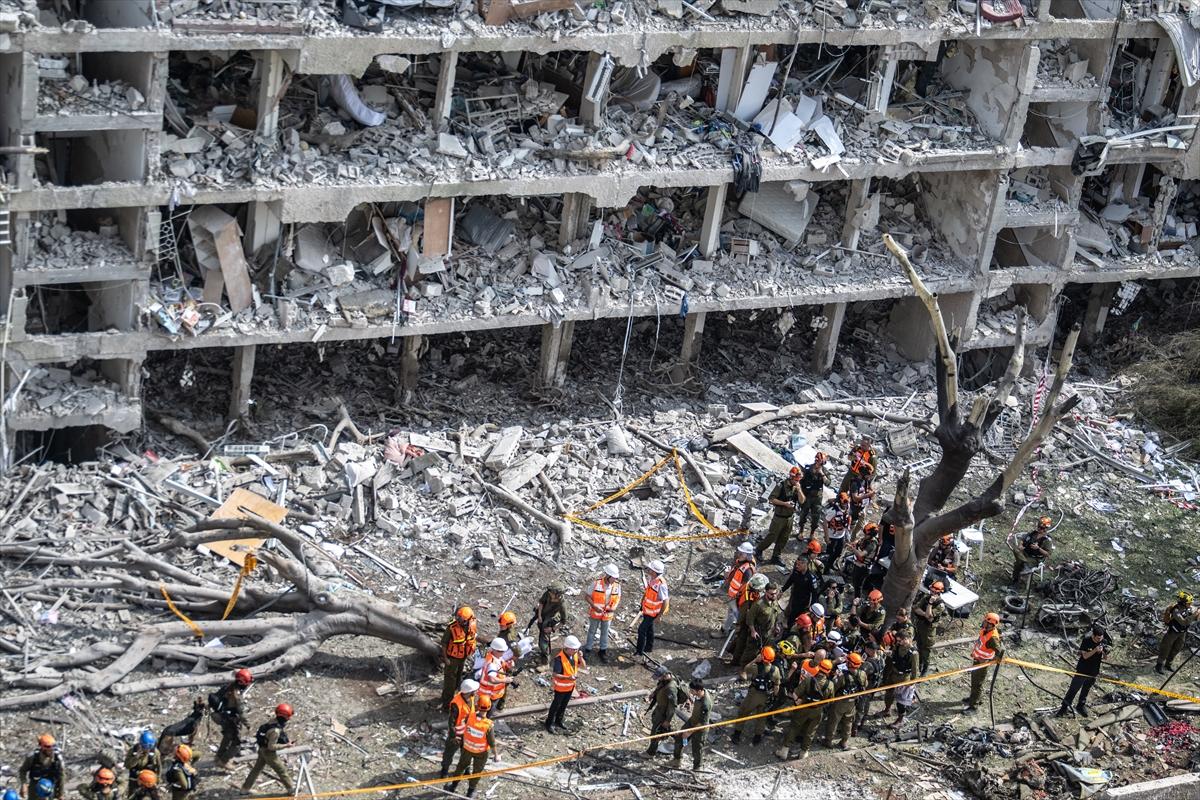
One of the missiles launched by Iran in retaliation for Israel’s attacks struck the Ramat Aviv district of Tel Aviv, June 22, 2025 – (Anadolu Agency)
The Iranian missile strikes caused damage to military and logistical port infrastructure in Haifa. A fire broke out in part of the port facilities, prompting the deployment of fire and security units to the area. In western neighborhoods of Tel Aviv, damage occurred in various residential units struck by missile fragments. Israeli authorities confirmed that some homes and commercial buildings were damaged, with localized disruptions to infrastructure services. Eyewitnesses reported dense smoke clouds forming in some areas after the attacks and civilians being directed to shelters.
The Israeli Ministry of Health announced that 45 people were injured in the Iranian attacks, with 11 of them in critical condition. Among the injured were civilians in residential areas of Tel Aviv as well as port personnel in Haifa. Emergency response teams reached the sites shortly after the attacks, and ambulance and rescue personnel provided initial medical care. Israeli Internal Security Forces implemented civilian evacuation procedures in certain areas. Hospitals raised their alert levels, and emergency services in healthcare centers in Tel Aviv and Haifa began operating at full capacity.
The Islamic Revolutionary Guard Corps announced that it had for the first time operationally deployed a new ballistic missile system named “Hayber-Shiken” during the June 22 strikes. The missile is said to differ from previous systems through advanced guidance technology, high maneuverability, and a hardened penetrator warhead structure. Iranian sources stated that the Hayber-Shiken carries a conventional warhead and has a range capacity of up to 1,400 kilometers. Its high hit probability and ability to evade radar detection were emphasized as factors enhancing its operational effectiveness. Israeli authorities confirmed the detection of missile debris from this type in certain areas around Tel Aviv.
On the morning of June 22, 2025, the Israel Defense Forces carried out retaliatory strikes against military targets in various regions of Iran. The operation primarily targeted military positions located southeast of Qom, northwest of Dezful city center, and within the boundaries of Isfahan province. Israeli sources stated that the strikes targeted areas from which Iran’s missile launches were conducted, as well as command elements in those regions. The targeted sites included military communication facilities, air defense systems, and radar equipment.
Israeli military operations reportedly neutralized several mobile ballistic missile launchers belonging to the Islamic Revolutionary Guard Corps. Israeli intelligence units had previously identified these launchers as having been used in the morning attacks on Tel Aviv and Haifa on June 22. The location of the launchers was determined via satellite and signals intelligence, and the operation was carried out using GPS-guided munitions. It was reported that these targets were concentrated around Isfahan and that explosion sounds were heard in the area after the strikes.
The Israeli Air Force targeted a military barracks located outside the city of Qum. The attack, carried out in the early morning hours, was supported by a large number of aircraft. The positions of Revolutionary Guard Corps elements stationed at the barracks were targeted, resulting in partial destruction of the structures. Initial reports from Iranian state media stated that a fire broke out following the attack and that injured personnel were transported to nearby hospitals. Iranian Civil Defense teams were dispatched to the site, and evacuation procedures at the barracks were initiated.
On June 22, Israeli Defense Forces (IDF) spokesperson Daniel Hagari stated during a press briefing that the operation was conducted within the framework of legitimate self-defense in response to missile attacks launched by Iran. Hagari said, “Any threat directed at Israeli territory is neutralized by a direct response at its source.” He emphasized that the strikes aimed to degrade Iran’s missile infrastructure, describing the operations as limited but effective and highlighting that targets were selected based on intelligence. Hagari also informed the public that additional operations are planned if new threats are identified in the coming days.
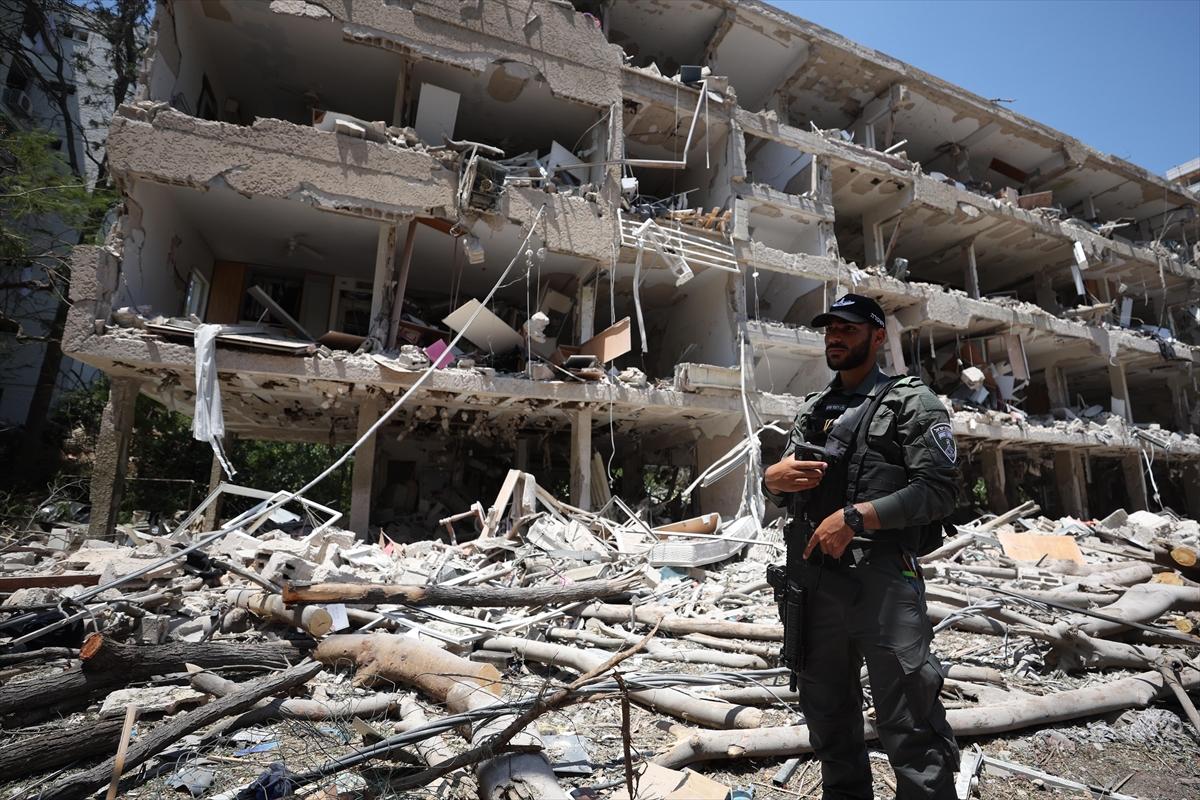
One of the missiles launched by Iran in retaliation for Israel’s attacks struck the Ramat Aviv district of Tel Aviv, June 22, 2025 – (Anadolu Agency)
On June 22, 2025, the Gulf Cooperation Council (GCC) released a statement disclosing the results of radiation monitoring efforts conducted in the region following U.S. strikes on nuclear facilities in Iran. The written statement, issued from its headquarters in Riyadh, noted that GCC member states continuously monitor environmental and radiological parameters and that a regional security assessment had been carried out. It was specified that measurements were concentrated particularly in the territories of countries bordering the Persian Gulf.
According to the assessment report published by the GCC, radiation measurements taken after the U.S. strikes on Iran’s Fordo, Natanz, and Isfahan facilities showed that all readings within member states remained within technically permitted limits. The statement confirmed that these findings comply with international nuclear safety standards and that no radiological leak was detected. GCC officials also disclosed to the public that these results had been verified by various independent technical teams and radiation monitoring centers.
The Gulf Cooperation Council reported that preventive measures against potential radiological threats are ongoing in the region. The statement noted that environmental monitoring stations in sensitive areas have increased their activity and that air and ground sampling procedures have been intensified. Medical screening units have been placed on standby in specific areas to protect public health, and evacuation plans, if needed, have been updated. The GCC also emphasized that radiation measurement data are updated daily and shared with relevant health authorities.
Beginning in the early morning hours of June 22, 2025, the Israeli Civil Aviation Authority imposed temporary restrictions on the national airspace. All international and domestic flights at airports across the country, including Tel Aviv’s Ben Gurion Airport, were suspended. The flight ban was implemented following missile launches from Iran and remained in effect until a second official announcement. The Israeli Ministry of Defense clarified that the airspace closure applied exclusively to civilian flights, while military air traffic continued operations as normal.
The Israeli Ministry of Interior announced that all educational institutions across the country were temporarily closed following the attacks. The decision applied particularly to the regions of Tel Aviv, Haifa, Ashkelon, Netanya, and Jerusalem, covering all levels of education from preschools to universities. Simultaneously, large public gatherings, social events, and demonstrations were prohibited, and security measures around outdoor assemblies were heightened. Although no curfew was declared, citizens were advised to remain indoors.
The Israeli Ministry of Foreign Affairs announced the launch of a special evacuation program to ensure the safe return of Israeli citizens abroad due to the conflict. Flights to repatriate Israeli nationals, particularly those in Europe, North America, and Asia, were organized based on their requests.
In various cities across Israel, public initiatives expressing support for U.S. President Donald Trump were undertaken. Banners and posters bearing messages of thanks to Trump were displayed in certain squares and main streets in Tel Aviv and West Jerusalem. These initiatives were reported to have been organized by civil groups and some local government officials.
Anadolu Ajansı. "ABD, İran’da Üç Nükleer Tesise Hava Saldırısı Düzenledi." Accessed June 22, 2025. https://www.aa.com.tr/tr/dunya/abd-iran-da-uc-nukleer-tesise-hava-saldirisi-duzenledi/3607410#
Iran’s Minister of Foreign Affairs, Abbas Araghchi, stated that the U.S. air strikes fundamentally altered Iran’s security perception and deeply affected diplomatic processes. Araghchi emphasized that the attack has put under strain the negotiations planned with the United States and described it as “a betrayal of diplomacy.” In a statement issued by the Islamic Revolutionary Guard Corps Command, it was reported that the United States and Israel carried out a coordinated attack on Iran’s nuclear infrastructure, and that this action violated international norms including the United Nations Charter and the Treaty on the Non-Proliferation of Nuclear Weapons. The Revolutionary Guard Corps asserted that all forces attacking Iran must be prepared to face consequences they will regret. The same statement also claimed that the flight paths of the aircraft involved in the attack had been identified and that U.S. bases stationed in the region were vulnerable.
U.S. President Donald Trump characterized the operation as a “successful intervention against Iran’s nuclear program” and addressed the public from the White House following the strike. Trump declared that the attacks on three Iranian nuclear facilities had “destroyed key nuclear enrichment capacity.” He further stated that this intervention was intended as a call for Iran to pursue peace and warned that any retaliation would be met with a much greater response.
In contrast, extensive debate erupted in Congress. Democratic Party members criticized President Trump for making the decision to launch the attack without congressional approval, arguing that it constituted an unconstitutional military action. Representative Alexandria Ocasio-Cortez stated that the decision “constituted grounds for impeachment,” while Senator Bernie Sanders and several Republican lawmakers also condemned the attack for being carried out without congressional authorization. Democratic Senator Tim Kaine introduced a “War Powers Resolution” on June 16 seeking to prevent such unilateral military actions.
United Nations Secretary-General Antonio Guterres expressed “deep concern” over the U.S. attack on three nuclear facilities in Iran. Guterres noted that the strike dangerously escalated existing regional tensions and posed a direct threat to international peace and security. In an official letter sent to the UN Security Council, Iran’s permanent representative, Amir Said Iravani, called for the immediate examination and condemnation of the attack, describing the U.S. action as a violation of international law and a breach of IAEA safeguards.
The International Atomic Energy Agency (IAEA), in its subsequent statement, reported no increase in radiation levels in the external environment of the targeted nuclear facilities, including Fordo. IAEA Director General Rafael Grossi announced that the IAEA Board of Governors would convene an extraordinary meeting to assess the situation.
European countries issued statements with varying tones regarding the U.S. attacks on nuclear facilities in Iran. Germany emphasized that the United States and Israel must begin negotiations as soon as possible and prioritize diplomatic solutions. France expressed concern over the attack and clarified that it had not participated in its planning or execution. The United Kingdom stated that Iran’s development of nuclear weapons was unacceptable and that the U.S. action was taken to reduce this threat. Italy welcomed the hope that regional tensions would ease after the strike and declared that nuclear weapons production posed a danger to the entire region. Spain affirmed that a solution in the Middle East could only be achieved through diplomacy and negotiations. Austria and Finland similarly called on all parties to return to the negotiating table and avoid escalation of conflict.
Saudi Arabia condemned the attack and called for a political solution to preserve regional stability. The United Arab Emirates stressed the urgent need to reduce tensions and expressed deep concern over the escalation. Kuwait stated that targeting nuclear facilities in Iran constituted a serious threat to the region and the world. Oman declared that the strikes were a serious violation of the United Nations Charter. Qatar warned that the attacks could lead to catastrophic consequences at both regional and global levels. Egypt stated that such escalations threatening regional and global security were unacceptable and underscored the necessity of a political solution. Iraq and Lebanon emphasized that striking nuclear facilities endangered regional security and stability. Pakistan condemned the attack and asserted that Iran had the right to self-defense under the UN Charter. Türkiye expressed deep concern over the potential consequences of the attack.
Russia criticized the strikes, noting that U.S. President Trump had come to office as a peacemaker but quickly initiated a new war. China strongly condemned the U.S. attacks on Iran’s internationally monitored nuclear facilities, stating that the international monitoring regime had been damaged. India expressed concern over rising tensions in the Middle East and called on all parties to reduce tensions.
Latin American countries including Chile, Cuba, Venezuela, Colombia, and Bolivia directly condemned the U.S. attack. Cuba stated that the strikes constituted serious violations under the United Nations Charter and international law. Venezuela declared its firm and resolute condemnation of the bombardment, while Colombia stated that unilateral use of force threatened international peace. The United Nations expressed deep concern over the U.S. use of force against nuclear facilities in Iran. The European Union emphasized that Iran must not acquire nuclear weapons and called for a diplomatic resolution.
Anadolu Ajansı. “ABD, İran’daki Nükleer Tesisleri Vurdu, İran Tel Aviv ve Hayfa’yı Hedef Aldı.” Accessed June 23, 2025. https://www.aa.com.tr/tr/dunya/abd-iran-daki-nukleer-tesisleri-vurdu-iran-tel-aviv-ve-hayfayi-hedef-aldi/3607410
On 23 June 2025, Iran carried out three successive missile attacks beginning in the early morning hours. Air raid sirens sounded across central and northern Israel for approximately 40 minutes. The Israel Defense Forces Home Front Command announced that the attack had ended and that civilians could leave shelters. According to local media, around 15 missiles were launched by Iran in three separate salvos. Following the missile strikes, impacts were recorded in several southern cities, beginning with Ashdod (Usdud). The Israeli electricity company reported that a missile striking near a strategic power plant in the south caused a power outage affecting 8,000 households.
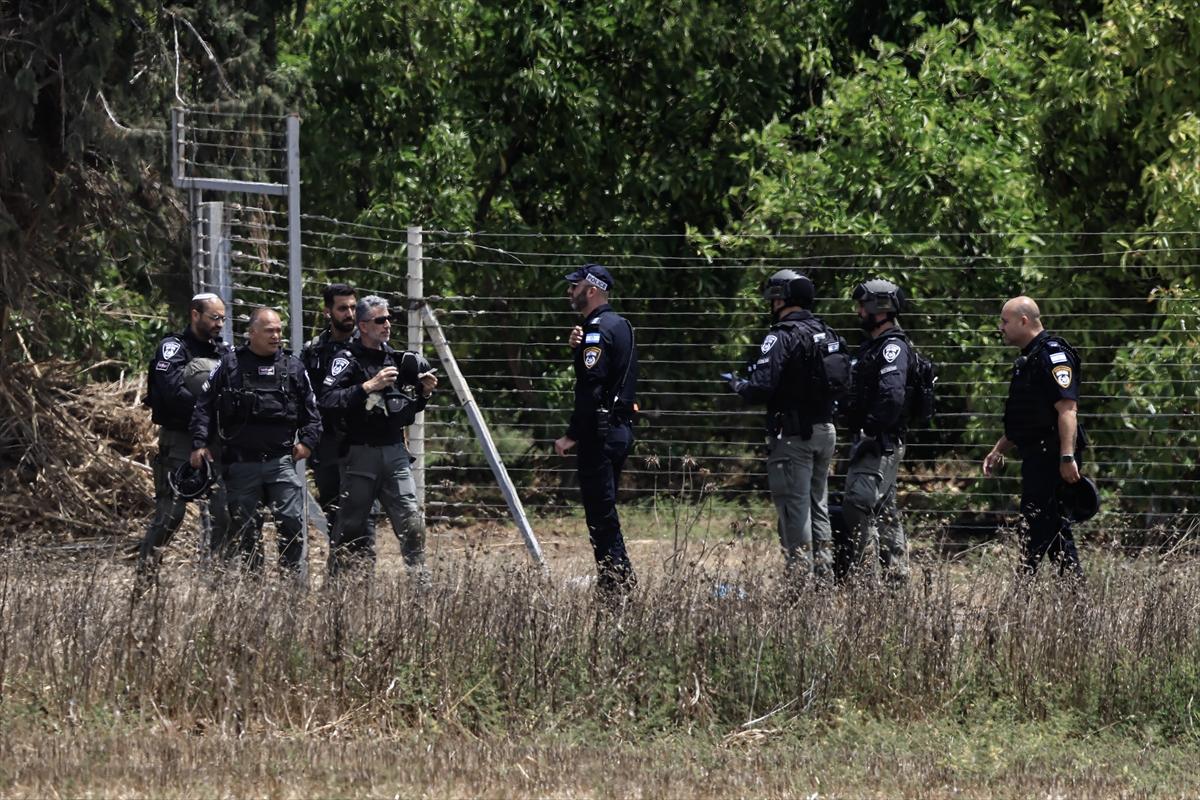
Security forces stationed around shelters in Israel, 23 June 2025 – (Anadolu Agency)
On the same day, the Israeli military launched comprehensive airstrikes targeting Iran’s capital, Tehran. Targeted sites included the headquarters of the Islamic Revolutionary Guard Corps, facilities belonging to the Basij militia, Evin Prison, and Palestine Square—symbolic locations of strategic and political significance. Israeli Defense Forces spokesperson Effie Defrin and Defense Minister Yisrael Katz stated that the strikes were directed at security and military installations. Israel had previously targeted similar areas. Israeli Foreign Minister Gideon Saar shared images of the attack on Evin Prison on his social media account. The Mizan News Agency confirmed damage to Evin Prison but reported no chaos at the scene and stated that the situation remained under control.
The Israeli military reported that roads leading to the Fordo Nuclear Facility had been struck, with targets also including the Sarullah headquarters of the Islamic Revolutionary Guard Corps, the Sayyid al-Shuhada units, and the General Intelligence Directorate. Israel also stated that since 13 June, it had targeted six Iranian airfields, destroying runways at Tehran Mehrabad, Tabriz, and Mashhad airports along with several fighter aircraft.
International Atomic Energy Agency (IAEA) Director General Rafael Mariano Grossi stated that damage to Iran’s nuclear facilities had not yet been fully assessed and that serious damage may have occurred to the underground structures of the Fordo facility. Iran has communicated that it requires the cessation of hostilities before IAEA teams can conduct inspections.
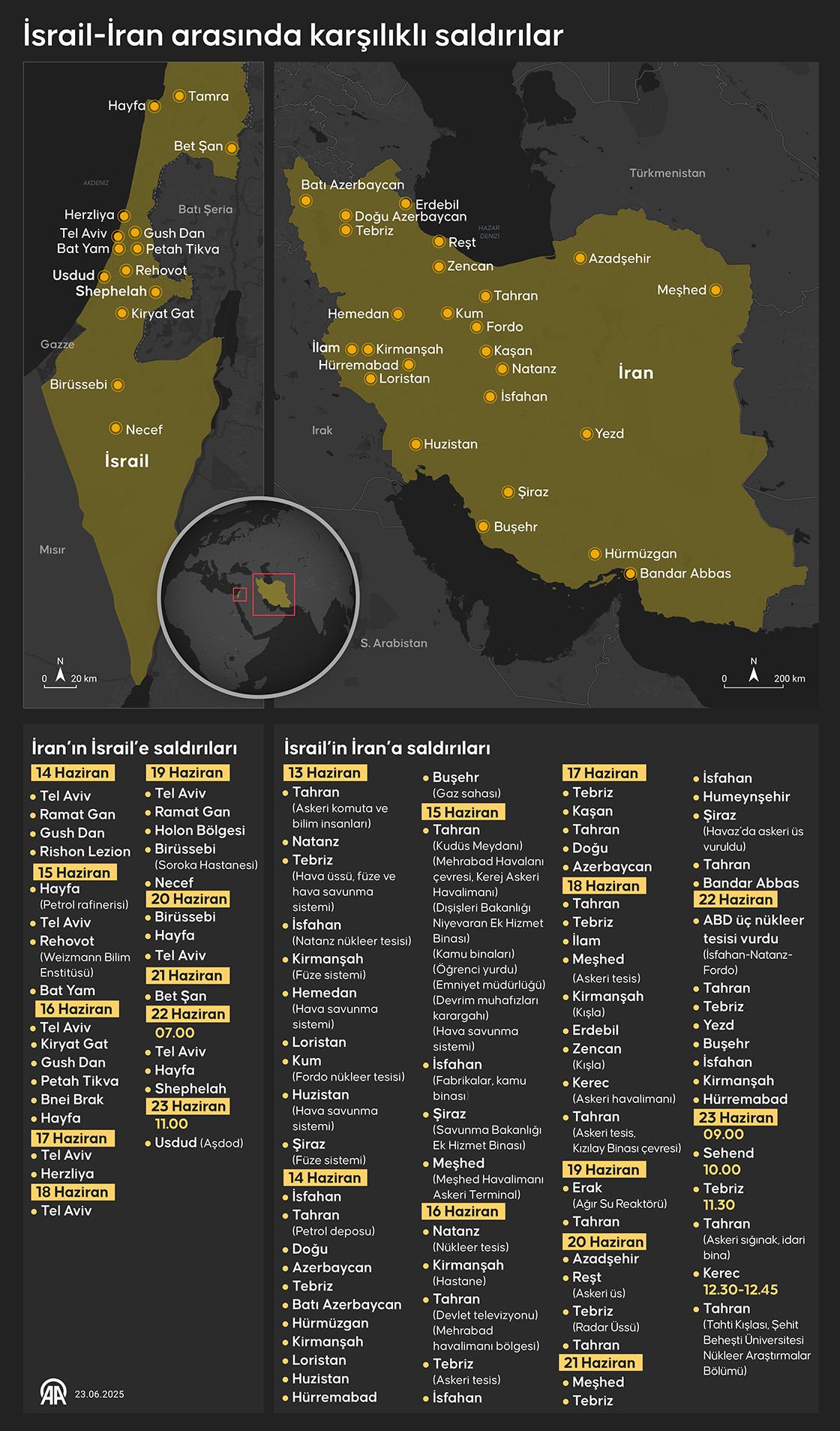
Infographic illustrating reciprocal attacks between Iran and Israel, 23 June 2025 – (Anadolu Agency)
Israeli police arrested two individuals in Tel Aviv on suspicion of spying for Iran. The suspects are alleged to have filmed strategic locations and residences of political figures and transmitted the footage to Iranian units, receiving cryptocurrency payments in return. Israeli media reported that 35 individuals suspected of working for Iran since 7 October 2023 have been arrested.
In Iran, 36 individuals were arrested in Gilan Province on charges of “collaboration with the enemy.” Authorities stated that these individuals used drones to monitor military zones and engaged in various sabotage activities. Seized materials included 20 batteries, 15 communication devices, one drone, four improvised explosives, and various electronic equipment. The Tehran Police Spokesperson also announced the arrest of two additional individuals in the mountainous region of northwestern Iran, along with equipment used to control unmanned aerial vehicles.
Anadolu Ajansı. “İsrail-İran Arasında Karşılıklı Saldırılar.” Anadolu Ajansı İnfoGrafik. Accessed June 23, 2025. https://www.aa.com.tr/tr/info/infografik/46643
Anadolu Ajansı. “İsrail’in İran’a Saldırılarıyla Başlayan Çatışma 11. Günde Sürüyor.” Accessed June 23, 2025. https://www.aa.com.tr/tr/dunya/israil-in-iran-a-saldirilariyla-baslayan-catisma-11-gunde-suruyor/3609129#
On 23 June 2025, the Iranian Armed Forces launched a comprehensive missile strike targeting the Al Udeid Air Base in Qatar. The operation was designated by the Islamic Revolutionary Guard Corps as “Fetih Müjdesi” or “Blessings of Victory.” It was stated that the attack was carried out in response to U.S. airstrikes on Iran’s nuclear facilities at Natanz, Fordow, and Isfahan. Iran’s Supreme National Security Council declared that the strike was proportionate to the number of bombs dropped by the United States. Iran reported that no civilians were harmed due to the base’s distance from populated areas in Qatar and emphasized that the attack was directed solely against U.S. military presence and posed no threat to the Qatari people.
The Al Udeid Air Base is located near Doha, the capital of Qatar, and is the largest U.S. military installation in the Middle East. The base hosts approximately 10,000 U.S. military personnel and serves as the forward headquarters of U.S. Central Command (CENTCOM). It has the capacity to accommodate nearly 100 combat aircraft and unmanned aerial vehicles.
The Qatari Ministry of Defense announced that its air defense systems intercepted all incoming missiles from Iran’s attack on Al Udeid. No casualties were reported. Qatar stated that it had been informed by Iran prior to the attack and that the base had been evacuated accordingly.
The Qatari Ministry of Foreign Affairs characterized the attack as “a clear violation of sovereignty” and asserted its right to respond in accordance with international law. The Doha administration also temporarily closed its airspace and issued appeals through the U.S. and British embassies urging citizens to seek shelter.
At the time of the attack, U.S. President Donald Trump was in the White House Situation Room alongside Chairman of the Joint Chiefs of Staff Dan Caine and Secretary of Defense Pete Hegseth. The U.S. administration stated that it had detected threats against the Al Udeid Base in Qatar in advance and had been monitoring the situation in real time.
Al-Monitor. “Iran Retaliates, Fires Missiles at US Bases in Qatar, Iraq.” Al-Monitor. Accessed June 23, 2025. https://www.al-monitor.com/originals/2025/06/iran-retaliates-fires-missiles-us-bases-qatar-iraq
Anadolu Ajansı. “İran Devlet Televizyonu IRIB: İran’ın Katar’daki ABD Üssüne Yönelik Askerî Harekâtı Başladı.” Accessed June 23, 2025. https://www.aa.com.tr/tr/dunya/iran-devlet-televizyonu-irib-iranin-katardaki-abd-ussune-yonelik-askeri-harekati-basladi/3609968
Reuters. “Iran Weighs Retaliation against US Strikes on Nuclear Sites.” Accessed June 23, 2025. https://www.reuters.com/world/middle-east/iran-weighs-retaliation-against-us-strikes-nuclear-sites-2025-06-23/
The Guardian. “Israel-Iran War Live Updates: US, Trump, Regime Change, Middle East, Gaza – Latest News.” Accessed June 23, 2025. https://www.theguardian.com/world/live/2025/jun/23/israel-iran-war-live-updates-us-trump-regime-change-middle-east-gaza-latest-news?page=with:block-6859
On the morning of 24 June, the Israeli military reported that it conducted air strikes against several launch ramps in Iranian territory that were identified as being prepared for missile launches. These strikes were carried out just minutes before the ceasefire announced by U.S. President Donald Trump came into effect. The Israel Defense Forces (IDF) stated that its air forces targeted missile systems detected in Iran and shared visual recordings related to the operations.
On the morning of 24 June, Iran launched its fifth wave of ballistic missile attacks against Israel. The Israeli military confirmed that the assault occurred during the early hours and that its missile defense systems were activated. Air raid sirens sounded in northern regions, and alert conditions were maintained across various parts of the country.
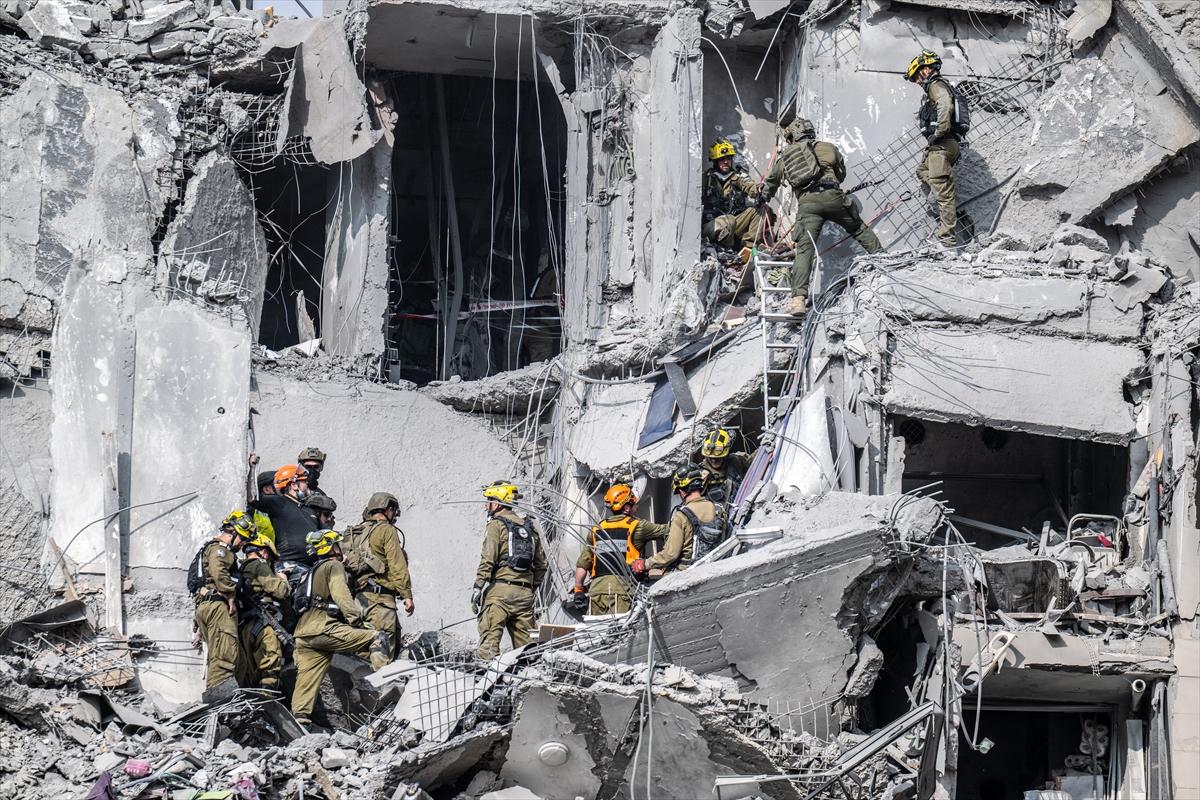
Search and rescue operations in the city of Beersheba, southern Israel, 24 June 2025 – (Anadolu Agency)
A missile launched from Iran directly struck a seven-story building in Beersheba, resulting in the deaths of four people. Israel’s emergency medical service, Magen David Adom, reported that another body was recovered from the rubble. The number of injured was confirmed at 22, with two in serious condition and the rest sustaining minor injuries. Search and rescue operations continued in the area following the missile strikes, with authorities warning that the death toll could rise.
U.S. President Donald Trump announced that a “complete and unconditional” ceasefire had been achieved between Iran and Israel. In a statement posted on social media, Trump indicated that the ceasefire had taken effect in the early morning and urged both sides to “please do not violate it.” He further stated that Iran would initiate the ceasefire first, followed 12 hours later by Israel’s formal adherence to it.
The Israeli government announced that it had accepted the ceasefire proposal put forward by Trump. During a nighttime security meeting chaired by Prime Minister Benjamin Netanyahu, it was assessed that all military objectives against Iran had been fulfilled. The statement claimed that the threat posed by Iran’s nuclear weapons and missile programs had been neutralized and warned that Israel would respond firmly to any violation of the ceasefire.
Iran’s Foreign Minister Abbas Araghchi, in a statement on his social media account, stated that no formal ceasefire agreement was currently in place. However, he indicated that Iran would refrain from further retaliation if Israel halted its attacks by 04:00. Araghchi emphasized that Israel had initiated the war and stated that final decisions would be made at a later time.
Israel reopened its airspace, which had been closed due to Iran’s missile attacks, approximately three hours after the latest strikes. The Israeli military also announced that citizens in northern regions no longer needed to remain in shelters following the most recent missile attacks. It was reported that air defense systems remained active, with sirens still sounding particularly in the Hafya region.
Anadolu Ajansı. "Trump, İsrail ve İran’ın Ateşkes Konusunda Anlaştığını Duyurdu." Accessed June 24, 2025. https://www.aa.com.tr/tr/dunya/trump-israil-ve-iranin-ateskes-konusunda-anlastigini-duyurdu/3610443#
Anadolu Ajansı. “ABD Başkanı Trump: İran-İsrail Ateşkesi Yürürlüğe Girdi, Lütfen İhlal Etmeyin.” Accessed June 24, 2025. https://www.aa.com.tr/tr/dunya/abd-baskani-trump-iran-israil-ateskes-yururluge-girdi-lutfen-ihlal-etmeyin/3610629#
Anadolu Ajansı. “İsrail, Gece Saatlerinde İran’da Füze Rampalarını Vurduğunu Açıkladı.” Accessed June 24, 2025. https://www.aa.com.tr/tr/dunya/israil-gece-saatlerinde-iranda-fuze-rampalarini-vurdugunu-acikladi/3610638#
Anadolu Ajansı. “İsrail, Trump’ın Açıkladığı İran ile Ateşkesi Kabul Ettiğini Duyurdu.” Accessed June 24, 2025. https://www.aa.com.tr/tr/dunya/israil-trumpin-acikladigi-iran-ile-ateskesi-kabul-ettigini-duyurdu/3610682#
On June 25, 2025, the Israeli military announced that it had neutralized two unmanned aerial vehicles (UAVs) believed to have been launched from Iran before they reached Israeli territory. Israeli Army Radio reported that these UAVs may have been dispatched simultaneously with ballistic missiles launched by Iran earlier that morning, prior to the ceasefire taking effect.
Israeli intelligence officials assessed that Iran’s nuclear program was not fully dismantled as a result of Israel’s 12-day campaign and the United States’ operations targeting Iran’s nuclear facilities in Fordo, Natanz and Isfahan. These strikes were said to have set back Iran’s nuclear activities by only a few years. Israeli sources further stated that the objective of these operations was to deter Iran from restarting its uranium enrichment efforts.
Iran’s Permanent Representative to the United Nations, Amir Said Iravani, stated in a speech before the UN Security Council that the expectations of Israel and the United States to end Iran’s nuclear program had failed. Iravani condemned attacks on Iran’s peaceful nuclear program and declared, “Today we are closer to diplomacy than ever before.” He also emphasized that Israel is not a party to the Treaty on the Non-Proliferation of Nuclear Weapons and has evaded International Atomic Energy Agency inspections.
U.S. Acting Alternate Representative to the UN Dorothy Shea, meanwhile, recalled reports from the International Atomic Energy Agency highlighting Iran’s non-compliance with its obligations and affirmed that the United States would not ignore the Iranian threat.
Iranian President Masoud Pezeshkian held telephone conversations with Saudi Crown Prince Mohammed bin Salman, UAE President Sheikh Mohammed bin Zayed Al Nahyan, and Pakistani Prime Minister Shehbaz Sharif. During these talks, Pezeshkian expressed Iran’s readiness to resolve its disputes with the United States within an international framework. Saudi Crown Prince bin Salman stated that his country had consistently condemned Israel’s actions against Iran and underscored that Saudi Arabia and other regional nations had not and would not open their airspace for any military operation against Iran.
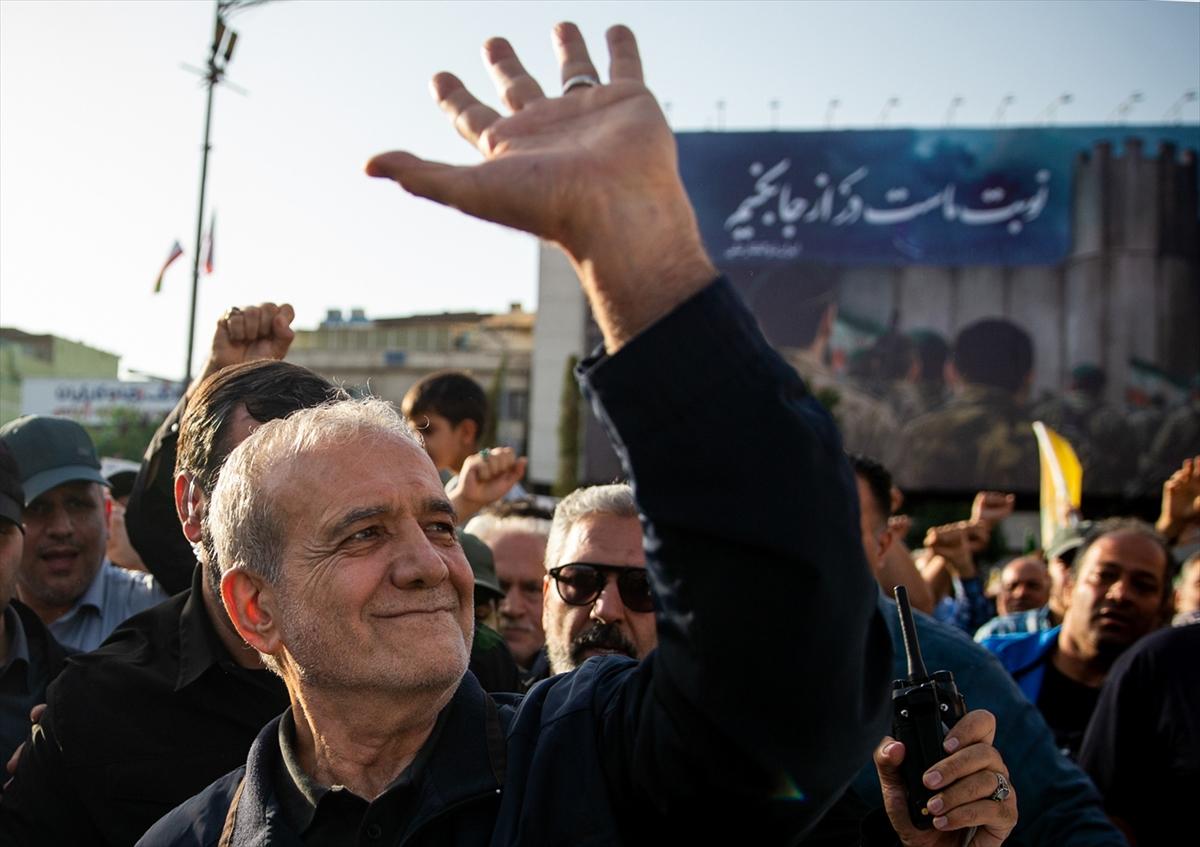
President MasoudPezeshkian among citizens gathered in a public square in Iran, June 22, 2025 – (Anadolu Agency)
UAE President Al Nahyan expressed satisfaction with Pezeshkian’s efforts to engage in dialogue on the basis of good neighborly relations. During the Iran-Pakistan conversation, Pakistani Prime Minister Shehbaz Sharif condemned the attacks by Israel and the United States on Iranian territory.
U.S. President Donald Trump, while in The Hague for the NATO Summit, commented on the strikes against Iran’s nuclear facilities. Trump described the air operation against Iran as “excellent.” He also stated that Israeli fighter jets, after taking off on grounds of violating the ceasefire, had returned to base under his direct orders.
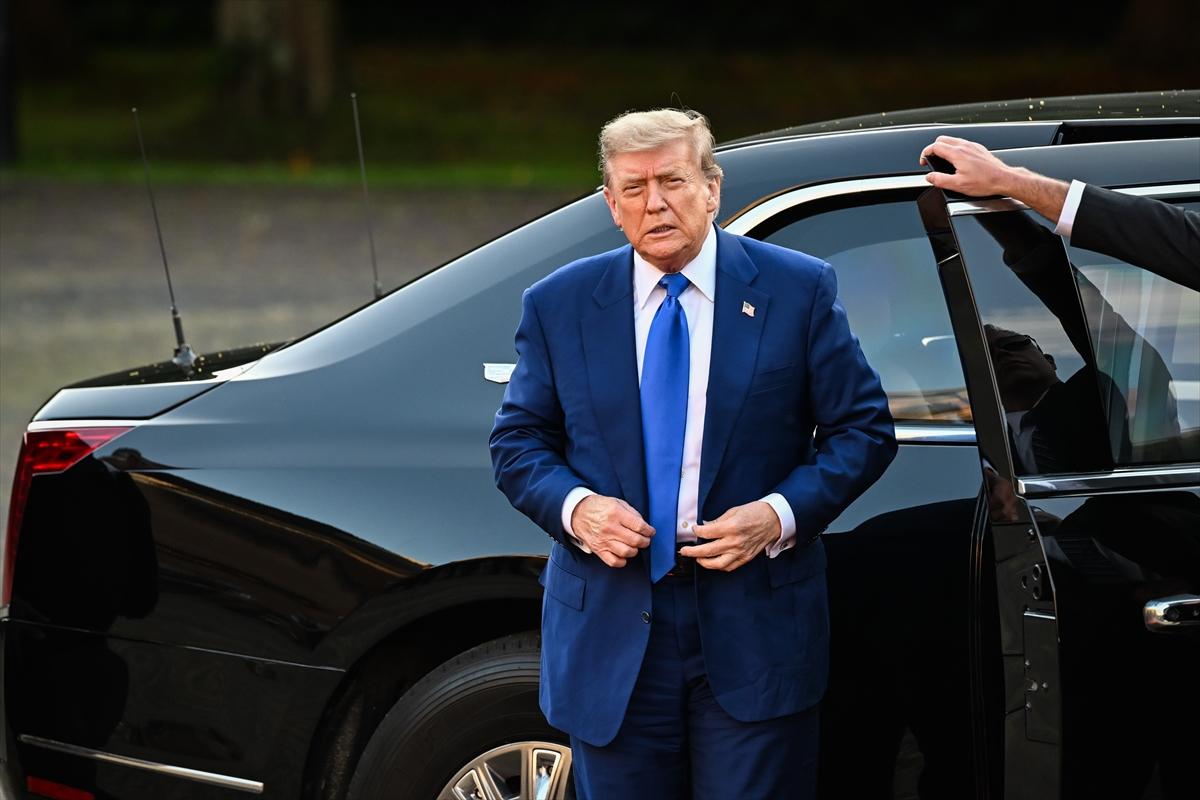
U.S. President Donald Trump, June 24, 2025 – (Anadolu Agency)
The Israeli Home Front Command announced the lifting of nationwide security restrictions that had been in place since June 13 following the ceasefire with Iran. As a result, schools resumed classes, businesses reopened, and bans on public cultural, artistic and sporting events were lifted.
Israeli Transport Minister Miri Regev announced the reopening of Israeli airspace and indicated that international airlines would be encouraged to resume flights to the country. Extended operating hours at Ben Gurion Airport in Tel Aviv are planned.
Public reactions in Tehran to the ceasefire reflected a cautious optimism mixed with skepticism. While some Iranian citizens expressed support for the ceasefire decision, others argued that a genuine ceasefire was impossible unless Israel was completely eliminated. Iranian academic Leyla Chehre, stated that the ceasefire could only be viable through the destruction of Israel. In demonstrations held at Tehran’s Revolution Square, Iranians chanted anti-U.S. and anti-Israel slogans and celebrated what they described as a victory.
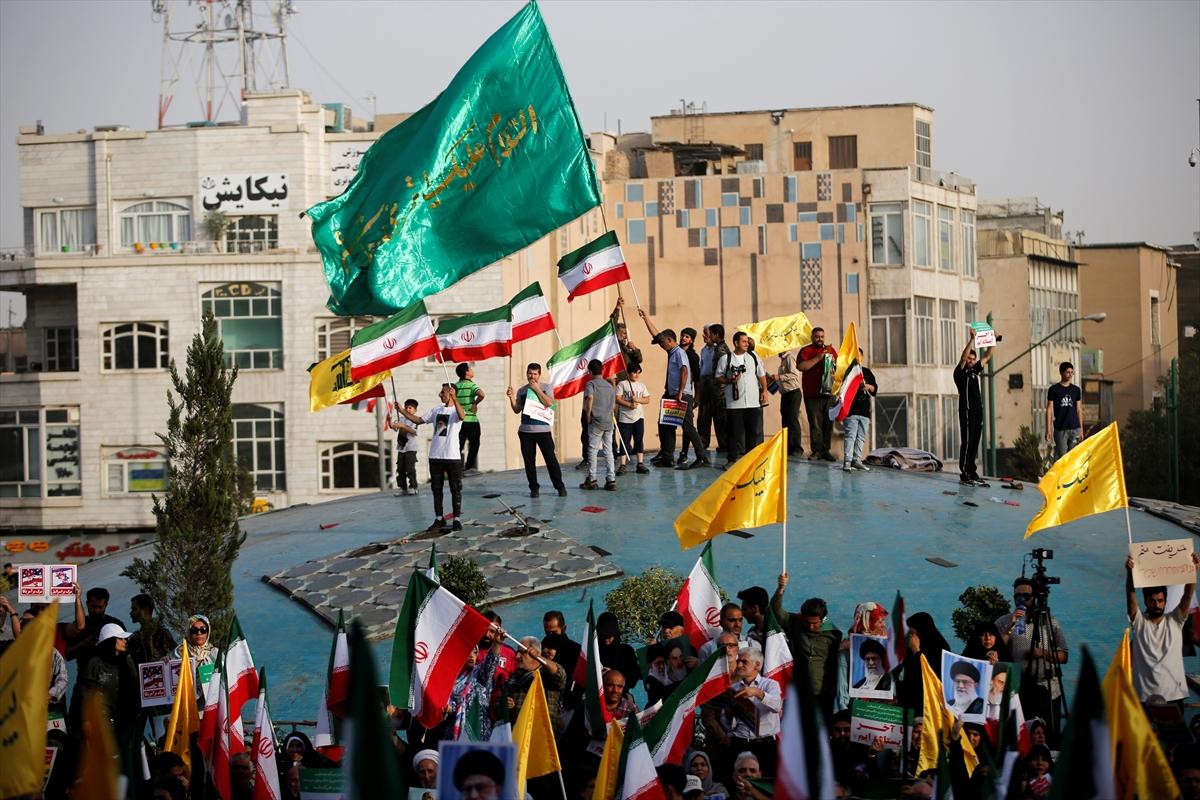
Iranians celebrating a “victory against the U.S. and Israel” following the ceasefire at Revolution Square in Tehran, June 24, 2025 – (Anadolu Agency)
Iranian state news agencies published footage showing Quds Force Commander Major General Ismail Qaani participating in the demonstrations in Tehran, despite earlier reports claiming he had been killed in Israeli strikes.
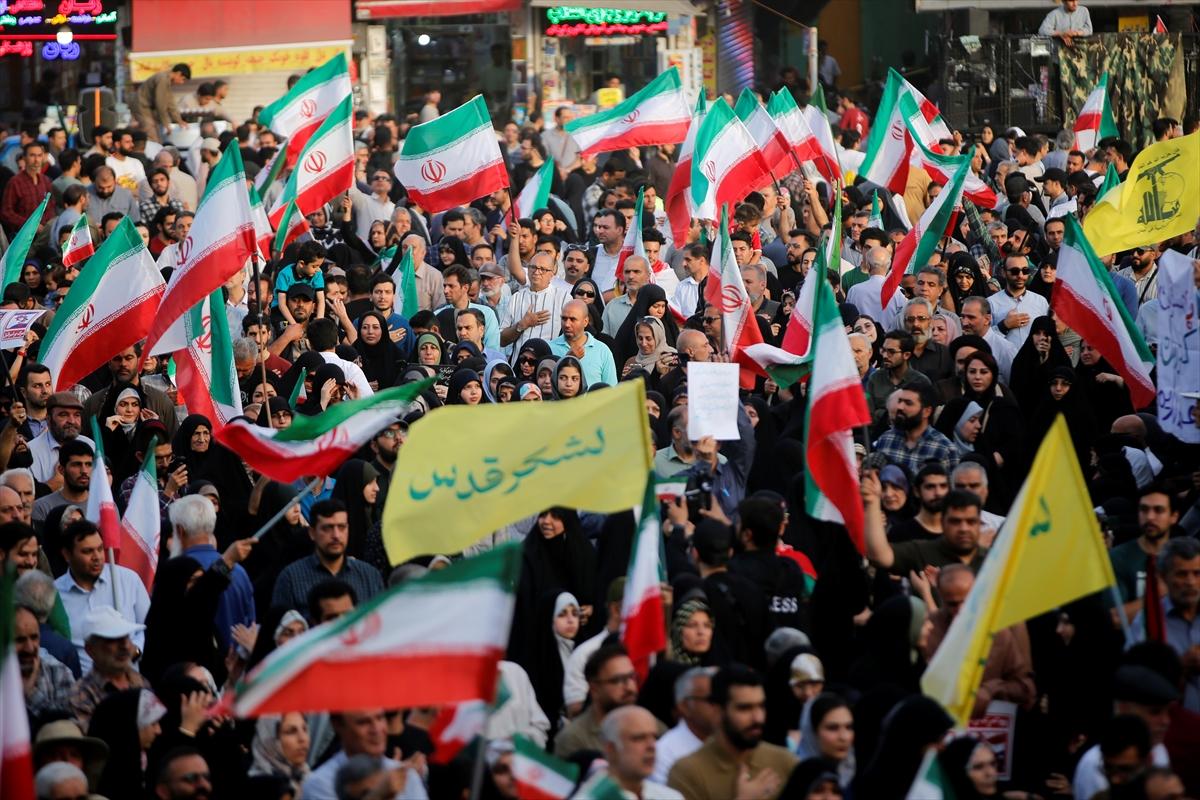
Iranians celebrating a “victory against the U.S. and Israel” following the ceasefire at Revolution Square in Tehran, June 24, 2025 – (Anadolu Agency)
Approximately 39,000 compensation claims have been filed in Israel for material damage caused by Iranian missile attacks. Of these, 30,809 relate to building damage, 3,713 to vehicle damage, and 4,085 to equipment loss. Heavy concentrations of claims were reported from Tel Aviv and Ashkelon.
According to earlier reports by Israeli Channel 7 television, approximately 10,630 people were evacuated from their homes due to Iranian missile strikes.
Anadolu Ajansı. “ABD Başkanı Trump: İran Nükleer Tesislerine Operasyon ‘Mükemmeldi.’” Accessed June 25, 2025. https://www.aa.com.tr/tr/dunya/abd-baskani-trump-iran-nukleer-tesislerine-operasyon-mukemmeldi/3612394#
Anadolu Ajansı. “İran Cumhurbaşkanı Pezeşkiyan: ABD ile Meseleleri Uluslararası Çerçeve Temelinde Çözmeye Hazırız.” Accessed June 25, 2025. https://www.aa.com.tr/tr/dunya/iran-cumhurbaskani-pezeskiyan-abd-ile-meseleleri-uluslararasi-cerceve-temelinde-cozmeye-haziriz/3611851#
Anadolu Ajansı. “İran: Bugün Diplomasiye Her Zamankinden Daha Yakınız.” Accessed June 25, 2025. https://www.aa.com.tr/tr/-haberici/iran-bugun-diplomasiye-her-zamankinden-daha-yakiniz/3612033#
Anadolu Ajansı. “İranlılar, Tahran’daki İnkılap Meydanında Ateşkes Sonrası ABD ve İsrail’e Karşı Zafer Kutlaması Yaptı.” Accessed June 25, 2025. https://www.aa.com.tr/tr/dunya/iranlilar-tahrandaki-inkilap-meydaninda-ateskes-sonrasi-abd-ve-israile-karsi-zafer-kutlamasi-yapti/3611789#
Anadolu Ajansı. “İsrail Ordusu, Ateşkesin Ardından Ülke Genelindeki Kısıtlamaları Kaldırdı.” Accessed June 25, 2025. https://www.aa.com.tr/tr/dunya/israil-ordusu-ateskesin-ardindan-ulke-genelindeki-kisitlamalari-kaldirdi/3611857#
Anadolu Ajansı. “İsrail, İran’dan Gönderildiğini Öne Sürdüğü 2 İHA’yı Düşürdüğünü İddia Etti.” Accessed June 25, 2025. https://www.aa.com.tr/tr/dunya/israil-irandan-gonderildigini-one-surdugu-2-ihayi-dusurdugunu-iddia-etti-/3612042#
Anadolu Ajansı. “İsrail’de İran’ın Misilleme Saldırıları Nedeniyle Yaklaşık 39 Bin Hasar Tazminat Başvurusu Yapıldı.” Accessed June 25, 2025. https://www.aa.com.tr/tr/dunya/israil-de-iran-in-misilleme-saldirilari-nedeniyle-yaklasik-39-bin-hasar-tazminat-basvurusu-yapildi/3611877#
Anadolu Ajansı. “İsrail’in Başlattığı ve ABD’nin Dahil Olduğu İran’a Saldırılar Ateşkesle Sonuçlandı.” Accessed June 25, 2025. https://www.aa.com.tr/tr/dunya/israilin-baslattigi-ve-abdnin-dahil-oldugu-irana-saldirilar-ateskesle-sonuclandi/3611754#
Al Jazeera. “Israel-Iran Conflict: List of Key Events (June 15, 2025).” Accessed June 25, 2025. https://www.aljazeera.com/news/2025/6/15/israel-iran-conflict-list-of-key-events-june-15-2025.
Al Jazeera. “Israel-Iran Conflict: List of Key Events (June 16, 2025).” Accessed June 25, 2025. https://www.aljazeera.com/news/2025/6/16/israel-iran-conflict-list-of-key-events-june-16-2025.
Al Jazeera. “Israel-Iran Conflict: List of Key Events (June 17, 2025).” Accessed June 25, 2025. https://www.aljazeera.com/news/2025/6/17/israel-iran-conflict-list-of-key-events-june-17-2025.
Al Jazeera. “Israel-Iran Conflict: List of Key Events (June 18, 2025).” Accessed June 25, 2025. https://www.aljazeera.com/news/2025/6/18/israel-iran-conflict-list-of-key-events-june-18-2025.
Al Jazeera. “Israel-Iran Conflict: List of Key Events (June 19, 2025).” Al Jazeera. Accessed June 25, 2025. https://www.aljazeera.com/news/2025/6/19/israel-iran-conflict-list-of-key-events-june-19-2025.
Al Jazeera. “Israel-Iran Conflict: List of Key Events (June 20, 2025).” Accessed June 25, 2025. https://www.aljazeera.com/news/2025/6/20/israel-iran-conflict-list-of-key-events-june-20-2025.
Al Jazeera. “Israel-Iran Conflict: List of Key Events (June 21, 2025).” Accessed June 25, 2025. https://www.aljazeera.com/news/2025/6/21/israel-iran-conflict-list-of-key-events-june-21-2025.
Al Jazeera. “Israel-Iran Conflict: List of Key Events (June 22, 2025).” Accessed June 25, 2025. https://www.aljazeera.com/news/2025/6/22/israel-iran-conflict-list-of-key-events-june-22-2025.
Al Jazeera. “Israel-Iran Conflict: List of Key Events (June 23, 2025).” Accessed June 25, 2025. https://www.aljazeera.com/news/2025/6/23/israel-iran-conflict-list-of-key-events-june-23-2025.
Al Jazeera. “Israel-Iran Conflict: List of Key Events (June 24, 2025).” Accessed June 25, 2025. https://www.aljazeera.com/news/2025/6/24/us-israel-iran-conflict-list-of-key-events-june-24-2025.
Anadolu Ajansı. “İsrail-İran Çatışmasındaki Son Durum (23 Haziran 2025).” Anadolu Ajansı Infographic. Accessed June 25, 2025. https://www.aa.com.tr/tr/info/infografik/46643.
Anadolu Ajansı. “İsrail-İran Çatışmasındaki Son Durum (24 Haziran 2025).” Anadolu Ajansı Infographic. Accessed June 25, 2025. https://www.aa.com.tr/tr/info/infografik/46665.
USA Today. “Israel-Iran Timeline, Maps, Graphics.” Accessed June 25, 2025. https://www.usatoday.com/story/graphics/2025/06/17/israel-iran-timeline-maps-graphics/84240285007/.
Xinhua. “List of Key Events in Ongoing Israel-Iran Conflict.” Accessed June 25, 2025. https://english.news.cn/20250625/da57ea401a194463824ddf749973923a/c.html.
On 26 June 2025, Iran’s leader Ayatollah Ali Khamenei addressed the public through a video message broadcast on state television. This message marked the third video statement issued by Khamenei since the commencement of Israel’s attacks. In his address, Khamenei characterized the outcomes achieved against Israel as a “victory.” The statement claimed that Israel had been brought to the brink of collapse and had entered a process of disintegration as a result of Iran’s strikes.
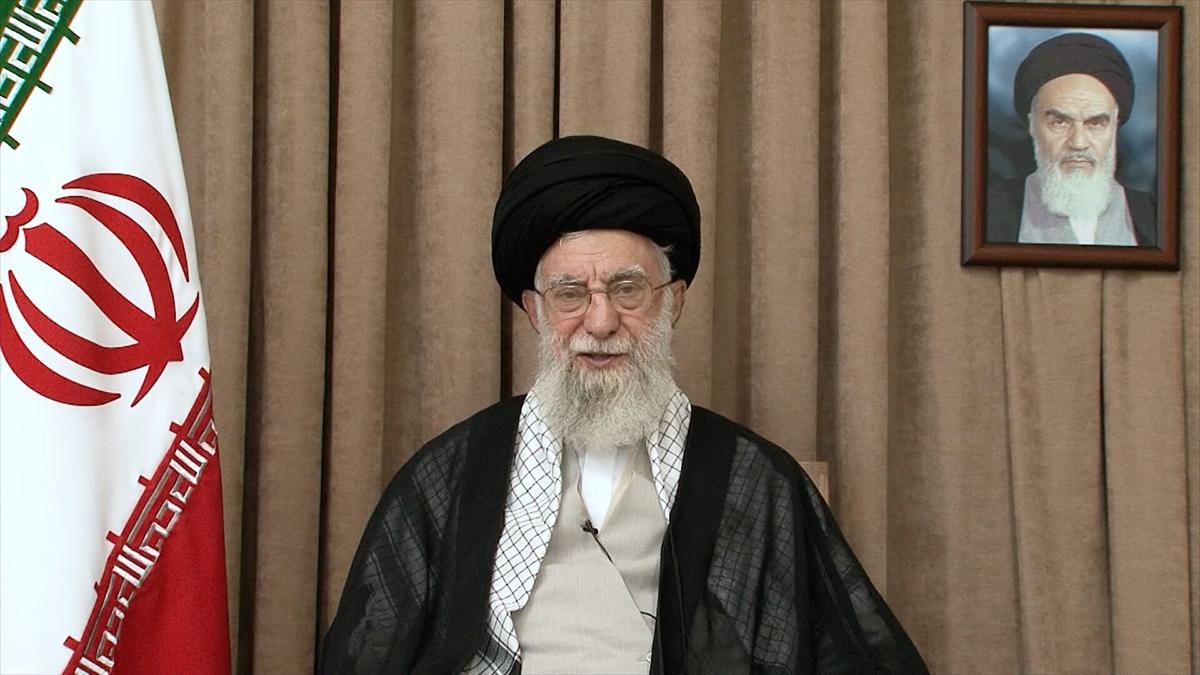
Iran’s leader Ayatollah Ali Khamenei – (Anadolu Ajansı)
Khamenei asserted that the United States had directly entered the conflict in an attempt to rescue Israel and emphasized that the U.S. had gained no strategic advantage from its attack on Iran’s nuclear facilities. He stated that the U.S. air strikes targeting facilities in Fordo, Natanz and Isfahan would be brought before international courts and that the attack would be held accountable before international tribunals.
Khamenei also confirmed that Iran had carried out a military reprisal against the United States, specifically targeting the Al Udeid Air Base in Qatar. Describing this strike as a “significant blow,” Khamenei stressed that Iran would respond to any future attack against it by repeatedly targeting U.S. bases. In his remarks, he stated, “The Islamic Republic has won and delivered a heavy slap to America.”
Anadolu Ajansı. “Hamaney: Bize Yönelik Saldırılara ABD Üslerini Tekrar Hedef Alarak Yanıt Vereceğiz.” Accessed June 26, 2025. https://www.aa.com.tr/tr/dunya/hamaney-bize-yonelik-saldirilara-abd-uslerini-tekrar-hedef-alarak-yanit-verecegiz/3614154.
On 28 June 2025, mass funeral ceremonies were held in Tehran for Iranian senior military officials, nuclear scientists, and civilians killed in Israeli attacks beginning on 13 June 2025. The ceremonies began in the morning with funeral prayers held at the campus of Tehran University. Numerous government officials, including Iranian President Masoud Pezeshkian, attended the event.
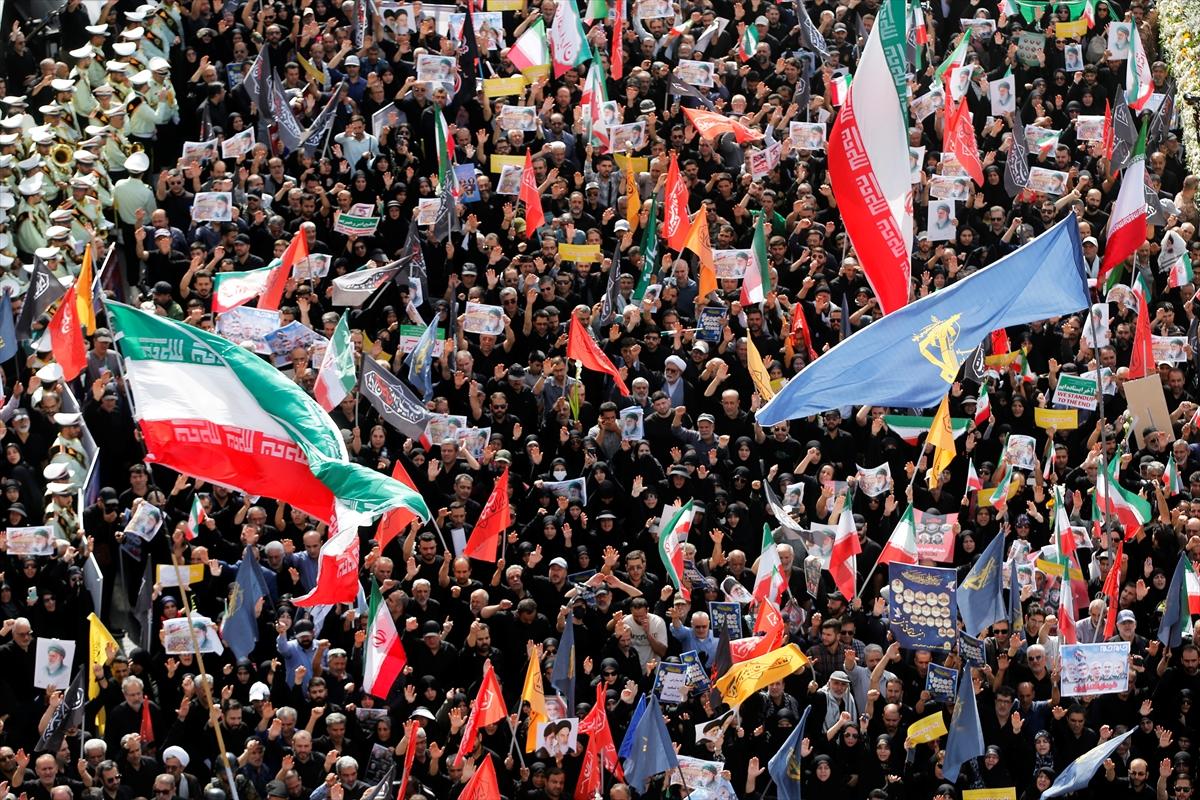
Funeral ceremonies held in Tehran for officials and scientists killed in Israeli attacks, 28 June 2025 – (Anadolu Agency)
A large crowd gathered at the funeral site recited prayers, chanted elegies, and shouted slogans against the United States and Israel, holding Iranian flags and black mourning banners. Among those reported to have been present were Major General Ismail Qaani, commander of the Quds Force of the Islamic Revolutionary Guard Corps, who was previously alleged to have been killed, and Ali Shemhani, former head of the Supreme National Security Council and advisor to Iran’s Supreme Leader Ayatollah Ali Khamenei.
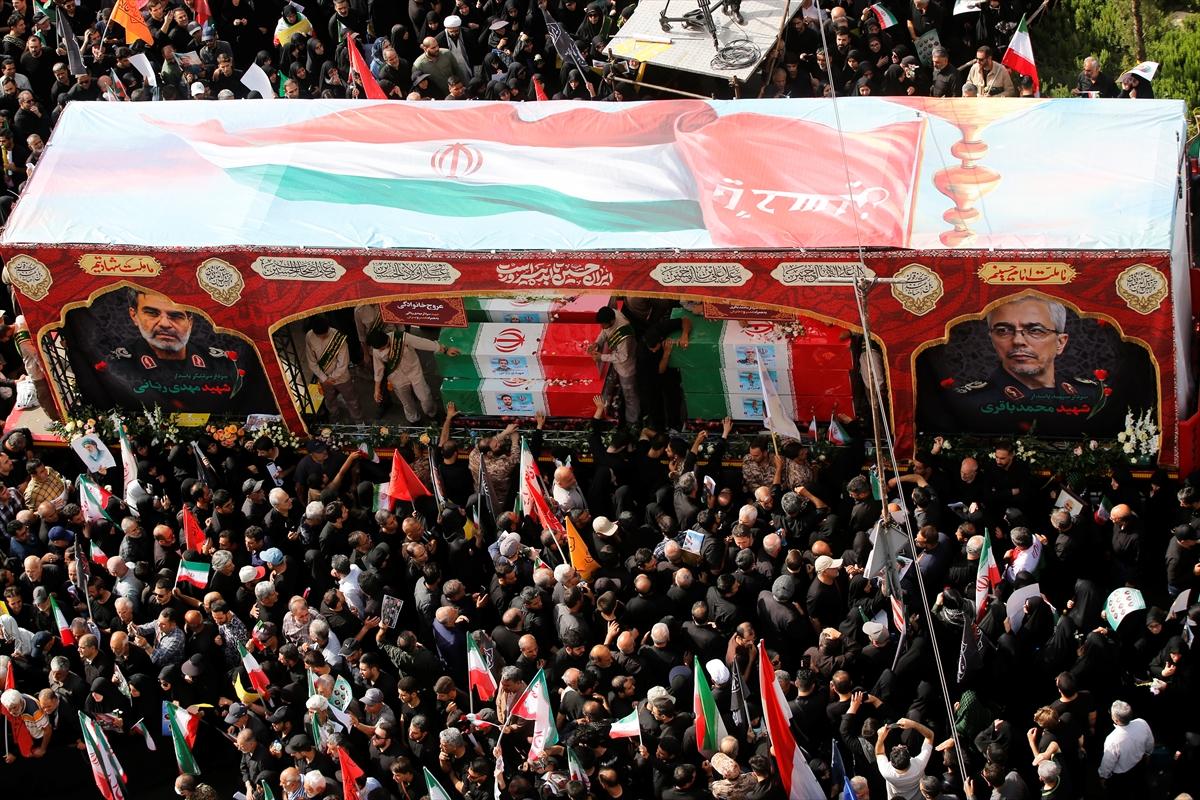
Funeral ceremonies held in Tehran for officials and scientists killed in Israeli attacks, 28 June 2025 – (Anadolu Agency)
After the ceremonies, the coffins were carried in a public procession from Revolution Square to Azadi Square. Some of the funerals were held in Tehran, while others took place in different cities across the country.
Anadolu Ajansı. “İsrail'in Saldırılarında Hayatını Kaybeden Yetkililer ve Bilim İnsanları İçin Tahran'da Cenaze Törenleri Düzenlendi.” Accessed June 30, 2025. https://www.aa.com.tr/tr/dunya/israil-in-saldirilarinda-hayatini-kaybeden-yetkililer-ve-bilim-insanlari-icin-tahran-da-cenaze-torenleri-duzenlendi/3615879#

On 13 June 2025 tensions escalated as Israel launched large-scale aerial strikes against Iran’s nuclear and military infrastructure under the operation name “Rising Lion.” Critical targets including the Natanz nuclear facility the Parchin military site and command complexes in Tehran were hit; senior officials such as Chief of Staff of the Iranian Armed Forces Mohammad Bagheri and Commander of the Islamic Revolutionary Guard Corps Hossein Salami along with nuclear scientists lost their lives. In retaliation for Israel’s strikes Iran launched attacks on Israeli cities including Tel Aviv Haifa and Dimona using hundreds of unmanned aerial vehicles and ballistic missiles. As clashes continued the United States announced it had conducted aerial strikes on Iran’s nuclear facilities in Fordo Natanz and Isfahan under an operation named “Midnight Attractor.” In response to these U.S. strikes Iran declared it had launched missile attacks on the Al Udeid Air Base in Qatar and several U.S. bases in Iraq on 23 June. On 24 June U.S. President Donald Trump announced that a ceasefire had been agreed upon between Israel and Iran.
No Discussion Added Yet
Start discussion for "Israel-Iran Conflict (2025)" article
June 13, 2025
Timing and Scope of the Attack
June 13, 2025
Targeted Facilities and Command Structures
June 13, 2025
Killed and Injured Senior Officials
June 13, 2025
Civilian Impact of the Attack
June 13, 2025
Iran’s Response and Retaliation Process
June 13, 2025
Iran’s Ballistic Missile Attacks (Retaliation Phase)
June 13, 2025
International Reactions and Diplomatic Discussions
June 13, 2025
European Trio (Germany-France-United Kingdom) Negotiation Proposal
June 13, 2025
Türkiye’s Diplomatic Engagement and Regional Mediation Efforts
June 13, 2025
Iran’s Diplomatic Initiatives
June 13, 2025
Pressure on China from Israel and the United States
June 13, 2025
Energy Markets and Economic Impacts
June 13, 2025
U.S.-Israel Coordination and Military Planning
June 14, 2025
Airspace and Aviation Security
June 14, 2025
Israel’s Security and Military Measures
June 14, 2025
Background to Iran-Israel Tensions
June 14, 2025
Mutual Military Preparations by Iran and Israel
June 16, 2025
New Military Preparations After June 14
June 16, 2025
New Attacks and Losses (June 15, 2025)
June 16, 2025
Chronology of the Iran-Israel Conflict (June 13–15, 2025)
June 17, 2025
Missile Attacks, Counteroperations, and Security Measures (16 June 2025)
June 17, 2025
US President Trump’s Warnings and Evacuation Call
June 17, 2025
Netanyahu’s Statements Directed at Khamenei
June 17, 2025
Pentagon and White House Crisis Management Meetings
June 17, 2025
Iran’s New Attacks (17 June 2025)
June 18, 2025
Mutual Attacks and Current Situation on June 17, 2025
June 18, 2025
Statements and Threat Assessment by U.S. President Trump
June 18, 2025
Status of Nuclear Facilities
June 18, 2025
Current Status as of 18 June 2025
June 18, 2025
New Statements by U.S. President Trump
June 19, 2025
Developments of 19 June 2025
June 20, 2025
Developments of 20 June 2025
June 22, 2025
Developments of June 21, 2025
June 22, 2025
Developments of June 22, 2025
June 23, 2025
International Reactions and Diplomatic Statements Against the U.S. Attack
June 23, 2025
Developments of 23 June 2025
June 23, 2025
Iran’s Missile Strike on U.S. Military Bases
June 24, 2025
Developments of 24 June 2025
June 25, 2025
Developments Following the Ceasefire (June 24–25, 2025)
June 25, 2025
Iran-Israel Conflict (2025) – Chronology of Military and Diplomatic Developments from June 13 to 25
June 26, 2025
Statements by Iran’s Leader Ayatollah Ali Khamenei
June 30, 2025
Mass Funeral Ceremonies Held in Tehran (28 June 2025)