


This article was automatically translated from the original Turkish version.
+1 More
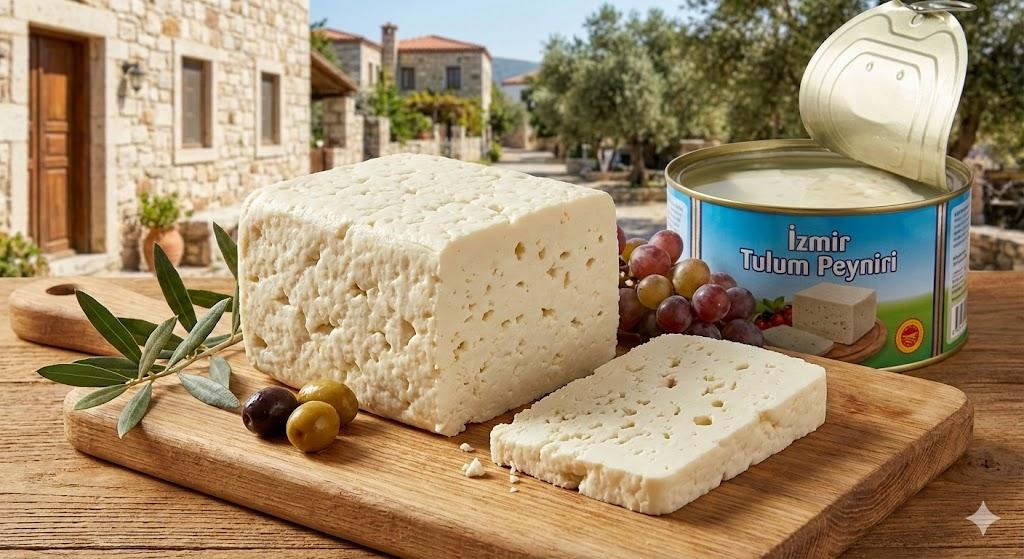
Izmir Tulum Cheese (Generated by Artificial Intelligence.)
Registration Number | 1006 | ||||||||
|---|---|---|---|---|---|---|---|---|---|
Registration Date | 24.01.2022 | ||||||||
Applicant/Registrant(s) | İzmir Chamber of Commerce | ||||||||
Registration Status | Geographical Indication | ||||||||
Product Name | Cheese | ||||||||
Origin(s) | Aydın İzmir and Manisa provinces Balıkesir | ||||||||
Izmir Tulum Cheese is a brined cheese variety produced in the Aegean Region, specifically in the provinces of İzmir, Aydın, Manisa, and Balıkesir. It is recognized by its semi-hard texture, porous structure, and distinctive aroma. Unlike traditional cheeses stored in animal hide sacks, İzmir tulum cheese is distinguished by its production process, which involves aging in tin containers submerged in brine. It was officially registered in 2022 by the Turkish Patent and Trademark Office with the designation “Geographical Indication”.【1】

Izmir Tulum Cheese (Ministry of Culture and Tourism of the Republic of Türkiye)
The production zone, as officially registered by the Turkish Patent and Trademark Office, encompasses the provinces of İzmir, Aydın, Manisa, and Balıkesir. This cheese is regarded as one of the most widespread and economically significant dairy products of the Aegean Region. Historical analysis reveals a direct connection between this cheese type and the nomadic Yörük culture of Anatolia. The tradition of storing milk in animal hide sacks (tulum) to enhance its durability, developed in an era before refrigeration, gradually evolved with the transition to settled life and increasing demands for commercial production.
Leather tulum sacks traditionally used in production have largely been replaced by tin containers today. Although a distinction has emerged among the public between “Leather Tulum” and “Tin Tulum,” in literature and commercial practice, İzmir tulum cheese is predominantly associated with the form aged in tin containers within brine.
The most defining characteristic of İzmir tulum cheese is the type and proportion of milk used in its production. The milk must be sourced from animals raised within the designated geographical boundaries. The milk blend used in the product composition is as follows:
These ratios are the fundamental factor determining the cheese’s characteristic flavor and texture. The accuracy of these proportions is scientifically verified during quality control using ELISA and DNA-based analytical methods (Real Time PCR).【2】
The cheese-making process begins with pasteurization of the milk and fermentation at controlled temperatures. The coagulated milk (curd) is then pressed to separate the whey. The pressed curd is broken into pieces and dry-salted. The key distinction between İzmir tulum cheese and other tulum cheeses lies in its aging technique. The salted cheese is placed in tin containers and covered with brine, sealed tightly to exclude air. This method enables the cheese to mature within the brine, developing its unique texture.
While industrial production typically employs standardized starter cultures, research has demonstrated that the use of traditional “whey culture” significantly influences cheese quality. The use of whey culture positively affects protein development (proteolysis), texture, and sensory properties, contributing to the preservation of the traditional aroma.
Izmir tulum cheese is classified as a “semi-hard” cheese based on its physical structure. The most prominent physical feature of a high-quality İzmir tulum cheese is its porous surface when cut. According to the technical standards specified in the registration document, these pores must have a diameter ranging between 50 and 100 µm (micrometers) and exhibit a uniform distribution across the cheese block.【3】 The color of the cheese may vary from porcelain white to cream, depending on the type of milk used (sheep, goat, cow) and seasonal variations; however, it is expected to conform to the Hunter color scale.
Sensorially, İzmir tulum cheese possesses a distinctive aromatic and sharp profile. Its taste is described in literature as “bitter”. This characteristic flavor results from the fat content of the milk, salting technique, and the proteolysis (protein breakdown) and lipolysis (fat breakdown) processes that occur during a minimum aging period of three to four months. Scientific studies have found that using “whey culture” in production affects the cheese’s hardness and gumminess values, and enhances aroma intensity in sensory panels, yielding results closer to the traditional flavor.
Izmir tulum cheese is one of the foundational elements of Aegean culinary culture and is considered a “key attraction” in the region’s gastronomic tourism potential. Particularly in İzmir’s districts of Bergama, Ödemiş, Tire, Karaburun, Seferihisar, Urla, Menemen, Foça, Çeşme, and Dikili, traditional production and consumption of this cheese are especially prominent.
Examination of consumption habits reveals that the cheese is not limited to breakfast tables. In regional cuisine, it is widely used in salads, pasta, pizza, sandwiches, and various pastry dishes (börek, boyoz, etc.). Additionally, in Aegean gastronomy, it is commonly served alongside melon and watermelon, becoming an integral part of the meze culture.
Dağ, Tuğba, and Keskin, Emrah. "Geleneksel Peynirlerin Gastronomi Turizmi Açısından Değerlendirilmesi: İzmir Örneği." *Türk Turizm Araştırmaları Dergisi* 5, no. 4 (2021): 2630-2652. Accessed December 30, 2025. https://doi.org/10.26677/TR1010.2021.890v
T.C. Ministry of Culture and Tourism. "İzmir İl Peyniri." İzmir Provincial Directorate of Culture and Tourism. Accessed December 30, 2025. https://izmir.ktb.gov.tr/TR-311031/izmir-tulum-peyniri.html
Tulukoğlu, Gizem Başak., Akan, Ecem., and Kınık, Özer. "İzmir Tulum Peyniri Üretiminde Peynir Altı Suyu Kültürü Kullanımı." *Ege Üniversitesi Ziraat Fakültesi Dergisi* 57, no. 3 (2020): 441–453. Accessed December 30, 2025. https://doi.org/10.20289/zfdergi.644194
Turk Patent and Trademark Office. "İzmir Tulum Peyniri Coğrafi İşaret Sicil Belgesi." *Coğrafi İşaretler Portalı.* Accessed December 30, 2025. https://ci.turkpatent.gov.tr/Files/GeographicalSigns/72664144-0b52-48f1-b84c-52fa9c4edf8e.pdf
[1]
Türk Patent ve Marka Kurumu, "İzmir Tulum Peyniri Coğrafi İşaret Sicil Belgesi," Coğrafi İşaretler Portalı, syf 2, https://ci.turkpatent.gov.tr/Files/GeographicalSigns/72664144-0b52-48f1-b84c-52fa9c4edf8e.pdf
[2]
A.e., syf 2.
[3]
A.e., syf 5.

Izmir Tulum Cheese (Generated by Artificial Intelligence.)
Registration Number | 1006 | ||||||||
|---|---|---|---|---|---|---|---|---|---|
Registration Date | 24.01.2022 | ||||||||
Applicant/Registrant(s) | İzmir Chamber of Commerce | ||||||||
Registration Status | Geographical Indication | ||||||||
Product Name | Cheese | ||||||||
Origin(s) | Aydın İzmir and Manisa provinces Balıkesir | ||||||||
Geographical Distribution and Origin
Raw Materials and Milk Composition
Production Method
Physical and Sensory Characteristics
Cultural Significance and Consumption