


This article was automatically translated from the original Turkish version.
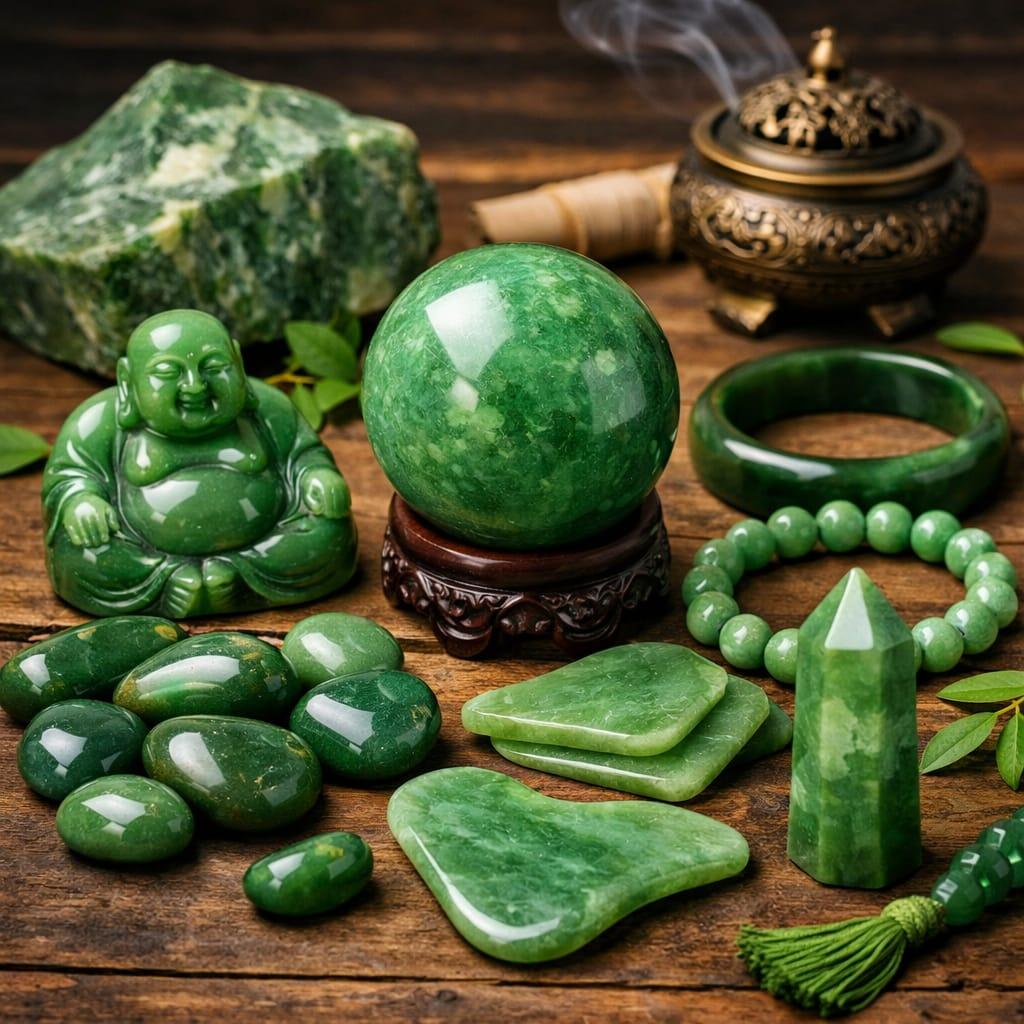
Yeşim Taşı (Yapay zeka tarafından oluşturulmuştur)
Jade is a precious stone that encompasses two distinct mineral groups and has been used throughout history both as ornamental objects and as cultural and symbolic artifacts. These two groups consist of nephrite and jadeite minerals, which differ in their chemical and physical properties. Due to its hardness, durability, and workability, jade has found diverse applications in many cultures, especially in Asia.
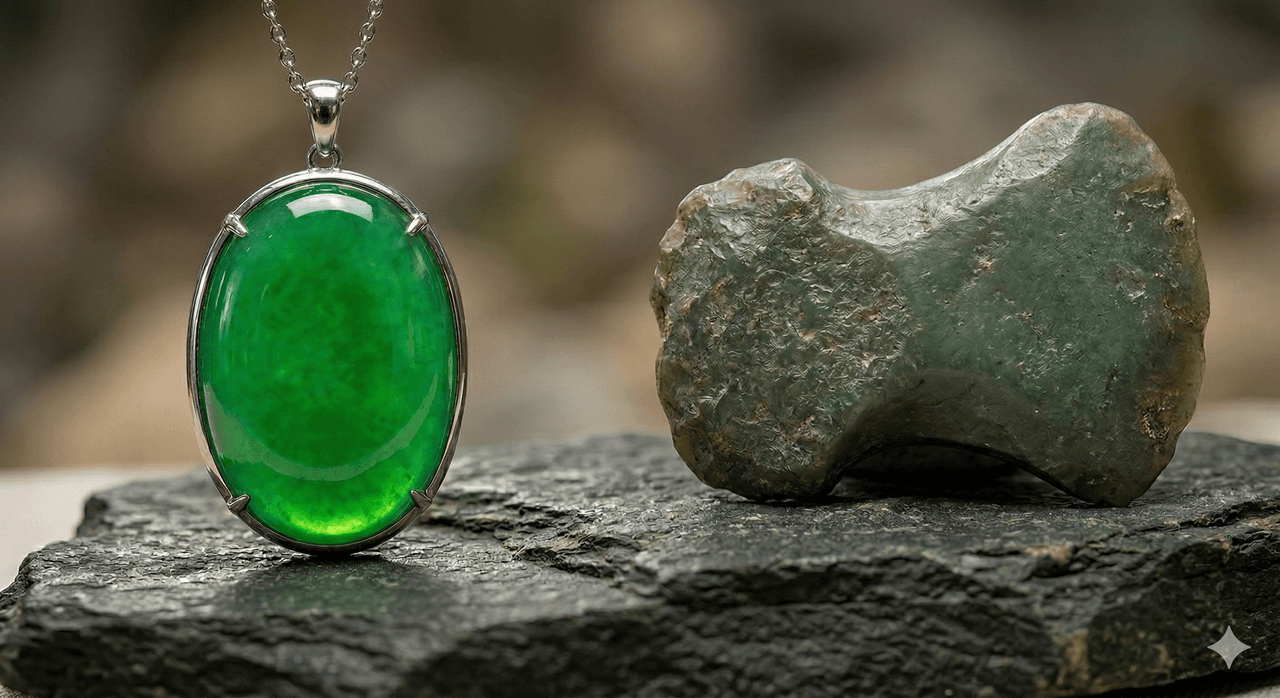
Jade stone (generated by artificial intelligence)
Jade consists of two distinct mineral types differing in chemical composition and crystal structure:
Jadeite is a sodium aluminum silicate with the chemical formula NaAlSi2O6.
Nephrite is a calcium magnesium iron silicate with the formula Ca2(Mg,Fe)5Si8O22(OH)2.
Jade stones typically form under conditions of high pressure and low temperature, commonly observed in regions with metamorphic rocks. Nephrite is mostly associated with serpentinite rocks, while jadeite forms primarily in high-pressure metamorphic environments.
Significant jade deposits are found across various regions worldwide. These deposits originated during different stages of geological processes and exhibit distinct geographic distributions depending on the type of mineral.
Jade has been regarded not merely as an ornamental material but also as a spiritual protector and a cosmological symbol across world civilizations.
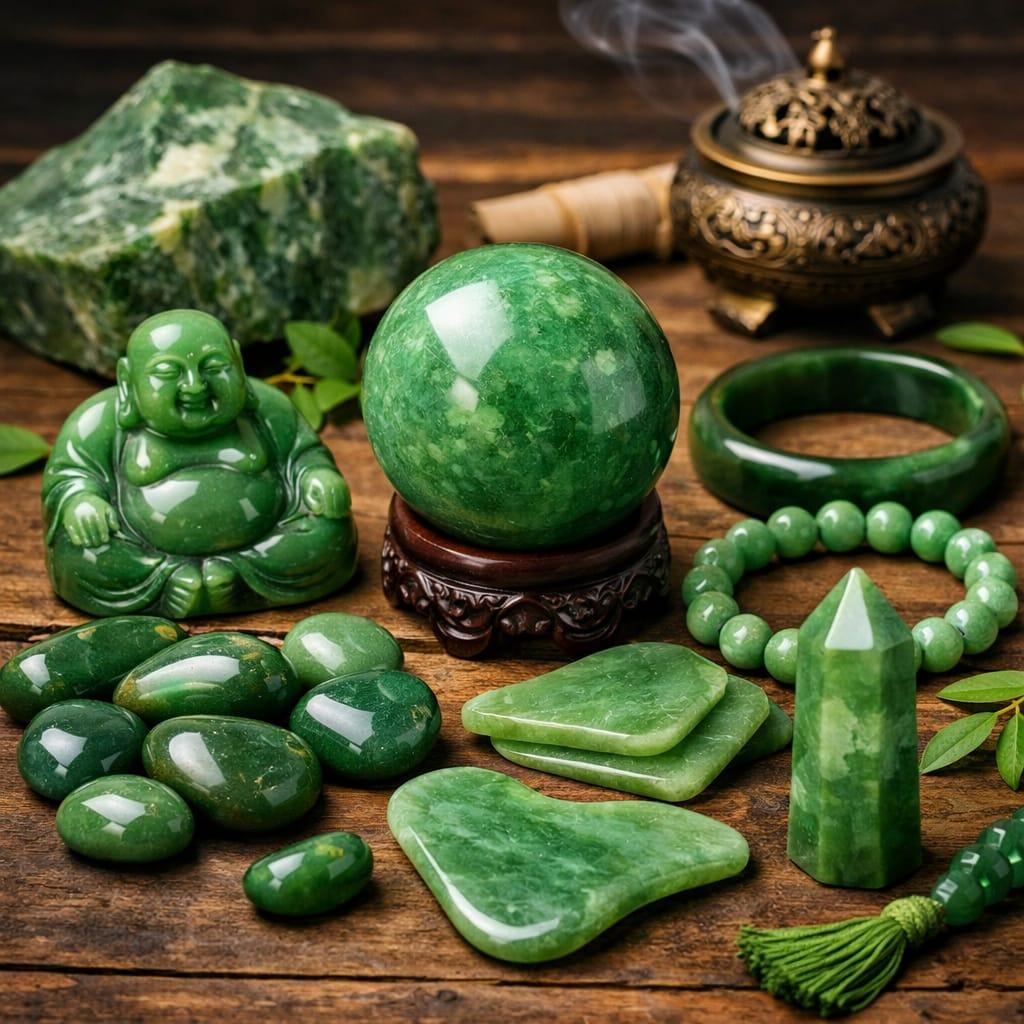
Jade stone (generated by artificial intelligence)
In Chinese culture, jade has historically held profound symbolic value. It has been associated with concepts such as purity, virtue, and immortality. Within Chinese philosophical systems, jade is regarded as an embodiment of moral values.
The value of jade is determined by the intensity of its color, the smoothness of its texture, and its interaction with light (translucency). Although commonly known for its green tones, jade also occurs in lavender, black, white, yellow, and orange hues. Due to its opaque nature, it is typically cut as cabochons or fashioned into thin-walled vessels and filigree figures. In the gemstone market, natural jade is classified as Type A, jade treated with chemical processes as Type B, and dyed jade as Type C.
Accessed November 26, 2025. https://www.aa.com.tr/tr/kultur/ahlatta-acilan-kurslarla-geleneksel-tas-isciligi-yasatiliyor/3116279.
Aydın, Fatma. "Divan Şiirinin Yeşil Mücevherleri: Yeşim, Zebercet ve Zümrüt." *TURAS no. 2* (December 2022). Accessed March 22, 2026. https://dergipark.org.tr/tr/download/article-file/2728324
Bulut, Funda, and Şahin Şimşek. "Çocuk Edebiyatı Eserlerinde Mitik Görünüm: Yeşim Taşı Efsanesi Gizemli Kitap" Örneği. *RumeliDE Dil ve Edebiyat Araştırmaları Dergisi*, no. 31 (December 2022): 462-503. Accessed March 22, 2026. https://dergipark.org.tr/en/download/article-file/2604498
Ceylan, Ertuğrul. "Çin Kültüründe Yeşim Taşı." DTCF Dergisi 65.2 (2025). Accessed March 22, 2026.
Gemological Institute of America (GIA). "Jade." *GIA Gem Encyclopedia*. Accessed March 22, 2026. https://www.gia.edu/jade
International Colored Gemstone Association (ICA). "Jade." *Gem by Gem: ICA Resources*. Accessed March 22, 2026. https://www.gemstone.org/jade

Yeşim Taşı (Yapay zeka tarafından oluşturulmuştur)
Mineralogical Structure and Physical Properties
Jadeite
Nephrite
Formation and Deposits
Historical and Cultural Symbolism
Asian Cosmology and Alchemy
Jade in Chinese Culture
Turkish Culture and Literature
America and Other Civilizations
Value Assessment and Processing