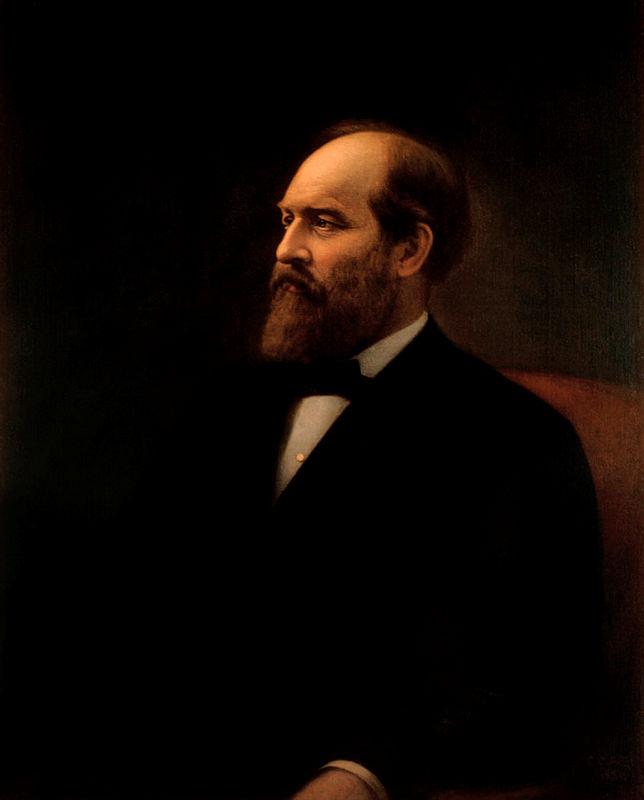
Doğum tarihi | 1831-11-19 | ||||||||
|---|---|---|---|---|---|---|---|---|---|
Eş | Lucretia Rudolph Garfield (m. 1858 – d. 1918) | ||||||||
Place of Birth | Moreland Hills, Ohio, USA | ||||||||
Ölüm tarihi | 1881-09-19 | ||||||||
Place of Death | Iberon, New Jersey, USA | ||||||||
Parents | Abram Garfield, Eliza Ballou Garfield | ||||||||
Presidential Order | 20th President of the United States (1881) | ||||||||
James Abram Garfield was born on November 19, 1831, in the town of Moreland Hills, Cuyahoga County, Ohio. He was the youngest of five children. His father, Abram Garfield, died when James was only eighteen months old. His mother, Eliza Ballou Garfield, raised the children alone. From a young age, he worked in jobs such as canal boat pilot, but remained determined to continue his education. He first attended Geauga Seminary, then transferred to the Western Reserve Eclectic Institute (now Hiram College), and later to Williams College in Massachusetts, from which he graduated in 1856 as second in his class.
After graduation, he returned to Ohio and became a professor of classics at the Western Reserve Eclectic Institute, quickly rising to become its president. During this same period, he also served as a preacher affiliated with the Disciples of Christ denomination. He was recognized not only for his educational and intellectual activities but also as a successful orator. In 1858, he married Lucretia Rudolph.
With the outbreak of the American Civil War, Garfield resigned from the Ohio State Senate, to which he had been elected in 1859, and joined the Union Army. Appointed by the Governor of Ohio as commander of the 42nd Ohio Infantry Regiment, he gained national recognition after his victory at the Battle of Middle Creek in Kentucky in 1862. Following this success, he was promoted to brigadier general and soon after to major general. In 1863, he distinguished himself through his determination at the Battle of Chickamauga.
That same year, he was elected by the people of Ohio to the House of Representatives. At the request of President Abraham Lincoln, he resigned his military commission and represented Ohio’s 19th district for seventeen years. During his tenure, he served on various committees including Military Affairs, Banking and Currency, and Appropriations. From 1871 to 1875, he chaired the House Committee on Appropriations. The statistical form he developed for the 1870 U.S. Census became the model used in the 1880 census. He also authored the legislation that established a Bureau of Education to evaluate school systems. During his congressional years, he advocated for the gold standard and supported the removal of paper currency from circulation.
James A. Garfield was inaugurated as the 20th President of the United States on March 4, 1881. His presidency lasted only 200 days. During his term, he took steps to strengthen the authority of the federal government. His most notable action was the appointment of William H. Robertson as head of the New York Customs House. This appointment directly clashed with Roscoe Conkling, leader of the Stalwart faction within the Republican Party and a U.S. Senator from New York. Despite Conkling’s fierce opposition, Garfield refused to withdraw the appointment, defending the principle of executive independence in managing the crisis. Ultimately, Conkling and another New York senator resigned but were never reappointed. This episode demonstrated the president’s political resolve.
Before his term could be completed, President Garfield was shot on July 2, 1881, at the Baltimore and Potomac Railroad Station in Washington, D.C., by an assassin named Charles Guiteau. Guiteau was enraged that Garfield had not given him a government position and claimed he acted to send a political message. Garfield fought for two months with severe injuries. An electromagnetic device developed by Alexander Graham Bell was used in an attempt to locate the bullet, but it was unsuccessful. On September 6, he was taken to the New Jersey shore in hopes of improving his health, but he died on September 19, 1881, from infection and internal bleeding.
Although his presidency was brief, Garfield’s death sparked public demands for the merit-based reform of government appointments, laying the groundwork for civil service reform in the following years. Throughout his life, James A. Garfield placed great importance on education, liberty, and responsible governance. He fulfilled multiple roles as a teacher, preacher, soldier, and legislator, and was known within the Republican Party for his pursuit of unity and reform.
Doenecke, Justus. “James A. Garfield: Life in Brief.” Miller Center, University of Virginia. Accessed August 3, 2025. https://millercenter.org/president/garfield/life-in-brief
Library of Congress. “President James Garfield: Topics in Chronicling America.” Chronicling America: Historic American Newspapers. Accessed August 3, 2025. https://guides.loc.gov/chronicling-america-president-james-garfield
The White House Archives. “James A. Garfield.” George W. Bush White House Archives. Accessed August 3, 2025. https://georgewbush-whitehouse.archives.gov/history/presidents/jg20.html
U.S. National Park Service. “James A. Garfield: A Life Cut Short.” U.S. National Park Service Articles. Accessed August 3, 2025. https://www.nps.gov/articles/000/james-a-garfield.htm
U.S. National Park Service. “James Abram Garfield: 1831–1881.” James A. Garfield National Historic Site. Accessed August 3, 2025. https://www.nps.gov/people/james-abram-garfield-1831-1881.htm
University of Mary Washington. “James A. Garfield.” Great Lives Lecture Series. Accessed August 3, 2025. https://www.umw.edu/greatlives/lecture/james-a-garfield/
White House Historical Association. “James A. Garfield.” White House History. Accessed August 3, 2025. https://www.whitehousehistory.org/bios/james-garfield

Doğum tarihi | 1831-11-19 | ||||||||
|---|---|---|---|---|---|---|---|---|---|
Eş | Lucretia Rudolph Garfield (m. 1858 – d. 1918) | ||||||||
Place of Birth | Moreland Hills, Ohio, USA | ||||||||
Ölüm tarihi | 1881-09-19 | ||||||||
Place of Death | Iberon, New Jersey, USA | ||||||||
Parents | Abram Garfield, Eliza Ballou Garfield | ||||||||
Presidential Order | 20th President of the United States (1881) | ||||||||
Military Service and Congressional Years
Presidency and Death