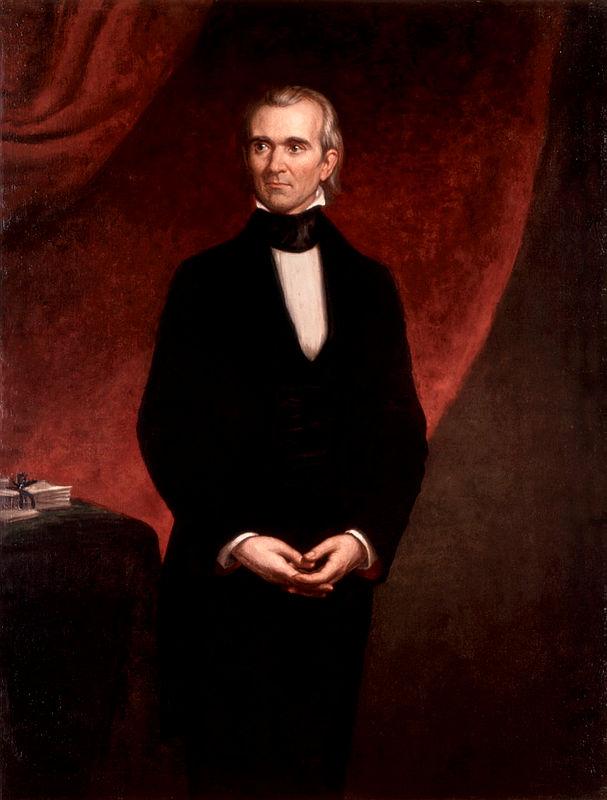
Doğum tarihi | 1795-11-02 | ||||||||
|---|---|---|---|---|---|---|---|---|---|
Eş | Sarah Childress Polk (1824 - 1891) | ||||||||
Place of Birth | Mecklenburg County, North Carolina - USA | ||||||||
Ölüm tarihi | 1849-06-15 | ||||||||
Place of Death | Tennessee - USA Nashville | ||||||||
Parents | Jane Knox Polk Samuel Polk | ||||||||
Presidential Order | 11th President of the United States (1845–1849) | ||||||||
James Knox Polk was born on November 2, 1795, in Mecklenburg County, North Carolina, to Samuel and Jane Knox Polk. His family migrated to Tennessee in 1806 in search of better economic opportunities, a move that played a significant role in shaping Polk’s childhood and youth. During his early years, he suffered serious health problems and was educated at home. However, after undergoing a difficult surgical procedure, his health improved and he was able to focus on his academic pursuits. In 1818, he graduated first in his class from the University of North Carolina and returned to Nashville to study law, beginning his legal career in 1820.
Polk’s political career began with his election to the Tennessee State Legislature. In 1825, he entered the U.S. House of Representatives, where he served for seven terms. During his time in Congress, he was recognized as a loyal supporter of Andrew Jackson, a loyalty that earned him the nickname “Young Hickory.” He consistently adopted Jacksonian positions on major political issues of the era, particularly the Bank War and the question of slavery. In 1835, he was elected Speaker of the House, during which he strictly enforced the “Gag Rule,” which prevented the consideration of anti-slavery petitions. In 1839, he was elected Governor of Tennessee but lost the next two gubernatorial elections. These defeats, however, did not end his political career.
James K. Polk emerged as a presidential candidate at the 1844 Democratic National Convention, initially seeking the vice presidency. With the support of the party’s expansionist wing, he was nominated and defeated Whig Party candidate Henry Clay in the election. Polk was inaugurated as the 11th President of the United States on March 4, 1845. Throughout his term, he focused on achieving four major goals: lowering tariff rates, establishing an independent treasury system, resolving the Oregon boundary dispute, and securing the annexation of California and New Mexico.
Economically, Polk implemented the Walker Tariff, which reduced import duties, aligning with the commercial interests of the Southern states. The Independent Treasury System was established, ensuring that federal revenues were held in government vaults independent of private banks. In foreign policy, he pursued diplomacy to resolve the Oregon dispute without war, culminating in the 1846 treaty with Britain that set the boundary at the 49th parallel, ceding all territory north of it to Britain and securing U.S. access to the Pacific Ocean.
However, the defining event of his presidency was the Mexican-American War. Polk advocated for the annexation of Texas and, after diplomatic efforts to resolve border disputes with Mexico failed, ordered military action. As a result of the 1848 Treaty of Guadalupe Hidalgo, Mexico was compelled to cede vast territories to the United States, including California and New Mexico. This expansion added approximately one million square miles to U.S. territory. Yet these developments deepened the national debate over slavery and contributed to the conditions that led to the Civil War.
James K. Polk kept his pledge to serve only one term and did not seek re-election. Shortly after leaving office in 1849, his health rapidly declined. After returning to Nashville, he died of cholera on June 15, 1849, at the age of only 53. His wife, Sarah Childress Polk, outlived him by many years and preserved his political legacy.
Polk’s presidency witnessed one of the greatest territorial expansions in American history, extending the nation from the Atlantic Ocean to the Pacific. Yet this expansion also complicated the issue of slavery. Polk described slavery as a “common evil” but believed its abolition would be destructive to national unity. Consequently, he produced no decisive solution to the slavery question.
Historians evaluate Polk’s legacy in two ways. On one hand, he successfully accomplished every major goal he set for his presidency and presided over a highly effective administration. On the other hand, he is criticized for his role in the Mexican War and expansionist policies, which many argue helped push the nation toward civil war. Nevertheless, some statesmen, such as Harry S. Truman, have regarded him as a successful president. Polk’s meticulous daily journals provide valuable insight into the political atmosphere of his era and illuminate the history of the American presidency. Today, James K. Polk is remembered as one of the rare presidents who fulfilled his duties and then retired from office.
American Battlefield Trust. “James Polk.” American Battlefield Trust. Accessed July 15, 2025. https://www.battlefields.org/learn/biographies/james-polk
American History Central. "James Knox Polk — 11th President of the United States." Accessed July 15, 2025. https://www.americanhistorycentral.com/entries/james-knox-polk/
Biographical Directory of the United States Congress. "Polk, James Knox." Accessed July 15, 2025. https://bioguide.congress.gov/search/bio/P000409
Charlotte Museum of History. “President James K. Polk.” Charlotte Museum of History. Accessed July 15, 2025. https://charlottemuseum.org/learn/articles/president-james-k-polk/
James K. Polk Home & Museum. “Who is James K. Polk?” James K. Polk Home & Museum. Accessed July 15, 2025. https://jameskpolk.com/history/james-k-polk/
Library of Congress. “Provenance of the James K. Polk Papers.” Accessed July 15, 2025. https://www.loc.gov/collections/james-k-polk-papers/articles-and-essays/provenance-of-the-james-k-polk-papers/
Miller Center, University of Virginia. “James K. Polk.” Miller Center. Accessed July 15, 2025. https://millercenter.org/president/polk
Miller Center, University of Virginia. “James K. Polk: Life in Brief.” Miller Center. Accessed July 15, 2025. https://millercenter.org/president/polk/life-in-brief
North Carolina History Project. “James K. Polk (1795-1849).” North Carolina History Project. Accessed July 15, 2025. https://northcarolinahistory.org/encyclopedia/james-k-polk-1795-1849/
Rutherford B. Hayes Presidential Library & Museums. “Who is James K. Polk? The Enigma of Our Eleventh President.” Accessed July 15, 2025. https://www.rbhayes.org/hayes/who-is-james-k.-polk-the-enigma-of-our-eleventh-president/
The American Presidency Project. "James K. Polk." The American Presidency Project. Accessed July 15, 2025. https://www.presidency.ucsb.edu/people/president/james-k-polk
The White House Historical Association. “James K. Polk.” The White House. Accessed July 15, 2025. https://bidenwhitehouse.archives.gov/about-the-white-house/presidents/james-k-polk/
White House Historical Association. “James Polk.” Accessed July 15, 2025. https://www.whitehousehistory.org/bios/james-polk

Doğum tarihi | 1795-11-02 | ||||||||
|---|---|---|---|---|---|---|---|---|---|
Eş | Sarah Childress Polk (1824 - 1891) | ||||||||
Place of Birth | Mecklenburg County, North Carolina - USA | ||||||||
Ölüm tarihi | 1849-06-15 | ||||||||
Place of Death | Tennessee - USA Nashville | ||||||||
Parents | Jane Knox Polk Samuel Polk | ||||||||
Presidential Order | 11th President of the United States (1845–1849) | ||||||||
Presidency and Policies
Legacy and Death