This article was automatically translated from the original Turkish version.
Japanese Maple (Acer palmatum)
Family | Sapindaceae (formerly: Aceraceae) | ||||||||
|---|---|---|---|---|---|---|---|---|---|
Native Country | China South Korea Japan | ||||||||
Plant Species | Deciduous small tree / large shrub | ||||||||
Lifespan | Long-lived (perennial) | ||||||||
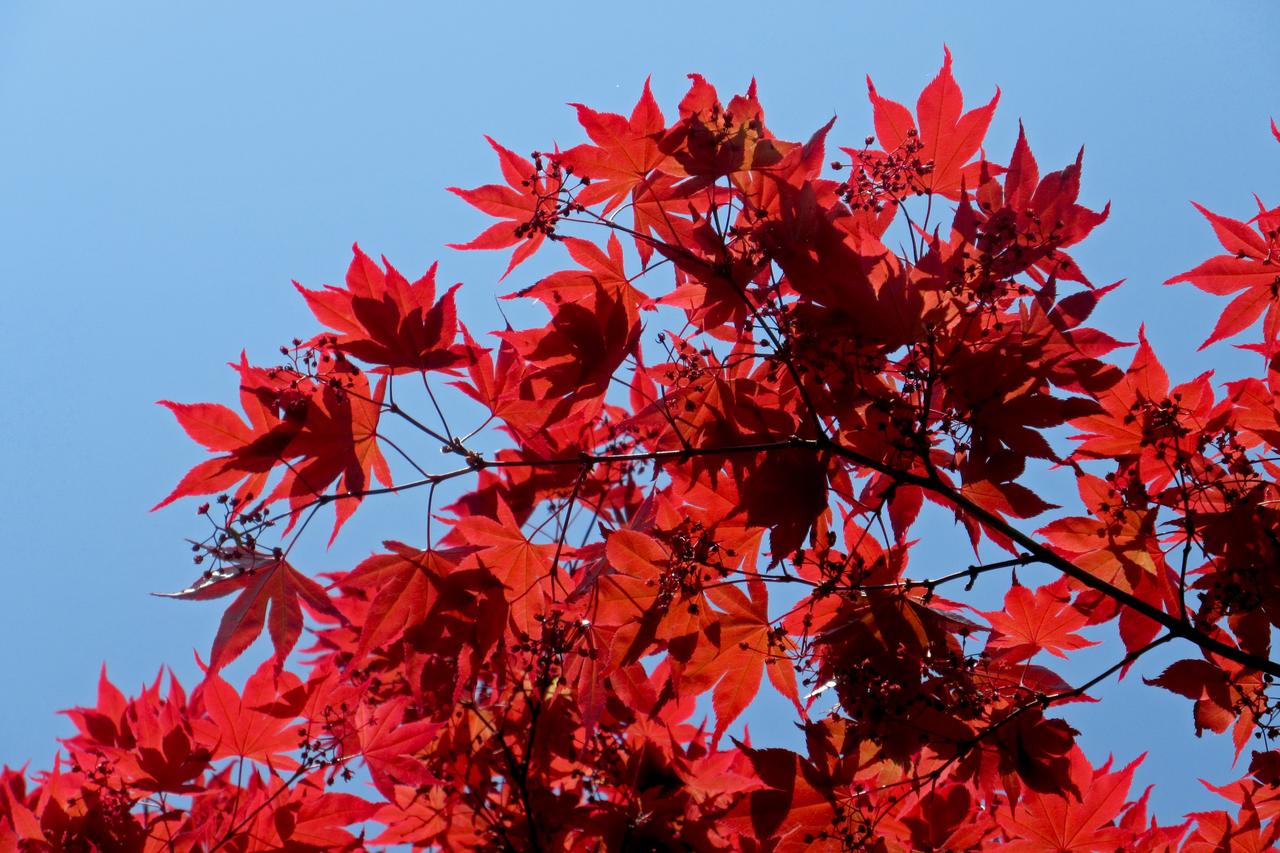
The Japanese maple (Acer palmatum) is a small-sized and elegant tree species. This species typically grows to a height of 8 to 10 meters and has a crown width ranging from 4 to 8 meters. It can naturally develop as either multi-stemmed or single-stemmed. Its branches spread horizontally, and over time the tree acquires a layered, rounded crown form. The leaves are palmate with 5 to 9 lobes and are arranged oppositely. Leaf color varies during summer between green and red tones, and in autumn it transforms into yellow, bronze, purple or vivid red hues. The shape and color of the leaves show considerable variation depending on the cultivar. Flowering usually occurs in April and May, and seeds mature in September. This slow- to medium-growing species is frequently chosen in landscape design for its aesthetic structure.
The Japanese maple is a tree species scientifically known as Acer palmatum, belonging to the maple family (Aceraceae; in some classifications Sapindaceae). The Latin genus name Acer means “sharp,” while the specific epithet palmatum means “palm-shaped,” referring to the leaf’s resemblance to a five-fingered hand. This species is native to East Asia, with its natural distribution occurring in central and southern Japan, eastern South Korea, and certain regions of China. In its natural habitat, it grows as an understory plant. Numerous cultivars have been developed within this species, including varieties such as ‘Mikawa yatsubusa’ and ‘Osakazuki’. Due to its low stature, aesthetic appeal, and diverse growth forms, it is widely cultivated as an ornamental tree around the world.
Acer palmatum is a small, deciduous tree species. This slow- to medium-growing tree typically reaches a height of 8–10 meters with a crown width of 4–8 meters. It exhibits a layered, densely branched structure with a rounded or spreading crown form. The trunk and branches spread gracefully with age. The leaves are simple, oppositely arranged, and generally 5–13 cm (2–5 inches) long. These leaves are palmate with 5 to 9 deeply incised lobes and toothed margins. Leaf color during summer ranges from green to red, while in autumn it turns to yellow, bronze, purple, or bright red. Color variation and leaf form differ according to the cultivar. In some cultivars, young shoots and branches also display reddish or greenish tones, adding ornamental value. The flowers are small and inconspicuous, blooming in April–May. The fruits are samaras with two wings, and seeds mature in September.
The Japanese maple (Acer palmatum) has wide application in landscape architecture due to its aesthetic structure, seasonal leaf color changes, and diverse forms. It is especially favored as a focal tree in small gardens, courtyards, along walkways, and in Japanese-style landscape designs. Its layered branching pattern, low crown form, and colorful foliage make it suitable for both standalone and mixed plantings for decorative purposes. Its tolerance for partial shade also makes it appropriate for understory plantings in forests. Its compact size renders it a safe and visually appealing option for children’s play areas and themed gardens. With a broad range of cultivars available, including upright, weeping, and dwarf varieties, it can meet diverse design requirements.
Acer palmatum naturally occurs in central and southern Japan, eastern South Korea, and certain regions of China. This species typically thrives in the understory of moist forests, in partially shaded and sheltered areas. In its natural habitat, it prefers well-drained, slightly acidic to neutral soils. Some cultivars can adapt to calcareous soils. In cultivation, it performs best in soils that are consistently moist but not waterlogged and rich in organic matter. Excessive sun exposure, drought, and strong winds can cause leaf scorch, particularly in young specimens; therefore, planting in partial shade is recommended. Young shoots and leaves are sensitive to late frosts, which makes protected microclimates ideal for healthy growth. As a deciduous species with seasonal color changes, it contributes to visual diversity and ecological balance within its habitat.
The Acer palmatum species can be propagated both generatively (by seed) and vegetatively (by cutting or grafting). In natural environments, seed propagation is common; the winged samara fruits produced from flowers blooming in April–May mature in September. Mature seeds can germinate spontaneously under suitable conditions, leading to new individuals. Consequently, in certain regions with favorable climates, it may self-seed and potentially exhibit invasive tendencies. In horticulture and commercial production, however, grafting is generally preferred to preserve the aesthetic and structural traits of specific cultivars. The most commonly used grafting methods are chip budding and English grafting. Some cultivars can also be propagated through semi-hardwood cuttings, although this method has a lower success rate. The choice of propagation method is crucial for maintaining cultivar consistency and ensuring uniform plant development.
Acer palmatum plays various roles within its natural habitat as an understory species. Its dense, layered crown structure creates shaded microclimates that benefit understory plants. As a deciduous species, it contributes organic matter to the soil through its autumn leaf litter, thereby enhancing soil fertility. During its flowering period, it provides nectar and pollen resources for pollinating insects. Its seeds are consumed by some small mammals and birds. Additionally, its branches offer temporary shelter for insects, birds, and other small animals. When used in landscape settings, it functions as an ornamental plant that supports biodiversity and provides visual and ecological benefits. However, because it readily produces seeds and spreads under favorable conditions, it may pose a risk of exerting pressure on native vegetation in some areas and thus requires careful monitoring.
Kahramanmaraş Büyükşehir Municipality. "Japon Akçaağacı." *Bitki Bilgi Kataloğu*. Accessed May 31, 2025. https://kahramanmaras.bel.tr/bitki-bilgi-katalogu/japon-akcaagaci
North Carolina State University. “Japanese Maple Acer palmatum.” NC State Extension Plant Toolbox. Accessed May 2025. https://plants.ces.ncsu.edu/plants/acer-palmatum/common-name/japanese-maple/
Pixabay. “Bonsai Akçaağaç Japon.” Pixabay. Accessed May 31, 2025. https://pixabay.com/tr/photos/bonsai-ak%C3%A7aa%C4%9Fa%C3%A7-japon-ak%C3%A7aa%C4%9Fa%C3%A7-2143262/

Japanese Maple (Acer palmatum)
Family | Sapindaceae (formerly: Aceraceae) | ||||||||
|---|---|---|---|---|---|---|---|---|---|
Native Country | China South Korea Japan | ||||||||
Plant Species | Deciduous small tree / large shrub | ||||||||
Lifespan | Long-lived (perennial) | ||||||||
No Discussion Added Yet
Start discussion for "Japanese Maple (Acer palmatum)" article
Taxonomy and General Information
Morphological Characteristics
Uses
Habitat
Reproduction
Ecological Role