


This article was automatically translated from the original Turkish version.
+1 More
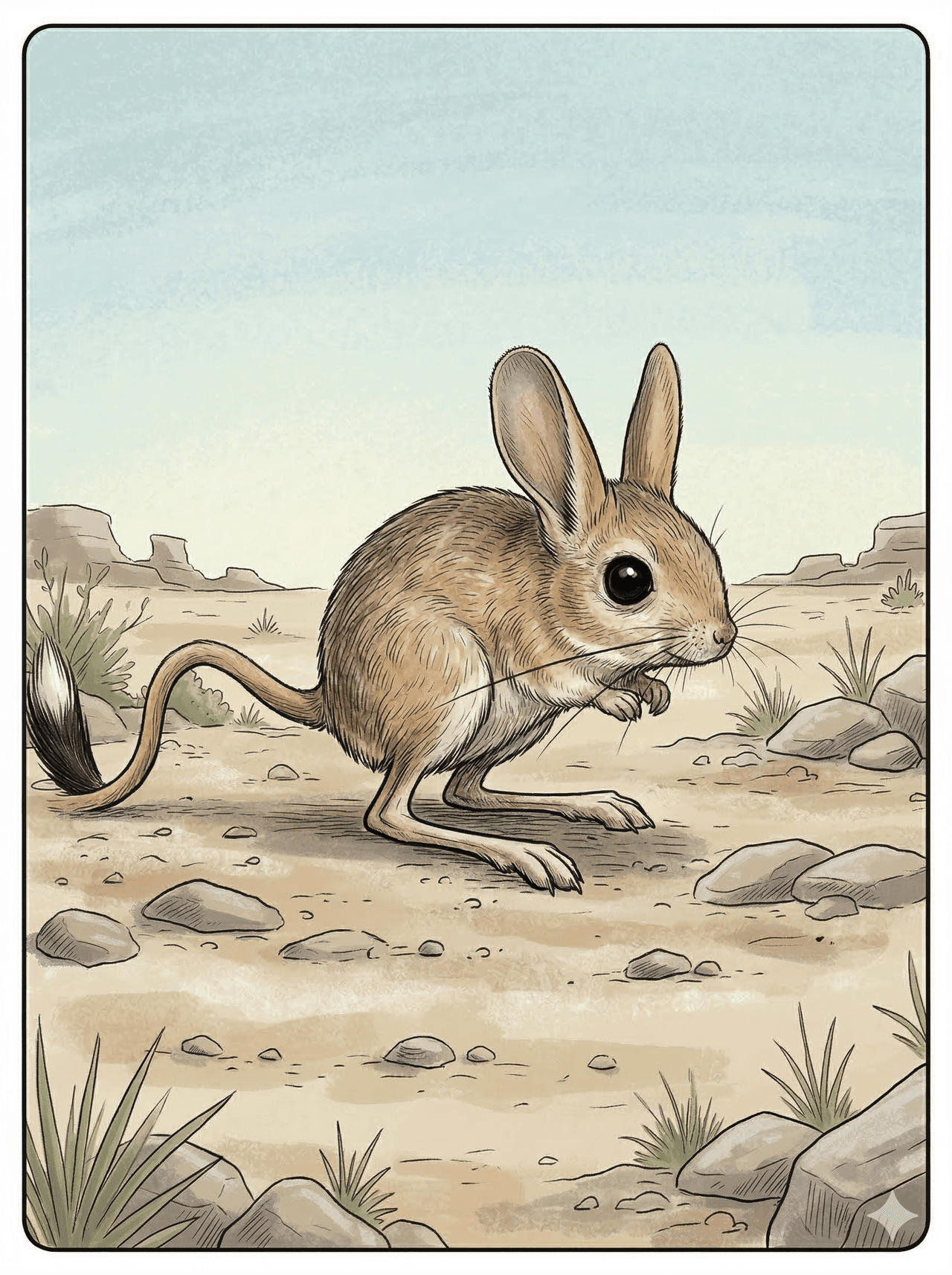
Arap Tavşanı
(Yapay Zekayla Oluşturulmuştur)
Jerboa (Jaculus jaculus) is a nocturnal rodent species adapted to desert life. Its appearance is striking, featuring rabbit-like ears, a mouse-like body, and kangaroo-like hind legs.

Jerboa (Jaculus jaculus)
Jerboas resemble miniature kangaroos when moving and hop in a manner similar to them. In normal locomotion, they cover distances of 10 to 13 cm per hop. When threatened by a predator, their jumps become more powerful, allowing them to cover up to 3 meters in a single leap. This enables them to reach speeds of up to 25 km/h while escaping. During escape, they maneuver in a zigzag pattern to make it difficult for predators to catch them.
They possess specialized adaptations for life in desert sands, including unique skin folds and fur in the ears and nostrils that prevent sand from entering. They are burrowing animals, using their short forelimbs to dig and their powerful hind legs to propel the excavated soil backward, rapidly creating burrows.
Jerboas are species capable of surviving in both hot and cold deserts. They are mostly solitary animals, each possessing its own burrow. Occasionally, small colonies composed of separate burrows have been observed. To survive desert conditions, they live underground.

Jerboa (Jaculus jaculus)
By living underground, they avoid the daytime heat of hot deserts and the winter cold of cold deserts. They typically dig their burrows near vegetation, but during the rainy season, they may construct burrows on hill slopes. These excavated burrows can be about 2 to 3 meters long. Winter burrows may reach depths of up to 3 meters.
In African deserts, jerboas block burrow entrances with soil plugs to prevent heat from entering; in Asian populations, they seal entrances during winter to retain warmth. Jerboas spend most of the day sleeping in their burrows and emerge primarily at night to forage. During winter months, they enter hibernation to avoid food shortages.
Breeding occurs twice a year. Each litter typically consists of three young, though litters of two to six have been recorded. Young are born hairless and their hind legs do not fully develop until they are eight weeks old. They cannot hop until they are eleven weeks old. They reach sexual maturity at 14 weeks, which is twice as long as in rats. In their natural habitats, they can live up to six years, twice the average lifespan of rats.
The jerboa is a rare and endangered species listed on the Red List of the International Union for Conservation of Nature (IUCN).
Although it has the potential to inhabit many regions of Türkiye, it is a rarely observed species. It has been reported in the Baskil district of Elazığ and the Alaca district of Çorum. Experts have noted that different subspecies with distinct characteristics may exist, and the population observed in Baskil could be a rare subspecies found nowhere else in the world.
Al–Mutairi, M., F. Mata, and R. Bhuller. “The Effect of Habitat Degradation, Season and Gender on Morphological Parameters of Lesser Jerboas (Jaculus jaculus L.) in Kuwait.” Animal Biodiversity and Conservation 35, no. 1 (2012): 119–124. Accessed October 26, 2025. https://museucienciesjournals.cat/en/abc/issue/35-1-2012-abc/the-effect-of-habitat-degradation-season-and-gender-on-morphological-parameters-of-lesser-jerboas-jaculus-jaculus-l-in-kuwait.pdf
Bennett, Nigel C., Daniel W. Hart, S. Munro, N. Amor, O. B. Mohammed, and A. N. Alagaili. “Hopping from the Heat: The Locomotory Activity Patterns of the Lesser Egyptian Jerboa (Jaculus jaculus).” Journal of Arid Environments 220 (2024): 105116. Accessed October 26, 2025. https://www.sciencedirect.com/science/article/pii/S0140196323001878
Better Planet Education. 2025. “Jerboas – Jerboa Behaviour.” Accessed October 26, 2025. https://betterplaneteducation.org.uk/factsheets/jerboas-jerboa-behaviour
Depositphotos. 2025. “Arap Tavşanı Fotoğrafı.” Accessed October 26, 2025. https://depositphotos.com/tr/photos/arap-tav%C5%9Fan%C4%B1.html?filter=all&qview=170399802
Depositphotos. 2025. “Arap Tavşanı Fotoğrafı.” Accessed October 26, 2025. https://depositphotos.com/tr/photos/arap-tav%C5%9Fan%C4%B1.html?filter=all&qview=332252528
Tarım Orman Ekranı. 2019. “Çorum’da ‘Arap tavşanı’ görüldü.” Date Published October 28, 2019. Accessed October 26, 2025. https://www.tarimtv.gov.tr/tr/video-detay/corum-da-arap-tavsani-goruldu-12561
Yeşil Gazete. 2021. “Elazığ’da nesli tehlike altında olan Arap tavşanı görüldü.” Date Published August 25, 2021. Accessed October 26, 2025. https://yesilgazete.org/elazigda-nesli-tehlike-altinda-olan-arap-tavsani-goruldu/

Arap Tavşanı
(Yapay Zekayla Oluşturulmuştur)
No Discussion Added Yet
Start discussion for "Jerboa (Jaculus jaculus)" article
Physical Characteristics and Locomotion
Habitat and Behavior
Reproduction and Lifespan
Conservation Status and Situation in Türkiye