



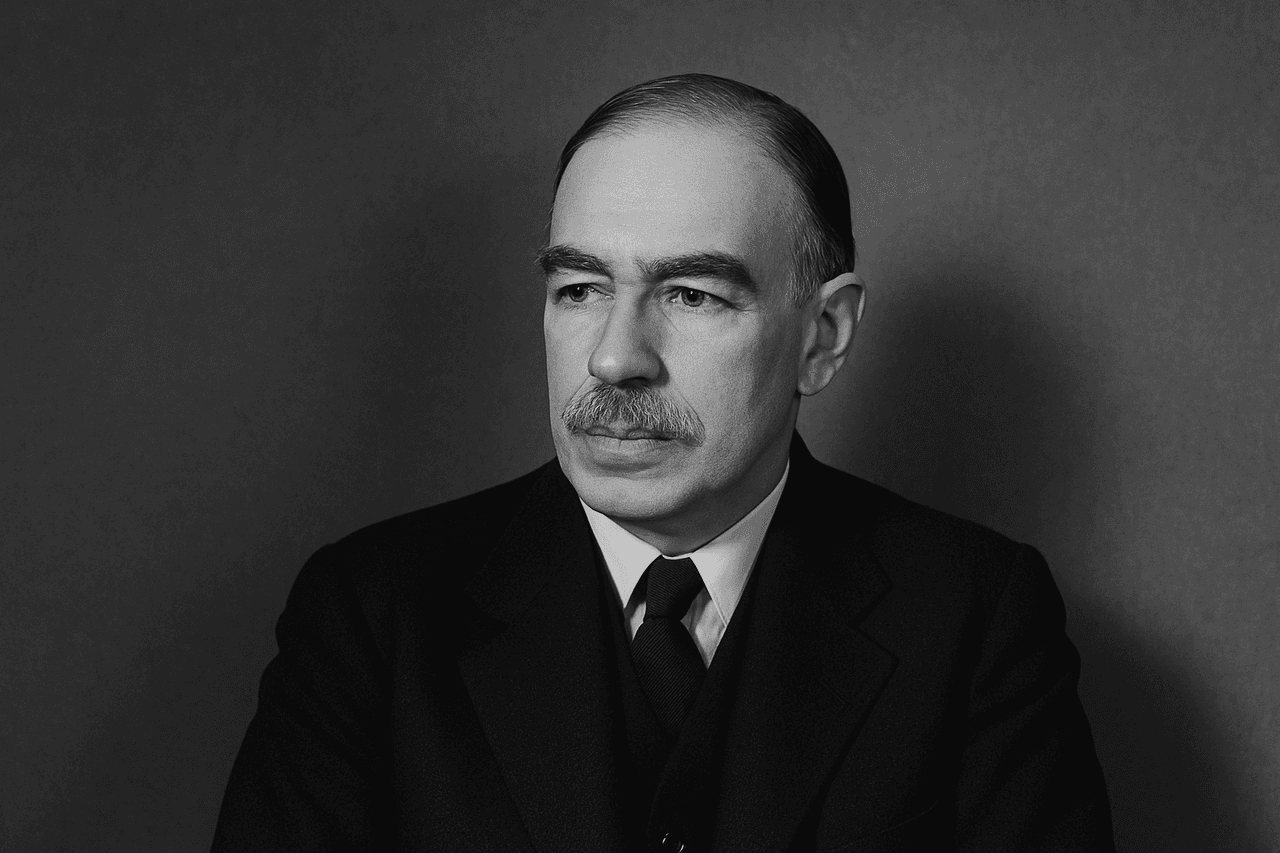
John Maynard Keynes
Babası | John Neville Keynes (1852-1949) | ||||||||
|---|---|---|---|---|---|---|---|---|---|
Eş | Lydia Lopokova (1891-1981) | ||||||||
Annesi | Florence Ada Keynes (1861-1958) | ||||||||
Doğum tarihi | 1883-06-05 | ||||||||
Ölüm tarihi | 1946-04-21 | ||||||||
John Maynard Keynes, the British economist, mathematician, and thinker, is recognized as the founder of "Keynesian Economics," which laid the foundations of macroeconomics. Throughout his career he made his name both in academia and in politics; his work The General Theory of Employment, Interest and Money ushered in a new era in economic thought. As a member of the Bloomsbury Group, he contributed to intellectual circles, held key roles in the British Treasury during the First and Second World Wars, and was one of the figures who shaped the postwar global economic order at the Bretton Woods Conference.
John Maynard Keynes was born on 5 June 1883 in Cambridge, England, into a family of high intellectual and social standing. His father, John Neville Keynes, was a professor of economics and logic at the University of Cambridge; his mother, Florence Ada Keynes, was a social reformer and the first female mayor of Cambridge. Keynes spent his childhood in a home frequently visited by Alfred Marshall and Henry Sidgwick, leading economists and philosophers of the era. This intellectual environment fostered his early scientific and artistic curiosity.
In 1897, at the age of 14, Keynes was admitted on scholarship to Eton College, one of England’s most prestigious schools. He excelled in literature and history and won mathematics prizes in 1899 and 1900. In 1902 he entered King’s College, Cambridge, to study mathematics and graduated in 1905. Subsequently, influenced by economists such as Alfred Marshall and Arthur Pigou, he turned to economics. For a year, without formal enrollment, he attended lectures by Marshall and Pigou to deepen his economic knowledge. He also joined intellectual societies such as the Cambridge Apostles and the Bloomsbury Group, broadening his horizons in aesthetics, ethics, and politics.
Keynes began his professional life in 1906 as a civil servant at the India Office but resigned in 1908 to return to Cambridge and embark on an academic career. In 1915, during the First World War, he joined the British Treasury. In 1919, he served as a financial adviser in the British delegation led by David Lloyd George at the Versailles Peace Conference. He resigned in protest against the harshness of the reparations imposed on Germany, a stance he articulated in his widely acclaimed book The Economic Consequences of the Peace, published the same year. During the Second World War, he returned to the Treasury and represented Britain at the Bretton Woods Conference in 1944. In addition to his academic work, he increased his personal wealth by serving as a financial adviser to King’s College and edited the Economic Journal from 1912 to 1944.
In 1942, Keynes was appointed a life peer with the title Baron Keynes of Tilton and was elected to the British Academy. He played a pivotal role in the establishment of the International Monetary Fund (IMF) and the World Bank at Bretton Woods. His 1919 book was widely regarded by critics as a powerful critique of postwar policies and established him as an international authority.
Keynes rejected the classical economic assumption that “markets automatically achieve equilibrium,” arguing instead that economic instability stems from insufficient effective demand. In The General Theory, he advocated for government intervention to ensure full employment and introduced concepts such as the multiplier mechanism to macroeconomics. His ideas on fiscal policy during the Great Depression and the postwar period fundamentally reshaped 20th-century economic thought.
Keynes’s major works include Indian Currency and Finance (1913), The Economic Consequences of the Peace (1919), A Treatise on Probability (1921), A Tract on Monetary Reform (1923), A Treatise on Money (1930), and The General Theory of Employment, Interest and Money (1936). His “Keynes Plan” presented at Bretton Woods became one of the foundational pillars of the global monetary system.
Keynes had a deep interest in art, mathematics, and literature. He was active in artistic circles through the Bloomsbury Group, engaged in business, and collected modern art. He also owned a rare collection of Isaac Newton’s manuscripts.
In 1925 he married Russian ballerina Lydia Lopokova, though the couple had no children. Keynes was known for his intellectual circles and personal relationships, forming friendships with figures such as Lytton Strachey and Bertrand Russell.
Keynes worked intensively during the Second World War; in 1945 he participated in negotiations to secure financial aid for Britain from the United States. However, his health deteriorated during this period. Although advised to slow down after suffering a heart attack in 1937, he continued his work. On 21 April 1946, he died at the age of 62 in his home in Sussex, following a second heart attack.
Keynes’s ideas remained influential after his death; many governments adopted Keynesian policies until the 1980s. His views, revived during the 2008 global crisis, once again demonstrated the necessity of government intervention in the economy. Institutions such as the IMF and the World Bank continue to uphold his legacy in their policies.
Keynes inspired economists such as Paul Samuelson and John Hicks; his ideas shaped modern macroeconomics. The Times described him as an equivalent figure to Newton.
BBC. "John Maynard Keynes." *BBC History*. Accessed March 28, 2025. https://www.bbc.co.uk/history/historic_figures/keynes_john_maynard.shtml
Bilir, Hüsnü. "Entelektüel Bir İktisatçı: John Maynard Keynes." Dört Öge 8, no. 16 (December 2019): 83-96.
The Concise Encyclopedia of Economics. "John Maynard Keynes." The Concise Encyclopedia of Economics. Accessed March 28, 2025. https://www.econlib.org/library/Enc/bios/Keynes.html
Tomanbay, Mehmet. "John Maynard Keynes’in Yaşamı Ve İktisadi Düşüncesinin Gelişimi". Ufuk Üniversitesi Sosyal Bilimler Enstitüsü Dergisi 6, no. 11 (January 2017): 7-16.

John Maynard Keynes
Babası | John Neville Keynes (1852-1949) | ||||||||
|---|---|---|---|---|---|---|---|---|---|
Eş | Lydia Lopokova (1891-1981) | ||||||||
Annesi | Florence Ada Keynes (1861-1958) | ||||||||
Doğum tarihi | 1883-06-05 | ||||||||
Ölüm tarihi | 1946-04-21 | ||||||||
No Discussion Added Yet
Start discussion for "John Maynard Keynes" article
Childhood and Youth
Educational Journey
Career Path
Major Works and Contributions
Personal Life
Final Years and Death
Legacy and Influence