


This article was automatically translated from the original Turkish version.
+2 More
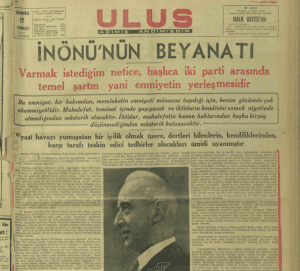
July 12 Declaration
History | 12 July 1947 | ||||||||
|---|---|---|---|---|---|---|---|---|---|
Author(s) | President İsmet İnönü | ||||||||
Purpose(s) | Creating a climate of trust between CHP and DP supporting the multi-party system | ||||||||
Background | CHP-DP tensions after the 1946 elections, the Hürriyet Misakı, allegations of bureaucratic pressure | ||||||||
Process | Inönü's meetings with Peker and Bayar between 7 June and 10 July 1947 | ||||||||
Content | Neutrality, equal treatment, climate of trust, responsibility of the administrative mechanism | ||||||||
Effects | Peker's resignation, moderation within CHP, establishment of the Millet Partisi within DP, institutional identity of the opposition, message of democracy to the West | ||||||||
Key Documents | Dörtlü Takrir Hürriyet Misakı | ||||||||
The July 12 Declaration is a statement issued by President İsmet İnönü on July 12, 1947. In response to tensions between the Republican People’s Party (CHP) and the Democrat Party (DP) reaching a level that threatened the regime, İnönü assumed the role of mediator and drafted this declaration. The statement was prepared following meetings between İnönü and CHP leader Recep Peker and DP leader Celal Bayar between June 7 and July 10, 1947. It was read on the radio on July 11 and published in the press on July 12. Comprising approximately 850 words, the declaration emphasized the president’s equal distance from both parties, the neutrality of the administrative machinery, and the guarantee of legal working conditions for political parties. The declaration institutionalized the DP’s identity as an opposition party, led to Peker’s resignation within the CHP and a shift toward a more moderate governance approach, and prompted a faction within the DP to break away and establish the Nation Party. Additionally, it demonstrated Türkiye’s commitment to a multi-party system to Western countries and laid the groundwork for developments such as İnönü’s domestic tours in 1947 and the 1949 election law introducing the principle of secret ballot with open counting. This document represents a significant milestone in Türkiye’s multi-party political life.
Turkey’s transition to multi-party political life accelerated under the influence of the international climate following World War II. The victory of democratic states in the war, combined with the Soviet Union’s refusal to renew the 1925 Non-Aggression Pact and its demands for territorial concessions and joint control of the straits, pushed Türkiye to cultivate a democratic image to secure support from Western nations. During the United Nations conference in San Francisco between April and June 1945, the Turkish delegation pledged to transition to a multi-party system. President İsmet İnönü’s emphasis on multi-party life on May 19, 1945, and his statement on November 1, 1945, that “our administration is the people’s administration,” were key indicators of this process. İnönü openly supported the establishment of new political parties.
On June 7, 1945, the Four-Point Proposal, submitted to the CHP Parliamentary Group by Celal Bayar, Adnan Menderes, Fuat Köprülü, and Refik Koraltan, called for the removal of undemocratic provisions in the constitution and laws, the strengthening of parliamentary oversight powers, and judicially supervised elections. After the proposal was rejected on June 12, Menderes, Köprülü, and Koraltan were expelled from the CHP, and Bayar resigned. On December 4, 1945, following Bayar’s meeting with İnönü and receiving his approval, the Democrat Party (DP) was established on January 7, 1946. The DP rapidly organized across the country.
The general elections of July 21, 1946, were controversial due to the open ballot-secret count method and allegations of irregularities. The DP managed to field candidates for 273 of the 465 parliamentary seats and entered parliament with 62 members, while the CHP retained sole power. The CHP government under Prime Minister Recep Peker adopted a harsh governance approach, while the DP claimed it was subjected to bureaucratic pressure. At the DP’s First Great Congress held from January 7 to 11, 1947, the Pact of Liberty was adopted, demanding the repeal of laws contrary to the constitution, the separation of the presidency from the party chairmanship, and amendments to the election law, and threatening to withdraw from parliament if these demands were not met. These developments intensified tensions between the ruling party and the opposition.
After the 1946 elections, relations between the Peker government and the DP deteriorated amid mutual accusations. The September 7 Decisions, which included the devaluation of the Turkish Lira, failed to resolve economic problems and instead fueled inflation, provoking sharp criticism from the DP. The extension of martial law for six months in Istanbul, Edirne, Kırklareli, Tekirdağ, Çanakkale, and Kocaeli in December 1946, and the closure of six newspapers and magazines on January 6, 1947, were viewed by the DP as attempts to suppress opposition. During the budget discussions of December 18, 1946, Peker’s characterization of Adnan Menderes as a “psychopathic soul” led the DP to leave parliament. The DP’s decision not to participate in the April 6, 1947, by-elections and Peker’s reference to the Independence Tribunals Law further heightened tensions. Allegations of irregularities in the municipal elections of February 16, 1947, particularly the events in Arslanköy, Mersin, strengthened the DP’s claims of repression.
Mediation efforts progressed as follows:
İnönü began meetings with Bayar on June 7, 1947. During meetings on June 7, 11, 14, 17, 20, 26 and July 5, 7, and 10, Bayar complained of bureaucratic pressure, while Peker denied the allegations. A meeting on June 14 between Peker, Mümtaz Ökmen, and Bayar under İnönü’s supervision ended in mutual accusations and no resolution. Bayar’s request in his speech in Sivas for İnönü to guide the removal of pressure, followed by Peker’s rejection of pressure claims on July 2, further intensified tensions. On July 5, İnönü presented the draft declaration to Bayar; on July 8, the DP General Administrative Board evaluated the draft. Although Ahmet Oğuz, Ahmet Tahtakılıç, and Yusuf Kemal Tengirşenk argued that the declaration lacked constitutional binding force and would restrict the party, the majority approved the draft. Due to Peker’s objections, the declaration was reduced from ten to six pages, and the clause separating the presidency from the party chairmanship was removed. The declaration was read on the radio on July 11 and published in the press on July 12, 1947.
The approximately 850-word declaration summarizes İnönü’s meetings with Peker and Bayar and offers proposals to resolve political tensions. The key points are:
İnönü acknowledged that both sides had valid grievances but stated that debating who was more unjust was futile. He accepted as assurance that the DP did not resort to unlawful methods and that the government rejected claims of repression, and conveyed these assurances to both parties.
The declaration directly affected the CHP and DP and transformed the broader political structure.
After the declaration, Peker received a vote of confidence in the CHP parliamentary group on August 26, 1947, but a faction of 35 dissenters emerged, known as the “35 Incident.” On September 4, during a vote on cabinet reshuffling, 47 votes opposed Peker. After his proposal to merge the party chairmanship with the premiership was rejected, he resigned on September 9. Hasan Saka succeeded him as prime minister. This process weakened the influence of hardliners within the CHP and facilitated a shift toward a more moderate governance approach.
Within the DP, a dissident faction—Sadık Aldoğan, Osman Nuri Köni, Necati Erdem, Mithat Sakaroğlu, and Kemal Silivrili—viewed the declaration as an agreement with the CHP and demanded withdrawal from parliament based on the Pact of Liberty. They were expelled. The resignations of Yusuf Kemal Tengirşenk, Enis Akaygen, Emin Sazak, Ahmet Tahtakılıç, Hasan Dinçer, and Ahmet Oğuz reduced the DP’s parliamentary representation to 31 members. Some of this group formed the Independent Democrats, and later, under the leadership of Hikmet Bayur, established the Nation Party. The declaration strengthened the legitimacy and institutional identity of the opposition by guaranteeing its status from the state.
The declaration supported the continuity of multi-party life and reduced the risk of a return to authoritarian rule through the DP’s withdrawal from parliament. İnönü’s impartiality fostered public trust. The declaration demonstrated Türkiye’s commitment to democracy to Western countries and reinforced its pledges made at UN meetings. İnönü’s tour of Eastern Anatolia and the Black Sea region from September 14 to 26, 1947, during which he visited DP organizations, reinforced the principle of impartiality outlined in the declaration. The 1949 election law, introduced during the premiership of Şemsettin Günaltay, which established the principle of secret ballot with open counting, can be regarded as a long-term outcome of the declaration.
Çavuşoğlu, Hüseyin. “12 Temmuz Beyannamesi Süreci ve Beyannamenin Türk Siyasal Hayatına Etkisi Üzerine Bir Değerlendirme.” *Bartın Üniversitesi İktisadi ve İdari Bilimler Fakültesi Dergisi* 12, no. 23 (2021): 141–149. Accessed May 23, 2025. https://dergipark.org.tr/tr/pub/bartiniibf/issue/62623/843205
İnan, Süleyman. “12 Temmuz Beyannamesi.” *Atatürk Ansiklopedisi*, May 25, 2022. Accessed May 23, 2025. https://ataturkansiklopedisi.gov.tr/detay/164/12-Temmuz-Beyannamesi
İsmet İnönü Vakfı. “12 Temmuz 1947 Beyannamesi.” Accessed May 23, 2025. https://www.ismetinonu.org.tr/12-temmuz-1947-beyannamesi/

July 12 Declaration
History | 12 July 1947 | ||||||||
|---|---|---|---|---|---|---|---|---|---|
Author(s) | President İsmet İnönü | ||||||||
Purpose(s) | Creating a climate of trust between CHP and DP supporting the multi-party system | ||||||||
Background | CHP-DP tensions after the 1946 elections, the Hürriyet Misakı, allegations of bureaucratic pressure | ||||||||
Process | Inönü's meetings with Peker and Bayar between 7 June and 10 July 1947 | ||||||||
Content | Neutrality, equal treatment, climate of trust, responsibility of the administrative mechanism | ||||||||
Effects | Peker's resignation, moderation within CHP, establishment of the Millet Partisi within DP, institutional identity of the opposition, message of democracy to the West | ||||||||
Key Documents | Dörtlü Takrir Hürriyet Misakı | ||||||||
No Discussion Added Yet
Start discussion for "July 12 Declaration" article
Historical Background
The Path to the Declaration
Content of the Declaration
Political Impact of the Declaration
Impact on the CHP
Impact on the DP
General Political Impact