This article was automatically translated from the original Turkish version.
+1 More
Name(s) | K2-155d | ||||||||
|---|---|---|---|---|---|---|---|---|---|
Type(s) | Super-Earth-type exoplanet | ||||||||
Constellation | Taurus | ||||||||
Distance | 203 light years (62.2 parsecs) | ||||||||
Discovery Instrument | NASA Kepler Space Telescope | ||||||||
Discovery Year | 2018 | ||||||||
Orbital Period | 40.7 days | ||||||||
Distance from Star | 0.1888 AU | ||||||||
Radius | 1.64 ± 0.09 R⊕ | ||||||||
Mass | 3–5 M⊕ | ||||||||
Planet Type | Rocky | ||||||||
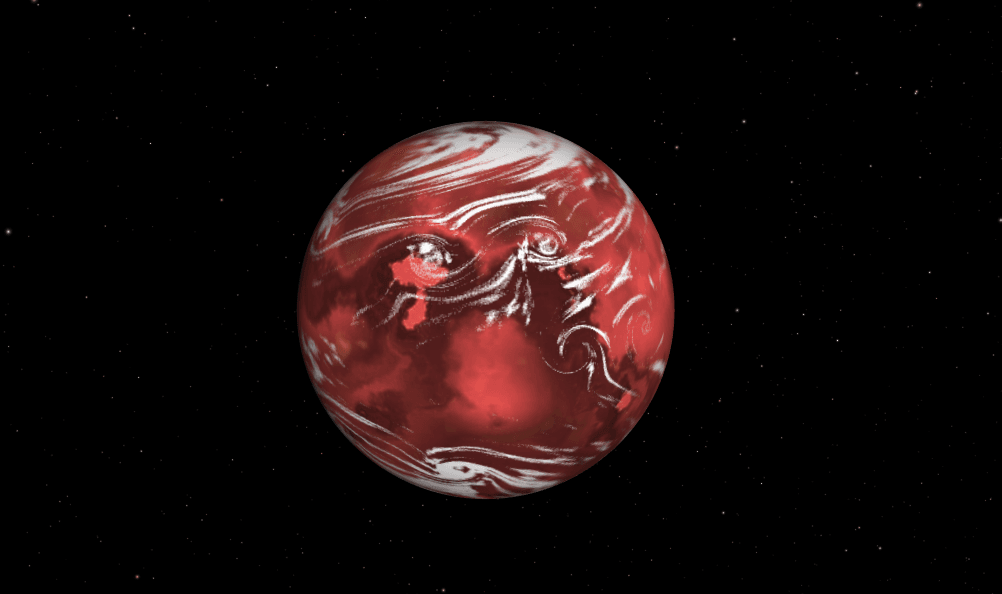
K2-155d is a super-Earth-type exoplanet orbiting the red dwarf star K2-155, located approximately 203 light years (62.2 parsecs) from Earth in the direction of the Taurus constellation. Discovered during NASA’s Kepler space telescope’s K2 mission, this planet has attracted scientific interest due to its orbital position near the inner edge of its host star’s habitable zone and climate modeling suggesting the potential presence of liquid water.
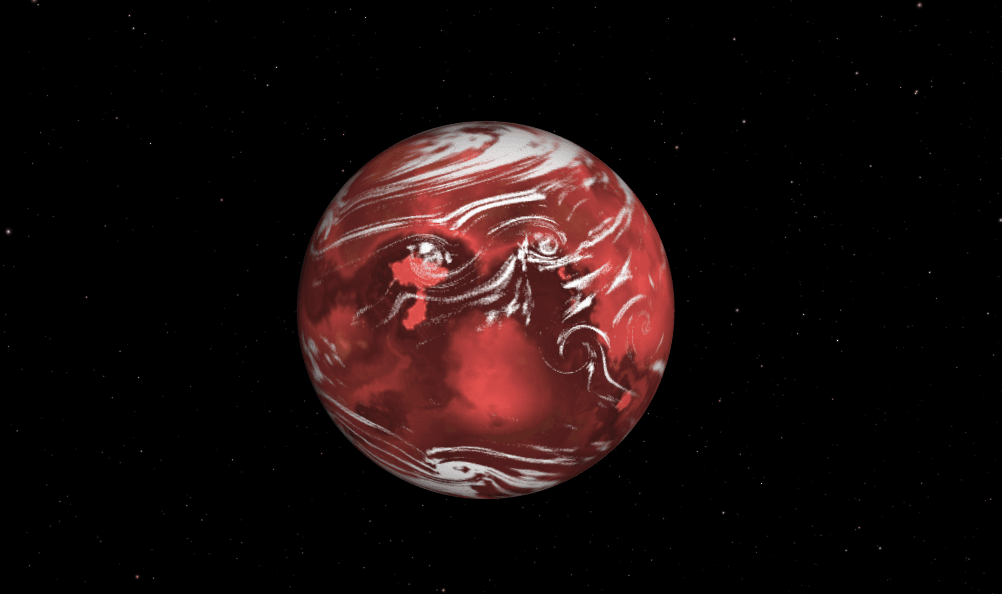
K2-155d (NASA)
The exoplanet K2-155d was discovered using data collected during the K2 mission, which followed the completion of Kepler’s primary mission. The discovery was made using the transit method, in which the periodic and slight dimming of a star’s brightness as a planet passes in front of it is measured to infer the planet’s existence.
The presence and characteristics of K2-155d and the two other planets in the system, K2-155b and K2-155c, were confirmed by an astronomical team led by Teruyuki Hirano from the Tokyo Institute of Technology. These findings were published in 2018. The researchers did not rely solely on Kepler data but also incorporated high-resolution imaging and spectroscopic data from ground-based observatories such as the Subaru Telescope in Hawaii and the Nordic Optical Telescope in Spain. This allowed them to confirm that the signals detected by Kepler were indeed caused by a planet and not by other astrophysical phenomena such as an eclipsing binary star system.
K2-155, also known as EPIC 210897587, is a red dwarf star of spectral class M1V. It is significantly smaller and cooler than the Sun, with a mass of approximately 45 percent of the Sun’s (0.45±0.04 M☉) and a radius of about 44 percent of the Sun’s (0.44±0.02 R☉). Its surface temperature has been measured at approximately 3,745 Kelvin. The star’s metallicity ([Fe/H]), which indicates its iron abundance relative to the Sun, is −0.08±0.11 dex, suggesting its chemical composition is very similar to that of the Sun.
Red dwarf stars are among the most common types of stars in the universe. They are also extremely long-lived, capable of persisting for trillions of years, thus offering a vast time window for the potential evolution of life on orbiting planets.
The transit method has enabled a precise measurement of K2-155d’s radius, which is estimated at 1.64±0.09 R⊕, or about 1.64 times that of Earth. This size classifies K2-155d as a “super-Earth,” a transitional type between rocky terrestrial planets and mini-Neptunes.
At the time of discovery, no radial velocity (Doppler) data were available to directly measure the planet’s mass. Therefore, its mass has been estimated using theoretical mass-radius relationships. According to these models, K2-155d’s mass is likely between three and five times that of Earth. When combined with the measured radius, these estimates suggest that the planet is most probably rocky and terrestrial in composition.
K2-155d completes one full orbit around its host star, K2-155, in approximately 40.7 days. Its average distance from the star, or semi-major axis, is about 0.1888 astronomical units (AU). This orbital period is longer than those of the other two planets in the system, K2-155b and K2-155c, making K2-155d the outermost known planet in the system.
The most scientifically intriguing feature of K2-155d is its orbital position near the inner edge of its host star’s habitable zone. The habitable zone is defined as the range of orbital distances where a planet’s surface temperature could allow for the presence of liquid water. The stellar insolation flux received by K2-155d has been calculated at approximately 1.67 times that received by Earth (S = 1.67±0.19 S⊕).
To investigate the planet’s possible climate conditions, Hirano and his research team employed three-dimensional global climate models (3D GCMs). These models aimed to estimate surface temperatures under hypothetical assumptions regarding atmospheric composition and albedo.
The modeling results suggest that K2-155d’s climate may lie at a critical balance point. Under certain scenarios, persistent liquid water could exist on its surface. However, due to the high insolation it receives, the planet may also be entering or have already entered a runaway greenhouse effect. This is a self-reinforcing process in which rising surface temperatures cause oceans to evaporate, and the resulting water vapor in the atmosphere acts as a potent greenhouse gas, further increasing temperatures.
This scenario could render K2-155d as extremely hot and uninhabitable, similar to Venus. Consequently, K2-155d is regarded as a natural laboratory for testing the concept of a “habitable zone gap,” offering critical insights into the limits of habitability for terrestrial planets.
Fulton, Benjamin J., et al. “The California-Kepler Survey. III. A Gap in the Radius Distribution of Small Planets.” The Astronomical Journal 154, no. 3 (August 2017): 109. https://iopscience.iop.org/article/10.3847/1538-3881/aa80eb.
Hirano, Teruyuki, et al. “K2-155: A Bright Metal-poor M Dwarf with Three Transiting Super-Earths.” *The Astronomical Journal* 155, no. 3 (February 2018): 124. https://iopscience.iop.org/article/10.3847/1538-3881/aaaa6e.
Howell, Stephen B., et al. “The K2 Mission: Characterization and Early Results.” *Publications of the Astronomical Society of the Pacific* 126, no. 938 (April 2014): 398–408. https://iopscience.iop.org/article/10.1086/676406.
Kopparapu, Ravi Kumar, et al. “Habitable Zones around Main-sequence Stars: New Estimates.” *The Astrophysical Journal* 765, no. 2 (March 2013): 131. https://iopscience.iop.org/article/10.1088/0004-637X/765/2/131.
NASA. “K2-155.” *NASA Science: Exoplanet Catalog*. Accessed July 19, 2025. https://ciencia.nasa.gov/exoplanet-catalog/k2-155-d/

Name(s) | K2-155d | ||||||||
|---|---|---|---|---|---|---|---|---|---|
Type(s) | Super-Earth-type exoplanet | ||||||||
Constellation | Taurus | ||||||||
Distance | 203 light years (62.2 parsecs) | ||||||||
Discovery Instrument | NASA Kepler Space Telescope | ||||||||
Discovery Year | 2018 | ||||||||
Orbital Period | 40.7 days | ||||||||
Distance from Star | 0.1888 AU | ||||||||
Radius | 1.64 ± 0.09 R⊕ | ||||||||
Mass | 3–5 M⊕ | ||||||||
Planet Type | Rocky | ||||||||
Discovery
Host Star: K2-155
Physical Properties
Orbital Characteristics
Habitability and Climate Modeling