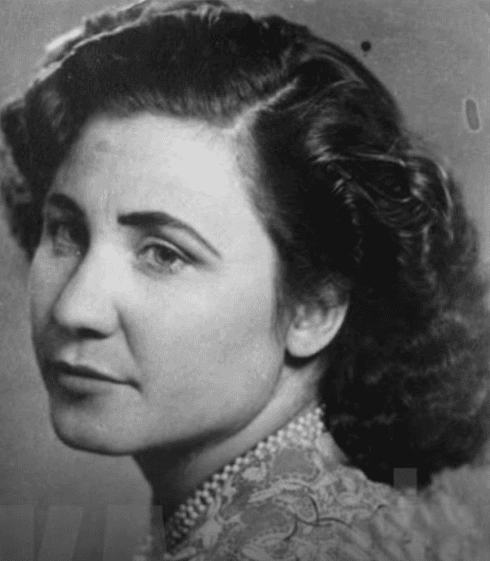



Birth Year | 1928 | ||||||||
|---|---|---|---|---|---|---|---|---|---|
Birth Place | Golemantsi, Haskovo, Türkiye | ||||||||
Nickname(s) | The nightingale of the Rhodopes | ||||||||
Death Year | 1962, (age 34) | ||||||||
Cause of Death | Traffic Accident | ||||||||
Kadriye Latifova (1928–1962) is remembered in Bulgarian Turkish folk music as the “Nightingale of the Rhodopes,” an artist whose voice and stage presence influenced generations. By performing native Turkish folk songs, she made a significant contribution to preserving the Turkish folk song heritage of Bulgaria and the Balkans; she worked with the Turkish theaters in Haskovo and Kırcaali, expanding her repertoire with hundreds of works.
In Front of the Houses of Kadriye Latifova, an Execution Named Handır (Kadriye Latifova)
Latifova was born in 1928 in the village of Golemantsi (Bey) near Haskovo. She began her artistic career in 1953 at the Haskovo Turkish Theater. In 1955, she won first prize at the first national folk music competition held in Sofia with the song “Aliş’imin Kaşları Kare,” quickly becoming a star whose fame spread from the south to the north of the country. She died in 1962 at the age of just 34 in a traffic accident. Despite her short life, she recorded over 500 folk songs.
Kadriye Latifova’s performance of “Aliş’imin Kaşları Kare” (Kadriye Latifova)
Latifova’s vocal style is noted for conveying the emotional world of the Rhodopes with simplicity and powerful tone. Among her most prominent repertoire pieces are “Lamba da Şişesiz Yanmaz mı,” “Sarı Gülüm Var Benim,” “Evlerinin Önü Handır,” and “Rodop Dağları Engindir.”
Her artistic value was formally and culturally recognized even after her death. The Bulgarian State honored her with the Order of Cyril and Methodius. Director Mariya Damyanova produced a documentary titled “Kadriye’s Theater Is Coming.” A monument in her honor has been erected in Kırcaali.
Latifova influenced not only her own generation but also subsequent generations of female artists. Many artists including Ulviye Ahmedova, Aysel Hasanova, Sıdıka Ahmedova, Fatmegül Bayramova, Ayfer Sadıkova, Emel Tabakova, and Raziye Fazlıeva continued her legacy by working in the Turkish theaters of Şumnu, Razgrad, and Kırcaali, performing on radio, and reaching wider audiences through recordings.
Latifova’s name has also become institutionalized in the cultural memory of her homeland. On 6 June 2003, the Turkish theater in Kırcaali reopened under the name “Kırcaali Kadriye Latifova State Music and Drama Theater,” continuing musical, dance, and theatrical productions to sustain the language and traditions of the Turkish minority in the Balkans. The theater brought renewed vitality to the region through performances and tours staged in the same year and afterward.
Although this institutional legacy was revived in 2003 after its closure in 1984, in 2010 the two Turkish theaters were merged with Bulgarian theaters under the pretext of “reform.” The Kırcaali ensemble was incorporated into the “Dimitır Dimov – Drama and Puppet Theater” under the name “Kadriye Latifova Stage.” This transformation generated widespread public reaction.
The stage bearing Latifova’s name has continued to host events over the years with contributions from artists in Türkiye and Bulgaria. For example, in 2008, Selim Gürata staged the play “Hürrem Sultan” at the Kırcaali Kadriye Latifova State Music and Drama Theater; in 2022, the play “Akide Şekeri” was performed on the “Kadriye Latifova Stage,” marking the 70th anniversary of Turkish theater in Bulgaria. These events demonstrate that Latifova’s name has become a living theatrical tradition.
Today, Kadriye Latifova remains an icon in the collective memory of Bulgarian Turks, alive through her more than 500 recorded songs and the theaters named in her honor; she symbolizes the continuity of Turkish music and stage culture in the Balkans.
Altaç, Embiye. “Bulgaristan’da Dünden Bugüne Türk Tiyatrosu.” *Türkoloji ve Sosyo-Kültürel Araştırmalar Dergisi* 1, no. 1 (December 23, 2024): 60–76. Accessed October 17, 2025. https://zenodo.org/records/14549143/files/9.%20Embiye%20Alta%C3%A7.pdf?download=1
Balkan Mode YouTube Channel. "Pencere Açıldı, Bilal Oğlan - Kadriye Latifova." Accessed October 17, 2025. https://www.youtube.com/watch?v=6K4a-HLaGXQ&list=PLuKx-ANPggXWDLvy3SHia_JqXrCFDxifo
Buttanrı, Müzeyyen. "Bulgaristan Türkleri Arasında Tiyatro Faaliyetleri." *Motif Akademi Halkbilimi Dergisi*, 2010, 3.6: 136–162. Accessed October 17, 2025. https://dergipark.org.tr/en/pub/mahder/issue/36318/410705
Kadriye Latifova YouTube Channel. "Kadriye Latifova - Evlerinin Önü Handır." Accessed October 17, 2025. https://www.youtube.com/watch?v=pAZkik5oXFo
Kadriye Latifova Youtube Channel. "Kadriye Latifova - Alişimin Kaşları Kare." Accessed October 17, 2025. https://www.youtube.com/watch?v=H6zR_hzOq7Y&list=RDH6zR_hzOq7Y&start_radio=1
Kayapınar, Ayşe. Osmanlı'dan Günümüze Bulgaristan'da Türk Kadını. *Uluslararası Toplumsal Bilimler Dergisi*, 2018, 2.2: 74–101. Accessed October 17, 2025.

Birth Year | 1928 | ||||||||
|---|---|---|---|---|---|---|---|---|---|
Birth Place | Golemantsi, Haskovo, Türkiye | ||||||||
Nickname(s) | The nightingale of the Rhodopes | ||||||||
Death Year | 1962, (age 34) | ||||||||
Cause of Death | Traffic Accident | ||||||||
Life
Artistic Persona
Awards
Influence