

This article was automatically translated from the original Turkish version.
+2 More
Historical Names | Varoş, Vartor, Kale-i Bala, Kale-i Zir | ||||||||
|---|---|---|---|---|---|---|---|---|---|
Castle Construction Period | 300 BCE (original construction) – 14th–15th centuries (reconstruction) | ||||||||
Construction Material | Cut Stone, Rubble Stone | ||||||||
Prominent Features | Within Kaçkar Mountains National Park; First Degree Protected Area | ||||||||
Kale Village is a mountainous settlement located within the boundaries of Kaçkar Mountains National Park, under the district of Çamlıhemşin in Rize. It is approximately 38–40 kilometers from the district center. The village lies within the boundaries of Hisarcık Village and overlooks the Fırtına River. Geographically, due to its proximity to Başhemşin and Tatos Pass, it has historically occupied a strategic position along transit routes into the interior of Anatolia. Situated at the foot of the Kaçkar Mountains, the village exhibits typical mountain settlement characteristics due to its high elevation and steep terrain.
Throughout its historical development, Kale Village has been known by several different names. In Ottoman tax registers, the village is recorded successively as Varoş, Vartor, Kale-i Hemşin-i Bala, Kale-i Zir, and finally as Kale Köyü. The settlement referred to as “Kale-i Hemşin-i Bala” in the 1515 records appears in the 1530 and 1554 registers as the villages of “Varoş” and “Vartor.” By the 1564 and 1583 registers, the name “Vartor” had disappeared, and only “Varoş” remained. In records dated 1681, it was mentioned as “Nefs-i Kala-i Hemşin,” and in 1835 and 1876, it was referred to as “Kale” and “Varoş.” During the Republican period, the village was briefly known as “Hisarcık” and is now recognized as Kale Köyü.
The founding of the village is based more on oral historical narratives than on written documents. According to tradition, migrants from the Oghuz tribes settled in the region and left their cultural imprint. The village’s dialect, which closely resembles the Istanbul dialect, is considered a linguistic reflection of this historical continuity.
The earliest recorded names, Varoş and Vartor, are particularly noteworthy. The word “Var” means “castle” in Hungarian, while “Varoş” means “the urban area outside the castle.” The suffix “Tor” in Turkish dialects signifies “high place” or “hill.” In this context, “Vartor” is interpreted as “high castle” or “upper town.” This meaning aligns precisely with the Ottoman-era term “Kale-i Bala” (Upper Castle).

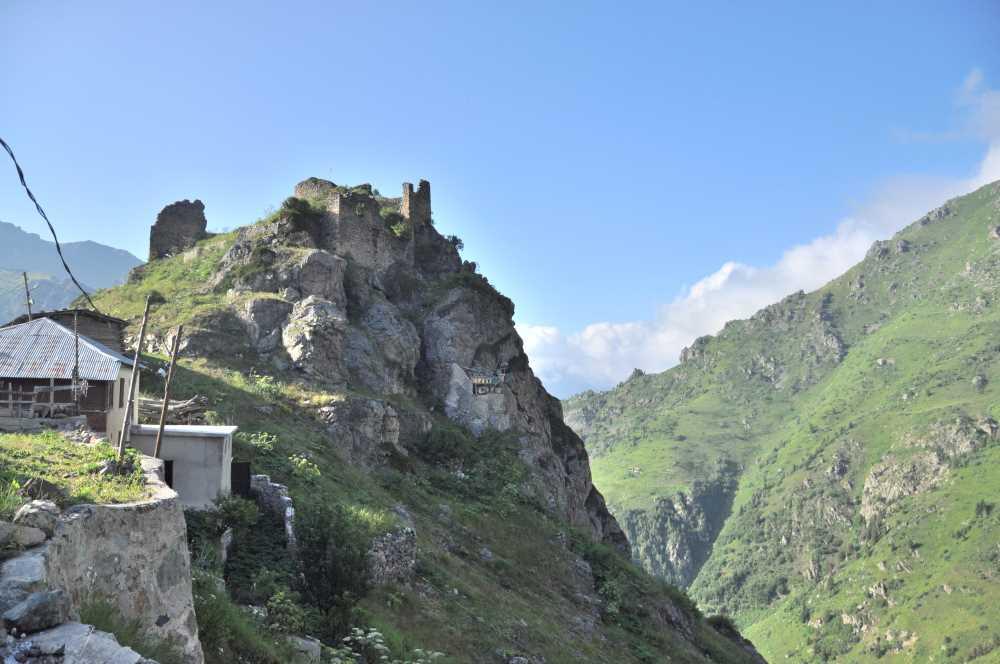
Kale-i Bala Castle (Rize Governorate)
The most prominent historical structure in Kale Village is the Kale-i Bala Castle, from which the village derives its name. The castle is dated to the 14th–15th centuries and exhibits architectural similarities to Zil Castle. According to some sources, the earliest foundations of the structure extend as far back as 300 BCE, to the period when the region was dominated by Iranian peoples.
The castle has a rectangular plan and is built atop a steep rocky outcrop. Its main entrance is located on the northwest side. The masonry is constructed using cut stone technique. Today, portions of the rampart walls have collapsed. Within the interior, it is believed that the vaulted space adjacent to the eastern wall served as a cistern. The castle is among the most important defensive structures in the region due to its strategic location and topographical dominance.
Throughout its history, Kale Village has been settled by numerous different families. According to the accounts of İslamoğlu Rasim Bozkurt, who served in the Ottoman administration, the Haşiloğulları and İslamoğulları migrated from Erzurum, the Hacınumanoğulları from Narman, the Kadıoğulları from Kahramanmaraş, and the Tonyalılar from the Tonya region of Trabzon. Other families present in the village include the Azizoğulları, Murtazaoğulları, Yahyaoğulları, Köseoğulları, and Canbazlar.
The villagers have historically maintained a transhumance culture. Seasonal migrations from Pazar Beach to Kale in spring and from Kale to Yalı in autumn hold both economic and cultural significance. Migration routes, rest points, and communal meal traditions have been passed down from generation to generation.
Traditional livelihoods in the village have centered on livestock farming and agriculture. Dairy, cheese, and meat production on the highland pastures have been significant economic activities. In recent times, livestock farming has declined, and livelihoods now largely depend on villagers who work outside the village and return during the summer months. In the village, a traditional ceremony known as “bablabublik” is held, expressing the hope for sunshine. During this ritual, children collect food from houses in the village, after which a communal meal is prepared and shared to complete the ceremony.
Kale Village consists of eleven settlement areas: Varoş, Kala, Dervişli, Merze, Orta Sırt, Baş Çayır, Faikli, Büyükdüz, Yenimahalle, Beşevler and Çiçekli Yayla. The Kale Camii, located at the village center, is notable for its historical structure. Originally built with wood, the mosque was reconstructed in stone after a fire. Adjacent to the mosque is the Topardı Şehitliği, believed to contain the graves of castle soldiers. Surrounding the village is the Beddualı Forest, a natural area preserved by villagers through traditional practices. This forest is considered sacred and permits tree cutting only for the construction or repair of communal village structures.
Kale Village was incorporated into the Kaçkar Mountains National Park in 1994.
The National Park Development Plan prepared in 2007 and the Protection-Oriented Urban Plan dated 2017 have served as foundational documents for the village’s planning. However, the preparation of these plans without the participation of villagers has led to various objections and legal proceedings.
Karadeniz Turizm ve Kalkınma Ajansı. "Kale-i Bala." Karadeniz.gov.tr. Accessed October 20, 2025. http://karadeniz.gov.tr/kale-i-b-l/
T.C. Ministry of Culture and Tourism. "Kale-i Bala - Gezilecek Yerler." KültürPortali.gov.tr. Accessed October 20, 2025. https://www.kulturportali.gov.tr/turkiye/rize/gezilecekyer/kale-i-bala
T.C. Rize Valiliği. “Kale-i Bala’nın Turizm Odağı Olmasını Hedefliyoruz.” Rize.gov.tr. Erişim Tarihi: 20 Ekim 2025. http://www.rize.gov.tr/kale-i-balanin-turizm-odagi-olmasini-hedefliyoruz
Çamlıhemşin Education and Culture Association. “Kaçkarın Kalesi Kale-i Bala.” Çamlıhemşin.org, November 15, 2023. Accessed October 20, 2025. https://camlihemsin.org/makale-kackarin-kalesi-kale-i-bala-256

Historical Names | Varoş, Vartor, Kale-i Bala, Kale-i Zir | ||||||||
|---|---|---|---|---|---|---|---|---|---|
Castle Construction Period | 300 BCE (original construction) – 14th–15th centuries (reconstruction) | ||||||||
Construction Material | Cut Stone, Rubble Stone | ||||||||
Prominent Features | Within Kaçkar Mountains National Park; First Degree Protected Area | ||||||||
No Discussion Added Yet
Start discussion for "Kale-i Bala (Kale Village)" article
History
Origin and Meaning of the Name
Kale-i Bala Castle
Sociological and Cultural Structure
Economic Life and Traditions
Settlement Areas and Neighborhoods
Natural and Archaeological Status