


This article was automatically translated from the original Turkish version.
+2 More
Place(s) | Osmancık Türkiye Çorum | ||||||||
|---|---|---|---|---|---|---|---|---|---|
Elevation(s) | 275 m (elevation) wall height: 30 m | ||||||||
Length(s) | 250 m | ||||||||
Number of Steps | 272 | ||||||||
Material(s) | Cut stone Horasan mortar | ||||||||
Period(s) | Roman Ottoman Seljuk | ||||||||
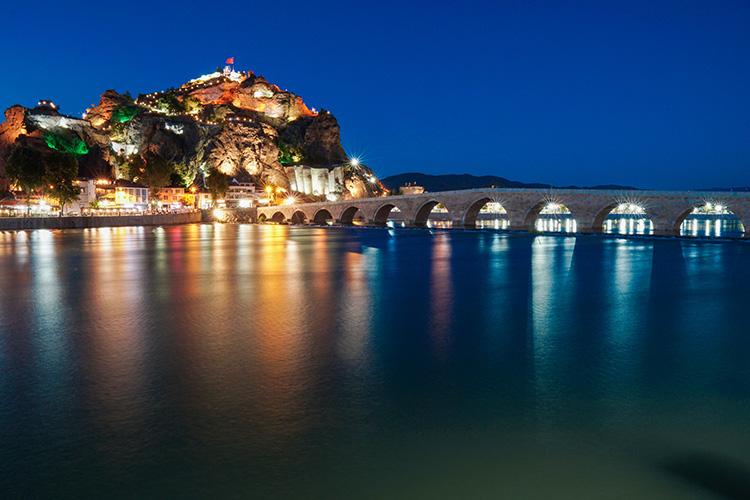
Kandiber Castle is built on a natural rocky outcrop along the northern bank of the Kızılırmak River within the boundaries of the Osmancık district of Çorum Province, Türkiye. The length of the castle’s walls is approximately 250 metres, and their height reaches about 30 metres. The structure commands a dominant position over the district centre. Within the castle’s interior, a rock-hewn bath remains along with two gate systems. The wall masonry employs Horasan mortar. Access to the castle is provided via a stone staircase consisting of 272 steps.

Kandiber Castle (Anadolu Agency)
The exact date of construction of Kandiber Castle is unknown. Various theories exist regarding its origins. Some sources suggest it dates back to the Hittite period, while others claim it was built during the Umayyad raids of the Byzantine era. According to the most widely accepted view, the castle was constructed during the Roman period and has survived to the present day through various repairs carried out during the Seljuk and Ottoman eras.
Within the castle remain remnants of towers, observation posts, entrance gates, and rock-cut tombs. These rock-cut tombs, dated to the Roman period, are located in the southern section of the castle. A fragment of an inscription is present on the front face of the structure. Additionally, foundations of recently abandoned dwellings have been identified on the castle’s summit. Historical sources indicate that at one time the castle housed nearly 200 homes, while the number of residences outside the walls did not exceed 80.

Kandiber Castle (Anadolu Agency)
The Ottoman traveler Evliya Çelebi described the castle’s perimeter as measuring 800 steps and noted that it had a gate made of iron. In the 19th century, Ainsworth, who visited the region, documented in his drawings that the nearby town of Osmancık contained 300 houses, five mosques, one caravanserai, and a bathhouse, while emphasizing the castle’s prominent elevation.
Kandiber Castle lies along the historic trade route connecting Istanbul to Amasya, granting it military and commercial significance throughout history. The castle preserves traces of various civilizations from the Hittites to the Ottomans, reflecting this layered heritage through its rock-cut tombs, water channels, and curtain walls.
Anadolu Ajansı. “Yüzyıllardır Ayakta Kalan 272 Basamaklı Kandiber Kalesi.” Accessed June 19, 2025. https://www.aa.com.tr/tr/kultur/yuzyillardir-ayakta-kalan-272-basamakli-kandiber-kalesi/2966739.
Osmancık Municipality. "Osmancık Kalesi." *Osmancık Belediyesi Resmî Web Sitesi*. Accessed June 19, 2025. https://osmancik.bel.tr/osmancik-kalesi.
T.C. Ministry of Culture and Tourism. "Kuleler-Kaleler." Çorum İl Kültür veTurizm Müdürlüğü. Accessed June 19, 2025. https://corum.ktb.gov.tr/TR-58709/kuleler-kaleler.html.
Türkiye Kültür Portalı. "Osmancık Kandiber Kalesi - Çorum." T.C. Kültür ve Turizm Bakanlığı Türkiye Kültür Portalı. Accessed June 19, 2025.

Place(s) | Osmancık Türkiye Çorum | ||||||||
|---|---|---|---|---|---|---|---|---|---|
Elevation(s) | 275 m (elevation) wall height: 30 m | ||||||||
Length(s) | 250 m | ||||||||
Number of Steps | 272 | ||||||||
Material(s) | Cut stone Horasan mortar | ||||||||
Period(s) | Roman Ottoman Seljuk | ||||||||
Historical Background
Architectural and Archaeological Remains
Observations and Traveler Accounts
Cultural and Historical Context