


This article was automatically translated from the original Turkish version.
+2 More
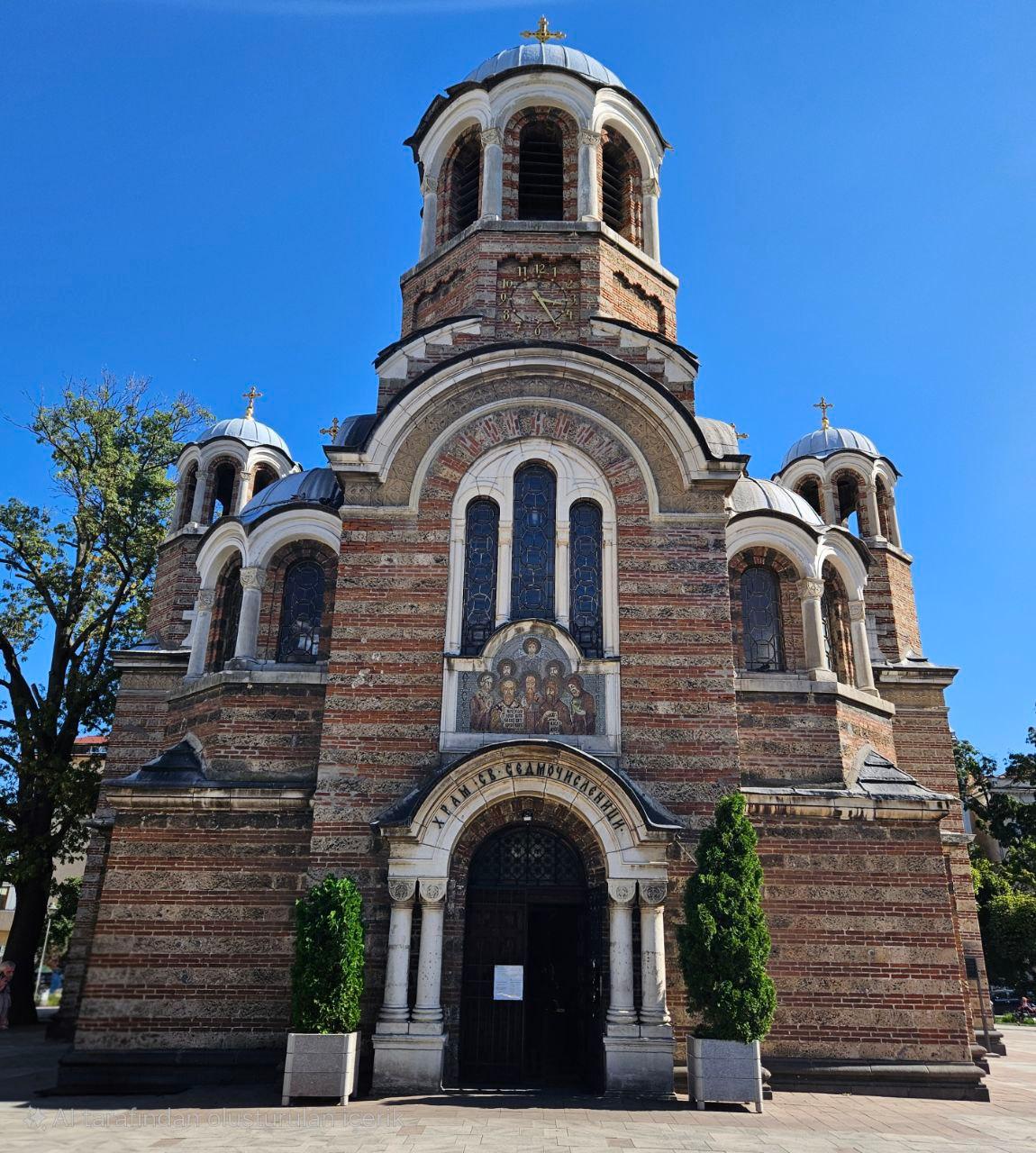
Black Mosque (Photo: Meryem Şentürk Çoban)
Location | Sofia Bulgaria | ||||||||
|---|---|---|---|---|---|---|---|---|---|
Founder(s) | Sofu Mehmed Pasha of Bosnia | ||||||||
Architect(s) | Mimar Sinan | ||||||||
Construction Date(s) | 1548 | ||||||||
Opening as a Church | 1903 | ||||||||
Kara Cami is a significant külliye structure from the Ottoman period located in Sofia, the capital of present-day Bulgaria. It was commissioned in 1548 by Bosnian Sofu Mehmed Pasha, who served as vizier during the reign of Kanuni Sultan Süleyman. Recognized as the only work of Mimar Sinan in Sofia, the mosque formed the center of a large waqf complex that included a madrasa, imaret, caravanserai, library, and later an additional hammam.

Kara Cami (Sveti Sedmočislenitsi Church) (Photo: Meryem Şentürk Çoban)
At the time of its construction, the mosque was known as the “İmaret Camii” due to the size of its imaret and as the “Cuma Camii” because it served as the central Friday prayer mosque. From the nineteenth century onward, it became known as “Kara Cami” due to its minaret being clad in black stones. Evliya Çelebi described the structure as a “bright place of worship,” highlighting its high dome and ornamental details.
By the mid-nineteenth century, the waqf’s revenues had declined, leading first to the cessation of the imaret’s operations and later to the closure of the madrasa’s educational activities.
During the Russo-Turkish War of 1877–1878, the mosque was used by the Russian army as an arsenal. During this period, it lost its religious function, and shortly afterward, its minaret was demolished by dynamite. As a result, the mosque completely lost its original Ottoman-era function.
After 1878, the Bulgarian authorities initiated efforts to convert the mosque into a church. In 1901, under the leadership of Bulgarian politician Petko Karavelov, an official decision was made to proceed with the conversion. The transformation project was designed by Russian architect A. N. Pomerantsev and Bulgarian architects Yordan Milanov and Petko Momčilov. During this process, the wall containing the mihrab was breached, a bell tower and additional domes were added, and the final prayer hall was demolished.

Depiction of the Seven Saints Giving the Church Its Name (Photo: Meryem Şentürk Çoban)
On 27 July/9 August 1903, the building was inaugurated as the Sveti Sedmočislenitsi (Seven Saints) Church for Orthodox worship. The opening ceremony was conducted by Bulgarian bishop Parteniy, and Karavelov, the intellectual architect of the conversion, was buried in the churchyard according to his will.

Grave of Petko Karavelov (Photo: Meryem Şentürk Çoban)
Today, Kara Cami serves as the Sveti Sedmočislenitsi Church for the Bulgarian Orthodox community. As the central structure of one of Sofia’s largest Ottoman-era külliyes, it is regarded as one of the most important examples of Ottoman heritage in the Balkans and one of Mimar Sinan’s most significant works in the region.
Kara Cami is recognized as the only work of Mimar Sinan in Sofia. The building was constructed on a square plan covering an area of 484 m². The central dome, supported by pendentives, rises to a height of approximately 22 meters.
The central space of the mosque is square and covered by a single large dome. The pendentive transition system supporting the dome is consistent with classical Ottoman mosque architecture of the period. In front of the main prayer hall stood a three-bay final prayer hall.
A slender, tall minaret stood to the right of the mosque. Because its shaft was clad in black stones, the structure became known as “Kara Cami” from the nineteenth century onward. The minaret was demolished by dynamite after the Russo-Turkish War of 1877–1878, carried out by Russian forces.
Evliya Çelebi described the mosque as a “bright place of worship,” noting its high dome, luminous interior, and decorative elements. This characterization underscores the mosque’s status as one of the most prominent examples of classical Ottoman mosque design in Sofia.
When the decision to convert the mosque into a church was made in 1901, extensive architectural modifications were carried out. The wall containing the mihrab was pierced, a bell tower was added, certain sections were demolished to make way for new domes, and the final prayer hall was removed. These alterations adapted the structure to conform to Orthodox church architecture.
Bayrak (Ferlibaş), Meral. "Sofya’da XVI. Yüzyıla Ait Bir Vakıf Örneği: Sofu Mehmed Paşa Külliyesi ve Camiden Kiliseye Çevrilmiş Bir Mabedin Hikâyesi." *Türk Kültürü İncelemeleri Dergisi*, no. 19 (2008): 1–42. https://dergipark.org.tr/tr/pub/tkidergi/issue/77643/1305625
Bilecik, Gülberk. "Sofya’da Günümüze Ulaşan Osmanlı Mimari Eserleri." *Yeni Türkiye*, 67 (2015): 1916-1926. https://stratejikistihbarat.wordpress.com/wp-content/uploads/2015/08/sofyada-gnmze-ulaan-osmanl-mimari-eserleri.pdf
Karakuş, Filiz. "Bulgaristan'ın Sofya, Filibe ve Eski Zağra Kentlerinde İnşa Edilen Osmanlı Camileri Üzerine Bir Değerlendirme Çalışması." *Uluslararası Sosyal ve Beşeri Bilimler Araştırma Dergisi* 8, no. 71 (2021): 1564-1582. https://jshsr.org/index.php/pub/article/view/356/345
Koyuncu, Aşkın. "Sofya’daki Sofu Mehmed Paşa Camisi (Kara Cami)’nin Kiliseye Dönüştürülmesi." *Uluslararası Balkanlarda Türk Varlığı Sempozyumu -II Bildiriler*. Edited by Şenel, Ünal. Volume 2. Manisa. (2010): 129-146. Bağlantı
Özkan, Selim Hilmi. "Balkanlar’da Bir Osmanlı Şehri: Sofya (1385-1878)." *Avrasya Etüdleri* 50, no. 2 (2016): 279–314. https://dergipark.org.tr/tr/pub/avrasya/issue/35350/392478

Black Mosque (Photo: Meryem Şentürk Çoban)
Location | Sofia Bulgaria | ||||||||
|---|---|---|---|---|---|---|---|---|---|
Founder(s) | Sofu Mehmed Pasha of Bosnia | ||||||||
Architect(s) | Mimar Sinan | ||||||||
Construction Date(s) | 1548 | ||||||||
Opening as a Church | 1903 | ||||||||
No Discussion Added Yet
Start discussion for "Kara Mosque (Sofu Mehmed Pasha Mosque / Saint Seven Saints Church)" article
History
Ottoman Period
The 93 War and Its Aftermath
Conversion into a Church
Present Day
Architectural Features
Plan and Spatial Organization
Minaret
Interior and Exterior Decorations
Changes Made During Conversion into a Church