


This article was automatically translated from the original Turkish version.
+2 More
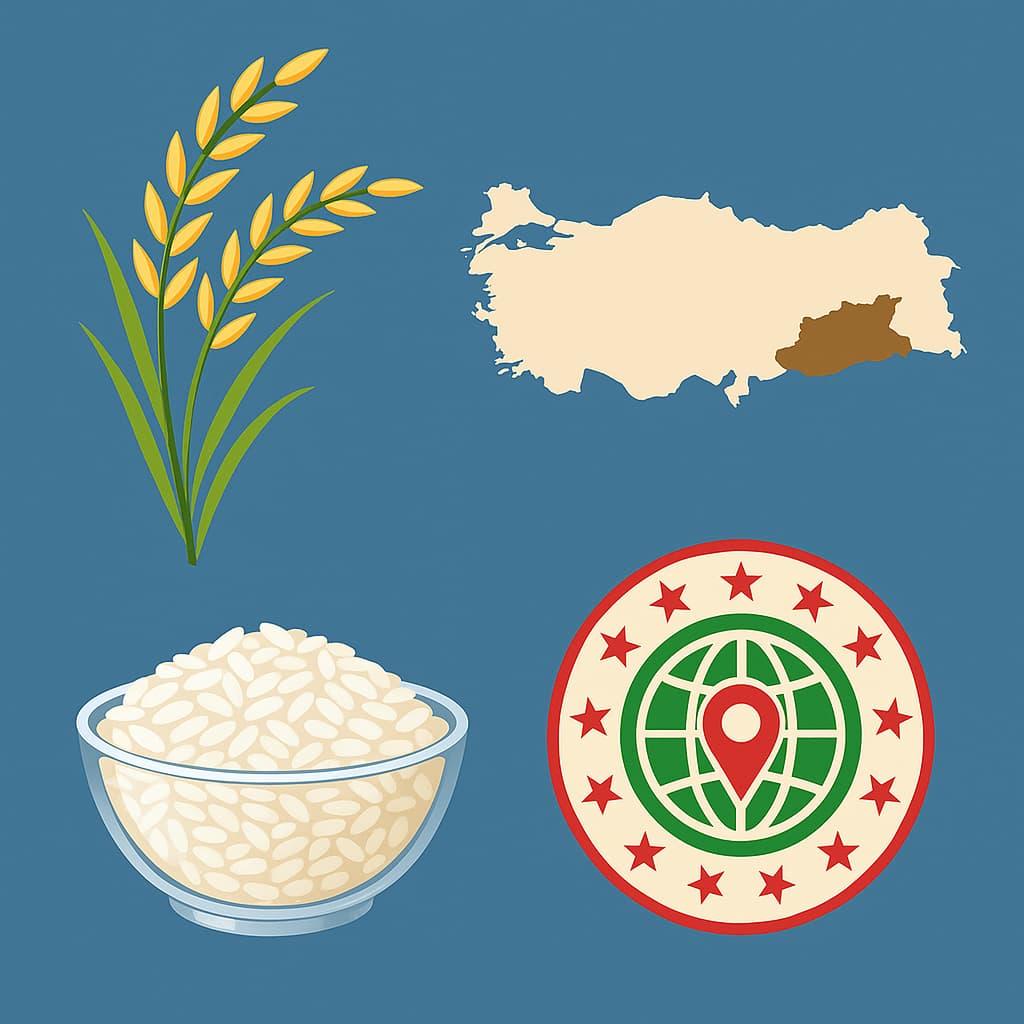
Karacadağ Rice
Geographical Indication Type(s) | Origin Name | ||||||||
|---|---|---|---|---|---|---|---|---|---|
Registration Number | 337 | ||||||||
Registration Date | 2018-03-28 | ||||||||
Geographical Boundary | Diyarbakır (Karacadağ basin) Mardin (Derik) Şanlıurfa (Siverek Viranşehir) | ||||||||
Karacadağ Rice is a registered rice variety derived from a local strain of Oryza sativa L. and is unique to Turkey’s Southeastern Anatolia Region. It was officially registered in 2018 by the Turkish Patent and Trademark Office with geographical indication status as a “name of origin.” The product is predominantly cultivated on stony volcanic soils in the Diyarbakır Karacadağ Basin and its surrounding areas. Karacadağ Rice differs from other cultivated rices due to its traditional production methods as well as its morphological physiological and biochemical characteristics.
The name “Karacadağ” originates from the mountain of the same name located in the region which has a basaltic volcanic structure. The Karacadağ Basin where the rice is grown encompasses districts and villages in Diyarbakır (Çınar Hazro Çermik Kocaköy) Şanlıurfa (Siverek Viranşehir) and Mardin (Derik). This basin is characterized by shallow reddish-brown soils rich in volcanic stones. The organic matter content is high approximately 5% but soil cultivation opportunities are very limited.
Karacadağ rice is a fibrous-rooted plant. During germination the coleorhiza forms first followed by embryonic roots and adventitious roots. From the opposite end of the embryo the coleoptile emerges and cylindrical leaves develop within this structure. The plant’s leaves are short and upright with high light permeability.
Karacadağ Rice has a high protein content (8–11%) and starch content (70–80%). It contains essential amino acids such as arginine and volatile fatty acids. This chemical composition enables the grains to absorb up to twice their weight in water during cooking. After cooking the grains remain intact non-gelatinized and non-sticky. The lipid content exceeds 2% which makes the rice unsuitable for long-term storage but ideal for fresh consumption.
Karacadağ rice is mostly grown with no-till or minimal tillage practices. Due to the difficulty of mechanized farming on stony terrain broadcast seeding is common. In flat areas deep plowing with a moldboard plow is followed by shallow tillage using a cultivator and disk harrow. The limited use of modern agricultural techniques and the absence of terracing are key distinguishing factors between Karacadağ Rice and conventional rice production.
Sowing typically occurs between April 20 and May 30. Of farmers 82% use certified seeds from private breeders while only 18% save seed from their own harvest. Seed quantity varies according to land structure ranging from 7 to 16 kg per hectare. Seeds are usually sown by hand. Germination is achieved through direct flooding without any covering operation.
Unlike conventional rice cultivation Karacadağ Rice is irrigated with cold water sources. Irrigation water is supplied by snowmelt reservoirs springs boreholes and tributaries of the Tigris and Euphrates rivers. The furrow irrigation method is applied. Water is generally provided every two to three days. Even when summer temperatures exceed 46 °C efforts are made to maintain minimal water stress in the plants.
According to survey data 98% of farmers use fertilizers. The most common are diammonium phosphate (DAP) and urea applied as basal and top dressings. Karacadağ Rice is notable for its low nutrient requirement and therefore high fertilizer doses are rarely used. Excessive fertilization has been observed to reduce product quality.
Harvesting typically takes place between September 20 and October 15. Depending on terrain the crop is harvested either mechanically with a combine harvester or manually with a sickle. The optimal harvest time is when 80% of the panicles have turned straw yellow. A grain moisture content of 22–24% is considered ideal for harvesting. Hand-harvested crops are dried before threshing using a traditional flail or combine harvester.
Karacadağ Rice production is primarily carried out by small and medium-sized family farms. Field surveys in Siverek indicate that 82% of producers own less than 200 decares of land. Of these 44% cultivate their own land while 56% are tenants or sharecroppers.
The responsibility for irrigation is often entrusted to local water distributors known as “cenan.” These individuals receive approximately 10% of the harvest as payment for irrigation services. In some villages water sources are shared communally in which case irrigation shares are distributed according to landowners’ proportional holdings.
Karacadağ Rice serves as a subsistence crop for farmers in the region. The quantity produced typically meets only the annual household consumption needs. Some producers sell surplus yields to generate limited income. Although the rice is preferred in local markets due to its distinctive aroma and traditional value its marketability on a larger scale remains limited.
Karacadağ Rice is not a pure variety but a mixed local population. This condition enables the preservation of genetic diversity and facilitates the development of resistance against ecological stressors such as drought disease and low temperatures. Its high adaptability to hot stony and nutrient-poor soils makes it a valuable genetic resource for local breeding programs. Additionally its low dependence on chemical inputs makes it a suitable candidate for transition to organic farming. To date no officially registered “certified Karacadağ seed” exists. This situation is limiting both for genetic conservation and commercialization.
Karacadağ Pirinci Geographical Indication Registration Certificate. Turkish Patent and Trademark Office, March 28, 2018. https://ci.turkpatent.gov.tr/Files/GeographicalSigns/3db407fd-1244-403b-920f-57d7918bc017.pdf.
Öktem, Abdullah. “Şanlıurfa Koşullarında Karacadağ Çeltiği (Oryza sativa L.) Yetiştiriciliği Üzerine Anket Çalışması.” *Türkiye Tarımsal Araştırmalar Dergisi* 3, no. 2 (2016): 102–108. Accessed June 3, 2025. https://dergipark.org.tr/tr/download/article-file/262520.
Karacadağ Rice
Geographical Indication Type(s) | Origin Name | ||||||||
|---|---|---|---|---|---|---|---|---|---|
Registration Number | 337 | ||||||||
Registration Date | 2018-03-28 | ||||||||
Geographical Boundary | Diyarbakır (Karacadağ basin) Mardin (Derik) Şanlıurfa (Siverek Viranşehir) | ||||||||
Etiology and Growing Region
Botanical and Morphological Characteristics
Plant and Structural Features
Grain Characteristics
Chemical and Nutritional Composition
Agricultural Methods and Production Techniques
Field Preparation
Sowing and Seed Production
Irrigation
Fertilization
Harvesting and Threshing
Socioeconomic Structure and Land Ownership Relations
Land Size and Producer Profile
Irrigation and Cooperative Systems
Economic Role
Genetic Value and Breeding Potential