This article was automatically translated from the original Turkish version.
Registration Number | 1096 | ||||||||
|---|---|---|---|---|---|---|---|---|---|
Registration Date | 28.04.2022 | ||||||||
Application Number | C2020/079 | ||||||||
Application Date | 13.03.2020 | ||||||||
Name of the Geographical Indication | Karaköprü Tat Karpuzu | ||||||||
Product / Product Group(s) | Watermelon / Processed and Unprocessed Fruits and Vegetables and Mushrooms | ||||||||
Type of Geographical Indication | Place of Origin | ||||||||
Registered Owner | Karaköprü Municipality | ||||||||
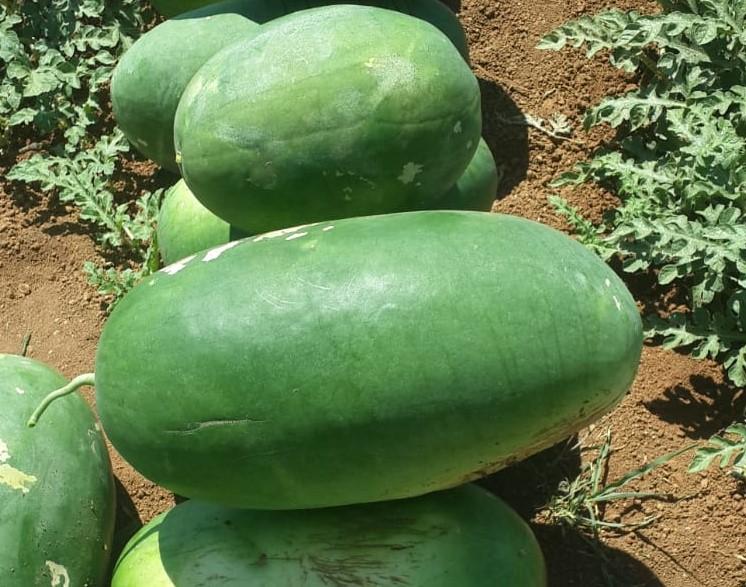
Karaköprü Sweet Watermelon is a product obtained from the annual watermelon plant Citrullus lanatus, cultivated in the Karaköprü district of Şanlıurfa Province. The product is labeled with the logo and origin designation “Karaköprü Tat Karpuzu” on its packaging or directly on the fruit. In cases where the logo and origin designation cannot be applied to the packaging or product, they must be visibly displayed at the production facility.

Karaköprü Tat Karpuzu (Karaköprü Municipality)
The Karaköprü Sweet Watermelon plant grows by branching. Leaves are 10–18 cm long and 7–11 cm wide, with a dark green color. They have a bubbled texture with wavy margins and a petiole measuring 4–5 cm in length. Flowers are monoecious, with male and female flowers occurring on separate parts of the same plant. The corolla of the female flower has a pointed tip, and the ovary measures 2–3 cm in length and 0.5–0.8 cm in width. The fruit is nearly spherical at the base and flat at the apex, with an average weight of approximately 8 kg. It has a cylindrical cross-section, with a green rind marked by narrow stripes. The outer rind thickness is 16.2 ± 2.4 mm.
The 1000-seed weight of Karaköprü Sweet Watermelon ranges from 1445 to 1460 mg, with individual seeds measuring approximately 15 mm in length and 8 mm in width. Seed coat color varies between cream and black tones. As a traditional watermelon variety, Karaköprü Sweet Watermelon is propagated using its own seeds for the following growing season.
Seeds are sown during the last week of May. The planting area is tilled several days in advance with row spacing of 3 m. A distance of three steps is maintained between individual seeds. Karaköprü Sweet Watermelon is highly tolerant of high temperatures and drought and is cultivated under conditions with no irrigation or fertilization. After the first seedlings emerge, inter-row weeding is performed and the crop is aerated. Insecticide treatment is applied 45 days after sowing to control aphids. Harvesting begins at the beginning of August and continues until the end of November. The product is stored in ventilated, dark storage facilities at temperatures of 2–8 ºC and relative humidity of 70–85%. Seeds are dried and stored in paper or cloth bags in a cool, dark place.

Karaköprü Tat Karpuzu (Karaköprü Municipality)
Inspections are conducted under the coordination of the Karaköprü Municipality by experts from the Karaköprü Municipality, Şanlıurfa Provincial Directorate of Agriculture and Forestry, GAP Agricultural Research Institute, and Harran University Department of Food Engineering. Inspections are carried out at least twice annually, during the second half of August and October. Additional inspections may be conducted at any time if deemed necessary or in response to complaints. Inspection criteria include conformity with botanical, seed and fruit characteristics, adherence to production methods, compliance with harvesting and storage conditions, and correct use of the logo and origin designation.
Before registration, the Karaköprü Municipality, in collaboration with Harran University, the Provincial Directorate of Agriculture and Forestry, and GAPTEM, conducted morphological characterization studies of the population. Efforts have also been made to revive production in the rural neighborhoods of Tatburç, Yoğunburç and Sayburç, where the variety was historically cultivated intensively.
Karaköprü Municipality. "Karaköprü’de Tat Karpuzunun Coğrafi İşareti Alınıyor." Accessed August 17, 2025. https://www.karakopru.bel.tr/icerik/792/12/-karakoprude-tat-karpuzunun-cografi-isareti-aliniyor.
Türk Patent ve Marka Kurumu. "Karaköprü Tat Karpuzu Coğrafi İşaret Detayı." Accessed August 17, 2025. https://ci.turkpatent.gov.tr/cografi-isaretler/detay/1813.
Türk Patent ve Marka Kurumu. "Karaköprü Tat Karpuzu Tescil Dosyası." Accessed August 17, 2025. http://ci.turkpatent.gov.tr/Files/GeographicalSigns/83c3526d-672b-4980-9859-5bb6677cd735.pdf.

Registration Number | 1096 | ||||||||
|---|---|---|---|---|---|---|---|---|---|
Registration Date | 28.04.2022 | ||||||||
Application Number | C2020/079 | ||||||||
Application Date | 13.03.2020 | ||||||||
Name of the Geographical Indication | Karaköprü Tat Karpuzu | ||||||||
Product / Product Group(s) | Watermelon / Processed and Unprocessed Fruits and Vegetables and Mushrooms | ||||||||
Type of Geographical Indication | Place of Origin | ||||||||
Registered Owner | Karaköprü Municipality | ||||||||
No Discussion Added Yet
Start discussion for "Karaköprü Sweet Watermelon" article
Botanical Characteristics
Seed Characteristics
Production Method
Inspection
Pre-Registration Studies