


This article was automatically translated from the original Turkish version.
+1 More
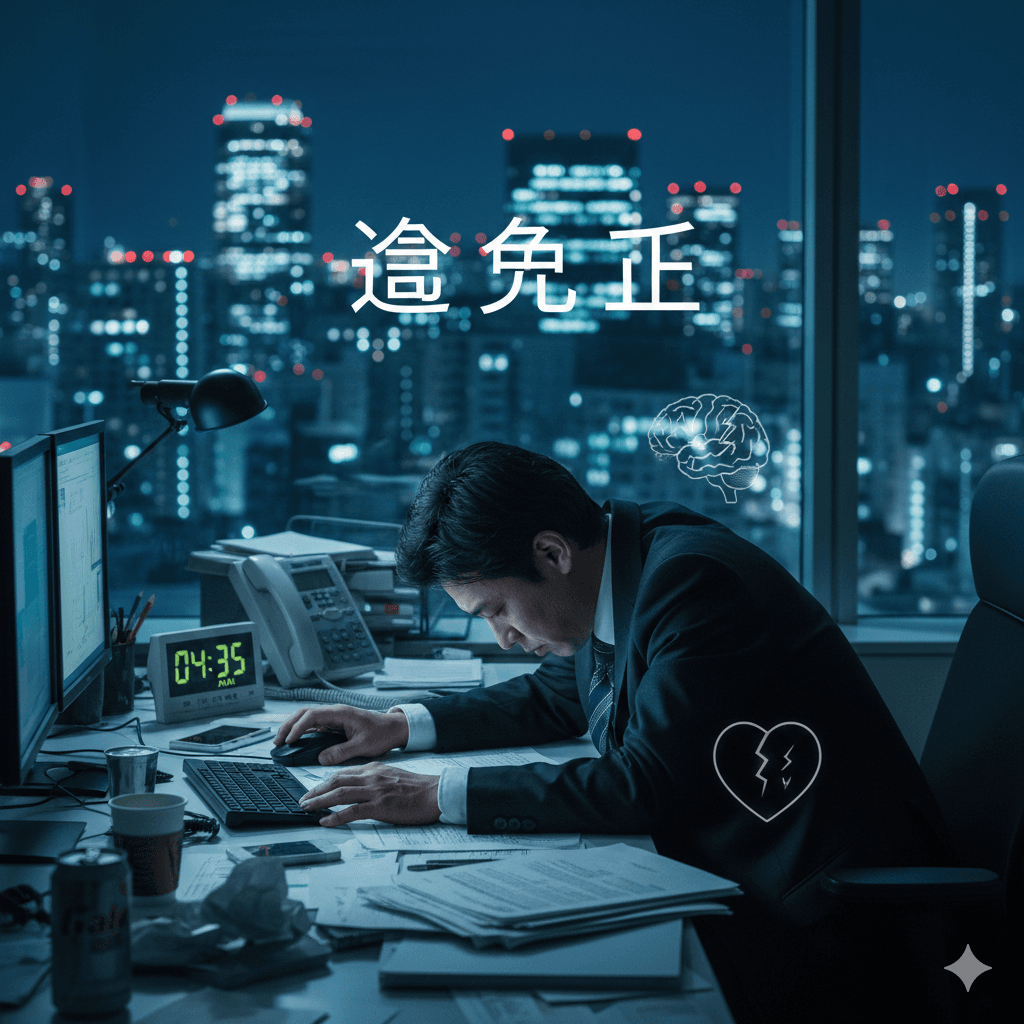
Karoshi (Generated by Artificial Intelligence.)
Official Name(s) | Karoshi (過労死) | ||||||||
|---|---|---|---|---|---|---|---|---|---|
Etymology(s) | A combination of the Japanese words 'Karo' (excessive work) and 'Shi' (death) | ||||||||
Scope(s) | Heart attack suicides due to severe work stress acute heart failure stroke | ||||||||
Prevention Methods | Work-rest interval system (11-hour rule), mandatory light shutdown, AI-supported mental health monitoring | ||||||||
Socioeconomic Causes | Culture of corporate loyalty, hierarchical pressure, tradition of unpaid overtime (sabisu zangyo) | ||||||||
Main Symptoms | Severe chest pain, shortness of breath, chronic insomnia, cognitive decline | ||||||||
Critical Legislation | 2014 Karoshi Prevention Law, 2019 Overtime Cap Reform | ||||||||
Fundamental Physiological Causes | Chronic fatigue, sleep deprivation, hypertension, malignant arrhythmias | ||||||||
First Officially Recognized Case | 1969; a 29-year-old newspaper distribution worker (death due to stroke) | ||||||||
Karoshi is a Japanese term that literally refers to deaths caused by overwork. This phenomenon is not merely a medical term but a social and legal concept encompassing deaths resulting from cardiovascular events such as stroke, myocardial infarction, or acute heart failure triggered by long working hours and excessive workloads, as well as work-related incapacity. Indeed, the law enacted in Japan in 2014 defines karoshi as deaths caused by cerebrovascular or ischemic heart disease due to excessive workloads, suicides resulting from mental disorders induced by severe workplace stress, and health problems arising from these causes even when they do not lead to death.
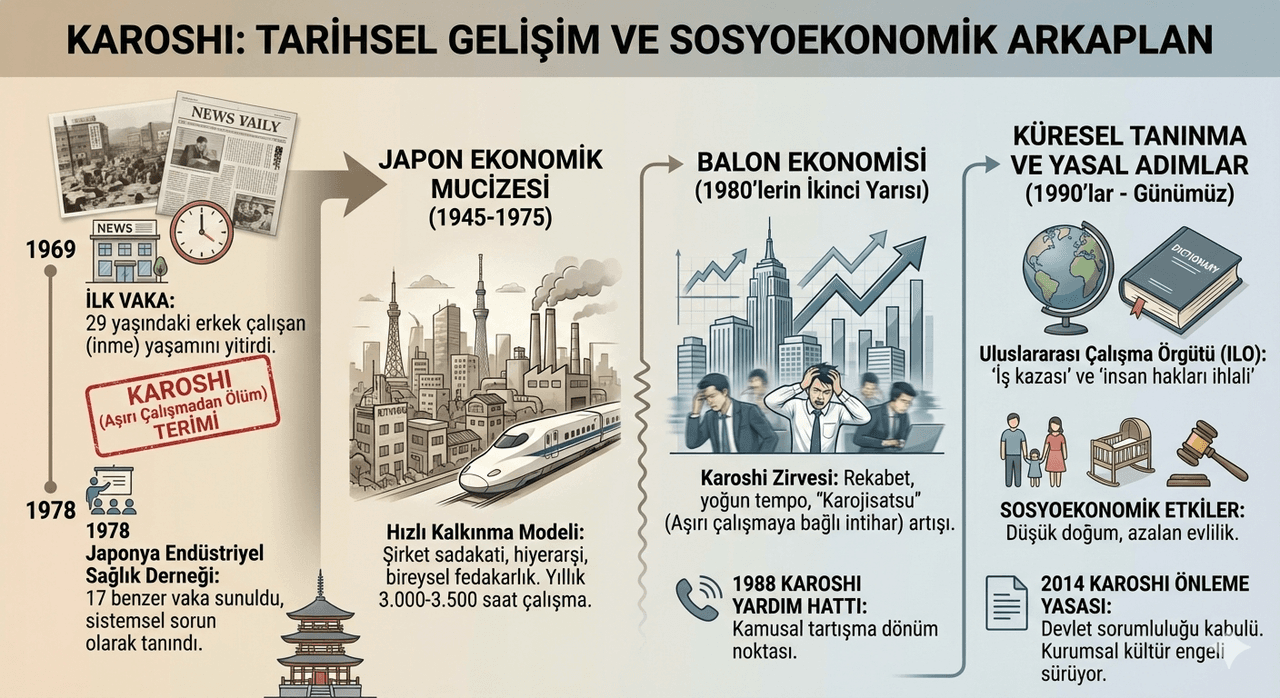
A Visual Representing the Historical Development of the Term Karoshi (Generated by Artificial Intelligence)
The term "karoshi" corresponds to the Japanese expression for "death from overwork." Its entry into medical and social literature dates back to the early 1970s. The first documented case occurred in 1969 when a 29-year-old male employee in the transportation and distribution division of one of Japan’s major newspaper companies died of a stroke caused by excessive workloads【1】. By 1978, the presentation of 17 similar cases at the annual meeting of the Japanese Association of Industrial Health established the issue as a systemic problem rather than isolated incidents.
The roots of the karoshi phenomenon lie in Japan’s post-World War II economic transformation. During the period from 1945 to 1975, known as the "Japanese Economic Miracle," the country became the world’s second-largest economy in less than thirty years. This rapid development model was built on foundations of corporate loyalty, absolute obedience to hierarchy, and the subordination of personal life to institutional goals. During this period, workers were not merely seen as sources of livelihood but as individual contributors to national development, leading to the social normalization of work hours reaching 3,000 to 3,500 hours per year.
The "bubble economy" of the second half of the 1980s marked the peak of karoshi cases. Workplace competition and intense work pace began affecting not only middle-aged managers but also young employees. During this period, alongside deaths, cases of "karojisatsu" (suicide due to overwork) also increased. The establishment of the "Karoshi Hotline" by victims’ families and legal advocates became a turning point in turning the issue into a public debate.
By the 1990s, karoshi had transcended Japan’s borders and become a globally recognized term in international labor literature and dictionaries. Organizations such as the International Labour Organization (ILO) began examining these cases within the frameworks of "workplace accidents" and "human rights violations." In Japanese society, the phenomenon is also discussed in relation to deep socio-economic side effects including low birth rates, declining marriage rates, and fragmented family structures. Although the 2014 Karoshi Prevention Law formally recognized the state’s responsibility to prevent such deaths, entrenched corporate cultural practices continue to sustain the phenomenon’s relevance.
The underlying medical mechanisms of karoshi cases are explained by the combination of chronic fatigue, high levels of work stress, and systematic sleep deprivation. Long working hours disrupt the body’s autonomic nervous system and endocrine balance, triggering a persistent "fight or flight" response. This leads to sustained high blood pressure, irregular heart rate, and structural damage to blood vessel walls. In medical literature, the primary causes of these deaths are severe cardiovascular events such as cerebral hemorrhage, cerebral infarction (stroke), myocardial infarction (heart attack), and acute heart failure.
The association between excessive work and disease prevalence is supported by large-scale epidemiological studies. Individuals working 55 hours or more per week have a 13 percent higher risk of developing coronary heart disease and a 33 percent higher risk of stroke compared to those working the standard 35 to 40 hours per week【2】. Additionally, sleep duration falling below six hours per day and insufficient uninterrupted rest periods negatively affect metabolic processes, contributing to secondary risk factors such as diabetes and obesity.
Forensic examinations of karoshi victims have often revealed no obvious macroscopic organic abnormalities at autopsy. However, microscopic studies indicate the presence of "myocardial interstitial fibrosis" (the replacement of heart muscle tissue with connective tissue). This pathological change can disrupt the heart’s electrical conduction system and trigger fatal (malignant) arrhythmias. Animal models have confirmed that extreme fatigue predisposes the heart to sudden lethal rhythms such as ventricular tachycardia.
Japanese legal regulations require specific thresholds of overtime to classify a death as medically attributable to overwork. According to these criteria, an individual must have worked more than 100 hours of overtime in the month preceding death, or averaged more than 80 hours of overtime per month over the two to six months prior to death (known as the "karoshi line"). These durations are considered to exceed human physiological tolerance and serve as legal evidence of destructive effects on the cardiovascular system.
In addition to physical illnesses, mental disorders caused by excessive workplace pressure and stress are a significant risk factor. Hierarchical pressure at work, inadequate social support, and the absence of rest time act as psychological triggers that erode an individual’s mental resilience and accelerate physical collapse.
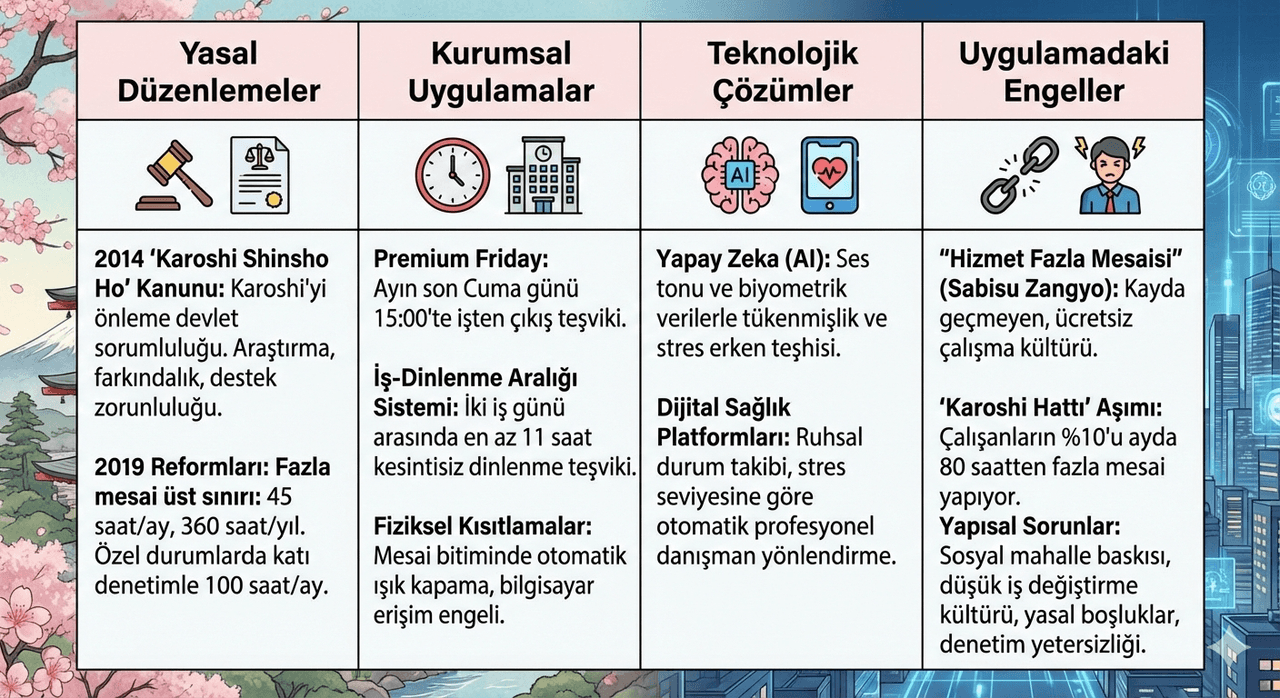
A Visual Representing Legal Regulations and Prevention Efforts (Generated by Artificial Intelligence)
In response to rising fatalities and societal pressure, the Japanese government enacted the "Law on the Promotion of Preventive Measures Against Karoshi and Other Health Disorders Caused by Overwork" (Karoshi Shinsho Ho) in 2014. This law was the first official regulation to recognize the prevention of overwork-related deaths as a state responsibility. It mandates national research on preventing overwork, the organization of awareness campaigns, and the establishment of support mechanisms for victims’ families. Reforms in 2019 introduced, for the first time in Japanese labor history, a legal upper limit on overtime: 45 hours per month and 360 hours per year (with limited exceptions allowing up to 100 hours per month under strict oversight).
The government has initiated initiatives such as "Premium Friday," a campaign encouraging employees to leave work at 3:00 p.m. on the last Friday of each month. Additionally, the "work-rest interval system" promotes at least 11 consecutive hours of uninterrupted rest between the end of one workday and the start of the next. Some local governments and private companies have implemented physical restrictions such as automatically turning off office lights or blocking computer access once working hours end.
Technological solutions have also been deployed to combat the overwork crisis. Artificial intelligence-based applications now analyze changes in employees’ vocal tones or biometric data to detect early signs of burnout and stress. Some companies use digital health platforms that monitor employees’ mental states and automatically refer individuals with elevated stress levels to professional counselors. These innovations aim to serve as early warning systems for Japanese workers who traditionally avoid disclosing psychological issues due to stigma.
Despite legal regulations, the most significant barrier in combating karoshi remains the culture of "sabisu zangyo" — unpaid, unrecorded overtime work. According to data, approximately one in ten Japanese workers still exceed the critical threshold of 80 hours of overtime per month (the karoshi line). Although the traditional Japanese concept of lifetime employment is weakening, the low culture of job mobility and social pressure from workplace communities continue to compel individuals to endure harsh working conditions. Furthermore, legal loopholes and insufficient oversight allow some sectors to maintain exploitative practices.
BBC. "Karoshi." Accessed February 9, 2026. https://www.bbc.com/worklife/article/20190718-karoshi
Digital Society Press. “How Japan is Healing from Its Overwork Crisis Through Innovation.” Chang, Grace. Accessed February 9, 2026. https://digitalsocietypress.com/2024/10/30/how-japan-is-healing-from-its-overwork-crisis-through-innovation/
International Labour Organization. "Case Study: Karoshi: Death from overwork." International Labour Organization. Accessed February 9, 2026.
Işık Erol, Sevgi. “Japon Çalışma Hayatının İki Büyük Problemi: Karoshi ve Karojisatsu / Two Big Problems of the Japanese Working Life: Karoshi and Karojisatsu.” *Çalışma Dünyası Dergisi* 3, no. 1 (January–April 2015): 15–31. Accessed February 9, 2026. https://kutuphane.dogus.edu.tr/mvt/pdf.php?pdf=0018899
KAROSHI. "KAROSHI Hotline" KAROSHI. Accessed February 9, 2026. https://karoshi.jp/english/
Pulitzer Center. “Karoshi: A Deep Look Into Japan’s Unforgiving Working Culture.” Accessed February 9, 2026. https://pulitzercenter.org/stories/karoshi-deep-look-japans-unforgiving-working-culture
UAB Institute for Human Rights. “Karoshi: The Problems with Japan’s Work Culture.” Accessed February 9, 2026. https://sites.uab.edu/humanrights/2024/11/22/karoshi-the-problems-with-japans-work-culture/
Xiao, Ning, Bo-Fan Yang, Jing-Zhuo Shi, Yan-Geng Yu, Fu Zhang, Qi Miao, and Dong-Ri Li. “Karoshi May Be a Consequence of Overwork-Related Malignant Arrhythmia.” *Medical Science Monitor* 25 (2019): 357–364. Accessed February 9, 2026. https://pmc.ncbi.nlm.nih.gov/articles/PMC6339454/
[1]
Digital Society Presss. “How Japan is Healing from Its Overwork Crisis Through Innovation.” Chang, Grace. Accessed 9 February 2026. https://digitalsocietypress.com/2024/10/30/how-japan-is-healing-from-its-overwork-crisis-through-innovation/
[2]
Xiao, Ning, Bo-Fan Yang, Jing-Zhuo Shi, Yan-Geng Yu, Fu Zhang, Qi Miao, and Dong-Ri Li. “Karoshi May Be a Consequence of Overwork-Related Malignant Arrhythmia.” Medical Science Monitor 25 (2019): 357–364, page 358, Accessed 9 February 2026, https://pmc.ncbi.nlm.nih.gov/articles/PMC6339454/


Karoshi (Generated by Artificial Intelligence.)
Official Name(s) | Karoshi (過労死) | ||||||||
|---|---|---|---|---|---|---|---|---|---|
Etymology(s) | A combination of the Japanese words 'Karo' (excessive work) and 'Shi' (death) | ||||||||
Scope(s) | Heart attack suicides due to severe work stress acute heart failure stroke | ||||||||
Prevention Methods | Work-rest interval system (11-hour rule), mandatory light shutdown, AI-supported mental health monitoring | ||||||||
Socioeconomic Causes | Culture of corporate loyalty, hierarchical pressure, tradition of unpaid overtime (sabisu zangyo) | ||||||||
Main Symptoms | Severe chest pain, shortness of breath, chronic insomnia, cognitive decline | ||||||||
Critical Legislation | 2014 Karoshi Prevention Law, 2019 Overtime Cap Reform | ||||||||
Fundamental Physiological Causes | Chronic fatigue, sleep deprivation, hypertension, malignant arrhythmias | ||||||||
First Officially Recognized Case | 1969; a 29-year-old newspaper distribution worker (death due to stroke) | ||||||||
Historical Development and Socioeconomic Background
Medical Causes and Risk Factors
Forensic Findings and the Malignant Arrhythmia Hypothesis
Legal Regulations and Prevention Efforts
Corporate Practices and the Right to Rest
Technological Innovation and Mental Health Monitoring
Implementation Barriers and Structural Issues