


This article was automatically translated from the original Turkish version.
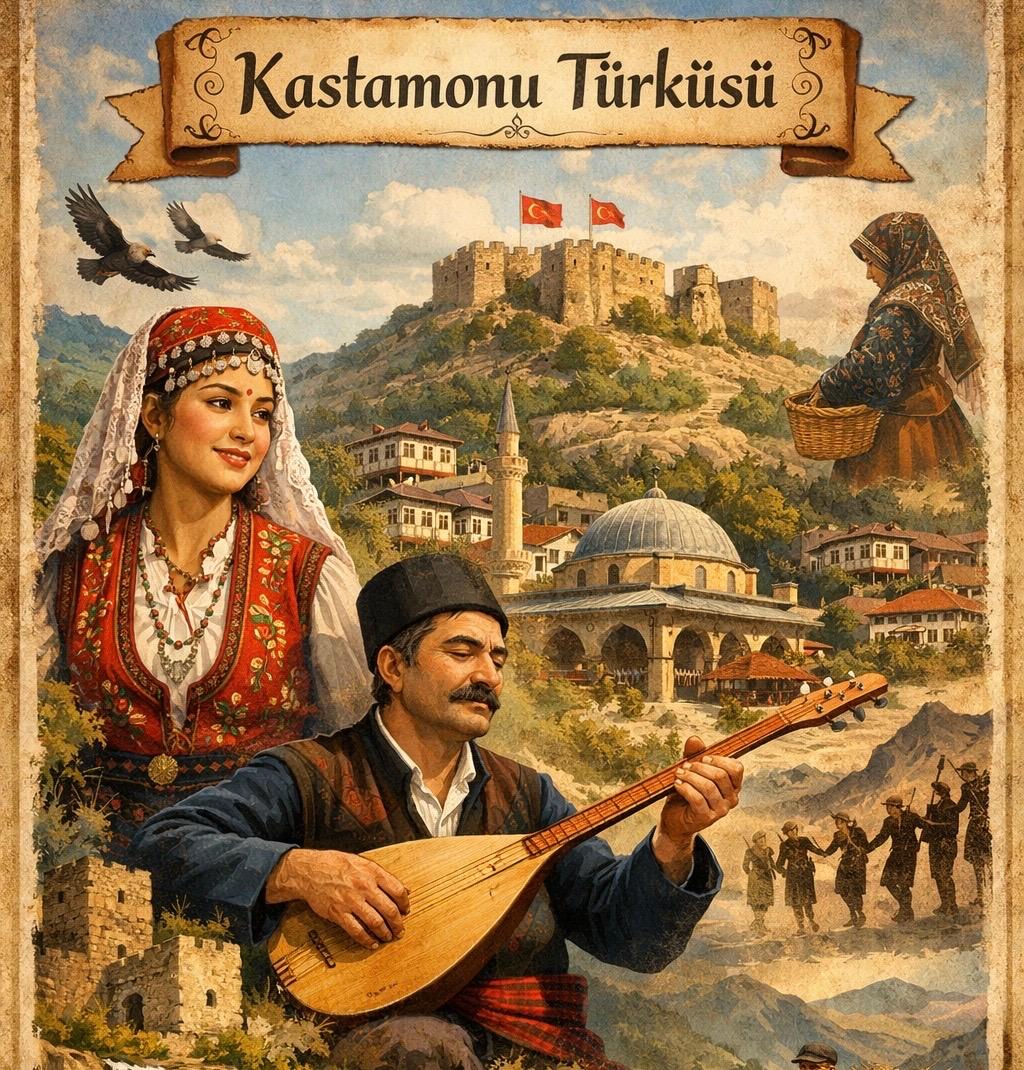
(Görsel, Yapay Zekâ İle Oluşturulmuştur.)
Kastamonu folk song is the general term for traditional folk music products of Kastamonu province in the Western Black Sea Region of Türkiye, reflecting the region’s historical, social and cultural heritage through words, melody and rhythm. These songs transmit the daily life of local people, their relationship with nature, their joys and sorrows, loves and separations, and collective memory from generation to generation.
These folk songs originated in an oral culture, were performed anonymously for many years, and over time were collected and transcribed into musical notation, becoming an integral part of Turkish folk music repertoire and one of the fundamental elements defining Kastamonu’s musical identity.
Kastamonu Türküsü - Kastamonu Sanat Kurulu Korosu (Taşkın Müzik Prodüksiyon)
Kastamonu folk songs emerged from a process directly linked to the region’s history as a crossroads of different civilizations, its mountainous and forested geography, and the resulting social lifestyle.
Social experiences centered around agriculture, livestock breeding, migration, military service and love have been powerfully expressed in the lyrics of these songs, enriching both the content and emotional depth of Kastamonu folk songs. In particular, weddings, military send-offs and communal labor gatherings such as imece are known as the primary cultural contexts in which these songs are performed.
Rhythmic diversity is a distinctive feature of Kastamonu folk songs, with both simple and irregular meters widely used in the region.
Studies show that in addition to regular meters such as 2/4 and 4/4, irregular meters such as 5/8, 7/8 and 9/8 also play a significant role, endowing Kastamonu folk songs with a unique sense of movement and expressive power. Meter choices are often connected to the subject matter and performance context of the songs.【1】
In terms of melody, Kastamonu folk songs predominantly employ modal sequences commonly found in Turkish folk music, such as Hüseynî, Uşşak and Hicaz. However, the regional performance style imbues these modes with a distinct character. Melodies generally unfold within a narrow vocal range, but in longer melodic forms, a wider range is achieved, highlighting the performer’s interpretive skill.【2】
The lyrics of Kastamonu folk songs are constructed with a simple yet deeply meaningful language that directly reflects the daily life of the people.
Love, separation, migration and death—universal themes—are expressed through local idioms and regional vocabulary, creating a powerful emotional impact. In this sense, Kastamonu folk song is not merely a musical product but also a carrier of oral history and cultural memory.【3】
During the Republican era, significant efforts were made to collect and transcribe Kastamonu folk songs, enabling academic study and integrating them into the Turkish folk music repertoire.
Today, these songs are performed in conservatories, folk music choirs and local events, preserving both traditional performance practices and ensuring their transmission to new generations.
The increased recognition of Kastamonu folk songs in contemporary times is significantly due to the contributions of lyricist and composer Yılmaz Cesur. Through works grounded in regional culture and musical heritage, Yılmaz Cesur revitalized Kastamonu folk songs through modern interpretations and laid the foundation for the national recognition of local musical traditions.
Yılmaz Cesur’s work has bridged the anonymous folk tradition of Kastamonu folk music with the concept of individual composition.【4】
[1]
Cantürk, Güray, ve Özel, Eruzun, Aslıhan. “Kastamonu Türkülerinin Usul Yönünden İncelenmesi (Examination of Kastamonu Folk Songs in Terms of Metric Structure).” International Social Sciences Studies Journal 9, no. 112 (2023), Sayfa: 7316–7325. Erişim tarihi: 29 Ocak 2026. https://www.academia.edu/105007919/Kastamonu_T%C3%BCrk%C3%BClerinin_Usul_Y%C3%B6n%C3%BCnden_%C4%B0ncelenmesi_Examination_of_Kastamonu_Folk_Songs_In_Terms_of_Metric_Structure
[2]
Cantürk, Güray, ve Özel, Eruzun, Aslıhan. “Kastamonu Türkülerinin Usul Yönünden İncelenmesi (Examination of Kastamonu Folk Songs in Terms of Metric Structure).” International Social Sciences Studies Journal 9, no. 112 (2023), Sayfa: 7316–7325. Erişim tarihi: 29 Ocak 2026. https://www.academia.edu/105007919/Kastamonu_T%C3%BCrk%C3%BClerinin_Usul_Y%C3%B6n%C3%BCnden_%C4%B0ncelenmesi_Examination_of_Kastamonu_Folk_Songs_In_Terms_of_Metric_Structure
[3]
İnanlı, Merve Öykü ve Akarsu, Sıtkı. “Kastamonu Yerel Basınında Yer Alan Âşıklık Geleneği: Kastamonu Gazetesi Örneği (1932–1980).” Aydın Adnan Menderes University Journal of Institute of Social Sciences 10, no. 2 (2023), Sayfa: 58–79. Erişim tarihi: 29 Ocak 2026. https://dergipark.org.tr/tr/download/article-file/3443859
[4]
Anadolu Kastamonulular Derneği. “Yılmaz Cesur Kimdir?” Anadolu Kastamonulular Derneği. Erişim tarihi: 29 Ocak 2026. https://www.anadolukastamonululardernegi.org.tr/yilmaz-cesur-kimdir/.

(Görsel, Yapay Zekâ İle Oluşturulmuştur.)
No Discussion Added Yet
Start discussion for "Kastamonu Folk Song" article
Historical and Cultural Background
Musical Characteristics
Meter and Rhythmic Structure
Melody and Modal Structure
Verbal Expression and Thematic Structure
Collection, Notation and Contemporary Status
Yılmaz Cesur and His Contribution to Kastamonu Folk Songs