This article was automatically translated from the original Turkish version.
Type of Geographical Indication | Mahreç Sign | ||||||||
|---|---|---|---|---|---|---|---|---|---|
Province(s) | Kastamonu | ||||||||
Registration Number | 435 | ||||||||
Registration Date | 21.06.2019 | ||||||||
Product / Product Group(s) | Bakery and confectionery products sweets dough products | ||||||||
Applicant/Registrant(s) | Kastamonu Municipality | ||||||||
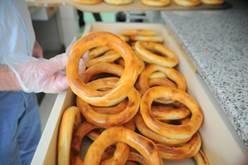
Kastamonu simidi is a traditional bakery product made by shaping a dough prepared from wheat flour, water, salt, and yeast using a special tying technique, boiling it in hot apple or grape molasses water, and then baking it in an oven. Due to the absence of sesame, it is also known locally as “kazan simidi,” “sade simit,” or “susamsız simit.”
The product holds an important place in regional culture and is produced through craftsmanship passed down through generations.【1】
The distinguishing features of Kastamonu simidi include the high resilience and firmness of the dough, its unique wick-tying technique, the absence of sesame on the surface, its glossy appearance, and its thick, crisp crust. These characteristics enable the simidi to maintain its structure during the molasses water treatment and achieve the desired thick crust and crispness after baking.
The production process of the product consists of the following stages:
To preserve and transmit the craftsmanship responsible for the unique qualities and quality of Kastamonu simidi, all production stages—including the wick-tying technique, the absence of sesame, and the crisp texture—must be carried out within the geographical boundaries of Kastamonu.
To ensure compliance with registered characteristics, a monitoring authority has been established under the coordination of the Kastamonu Municipality. This authority conducts monitoring activities with the participation of expert personnel from the Kastamonu Provincial Directorate of Agriculture and Forestry, the Kastamonu Chamber of Industry and Commerce, and Kastamonu University.
Inspections may be conducted at least once a year, and at any time in response to complaints or specific requirements. During inspections, distinguishing features such as the wick-knotting points, firmness, crispness, and the ratio of apple or grape molasses used are verified. The monitoring authority may receive support from qualified individuals or legal entities in carrying out its duties.
Turk Patent and Trademark Office. "Kastamonu Simidi Sicil Belgesi." Coğrafi İşaretler Portalı. Accessed October 24, 2025. https://ci.turkpatent.gov.tr/Files/GeographicalSigns/796d2595-fbaf-460a-a3f8-4ebcad6d3a15.pdf
Turkish Patent and Trademark Office. "Kastamonu Simidi." *Geographical Indications Portal.* Accessed October 24, 2025. https://ci.turkpatent.gov.tr/cografi-isaretler/detay/38468
[1]
Türk Patent ve Marka Kurumu, "Kastamonu Simidi Sicil Belgesi," Coğrafi İşaretler Portalı, Erişim tarihi: 24 Ekim 2025, https://ci.turkpatent.gov.tr/Files/GeographicalSigns/796d2595-fbaf-460a-a3f8-4ebcad6d3a15.pdf

Type of Geographical Indication | Mahreç Sign | ||||||||
|---|---|---|---|---|---|---|---|---|---|
Province(s) | Kastamonu | ||||||||
Registration Number | 435 | ||||||||
Registration Date | 21.06.2019 | ||||||||
Product / Product Group(s) | Bakery and confectionery products sweets dough products | ||||||||
Applicant/Registrant(s) | Kastamonu Municipality | ||||||||
Product Characteristics
Production Method
Geographical Boundary
Monitoring