This article was automatically translated from the original Turkish version.
+2 More
Location | Kayseri Melikgazi Republic Neighborhood | ||||||||
|---|---|---|---|---|---|---|---|---|---|
Commissioned by | Hacı Efendi | ||||||||
Material(s) | Regular Cut Stone | ||||||||
Size(s) | With 16 streets and 18 entrance doors it is known as Türkiye's largest bazaar after the Istanbul Covered Bazaar | ||||||||
Kayseri Covered Bazaar is a historical commercial center located in the Cumhuriyet Neighborhood of the Melikgazi District in Kayseri Province, Türkiye, constructed during the Ottoman period. It is regarded as the largest covered bazaar built in the Ottoman era after the Grand Bazaar in Istanbul. Through a series of fires, demolitions, and reconstructions throughout its history, it has attained its present form and has played a central role in the city’s commercial and social life.
The bazaar’s origins date to the mid-15th century, following Kayseri’s incorporation into Ottoman rule. It began to take shape within the area inside the historic city walls known as “İçerişar.” The earliest known core of the bazaar complex consisted of the bedesten and surrounding shops built by Mustafa Bey, the governor of Kayseri during the reign of Sultan Bayezid II.
Throughout the 16th century, the bazaar continued to expand. During the reign of Suleiman the Magnificent, the kadı of Kayseri, Burhaneddin, added new shops to the bazaar in 1548. During this period, specialized sections emerged, including the “Uzun Çarşı,” “Neccarlar,” “Kazzazlar,” “Keçeciler,” and “Kuyumcular Çarşıları.” There is no record indicating that the bazaar was originally covered; instead, the spaces between the shops were open, and “karlıklar” (snow-clearing paths) were maintained for winter snow removal. Evliya Çelebi’s travelogue, which mentions the structure during his visit in the 17th century, confirms the bazaar’s significance at that time.
The bazaar endured several major disasters throughout its history. Particularly devastating fires in 1849 and 1870 caused severe damage to the structure. After the 1870 fire, which nearly destroyed the entire complex, it was rebuilt through the determined efforts of Maraşlı Osman Paşa, the regional administrator, and the municipal authorities. During this reconstruction, stone was used as the primary building material, the layout was planned to include 1,804 shops, and the roof was covered with barrel vaults, giving the bazaar its present identity as a “covered” market.
The only surviving inscription in the structure is located in the section built in 1844 by Hacı Efendi and named after him. In the 1907 Ankara Salname, the bazaar was described as a “magnificent stone bazaar” encompassing more than two thousand shops.
The bazaar underwent significant changes in the 20th century. In 1935, the then-governor of Kayseri ordered the removal of nearly all the barrel vaults covering the structure. For many years, the bazaar remained open to the sky until a comprehensive restoration between 1987 and 1991 reconstructed it into its current modern, fully covered form.
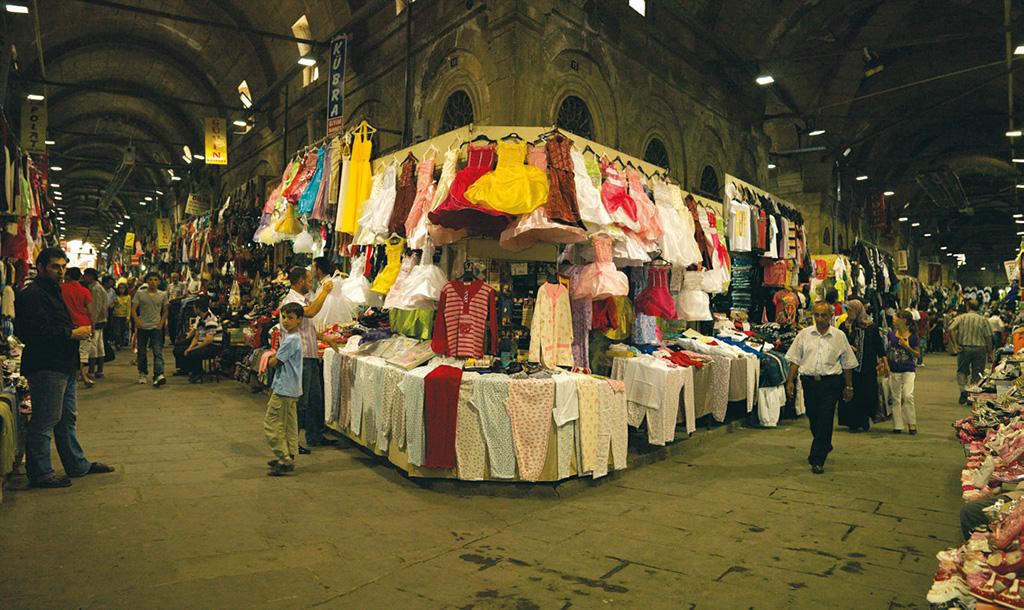
Kayseri Covered Bazaar features a grid-plan architectural layout composed of streets running parallel to each other and intersecting at right angles. The streets are covered with barrel vaults. The entire structure is built primarily using precisely cut stone. It is a complex structure housing numerous specialized sections named according to the trades and products they accommodate.

Kayseri Covered Bazaar Architecture - (Kayseri Municipality)
Today, Kayseri Covered Bazaar continues to serve as one of the city’s most vibrant commercial centers while preserving its historical fabric. Within its shops, regional food products such as spices, pastırma, sucuk, and traditional handicrafts including carpets and jewelry are sold. It has also become a daily shopping destination for local residents.

Present Condition of Kayseri Covered Bazaar - (Anadolu Agency)
Anadolu Ajansı. "Kayseri'de gurbetçiler tarihi Kapalı Çarşı'dan vazgeçmiyor." Accessed October 3, 2025. https://www.aa.com.tr/tr/yasam/kayseride-gurbetciler-tarihi-kapali-carsidan-vazgecmiyor/3659256
Anadolu Sağlık Turizm Derneği. "KAYSERİ KAPALI ÇARŞI." ASTUDER. Accessed October 3, 2025. https://astuder.org.tr/portfolio/kayseri-kapali-carsi/
Kayseri Metropolitan Municipality. "Kapalı Çarşı." Kayseri Metropolitan Municipality Official Website. Accessed October 3, 2025. https://www.kayseri.bel.tr/kesfet-listeleme/kapali-carsi
Kayseri Şehir Portalı. "Kapalı Çarşı." Kayseri.com.tr. Accessed October 3, 2025. https://www.kayseri.com.tr/tr/gor/kapali-carsi

Location | Kayseri Melikgazi Republic Neighborhood | ||||||||
|---|---|---|---|---|---|---|---|---|---|
Commissioned by | Hacı Efendi | ||||||||
Material(s) | Regular Cut Stone | ||||||||
Size(s) | With 16 streets and 18 entrance doors it is known as Türkiye's largest bazaar after the Istanbul Covered Bazaar | ||||||||
No Discussion Added Yet
Start discussion for "Kayseri Covered Bazaar" article
History
Founding and Early Development (15th–17th Centuries)
Major Fires and Reconstruction (19th Century)
20th Century and Present Condition
Architectural Features
Contemporary Significance and Function