This article was automatically translated from the original Turkish version.
+2 More
Registration Number | 1632 | ||||||||
|---|---|---|---|---|---|---|---|---|---|
Registration Date | 21.08.2024 | ||||||||
Application Number | C2021/000477 | ||||||||
Application Date | 17.11.2021 | ||||||||
Name of the Geographical Indication | Kilis Horoz Karası Grape | ||||||||
Product / Product Group(s) | Grape / Processed and unprocessed fruits and vegetables and mushrooms | ||||||||
Type of Geographical Indication | Place of origin | ||||||||
Applicant/Registrant(s) | Kilis Province Grape Producers Union | ||||||||
Address of the Registrant | Karbeyaz Village Road, Cluster Houses No:74, Musabeyli, KİLİS | ||||||||
Geographical Boundary | Kilis Province | ||||||||
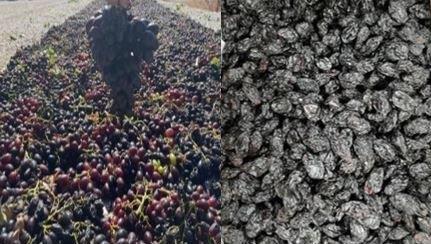
Kilis Horoz Karası grape is a variety of Vitis vinifera L. characterized by large, elongated elliptical berries with blue-black skin. Grown exclusively in the unique soil, climate, and atmospheric conditions of Kilis province, this grape distinguishes itself from similar varieties elsewhere through its high sugar content (17–25%), phenolic compounds (480–550 mg GAE/100 g), and antioxidant activity (95–97%). Although commonly used for drying, it is also widely consumed as a table grape. The drying process is carried out using traditional methods, involving immersion in a solution of olive oil and potassium carbonate. Vineyards are cultivated under rain-fed conditions using the Goble training system, and harvest is performed manually.
Kilis province is located within Upper Mesopotamia, in the region known as the Fertile Crescent, where agriculture first emerged. The area borders the Kurt Mountains to the northwest and the Gaziantep Plateau to the north-northeast. Due to its relatively low elevation, it enjoys a milder climate. The soil structure is predominantly basaltic, and despite limited irrigation possibilities, it is rich in minerals, providing a natural advantage for viticulture.
The Kilis Plain is influenced by “etzyen” wind patterns originating from the Mediterranean. These winds, cooled as they pass over the Amanos Mountains, reach the region between May and September, generating air currents with high oxygen content. The average difference between night and day temperatures is 14 °C. During the growing season, the region receives 1250–1300 hours of sunlight, with air temperatures ranging between 17 and 20 °C. These conditions enable the grape to develop high levels of phenolic compounds, antioxidant activity, and sugar content.
The Kilis Horoz Karası grape is defined by its blue-black skin, elongated elliptical shape, and large berries (8–9 g). The bunches are conical, shoulder-shaped, and branched. Berry dimensions range from 29.4–31.6 mm in length and 20.9–22.1 mm in width. The fruit is juicy and fleshy, with a medium sweetness profile and low acidity (0.24–0.26%). Sugar content in the must varies between 17–25%, while total soluble solids range from 21–25%. Total phenolic content measures 480–550 mg GAE/100 g, and antioxidant activity is recorded at 95–97%.
Due to Kilis’s unique soil structure and the influence of the local winds known as “Kalleşin hava,” this grape variety is distinctly different from Horoz Karası grapes grown in other provinces.
Historically, vineyards were established on Rupestris du Lot rootstocks; today, American rootstocks 1103P and 110R are preferred. The Goble training system is employed, with row spacing typically set at 3x3 m or 4x4 m. Vines are trained at a height of 20–60 cm and pruned short, leaving 2–4 main canes. Fertilization is carried out using animal manure without irrigation. This dry farming practice directly influences the mineral composition and sugar balance of the fruit.
In Kilis, vineyard soils consist partly of old sedimentary soils known as “white (ağ) soil,” and partly of heavy clayey basaltic soils called “felhan.” This variation affects the phenolic composition of the fruit.
The harvest period extends from mid-August to the end of September and is conducted manually. The fruit can be consumed directly as a table grape or, more commonly, processed for drying. Table grapes are packed immediately after harvest for daily consumption.
For drying, grape berries are immersed in a solution containing 1% olive oil and 5% potassium carbonate, then spread on cloth or concrete drying surfaces. Drying lasts approximately seven days until the berries lose 80% of their moisture. The dried grapes are then sorted to remove foreign matter, packed in 250–500 g units, and stored at 4 °C for up to one year.
Various phenolic compounds have been identified in both fresh and dried Kilis Horoz Karası grapes. Notable components include:
Shikimic acid is found only in fresh fruit (253.92 mg/kg), while the concentrations of certain flavonoid derivatives decrease after drying.
Monitoring is conducted by a five-member committee coordinated by the Kilis Grape Growers Union, comprising experts from the Kilis Provincial Directorate of Agriculture and Forestry and union representatives. Inspections are carried out annually during August and September, and may be initiated upon complaint or at the authority’s discretion. Inspection criteria cover cultivation techniques, product quality, production and packaging processes, and the correct use of the geographical indication.
Turk Patent and Trademark Office. "Kilis Horoz Karası Üzümü." Accessed July 17, 2025. https://ci.turkpatent.gov.tr/cografi-isaretler/detay/5493.
Turk Patent and Trademark Office. Kilis HorozKarası Üzümü. Turk Patent and Trademark Office. Accessed July 17, 2025. https://ci.turkpatent.gov.tr/Files/GeographicalSigns/88dbd0dd-df4f-4c8e-a4c1-ccba159940c6.pdf.

Registration Number | 1632 | ||||||||
|---|---|---|---|---|---|---|---|---|---|
Registration Date | 21.08.2024 | ||||||||
Application Number | C2021/000477 | ||||||||
Application Date | 17.11.2021 | ||||||||
Name of the Geographical Indication | Kilis Horoz Karası Grape | ||||||||
Product / Product Group(s) | Grape / Processed and unprocessed fruits and vegetables and mushrooms | ||||||||
Type of Geographical Indication | Place of origin | ||||||||
Applicant/Registrant(s) | Kilis Province Grape Producers Union | ||||||||
Address of the Registrant | Karbeyaz Village Road, Cluster Houses No:74, Musabeyli, KİLİS | ||||||||
Geographical Boundary | Kilis Province | ||||||||
No Discussion Added Yet
Start discussion for "Kilis Horoz Karası Grape" article
Geographical and Climatic Conditions
Distinctive Characteristics
Production Method
Harvest and Processing
Composition
Monitoring and Control