

This article was automatically translated from the original Turkish version.
+1 More
Type of Geographical Indication | Place of Origin | ||||||||
|---|---|---|---|---|---|---|---|---|---|
Registration Number | 1251 | ||||||||
Registration Date | 08.11.2022 | ||||||||
Product / Product Group(s) | Processed and Unprocessed Fruits Vegetables and Mushrooms | ||||||||
Province(s) | Hatay | ||||||||
Applicant/Registrant(s) | Kırıkhan Chamber of Commerce and Industry | ||||||||
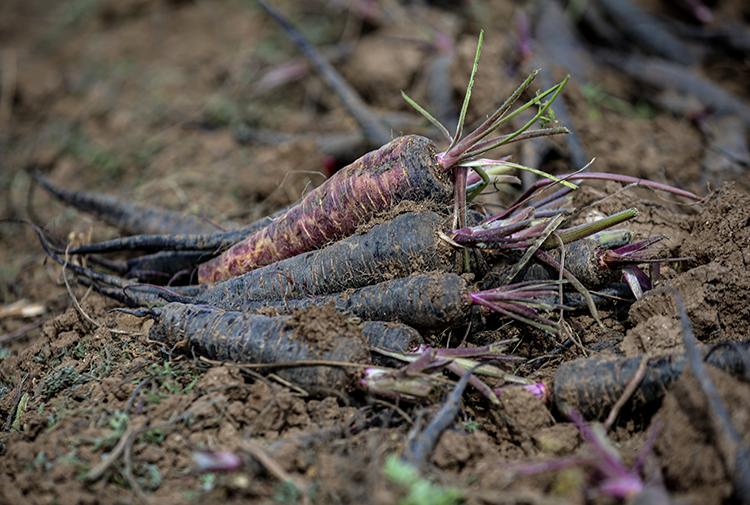
Kırıkhan Black Carrot is a registered agricultural product grown within the entire administrative boundaries of the Kırıkhan district in Hatay. During production, two varieties of Daucus carota var. sativus are used: the local ecotype “Yerli Siyah” and the “Deep Purple Haze F1” variety. The application submitted by the Kırıkhan Chamber of Commerce and Industry on 15 July 2021 was approved on 8 November 2022 under registration number 1251. The product is marketed with its registered logo and geographical indication emblem, either directly on the product or on its packaging.
The most distinctive feature distinguishing Kırıkhan Black Carrot from other varieties is its high phenolic compound content and deep coloration. This dark hue results from an abundance of anthocyanins, flavonoids, and carotenoids. The low lightness (L*) values of the carrot indicate a color tone close to black; the flesh’s L* value is even lower than that of the skin, demonstrating that the interior is darker still.
These unique characteristics are directly linked to Kırıkhan’s climate and soil structure. The region’s high annual average temperature, large number of sunny days, and extended sunlight duration promote the accumulation of phenolic compounds in the carrot. Additionally, the region’s soil, which has a weakly alkaline structure (pH 7.6–8.3), high calcium carbonate content (22.5%–58.7%), and sandy texture (29%–45%), allows the plant to develop easily underground.
Measurements conducted on the two varieties (“Yerli Siyah” and “Deep Purple Haze F1”) show that fruit weight ranges from 106.6 g to 167.4 g, and fruit length from 24.3 cm to 32.8 cm. The soluble dry matter (SDM) content varies between 9.1% and 10.7%, titratable acidity between 0.70% and 1.40%, and total phenolic compound content between 406.3 µg/kg and 766.2 µg/kg.
In the cultivation of Kırıkhan Black Carrot, seeding is carried out between 1 August and 15 October at a density of 200 seeds per square meter.
The fertilization process begins before sowing with the application of compound basal fertilizers such as 15:15:15 NPK or 18-46 DAP to the soil. Nitrogen fertilizers in nitrate form are applied during autumn. When root thickening begins, foliar fertilizers containing potassium, boron, and zinc are applied; 20–30 days later, fertilizers containing sulfur, boron, and zinc are applied. If cracking is observed in the fruit, calcium is sprayed onto the leaves; for disease prevention, copper-based preparations are applied. Approximately one month before harvest, potassium fertilizer applications are repeated one or two times. These foliar applications must be carried out in a clean field free of weeds. Irrigation is maintained using sprinkler methods until rainfall begins; when late harvest is planned, irrigation becomes critical as rainfall decreases.
The harvesting period extends from the first week of December to mid-June. Harvesting of late-maturing varieties begins in mid-April. Harvested carrots can be stored for five to seven months in environments maintained at 0–5 °C and 95%–98% relative humidity.
Compliance with the registered conditions of the product is monitored under the coordination of the Kırıkhan Chamber of Commerce and Industry. The monitoring body consists of at least three experts from the Chamber of Commerce and Industry, the Kırıkhan District Directorate of Agriculture and Forestry, and the Kırıkhan Chamber of Agriculture. These inspections are conducted at least once annually and may be repeated in the event of complaints or specific needs.
During inspections, the accuracy of the carrot varieties used, adherence to the production method including fertilization and storage practices, and the correct use of the registered logo and geographical indication emblem are examined. If deemed necessary, the total phenolic compound content is also analyzed. Inspection results are reported annually in accordance with Law No. 6769 on Industrial Property and submitted to the Turkish Patent and Trademark Office.
Anadolu Ajansı. “Depremin vurduğu Hatay'ın tescilli siyah havucunda rekolte artışı bekleniyor.” Accessed October 29, 2025.
Turk Patent and Trademark Office. "Kırıkhan Siyah Havucu Tescil Belgesi." Turk Patent and Trademark Office. Accessed October 23, 2025.
Turk Patent and Trademark Office. "Kırıkhan Siyah Havucu." Geographical Indications Portal. Accessed October 23, 2025. https://ci.turkpatent.gov.tr/cografi-isaretler/detay/4702.

Type of Geographical Indication | Place of Origin | ||||||||
|---|---|---|---|---|---|---|---|---|---|
Registration Number | 1251 | ||||||||
Registration Date | 08.11.2022 | ||||||||
Product / Product Group(s) | Processed and Unprocessed Fruits Vegetables and Mushrooms | ||||||||
Province(s) | Hatay | ||||||||
Applicant/Registrant(s) | Kırıkhan Chamber of Commerce and Industry | ||||||||
No Discussion Added Yet
Start discussion for "Kırıkhan Black Carrot" article
Product Characteristics
Production Method
Monitoring