

This article was automatically translated from the original Turkish version.
Kızılçan Lake
Depth(s) | 50 metres (seasonally variable) | ||||||||
|---|---|---|---|---|---|---|---|---|---|
Distance(s) | 50 km from the center of Sivas Province 2 km from Canova Village | ||||||||
Location | Canova Village Zara District Sivas Province | ||||||||
Neighboring Formations | Akgöl, Karagöl, Kızılırmak | ||||||||
Related Project | Upper Kızılırmak Culture and Nature Trail | ||||||||
Local Designation | Nazar Boncuğu | ||||||||
Fauna | Fish population | ||||||||
Hydrological Connection | Possible underground connection with Akgöl and Karagöl | ||||||||
Water Source | Springs originating from the bottom | ||||||||
Color | Turquoise | ||||||||
Lake Surface Diameter | 220 metres | ||||||||
Total Area Diameter | Approximately 300 metres | ||||||||
Formation Type | Huni-shaped collapse doline | ||||||||
Geographical Region | Upper Kızılırmak Basin | ||||||||
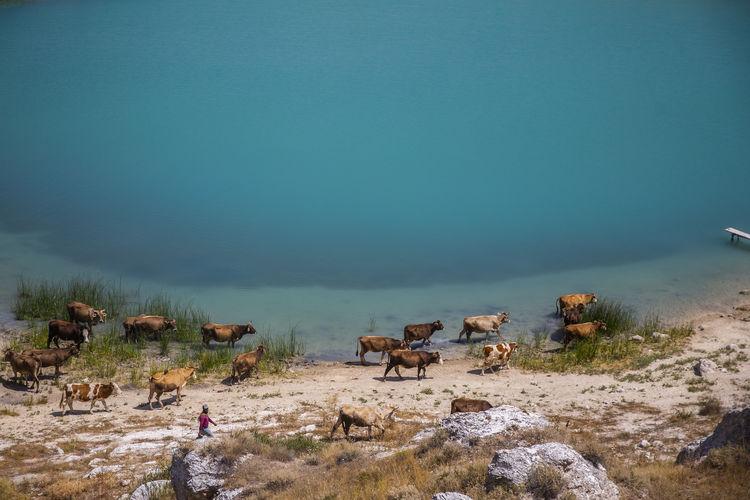
Kızılçan Gölü is a collapse doline lake formed within the boundaries of Canova Village in the Zara district of Sivas Province, situated in a gypsum karst region. Located within the Upper Kızılırmak Basin, the lake constitutes one of the region’s characteristic karstic landforms due to its distinctive turquoise color and circular shape.
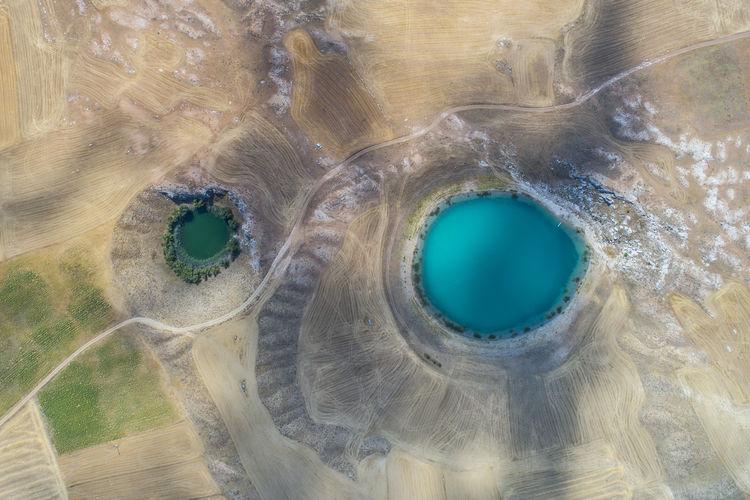
Kızılçan Gölü (AA)
The formation of the lake is directly linked to the gypsum (calcite) karst widely found along the Sivas-Zara corridor. Classified scientifically as a collapse doline, Kızılçan Gölü resulted from the dissolution of gypsum layers by groundwater and the subsequent collapse of the overlying rock stratum. According to academic measurements, the lake has a nearly circular perimeter with a diameter of approximately 300 meters and a depth of 50 meters.【1】 The area where the lake is located has also been shaped by tectonic activity; Kızılçan Gölü, along with other nearby karstic features such as Akgöl and Karagöl, aligns in a linear pattern following a tectonic fault line. Although local populations sometimes assume the lake to be a volcanic crater, scientific data confirm its gypsum karst origin and collapse doline structure.【2】
Kızılçan Gölü is fed by groundwater sources emerging from its bed. Seasonal fluctuations in water levels are observed in response to precipitation patterns and drought conditions. It is believed that the lake’s water is connected underground to other nearby collapse dolines such as Karagöl and Akgöl to its west. In this region dominated by a continental climate, winter temperatures frequently drop below freezing, causing the lake surface to freeze completely and become covered by a layer of ice.
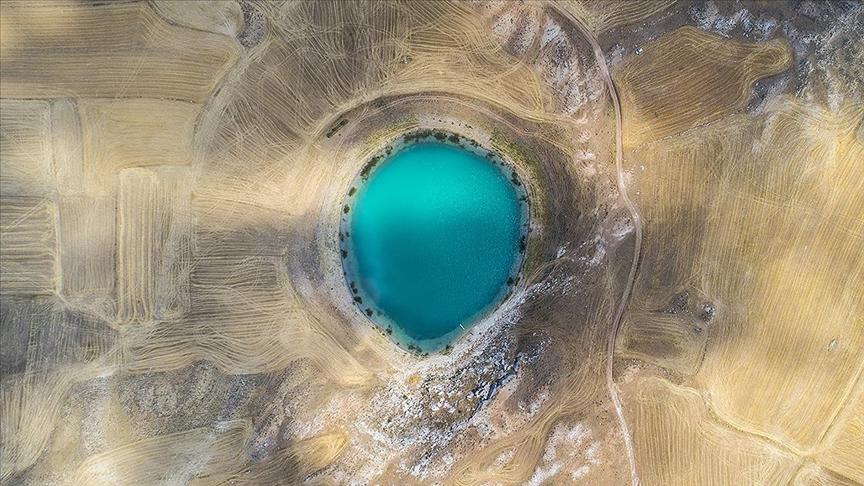
Kızılçan Gölü (AA)
Located approximately 50 kilometers from the center of Sivas Province and 2 kilometers from the center of Canova Village, the lake is one of the natural protected areas assessed under the first phase of the “Upper Kızılırmak Culture and Nature Route” project. Due to its circular shape when viewed from above and the distinctive color of its waters, the lake is frequently described in literature and local media as resembling a “nazar boncuğu” (evil eye bead).【3】 While the lake holds potential for photography and nature observation, it currently lacks comprehensive tourism infrastructure. However, local authorities have planned road and environmental improvement projects to enhance accessibility and preservation.
Akbulut Özpay, Gülpınar, and Ömer Ünsal. "Yukarı Kızılırmak Kültür Ve Doğa Yolu I. Etap (Sivas-Zara)." Atatürk Üniversitesi Sosyal Bilimler Enstitüsü Dergisi 22, no. Özel Sayı (October 2018): 2173-2193. Accessed February 11, 2026.
TRT Haber. "Sivas'ın nazar boncuğu Kızılçan Gölü'nün yüzeyi dondu." trthaber.com. Accessed February 11, 2026.
Yalçınkaya, Halife. "Sivas'ın gölleri keşfedilmeyi bekliyor." Anadolu Ajansı. Accessed February 11, 2026.
Zafer, Serhat. "Sivas'ın 'nazar boncuğu'nu andıran gölleri turizme kazandırılmayı bekliyor." Anadolu Ajansı. Accessed February 11, 2026.
İletişim Başkanlığı. "Sivas’ın nazar boncuğu büyülüyor." Türkiye Cumhuriyeti İletişim Başkanlığı. Accessed February 11, 2026.
[1]
Akbulut Özpay, Gülpınar and Ömer Ünsal. "Yukarı Kızılırmak Kültür Ve Doğa Yolu I. Etap (Sivas-Zara)." Atatürk Üniversitesi Sosyal Bilimler Enstitüsü Dergisi 22, no. Özel Sayı (Ekim 2018): 2173-2193. Erişim 11 Şubat 2026.
[2]
Akbulut Özpay, Gülpınar ve Ömer Ünsal. "Yukarı Kızılırmak Kültür Ve Doğa Yolu I. Etap (Sivas-Zara)." Atatürk Üniversitesi Sosyal Bilimler Enstitüsü Dergisi 22, no. Özel Sayı (Ekim 2018): 2173-2193. Erişim 11 Şubat 2026.
https://dergipark.org.tr/en/download/article-file/558092
Halife Yalçınkaya, “Sivas'ın gölleri keşfedilmeyi bekliyor,” Anadolu Ajansı, Erişim tarihi: 11 Şubat 2026.
https://www.aa.com.tr/tr/turkiye/sivasin-golleri-kesfedilmeyi-bekliyor-/1884579
[3]
İletişim Başkanlığı, “Sivas’ın nazar boncuğu büyülüyor,” Türkiye Cumhuriyeti İletişim Başkanlığı, Erişim tarihi: 11 Şubat 2026.
https://www.iletisim.gov.tr/turkce/yerel_basin/detay/sivasn-nazar-boncuu-bueyuelueyor
Serhat Zafer, “Sivas'ın 'nazar boncuğu'nu andıran gölleri turizme kazandırılmayı bekliyor,” Anadolu Ajansı, Erişim tarihi: 11 Şubat 2026.

Kızılçan Lake
Depth(s) | 50 metres (seasonally variable) | ||||||||
|---|---|---|---|---|---|---|---|---|---|
Distance(s) | 50 km from the center of Sivas Province 2 km from Canova Village | ||||||||
Location | Canova Village Zara District Sivas Province | ||||||||
Neighboring Formations | Akgöl, Karagöl, Kızılırmak | ||||||||
Related Project | Upper Kızılırmak Culture and Nature Trail | ||||||||
Local Designation | Nazar Boncuğu | ||||||||
Fauna | Fish population | ||||||||
Hydrological Connection | Possible underground connection with Akgöl and Karagöl | ||||||||
Water Source | Springs originating from the bottom | ||||||||
Color | Turquoise | ||||||||
Lake Surface Diameter | 220 metres | ||||||||
Total Area Diameter | Approximately 300 metres | ||||||||
Formation Type | Huni-shaped collapse doline | ||||||||
Geographical Region | Upper Kızılırmak Basin | ||||||||
Geological Formation and Physical Characteristics
Hydrological Characteristics and Climatic Influences
Location and Tourism Potential