


This article was automatically translated from the original Turkish version.
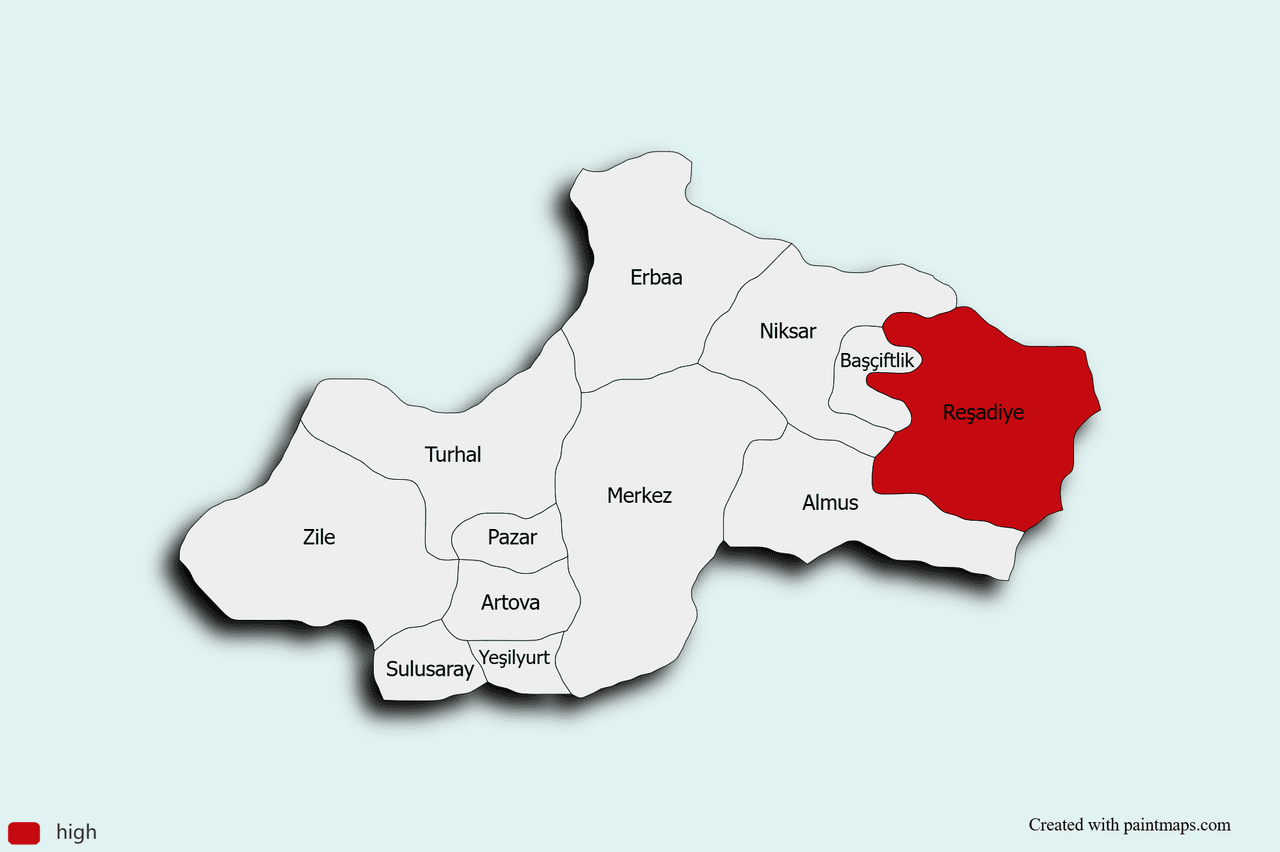
Reşadiye (District)
Province(s) | Tokat | ||||||||
|---|---|---|---|---|---|---|---|---|---|
Region(s) | Black Sea | ||||||||
Elevation(s) | 559 m | ||||||||
Mayor(s) | Ergül Ünal | ||||||||
District Governor | Ahmet Tan | ||||||||
Postal Code | 60700 | ||||||||
Climate(s) | Transition characteristics between the Black Sea and Central Anatolian climates | ||||||||
Economy | Agriculture thermal tourism livestock farming | ||||||||
Reşadiye is a district located east of the Tokat provincial center, along the banks of the Kelkit River. Agriculture and livestock farming are widespread in the district. Additionally, thermal springs and highland pastures contribute significantly to regional tourism.

Reşadiye (Tokat Provincial Directorate of Culture and Tourism)
The settlement area of Reşadiye has a layered habitation history extending back to the Early Bronze Age (3rd millennium BCE), as indicated by archaeological evidence. During the early 2nd millennium BCE, the region fell within the borders of the Hittite and Urartian kingdoms. In 670 BCE, it came under the control of the Milesians, followed later by the Kingdom of Pontus. Between 63 and 88 BCE, the settlement became a province of the Roman Empire. During the reign of Trajan (98–117 CE), it was detached from the provinces of Pontus Galaticus and Polemoniacus and incorporated into Cappadocia. The ancient settlement was known as Sebastapolis, a Greek name meaning “great majestic city,” which at times also took the form Heracleopolis.
Turkish tribes arriving during the Migration Period established dominance in the region between 1095 and 1175 through the conquests of Danişmend Gazi during the decline of the Anatolian Seljuks. Following the Battle of Köse Dağ in 1243, the region came under Ilkhanid administration. In the 1380s, it was conquered by the Hacıemiroğulları, a branch of the Çepni tribes, and was incorporated into the Ottoman Empire in 1427. In Ottoman records, the settlement was known as İskefsir; in 1906, by order of the Sivas Governor Reşit Paşa, it was renamed Reşadiye in honor of Sultan Reşad. The district, divided into five neighborhoods in 1912, covered a wide area according to the 1927–28 yearbook, with 75 villages and a population of 27,372, notable for its forested lands. After the 1939 Erzincan Earthquake, the district center was relocated northward, and reconstruction activities resumed after 1966. Since 20 May 1990, Reşadiye has been officially administered as a district and continues to preserve a multi-layered historical heritage spanning from the Hittites to the Ottomans.
Reşadiye is located 89 km from the Tokat provincial center, at the intersection of 40°25′ N and 37°20′ E. The district center is a riverside settlement at an elevation of 450 meters. To the north lie the southern extensions of the Canik Mountains; to the east are Koyulhisar in Sivas; to the west, Niksar in Tokat; and to the south, the districts of Almus and Hafik. The total area of 1,162 km² is largely composed of plateaus and valley fragments; low-lying areas are defined by the Kelkit Valley and limited flatlands along mountain slopes. The soil cover in the valley floors consists of deep alluvial and sandy-silty deposits, transitioning to stony-clayey structures at higher elevations. Within the district boundaries, the Kelkit River and its tributaries—Tozanlı, Delice, Tombalak, Köy, and Reşit streams—flow.
The climate exhibits transitional characteristics between the humid conditions of the Black Sea region and the continental climate of Central Anatolia. Summers are hot and dry; winters are cold and harsh. Annual precipitation ranges between 450 and 500 mm, with higher amounts in winter and spring and the lowest levels during summer. Average temperatures are 0–2 °C in January and 20–24 °C in July. Relative humidity averages around 55%. The district has 44 recorded highland pastures; the most well-known are Selemen, Cimban, Gedik, and Batmış. Natural water bodies such as Göllüköy (147,486 m²) and Zınav (348,514 m²) serve as recreational and leisure areas surrounded by forest belts.
The population of Reşadiye district was 40,319 in 2007 and recorded 41,952 in 2024. During this period, the population increased by 2,633 in 2008 and 2,484 in 2009, then declined by 5,556 in 2010 to 39,880, rose by 2,908 in 2012 to 42,365, and dropped by 4,911 in 2013 to 37,454. Increases of 3,449 (2017–2018) and 2,692 (2018–2019) were observed, followed by the largest decline of 9,659 between 2019 and 2020. Population growth of 4,127 (2022–2023) and 5,225 (2023–2024) brought the population back to 41,952. As of 2024, the male population stands at 21,354 (50.90%) and the female population at 20,598 (49.10%). Annual population fluctuations are largely attributable to migration patterns and administrative record updates.
The Reşadiye economy is primarily based on the primary sector, with agriculture, livestock farming, and forestry forming its core. Agricultural productivity varies according to irrigation infrastructure; irrigated areas in the valley plains cultivate wheat, barley, maize, and legumes. In dryland areas, drought-resistant cereals such as rye and korunga are preferred. Agricultural mechanization remains limited; insufficient availability of farming equipment affects crop yields. In addition to plant production, beekeeping provides a secondary source of income due to the rich flora of the highland pastures.
Livestock farming is largely restricted to small ruminant production due to the limited extent of pastures. Meat and milk production support rural household economies. Forestry contributes to the economic structure through the production of timber and non-timber products from approximately 75,000 hectares of forestland (45,000 ha beech, 15,000 ha Turkish pine, 15,000 ha oak). This sector also includes activities such as animal husbandry, mushroom and chestnut gathering.
The commercial and service sector includes a limited number of entrepreneurs, comprising 4,504 motor vehicles, 457 simple procedure businesses, 296 real procedure businesses, 57 institutions, 11 cooperatives, and 375 real estate tax payers. In 2012, tax revenues amounted to 4.34 million TL, while expenditures reached 22.77 million TL. Agricultural and Halk Bank branches, along with agricultural credit and artisan guarantee cooperatives, provide financial services in the district. There are no modern industrial facilities; only small-scale workshops operate, producing flour, animal feed, stationery, and monopoly goods. External migration is relatively high due to seasonal labor shortages in winter and inadequate infrastructure.
The thermal tourism potential combines canyons, waterfalls, lakes, highland pastures, and ancient settlement remains. Ilıca Thermal Spa provides complementary treatment for inflammatory rheumatic and orthopedic conditions using water with a temperature of 48–52 °C, rich in sodium, potassium, and magnesium. The spa complex includes accommodation units such as pensions, hotels, motels, apartments, and resorts, as well as physiotherapy and rehabilitation units, forming the health infrastructure. The spa area is located in the district center along the Kelkit River on the E80/D100 highway.
Zınav Canyon, Gündoğdu Waterfall, and Kurt Lake offer suitable areas for hiking, picnicking, camping, and amateur water sports. Kurt Lake, home to sazan fish, provides opportunities for sport fishing with a surface area of 1.5 km² and depths of 10–15 meters. Plateaus suitable for nature sports, rock formations, and cave clusters (Kokurdan, Güngerit, Tilkidibi, Deliklikaya, Kızıl, İnkaya, Kayadibi, and Abudeliği caves) enrich the region’s exploration routes.
Cultural heritage elements include the caravan route described by Evliya Çelebi as the “Eastern Road,” early-period burial grounds such as “Şehit Yakub” and “Cami-i Kebîr,” remnants of early Ottoman medreses, and the foundations of various ruined castles.
The regional cuisine is based primarily on wheat flour and legumes. Traditional dishes such as tarhana, akıtma, and fresh erişte, along with “buta,” a local meat dish, regional soups, and highland cheeses, form the daily dietary practice. Rural restaurants associated with thermal and nature tourism offer these flavors to visitors.
T. C. Ministry of Culture and TourismTokat İl Directorate of Culture and Tourism. “Resadiye.” Tokat Provincial Directorate of Culture and Tourism. Accessed May 5, 2025. https://tokat.ktb.gov.tr/TR-141055/resadiye.html
T. C. Resadiye Municipality. "Coğrafi Yapısı." Resadiye Belediyesi. Accessed May 5, 2025. https://resadiye.bel.tr/resadiye-cografi-yapisi/
T. C. Resadiye Municipality. "Tarihçe." Resadiye Belediyesi. Accessed May 5, 2025. http://www.resadiye.gov.tr/tarihce
T. C. Resadiye Municipality. “Kaplıcaları.” Resadiye Belediyesi. Accessed May 5, 2025. https://resadiye.bel.tr/resadiye-kaplicalari/
T. C. Tokat Municipality. "Ekonomi." Tokat Belediyesi. Accessed May 5, 2025. https://tokat.bel.tr/sayfa/ekonomi.html
T. C.Resadiye Kaymakamlığı Governorship. "Ekonomik Yapı." Resadiye District Governorship. Accessed May 5, 2025. http://www.resadiye.gov.tr/ekonomik-yapi
T. C.Resadiye Kaymakamlığı Governorship. "Nüfus." Resadiye District Governorship. Accessed May 5, 2025. http://www.resadiye.gov.tr/nufus
T. C.Tokat Valiliği. “Resadiye.” Tokat Governorship. Accessed May 5, 2025. http://www.tokat.gov.tr/resadiye
Türkiye İstatistik Institute (TÜİK). Address-Based Population Registration System Results, 2024. Accessed April 20, 2025. https://data.tuik.gov.tr/Bulten/Index?p=Adrese-Dayali-Nufus-Kayit-Sistemi-Sonuclari-2024-53783

Reşadiye (District)
Province(s) | Tokat | ||||||||
|---|---|---|---|---|---|---|---|---|---|
Region(s) | Black Sea | ||||||||
Elevation(s) | 559 m | ||||||||
Mayor(s) | Ergül Ünal | ||||||||
District Governor | Ahmet Tan | ||||||||
Postal Code | 60700 | ||||||||
Climate(s) | Transition characteristics between the Black Sea and Central Anatolian climates | ||||||||
Economy | Agriculture thermal tourism livestock farming | ||||||||
No Discussion Added Yet
Start discussion for "Reşadiye (District)" article
History
Geography and Climate
Population and Demographics
Economy
Tourism–Culture–Cuisine