
This article was automatically translated from the original Turkish version.
+2 More
Kızılkoyun Necropolis
Site | Tılfındır Tepesi, Eyyübiye, Şanlıurfa | ||||||||
|---|---|---|---|---|---|---|---|---|---|
Area(s) | ~5 hectares | ||||||||
Sit Degree | Second and Third Degree Archaeological Site Area | ||||||||
Archaeological Discovery | 105 rock tombs, frescoes, mosaics, inscriptions | ||||||||
Discovery Year | 2012 (official site designation) | ||||||||
Opening to Visitors | 2020 | ||||||||
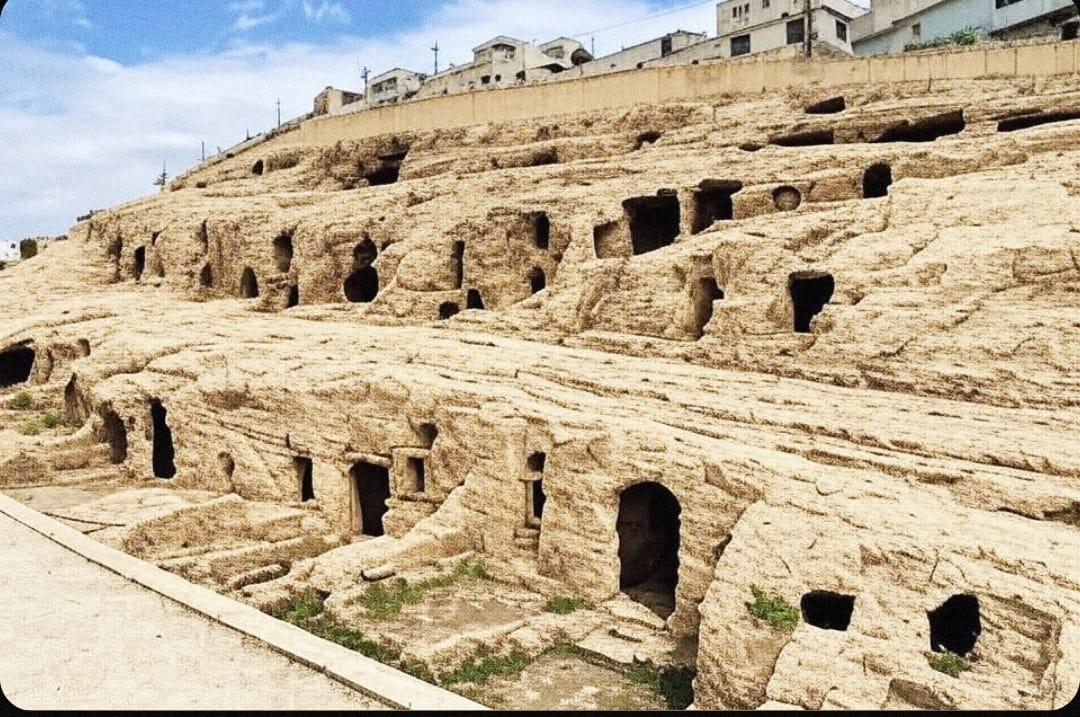
Kızılkoyun Nekropolü is an archaeological site located on the slopes of Tılfındır Tepe, above the Balıklıgöl Plateau, north of the city center of Şanlıurfa. It is distinguished by its rock-cut tombs, inscriptions, reliefs, and mosaics dating to the Roman period. Considered part of the necropolis of ancient Edessa, this area forms a cohesive component of Şanlıurfa’s historical landscape together with surrounding cultural heritage sites.

Kızılkoyun Nekropolü (Şanlıurfa Municipality)
Şanlıurfa is one of the oldest settlement areas in Mesopotamia. Over its approximately 12,000-year history it has hosted numerous civilizations and gained strategic importance due to its proximity to water sources, fertile agricultural land, and its position along major trade routes. Known in antiquity as Edessa, the city became the capital of the Kingdom of Osroene, established in 132 BCE, and maintained its independence until 244 CE. Subsequently incorporated into the Roman Empire, Edessa played a critical role in the early spread of Christianity. Under Roman administration, it attained provincial status and emerged as a prominent center on Rome’s eastern frontier. During this period, monumental necropolises with elaborate tomb structures were constructed around the city. Kızılkoyun Nekropolis emerged as a burial ground situated just beyond the city walls, outside the ancient urban perimeter.
Kızılkoyun Nekropolis is located within the Eyyübiye district of Şanlıurfa and covers an area of approximately five hectares. The site is built on a sloping terrain characterized by limestone bedrock that is easily carved, making it ideal for rock-cut tombs. The necropolis is surrounded by the Yenimahalle Archaeological Site to the east, the Haleplibahçe Archeopark to the west, Urfa Castle and Balıklıgöl to the south, and the Bedüzzaman Cemetery to the north.
In the planning efforts of 1979, the Kızılkoyun area was not included in the protective scope alongside neighboring cultural sites. By the 1992 Conservation-Oriented Urban Plan, it was designated for use as a park and children’s playground. However, in 2008, its designation as a Second-Degree Archaeological Site marked the first serious steps toward its protection. Following assessments in 2012, the area with the highest concentration of rock-cut tombs was officially registered as the “Kızılkoyun Nekropolis Second-Degree Archaeological Site,” while the northern section containing tombs that had lost their original character was registered as the “Kızılkoyun Nekropolis Third-Degree Archaeological Site.”
Between 2015 and 2017, excavation and cleaning works carried out in collaboration between the Şanlıurfa Metropolitan Municipality and the Museum Directorate uncovered 105 rock-cut tombs and demolished 389 informal settlements. Archaeological inventory work on the site is still ongoing.

Kızılkoyun Nekropolü (Anadolu Agency)
A large proportion of the rock-cut tombs are connected to the main burial chamber via a dromos, a staircase or sloping entrance corridor. Tombs M-1, M-5, and M-24 feature dromoses with five to seven steps. In this type of tomb, the entrance to the burial chamber is typically protected by monolithic stone doors.
Some tombs consist of a single chamber containing three arcosolia (arched burial niches). Examples such as M-8 and M-33 reveal a two-part plan with a front and rear chamber. Access between chambers is provided by stone arches, and within the inner chambers are bone-lined pits where the deceased were interred.
Loculi, rectangular prism-shaped burial cells carved into the walls, are found in tombs such as M-43, M-59, and M-59A. In some of these structures, more than ten loculi are arranged in rows, and some feature ornamental small niches above them.
Kızılkoyun Nekropolü (YouTube)
The rock-cut tombs contain Greek and Syriac inscriptions, figurative frescoes, and reliefs. In tomb M-16, a relief depicts a male figure reclining on a kline, accompanied by two women and a child. In tomb M-30, Greek inscriptions appear among the frescoes. In tomb M-65, a three-line mosaic inscription in Syriac is located on the floor. The Labarum symbol (a symbol of Jesus Christ) carved on the lintel of tomb M-54 indicates early Christian iconography.
As part of the documentation efforts at Kızılkoyun Nekropolis, photogrammetry, laser scanning, and unmanned aerial vehicle (UAV)-supported multi-method documentation techniques have been applied, following the work of Şenol, Memduhoğlu, and Ulukavak. A three-dimensional (3D) model of tomb M-54 was created using Agisoft software, generating point clouds, orthophotos, CAD-based drawings, and architectural vector data. These digital records enable the archival preservation of the tomb structures and support the development of restoration plans.
Since its completion in 2020, the landscape restoration of Kızılkoyun Nekropolis has opened the site to visitors, and it now contributes to Şanlıurfa’s tourism as an open-air archaeological museum. The site attracts significant interest from both domestic and international visitors and remains accessible for academic research.
Albayrak, Yılmaz. 2017. “Şanlıurfa Kale Eteği Nekropolü Kaya Mezarları.” *Karadeniz*, no. 36: 269–273. Accessed May 29, 2025. https://doi.org/10.17498/kdeniz.366359
Anadolu Ajansı. “Şanlıurfa’daki Turistik Mekanlar Özel Işıklandırmayla Gece de Görenleri Cezbediyor.” aa.com.tr. Accessed May 29, 2025. https://www.aa.com.tr/tr/pg/foto-galeri/-sanliurfadaki-turistik-mekanlar-ozel-isiklandirmayla-gece-de-gorenleri-cezbediyor/0
Aydın, İsmail, Celal Oso, Mahmut Yaşar, and Nihat Polat. 2023. “Tarihi Kızılkoyun Nekropol Alanında M54 No.lu Kaya Mezarının Fotogrametri ile 3B Modellemesi.” *Türkiye Fotogrametri Dergisi* 5, no. 1: 36–42. Accessed May 29, 2025. https://doi.org/10.53030/tufod.1304794
Visit Urfa. “Kızılkoyun Nekropolü.” YouTube Video. Accessed May 29, 2025. https://www.youtube.com/watch?v=VT_sFBhUwk0
Öztürk Tel, Hatice, and Fatma Şule Kuloğlu Yüksel. 2017. “Kızılkoyun Nekropolü Arkeolojik Sit Alanı’nın Koruma-Planlama Kapsamında Değerlendirilmesi.” *İnönü Üniversitesi Sanat ve Tasarım Dergisi* 7, no. 16: 1–16. Accessed May 29, 2025. https://doi.org/10.16950/iujad.335643
Şanlıurfa Büyükşehir Municipality. "Kızılkoyun Nekropolleri Işıl Işıl Görüntüsüyle Ziyaretçi Akınına Uğruyor." *sanliurfa.bel.tr*. Accessed May 29, 2025. https://sanliurfa.bel.tr/icerik/14331/21/kizilkoyun-nekropolleri-isil-isil-goruntusuyle-ziyaretci-akinina-ugruyor
Şenol, H. İbrahim, Ahmet Memduhoğlu, and Mehmet Ulukavak. 2020. “Multi Instrumental Documentation and 3D Modelling of an Archaeological Site: A Case Study in Kızılkoyun Necropolis Area.” *Dicle University Journal of Engineering* 11 (3): 1241–1250. Accessed May 29, 2025. https://dergipark.org.tr/en/download/article-file/1315627
Kızılkoyun Necropolis
Site | Tılfındır Tepesi, Eyyübiye, Şanlıurfa | ||||||||
|---|---|---|---|---|---|---|---|---|---|
Area(s) | ~5 hectares | ||||||||
Sit Degree | Second and Third Degree Archaeological Site Area | ||||||||
Archaeological Discovery | 105 rock tombs, frescoes, mosaics, inscriptions | ||||||||
Discovery Year | 2012 (official site designation) | ||||||||
Opening to Visitors | 2020 | ||||||||
No Discussion Added Yet
Start discussion for "Kızılkoyun Necropolis" article
Historical Background
Physical Location and Geological Structure
Site Status and Conservation Process
Tomb Architecture and Typology
Dromos Tombs
Single and Multi-Chamber Tombs
Loculus Tombs
Artistic and Epigraphic Findings
Digital Documentation and 3D Modeling
Current Status and Tourism