

+1 More

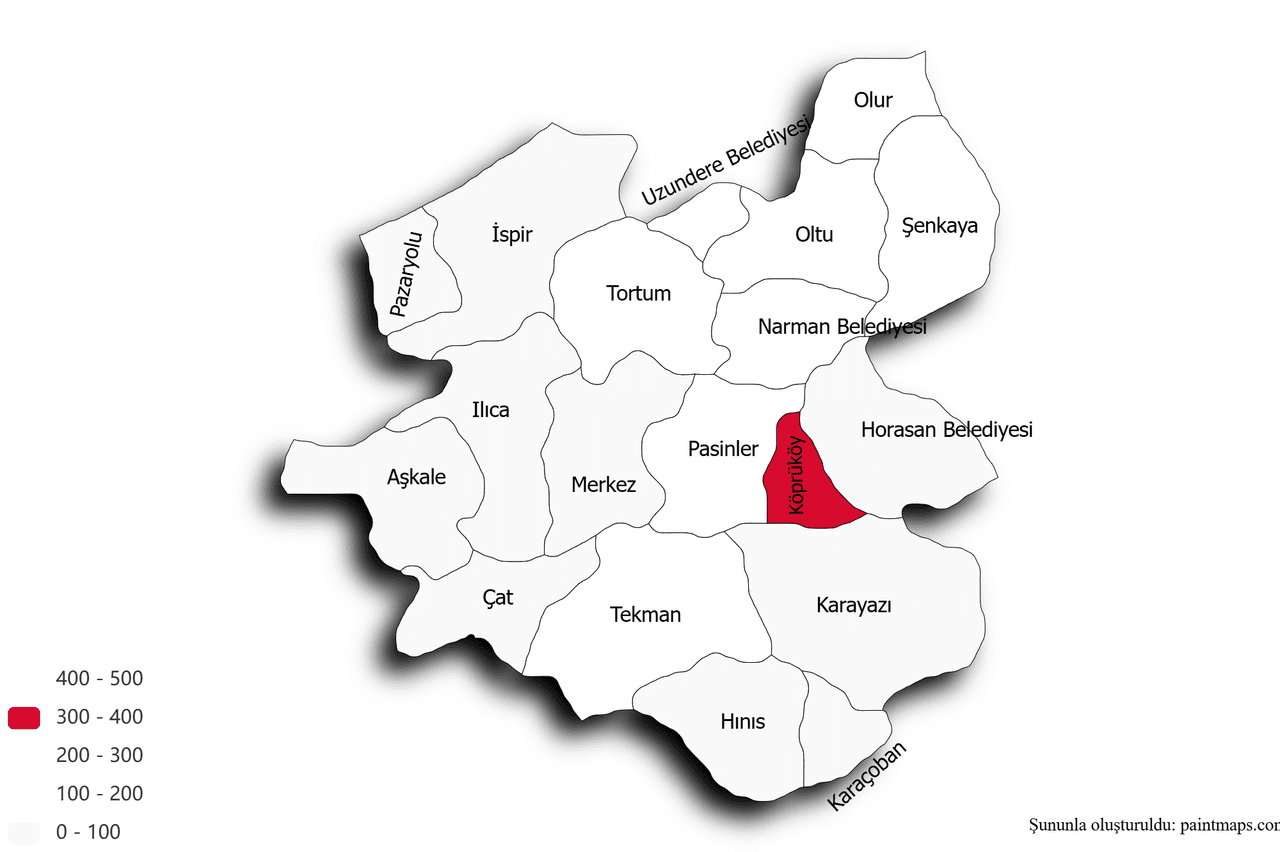
Köprüköy ( District)
Location | Türkiye Erzurum Köprüköy | ||||||||
|---|---|---|---|---|---|---|---|---|---|
Area(s) | 1 138 km² | ||||||||
Population | Approximately 15,000 as of 2023 | ||||||||
Geography | southeast of the Çoruh Valley Situated to the east of the Aras River | ||||||||
Climate(s) | characterized by cold winters and cool summers Continental climate | ||||||||
Economy | and limited tourism livestock farming sugar beet) barley Agriculture (wheat | ||||||||
Köprüköy is a district located in the province of Erzurum, Türkiye. Situated in the southeastern part of Erzurum, it lies to the east of the Aras River and southeast of the Çoruh Valley. Due to its high elevation, the district experiences a harsher continental climate compared to other regions of Erzurum. This climatic condition has made agriculture and livestock breeding the primary sources of livelihood for the local population. Köprüköy stands out with its fertile soils and traditional production methods, making it one of the region’s significant settlements in terms of both economic and cultural aspects. Furthermore, the district possesses local tourism potential with its natural landscapes and historical structures.

Avnik Castle (Republic of Türkiye, District Governorship of Köprüköy)
Köprüköy is located in the southeastern part of Erzurum, with its settlement area shaped around the Aras River. This river constitutes a significant portion of the region’s water resources, providing potable water for the local population as well as irrigation for agricultural activities. The region is characterized by a continental climate, with cold, snowy winters and cool summers. This climatic pattern supports the cultivation of crops such as wheat, barley, and sugar beets, which are commonly grown in the area.
Köprüköy has historically been one of the prominent settlement areas in the region. The Çobandede Bridge, from which the district derives its name, is a structure of considerable historical significance. It stands out as both an architectural monument and a testament to the region’s transportation history. In addition to this bridge, various other historical structures located in Köprüköy provide insight into the district’s past. Furthermore, several thermal springs in the area have become important centers for health tourism among the local population.

Çobandede Bridge (Republic of Turkey, District Governorship of Köprüköy)
The economy of Köprüköy is largely based on agriculture and animal husbandry. The local population primarily cultivates agricultural products such as wheat, barley, and sugar beets. Animal husbandry also constitutes a significant source of income, and the district contributes to Erzurum’s overall livestock production. The production of meat and dairy products is widespread in the area, forming a major component of regional trade. In addition, certain thermal springs and natural areas within Köprüköy support local tourism. However, the number of tourists visiting the region remains largely at the local level, and tourism appears to be less prominent when compared to other economic activities in the district.
The population of Köprüköy primarily consists of villagers who rely on agriculture and livestock for their livelihoods. The demographic structure of the district reflects characteristics typical of traditional rural life. As of 2023, demographic data indicate a population increase due to internal migration. The majority of the population is composed of families originating from Erzurum and nearby provinces, while the native residents within district boundaries continue to engage in traditional farming and animal husbandry.
The social structure of Köprüköy mirrors the dynamics of a traditional rural community. Cultural activities such as traditional handicrafts and local festivals play a significant role in the district. Village fairs held throughout the year promote social interaction among residents and reinforce the communal aspects of village life. Traditional folk dances and music in Köprüköy serve as vital tools for preserving local cultural heritage.
Although Köprüköy is administratively part of Erzurum province, transportation between the district center and its surrounding villages can be challenging. Access to the district is provided via road, and the distance to Erzurum city center is one of the main factors affecting local transportation. Infrastructure projects and road construction initiatives by local administrations aim to improve the district's transportation standards.
Köprüköy is a region rich in natural resources, surrounded by mountains, valleys, and rivers. These natural features offer significant potential for hiking and ecotourism activities. Forested and mountainous areas around the district not only support the livelihoods of local communities but also present attractive destinations for tourists seeking to explore natural landscapes. Ecotourism could play an important role in the district’s future economic development.
Köprüköy is a district predominantly engaged in agriculture and livestock farming. The main crops cultivated include wheat, barley, and sugar beets. In addition to traditional farming techniques, the adoption of modern agricultural practices has begun to improve productivity. Livestock farming, limited primarily to cattle and sheep breeding, makes a substantial contribution to the local economy.
Health services in Köprüköy are limited, reflecting the district’s size and geographical conditions. A basic health center provides primary medical services, while more comprehensive healthcare needs are met by facilities in the city of Erzurum. Residents of the district occasionally encounter difficulties in accessing adequate healthcare services.
The educational infrastructure of Köprüköy is generally limited to schools located in rural areas. The district hosts primary and secondary schools, but students typically need to travel to Erzurum city for higher education. From time to time, projects aimed at improving the level of education are implemented. Moreover, various social initiatives are organized to encourage public participation in educational and cultural activities.
The historical structures and natural wealth of Köprüköy present considerable potential for tourism. The Çobandede Bridge is one of the district’s most notable historical monuments and reflects the engineering style of the Ottoman period. In addition to the bridge, old settlements, villages, and natural landscapes offer valuable attractions for visitors interested in historical exploration. Cultural tourism represents a significant opportunity for the district’s development.

Çobandede Bridge (Culture Portal)
Erzurum Metropolitan Municipality. “About the District of Köprüköy.” Official Website of the Erzurum Metropolitan Municipality. Accessed May 31, 2025. https://erzurum.bel.tr/ilceler/koprukoy.
Erzurum Provincial Directorate of Culture and Tourism. “Köprüköy.” Official Website of the Ministry of Culture and Tourism, Erzurum Provincial Directorate. Accessed May 31, 2025. https://erzurum.ktb.gov.tr/TR-56059/koprukoy.html.
Erzurum Governorship. “Köprüköy.” Official Website of the Erzurum Governorship. Accessed May 31, 2025. http://www.erzurum.gov.tr/koprukoy.
Turkish Statistical Institute (TÜİK). “Address-Based Population Registration System Results, 2023.” Turkish Statistical Institute. Accessed May 31, 2025. https://www.tuik.gov.tr/indir/duyuru/favori-nufus-adnks-2023.pdf.
District Governorship of Köprüköy. “Avnik Castle.” Official Website of the District Governorship of Köprüköy. Accessed May 31, 2025. http://www.koprukoy.gov.tr/avnik-kalesi.
Paintmaps. “Erzurum Map Chart.” Paintmaps. Accessed May 31, 2025. https://paintmaps.com/map-charts/31c/Erzurum-map-chart.
Republic of Turkey Köprüköy District Governorship. “Çobandede Bridge.” Official Website of the Köprüköy District Governorship. Accessed May 31, 2025. http://www.koprukoy.gov.tr/cobandede-koprusu.
Republic of Turkey Ministry of Culture and Tourism. “Çobandede Bridge.” Culture Portal. Accessed May 31, 2025. https://kulturportali.gov.tr/turkiye/erzurum/gezilecekyer/cobandede-koprusu.

Köprüköy ( District)
Location | Türkiye Erzurum Köprüköy | ||||||||
|---|---|---|---|---|---|---|---|---|---|
Area(s) | 1 138 km² | ||||||||
Population | Approximately 15,000 as of 2023 | ||||||||
Geography | southeast of the Çoruh Valley Situated to the east of the Aras River | ||||||||
Climate(s) | characterized by cold winters and cool summers Continental climate | ||||||||
Economy | and limited tourism livestock farming sugar beet) barley Agriculture (wheat | ||||||||
No Discussion Added Yet
Start discussion for "Köprüköy (District)" article
Geography and Climate
Historical Structures and Cultural Heritage
Economy
Demographics
Social and Cultural Life
Transportation and Infrastructure
Natural Resources and Ecotourism Potential
Agriculture and Animal Husbandry
Health Services
Education and Cultural Activities
Historical Sites and Tourism Potential
This article was created with the support of artificial intelligence.