


This article was automatically translated from the original Turkish version.
+1 More
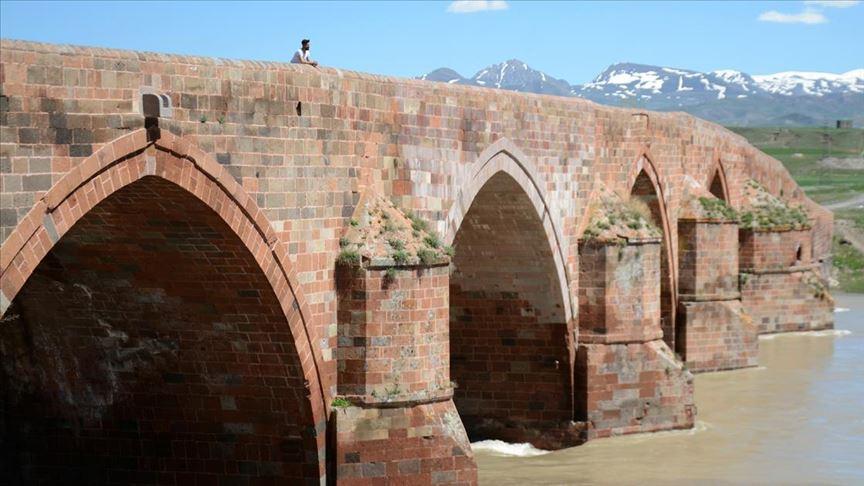
Çobandede Bridge
Location | Türkiye Erzurum Köprüköy | ||||||||
|---|---|---|---|---|---|---|---|---|---|
Construction Year | 1298 | ||||||||
Length(s) | 128 m | ||||||||
Width | 8.5 m | ||||||||
Highest Point | 30 m | ||||||||
Number of Arch Openings | 7 | ||||||||
The Çobandede Bridge is an important structure located in the Köprüköy district of Erzurum, along the historic Silk Road route, and exhibits Ilkhanid architectural features. It was commissioned in 1298 by Salduzlu Emir Çoban Noyin, vizier of Ilkhanid ruler Ghazan Khan (1295–1304), and derives its name from its builder. The bridge is situated approximately 50 kilometers from the center of Erzurum, near the exit to Pasinler district. Its location lies south of Çobandede Mountain, spanning the Aras River formed by the confluence of the Hasankale Stream and Bingöl Stream.

Çobandede Köprüsü (Culture Portal)
The bridge is 128 meters long and 8.5 meters wide. The largest arch span is reported in various sources as ranging between 13 and 16.8 meters, while its highest point reaches 30 meters. The structure consists of seven round arches, the first of which was sealed during recent restoration works. The arches are constructed from cut stones in black, red and gray colors. Original engineering techniques were employed in its construction: juniper logs were laid beneath the piers to prevent settling, and voids were left between the buffer walls to reduce overall weight.
The architectural form of the Çobandede Bridge and its decorative elements reflect Seljuk and Ilkhanid styles. The bridge is adorned with plant and geometric motifs. Some sources mention that it originally had eight pointed arches with domed kiosks featuring windows atop the piers.

Çobandede Köprüsü (Erzurum Governorship)
Throughout history, the Çobandede Bridge has served as a vital crossing point and witnessed numerous historical events and campaigns, including those of Kanuni Sultan Süleyman and Yavuz Sultan Selim to Iran. Evliya Çelebi also mentioned the bridge in his travelogue, highlighting its appearance.
The bridge has undergone several repairs throughout its history. It was restored in 1727, 1872 and 1948, and most recently in 2011. An inscription from the 1727 restoration records that it was repaired under the orders of Sultan Ahmed III.
Today, due to its location in an earthquake-prone region and the risk of damage, vehicular traffic has been prohibited on the Çobandede Bridge. It is preserved exclusively for pedestrian use to ensure its transmission to future generations. This measure helps sustain the architectural features and protective measures that have enabled the bridge to stand for centuries. The Çobandede Bridge is one of Erzurum’s most significant cultural heritage sites and holds historical value for visitors.
Anadolu Ajansı. “721 Yıllık Köprü Gelecek Nesiller İçin Sadece Yayalara Hizmet Veriyor.” Anadolu Ajansı, Date Published May 15, 2019; Accessed June 18, 2025. https://www.aa.com.tr/tr/turkiye/721-yillik-kopru-gelecek-nesiller-icin-sadece-yayalara-hizmet-veriyor/1479037
Erzurum Valiliği. “Çobandede Köprüsü.” Erzurum Valiliği Resmî Web Sitesi. Accessed June 18, 2025. http://www.erzurum.gov.tr/cobandede-koprusu
T.C. Kültür ve Turizm Bakanlığı. “Çobandede Köprüsü.” Kültür Portalı, Erzurum, Erzurum İl Kültür ve Turizm Müdürlüğü. Accessed June 18, 2025. https://www.kulturportali.gov.tr/turkiye/erzurum/gezilecekyer/cobandede-koprusu
Türkiye Turizm Ansiklopedisi. "Çobandede Köprüsü." Türkiye Turizm Ansiklopedisi. Accessed June 18, 2025. https://turkiyeturizmansiklopedisi.com/cobandede-koprusu

Çobandede Bridge
Location | Türkiye Erzurum Köprüköy | ||||||||
|---|---|---|---|---|---|---|---|---|---|
Construction Year | 1298 | ||||||||
Length(s) | 128 m | ||||||||
Width | 8.5 m | ||||||||
Highest Point | 30 m | ||||||||
Number of Arch Openings | 7 | ||||||||