

This article was automatically translated from the original Turkish version.
Krypton (Kr) (Generated with Artificial Intelligence.)
Discovery(ies) | William Ramsay & Morris Travers | ||||||||
|---|---|---|---|---|---|---|---|---|---|
Melting / Boiling Point | -157.36 °C / -153.22 °C | ||||||||
Density (0 °C - 1 Atm) | 3.749 g/L | ||||||||
Compounds | KrF₂ (Krypton Difluoride) – Forms Under Special Conditions | ||||||||
Isotopes | 81Kr – 85Kr (Radioactive) 86Kr (Stable) 84Kr 83Kr 82Kr 80Kr 78Kr | ||||||||
Applications | Nuclear Tracking Window Insulation Krypton Lasers Flash Lamps | ||||||||
Atomic Number | 36 | ||||||||
Group | 18 (Noble Gases) | ||||||||
Atomic Mass | 83.798 u | ||||||||
Electron Configuration | [Ar] 3d¹⁰ 4s² 4p⁶ | ||||||||
Period(s) | 4 | ||||||||
Block | p-Block | ||||||||
Physical State | Gas (Colorless – Odorless – Tasteless) | ||||||||
Krypton is one of the noble gases located in group 18 of the periodic table. A colorless, odorless, and tasteless gas, krypton occurs in trace amounts in the atmosphere and is chemically quite inert. Its name is derived from the Greek word kryptos, meaning “hidden.”【1】 This element, notable for its specialized applications in modern science and its rarity, plays important roles in both technological and environmental monitoring fields.
Krypton was discovered in 1898 by British chemists William Ramsay and Morris Travers through the fractional distillation of liquid air. Ramsay and Travers had also discovered other noble gases such as argon and neon, and the discovery of krypton was part of this series. The presence of the element was identified by examining residual gases obtained during the low-temperature distillation of air. The discovery process required careful laboratory work due to krypton’s extremely low natural abundance.
Krypton is an element with atomic number 36 and is located in the fourth period and group 18 of the periodic table. As a member of the noble gases, krypton is a p-block element. Its electron configuration is [Ar] 3d¹⁰ 4s² 4p⁶, a structure that confers chemical inertness. At room temperature, krypton exists as a gas with a standard atomic mass of 83.798 u. These fundamental properties make it similar to other noble gases, though it differs in atomic mass and density.
Krypton melts at −157.36 °C and boils at −153.22 °C. At 0 °C and 1 atm pressure, its density is 3.749 g/L, and it exhibits low solubility in water. Due to its colorless and odorless nature, it is difficult to detect with the naked eye. Chemically very stable, krypton forms compounds only under special conditions. These properties make it a safe gas in both laboratory and industrial applications.
The electronegativity of krypton is approximately 3.00 on the Pauling scale. Although this value is relatively high among noble gases, its reactivity remains very low due to its completely filled electron shell. However, in 1963 it was demonstrated that krypton can form compounds with fluorine, and krypton difluoride (KrF₂) was synthesized. This compound showed that krypton is not chemically completely inert and can become reactive under specific conditions.
Natural isotopes of krypton include ⁷⁸Kr, ⁸⁰Kr, ⁸²Kr, ⁸³Kr, ⁸⁴Kr, and ⁸⁶Kr. Most of these isotopes are stable and occur naturally in terrestrial proportions. Radioactive isotopes such as ⁸¹Kr also exist. ⁸¹Kr is used in dating groundwater, while ⁸⁵Kr is produced as a result of nuclear fission and plays a key role in monitoring nuclear activities. These isotopes provide scientific data for environmental monitoring and geological dating.
Krypton is found in the atmosphere at approximately one part per million. Consequently, its extraction from nature is difficult and is typically achieved through fractional distillation of liquid air. Naturally occurring krypton exists in its free state and does not form compounds in nature due to its low tendency to react. However, in laboratory settings, it can form compounds with highly electronegative elements such as fluorine. Krypton difluoride (KrF₂) is the best-known example of such compounds.
Krypton has no known biological role. Its interaction with living organisms is extremely limited and it is non-toxic. When inhaled, krypton does not participate in any reactions within the body due to its inert nature and is rapidly exhaled. Therefore, it can be safely used in medical applications, particularly in certain imaging techniques. There is no risk of accumulation or harmful effects of krypton in biological systems.
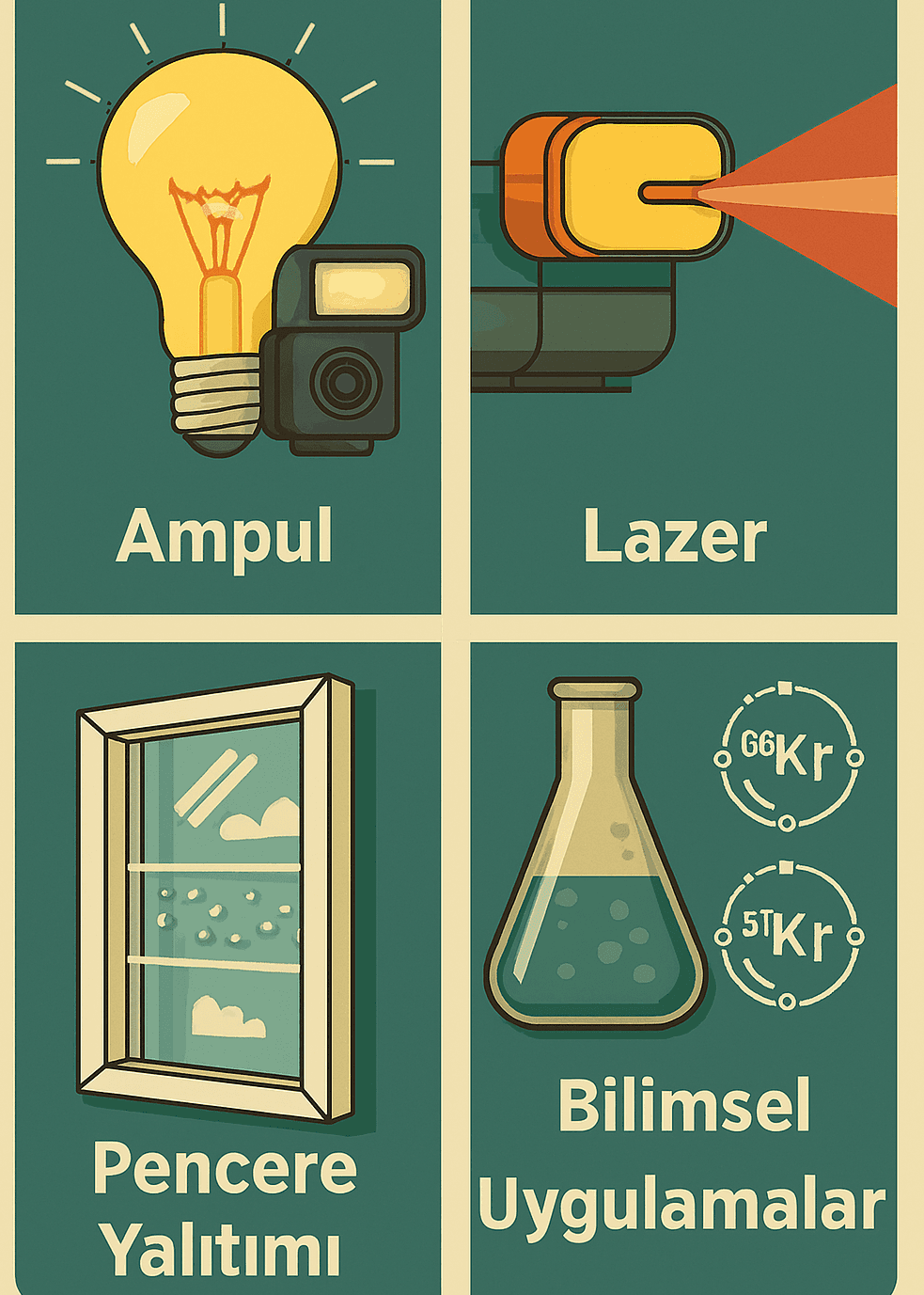
Applications of the Krypton Element (Generated by Artificial Intelligence.)
Krypton is used in various technological and scientific fields. In lighting technology, it is preferred in high-performance bulbs and flash lamps. Krypton lasers are employed in medical and industrial applications, and it serves as an insulating gas in the space between double-glazed windows. The isotope ⁸⁵Kr is used to monitor nuclear reactors and weapons, while ⁸¹Kr is utilized in geochronological analyses for determining the age of groundwater. These applications highlight krypton’s scientific and industrial value.
Krypton emits light at specific wavelengths, a property utilized in spectroscopic analyses. Krypton lasers are particularly favored in medical fields such as ophthalmology and dermatology. They are also used in certain industrial cutting and processing systems. These lasers offer advantages in precision applications due to their high energy efficiency and stable light output.
The radioactive isotopes of krypton play a critical role in environmental monitoring and nuclear security. The isotope ⁸⁵Kr is released into the atmosphere during nuclear fuel cycle operations, and its presence is used to monitor nuclear activities. The concentration of this isotope in the atmosphere serves as an important indicator of the operational level of nuclear facilities. Similarly, the isotope ⁸¹Kr is used to determine the age of groundwater sources and provides valuable information in hydrogeological research.
Holland, Greg. “Krypton.” *Encyclopedia of Geochemistry*, 1–4. Living Reference Work. Accessed August 16, 2025. https://link.springer.com/rwe/10.1007/978-3-319-39193-9_198-1
National Center for Biotechnology Information. “Krypton.” *PubChem Compound Summary.* Accessed August 16, 2025. https://pubchem.ncbi.nlm.nih.gov/compound/krypton.
National Center for Biotechnology Information. “Krypton.” *PubChem Element Record.* Accessed August 16, 2025. https://pubchem.ncbi.nlm.nih.gov/element/Krypton.
TÜBİTAK Bilim Genç. "Kripton." *Bilim Genç*. Accessed August 16, 2025. https://bilimgenc.tubitak.gov.tr/periyodik-tablo/kripton.
[1]
TÜBİTAK Bilim Genç, “Kripton,” Bilim Genç, son erişim 16 Ağustos 2025, https://bilimgenc.tubitak.gov.tr/periyodik-tablo/kripton.

Krypton (Kr) (Generated with Artificial Intelligence.)
Discovery(ies) | William Ramsay & Morris Travers | ||||||||
|---|---|---|---|---|---|---|---|---|---|
Melting / Boiling Point | -157.36 °C / -153.22 °C | ||||||||
Density (0 °C - 1 Atm) | 3.749 g/L | ||||||||
Compounds | KrF₂ (Krypton Difluoride) – Forms Under Special Conditions | ||||||||
Isotopes | 81Kr – 85Kr (Radioactive) 86Kr (Stable) 84Kr 83Kr 82Kr 80Kr 78Kr | ||||||||
Applications | Nuclear Tracking Window Insulation Krypton Lasers Flash Lamps | ||||||||
Atomic Number | 36 | ||||||||
Group | 18 (Noble Gases) | ||||||||
Atomic Mass | 83.798 u | ||||||||
Electron Configuration | [Ar] 3d¹⁰ 4s² 4p⁶ | ||||||||
Period(s) | 4 | ||||||||
Block | p-Block | ||||||||
Physical State | Gas (Colorless – Odorless – Tasteless) | ||||||||
Discovery
Classification and Fundamental Properties
Physical and Chemical Properties
Electronegativity and Reactivity
Isotopes
Natural Occurrence and Compounds
Biological Role and Importance to Living Organisms
Applications
Spectroscopic Properties and Laser Applications
Environmental Monitoring and Nuclear Security