

This article was automatically translated from the original Turkish version.
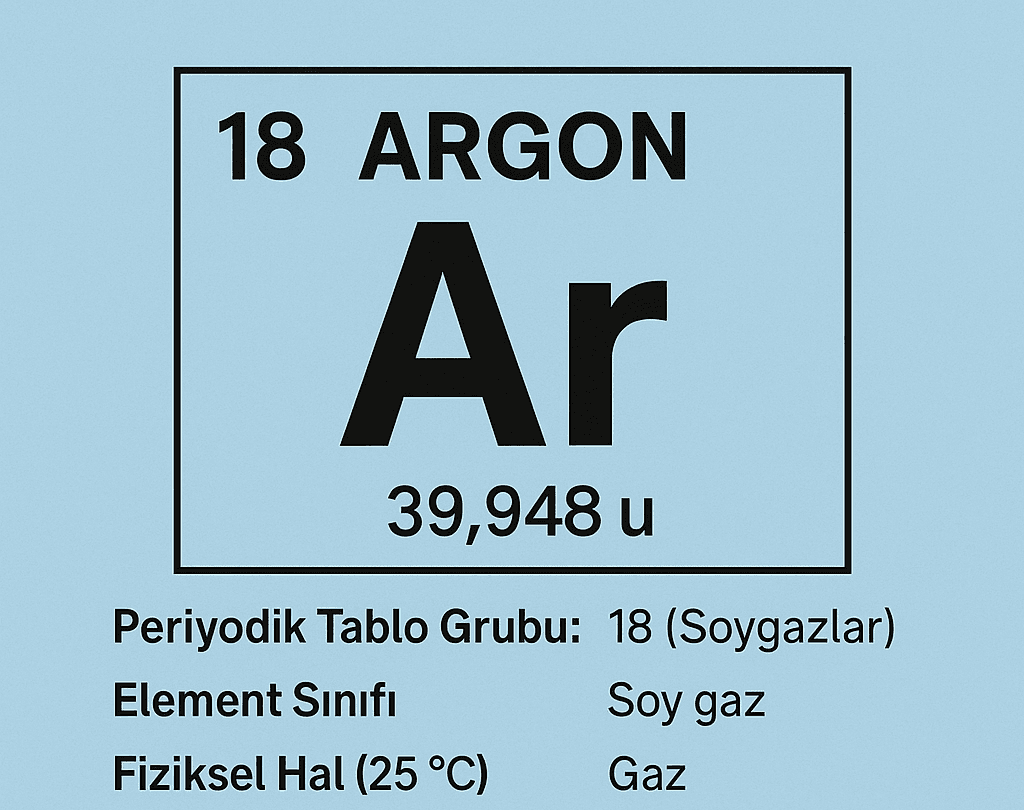
Argon (Ar)
Symbol | Ar | ||||||||
|---|---|---|---|---|---|---|---|---|---|
Atomic Number | 18 | ||||||||
Atomic Mass | 39,948 u | ||||||||
Periodic Table Group | Group 18 (Noble Gases) | ||||||||
Element Class | Noble Gas | ||||||||
Physical State (25 °C) | Gas | ||||||||
Electron Configuration | 1s² 2s² 2p⁶ 3s² 3p⁶ | ||||||||
Electronegativity | No Significant Value (Not Reactive) | ||||||||
Melting Point | -189.3 °C | ||||||||
Boiling Point | -185.8 °C | ||||||||
Isotopes | Ar-40 (Ar-40 Most Common) Ar-38 Ar-36 | ||||||||
Discovery(ies) | 1894 Lord Rayleigh and William Ramsay | ||||||||
Applications | Cryogenic Applications Analytical Chemistry Semiconductor Production Lighting Welding | ||||||||
Argon is a chemical element belonging to the noble gas group and located in group 18 of the periodic table. Its symbol is "Ar" and its atomic number is 18. Argon is a colorless odorless and tasteless gas that exhibits a stable monatomic structure at room temperature. It constitutes approximately 0.93% by volume of the atmosphere making it the third most abundant gas after nitrogen and oxygen. Due to its extremely low tendency to react it is predominantly found in its free state in nature owing to its stability and chemical inertness. Because of these properties it is widely used in industry to create protective atmospheres.
The element argon was discovered in 1894 by Lord Rayleigh (John William Strutt) and Sir William Ramsay. Scientists noticed that nitrogen obtained from air had a higher density than nitrogen produced by chemical means and sought to determine the source of this discrepancy. Subsequent research revealed the presence of another previously unidentified gas in the atmosphere. This gas was named "argon" derived from the Greek word meaning "inert" due to its nonreactive nature and was classified within the noble gases group of the periodic table.
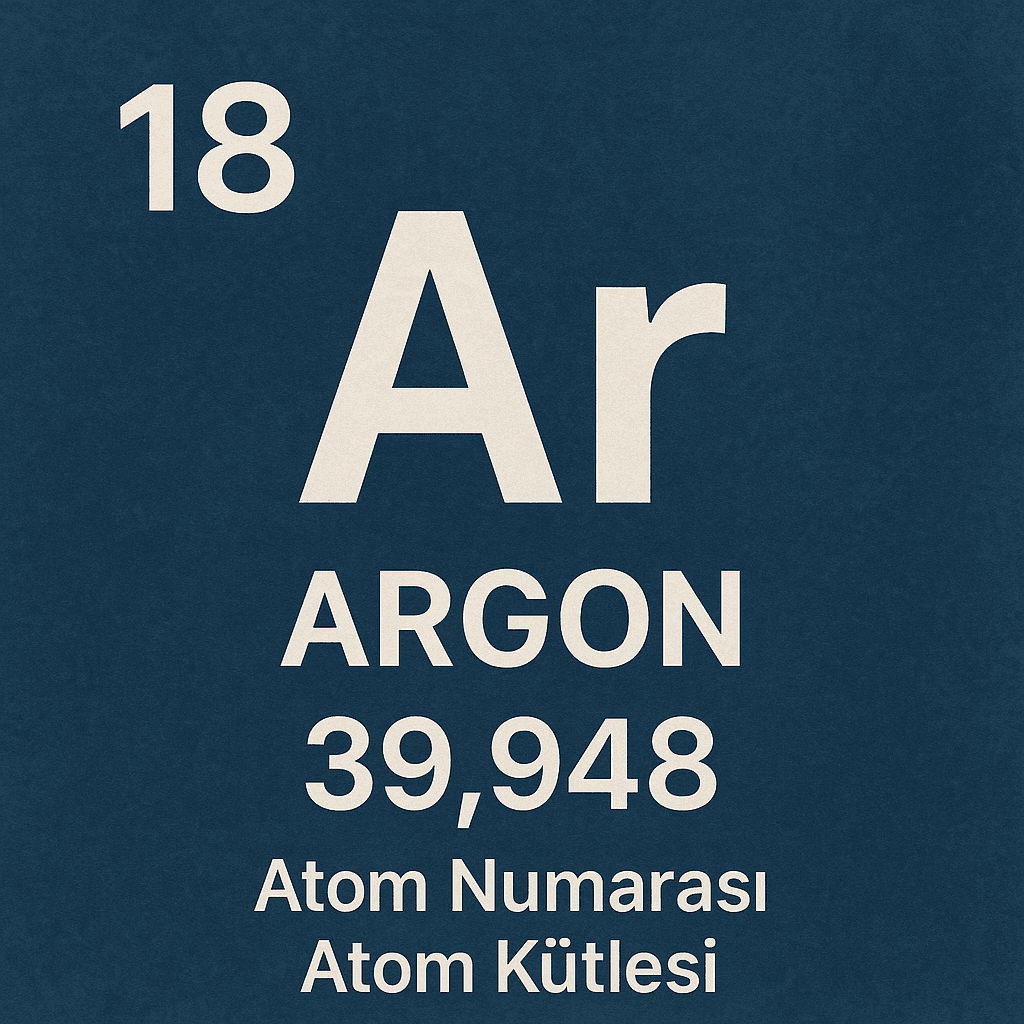
Argon Element (Generated by Artificial Intelligence.)
Argon belongs to the noble gas group and is located in period 3 group 18 of the periodic table. With an atomic number of 18 argon has an atomic mass of approximately 39.948 atomic mass units. Its electron configuration is 1s² 2s² 2p⁶ 3s² 3p⁶. At standard temperature and pressure it exists as a gas. Under these conditions argon appears as a molecular form occupying a volume of 22.4 L/mol. Its stable electron configuration forms the basis of its noble gas characteristics.
The name argon is derived from the Greek word "argos" meaning "idle" or "inert". This naming reflects the element's chemically inert nature its reluctance to participate in chemical reactions. The choice of name was determined by the element's inability to react with other substances.
At room temperature argon is a colorless odorless and tasteless gas. It is chemically stable due to its completely filled valence shell. The melting point of argon is −189.3 °C and its boiling point is −185.8 °C. Under natural conditions it exists solely as a monatomic gas and has an extremely low tendency to form chemical bonds. Its nonreactive nature makes it a preferred atmospheric gas in many industrial processes.
The electronegativity of argon is effectively zero and no specific value is assigned on the Pauling electronegativity scale. This is because argon's stable electron configuration renders it neither inclined to accept nor donate electrons from other atoms. Consequently its participation in chemical reactions is extremely limited. Although under highly specialized laboratory conditions a few compounds can be synthesized these compounds do not exist stably in nature.
Argon has three stable isotopes occurring naturally: Argon-36 Argon-38 and Argon-40. The most abundant isotope in natural argon is Argon-40 which is formed by the radioactive decay of Potassium-40. This decay process plays a significant role in determining the natural accumulation of argon in the atmosphere.
Argon constitutes approximately 0.93% by volume of the atmosphere making it the third most abundant gas in the air. Although trace amounts are found in the Earth's crust the most common economic method of extraction is fractional distillation of air. During this process oxygen nitrogen and other gases are separated to obtain pure argon. Since it does not participate in chemical reactions argon does not exist in nature as a compound but only in its free atomic form.
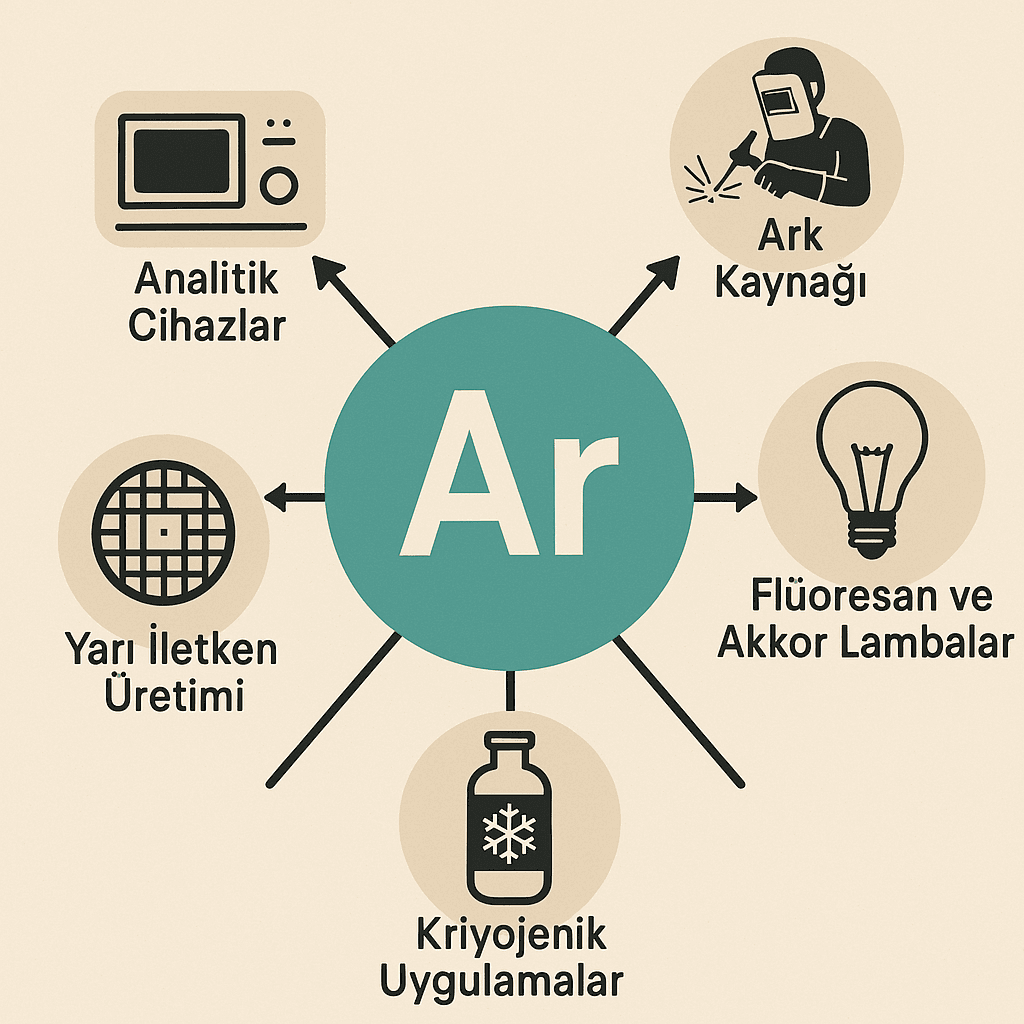
Applications of Argon Element (Generated by Artificial Intelligence.)
The primary application of argon stems from its high resistance to chemical reactions. This property enables its use in welding particularly in arc welding where it prevents unwanted oxidation by shielding the workpiece from contact with air. Argon also serves as a fill gas in fluorescent and incandescent lamps provides an inert atmosphere in semiconductor manufacturing and acts as a carrier gas in certain analytical instruments. Argon gas is also utilized in mass spectrometry atomic absorption spectroscopy and various cryogenic applications. In all these uses the fundamental objective is to create a nonreactive and stable environment.
National Center for Biotechnology Information. "Argon." PubChem. Accessed July 12, 2025. https://pubchem.ncbi.nlm.nih.gov/element/Argon
TÜBİTAK Bilim Genç. "Argon." *Bilim Genç*. Accessed July 12, 2025. https://bilimgenc.tubitak.gov.tr/periyodik-tablo/argon.

Argon (Ar)
Symbol | Ar | ||||||||
|---|---|---|---|---|---|---|---|---|---|
Atomic Number | 18 | ||||||||
Atomic Mass | 39,948 u | ||||||||
Periodic Table Group | Group 18 (Noble Gases) | ||||||||
Element Class | Noble Gas | ||||||||
Physical State (25 °C) | Gas | ||||||||
Electron Configuration | 1s² 2s² 2p⁶ 3s² 3p⁶ | ||||||||
Electronegativity | No Significant Value (Not Reactive) | ||||||||
Melting Point | -189.3 °C | ||||||||
Boiling Point | -185.8 °C | ||||||||
Isotopes | Ar-40 (Ar-40 Most Common) Ar-38 Ar-36 | ||||||||
Discovery(ies) | 1894 Lord Rayleigh and William Ramsay | ||||||||
Applications | Cryogenic Applications Analytical Chemistry Semiconductor Production Lighting Welding | ||||||||
Discovery
Classification and Fundamental Properties
Etimology
Physical and Chemical Properties
Electronegativity and Reactivity
Isotopes
Natural Occurrence and Compounds
Applications