

This article was automatically translated from the original Turkish version.
+2 More
Location | Manisa / Kula | ||||||||
|---|---|---|---|---|---|---|---|---|---|
Facade Elements | Shuttered/fingered windows, eaves, and projections | ||||||||
Construction System/Material | Stone masonry on the ground floor; wooden frame (hımış) and infill (kerpiç/stone) on upper floors | ||||||||
Plan Types | Commonly with outer sofas, inner sofas, and middle sofas | ||||||||
Street Fabric | Narrow, organic, winding, and dead-end streets | ||||||||
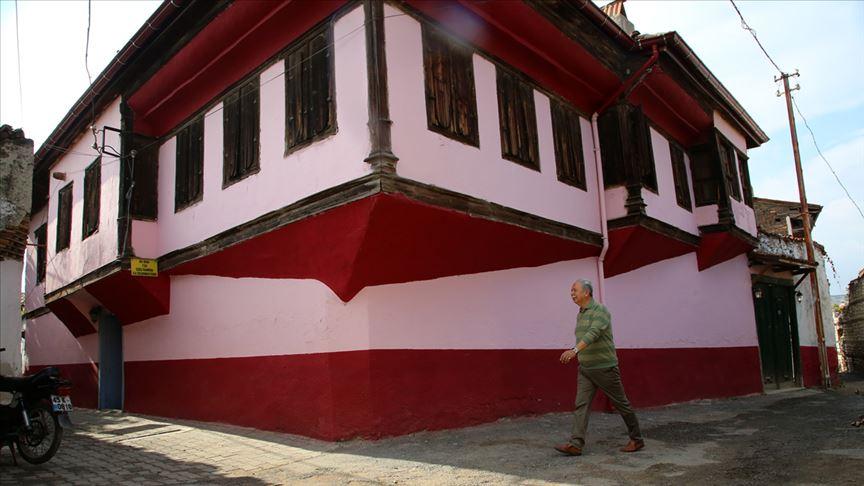
Kula Houses refer to the traditional housing stock concentrated in the historic settlement area of Kula district in Manisa province, and the organic urban fabric shaped by the relationship between plots, courtyards, and streets. The dwellings are predominantly two-story; service and storage functions are located on the ground floor, while living spaces are arranged on the upper floor. The coexistence of Turkish and Greek house examples within the same urban context is examined alongside neighborhood-level clustering and shared commercial practices.【1】

Kula Houses (AA)
The traditional housing culture of Kula emerged between the early 17th century and the early 20th century within the broader Anatolian “Turkish house” tradition; Kula houses are defined as two-story structures primarily featuring wooden frame construction during this period.【2】 The settlement exhibited a typical urban pattern during the Ottoman period, organized around a bazaar–neighborhood–street structure; commercial structures such as hans, baths, and shops were constructed in relation to historical trade networks.【3】
The street network in Kula generally exhibits a narrow, organic, and winding pattern. Streets frequently change direction, and due to the irregularity of the settlement fabric, regular connecting pathways between house groups are scarce while dead-end streets are common. Houses are predominantly oriented toward courtyards within their plots, courtyard walls are built tall, and overhanging upper floors significantly shape the street silhouette.【4】

Kula Houses Street Fabric (AA)
Turkish houses are concentrated in the Camicedit, Kızılkaya, and Seyitali neighborhoods, while Greek houses are primarily found in Zaferiye and Akgün neighborhoods.【5】 In contrast, commercial areas reflect sustained coexistence and interaction between different groups.【5】
Three primary plan types are identified in Kula houses: outer-sofa, inner-sofa, and central-sofa. Outer-sofa plans are prevalent in early examples, while inner and central-sofa plans appear in 19th-century examples. In outer-sofa types, the sofa faces the courtyard; entry is typically through a double-leaf door, and access to the upper floor is via stairs from the courtyard. Ground floors are allocated to storage and service spaces such as cellars, storerooms, and stables; kitchens and toilets are sometimes separated from the main structure in certain examples.【6】
The courtyard, though small in scale, is present in nearly every dwelling and is positioned at the rear of the plot to dominate the house’s spatial orientation. Spatial variation is achieved at the ends of the sofa through elements such as steps and eyvans; semi-open spaces projecting toward the street are enclosed by walls, and window openings are often covered with wooden lattice screens to ensure privacy.【7】

Kula Houses (AA)
In examples classified as “Sakız-type,” the entrance is typically set within a niche and accessed via stairs. The door may be double-leaf and constructed of wood or metal. In this typology, courtyard entrances may be located on the same facade as the main entrance or on a side facade; courtyard openings may feature flat lintels or curved arches. Additionally, plaster decorations in triangular or circular motifs appear on lintels, and in some cases, construction dates are inscribed.【8】
In Kula houses, ground floor walls are constructed using rubble or mixed masonry with locally abundant karataş and kayrak stone; upper floor walls are built using timber frame systems filled with adobe or similar materials. Another study emphasizes that wood, local black stone, and adobe were the primary building materials, and traditional houses were generally two-story with timber frame structures.【9】
In Kula’s traditional houses, facade and window arrangements are established according to functional and structural requirements, following specific proportional and detailing principles. Windows are among the primary elements reflecting the interior–exterior relationship and facade organization; Kula traditional houses and their facades were constructed based on design principles involving proportions and details. Elements such as shutters, grilles, and upper or top windows are used for lighting and privacy.【10】
Door knockers and rings serve distinct functions: the primary purpose of the knocker is to produce sound to announce one’s presence and request entry, while rings are used to pull and open or close the door leaves. Doors typically open inward toward the courtyard; knockers and rings are positioned at heights suitable for adult access. Iron is the dominant material, reflecting local blacksmithing traditions associated with casting and forging techniques.【11】
A study focusing on Kula’s historic commercial areas examines the commercial building stock within the urban conservation zone, analyzing 298 structures. The commercial fabric is concentrated around Hamdullah Caddesi, Şehit Raşit Uzun Caddesi, Yunus Emre Caddesi, and Beyler Sokak. The study also proposes spatial interventions such as removal of unsympathetic additions, facade and ground floor improvements, and restrictions on vehicular traffic.【12】
Assessments of Kula’s historic dwellings and urban fabric indicate that Turkish and Greek housing types influenced each other through shared living practices. Furthermore, the preservation of the historic neighborhood structure in which these dwellings are located constitutes an important cultural heritage area. In Sakız-type houses, construction dates inscribed on lintels and other architectural details can serve as valuable indicators for documentation and conservation processes.【13】
Atalan, Özlem, Gizem Özer Baş, İpek Gölükcü, Eymen Tatlıhayat, and Ahmet Yavuz Çamlı. “Ottoman Period of Commercial Urban Areas: Research of Manisa-Kula Conservation Area.” *Pamukkale Üniversitesi Sosyal Bilimler Enstitüsü Dergisi* 66 (2025): 1–16. Accessed December 29, 2025. https://dergipark.org.tr/en/download/article-file/3903095
Atalan, Özlem. “A Traditional Ottoman District, a Research on Window Arrangements of Kula Traditional Houses.” *Turkish Studies – Social Sciences* 16, no. 2 (2021): 449–468. Accessed December 29, 2025. https://www.academia.edu/76592649
Derin, Emine. *Manisa İli Kula İlçesindeki Sakız Tipi Evler ve Koruma Sorunları Üzerine Bir Araştırma*. Master's thesis,Yıldız Teknik University, Institute of Science and Technology, Department of Architecture, Survey and Restoration Program, 2019. Accessed December 29, 2025. https://tez.yok.gov.tr/UlusalTezMerkezi/tezDetay.jsp?id=lv0u5Pu6R-M7YR47UN171A&no=Yy_FLsRkFAxSF7mtluxG1g
Gölükcü, İpek. “Tarihi Kula Evleri.” In *Kula’nın Sosyo-Ekonomik Yapısının Akademik Perspektiften Araştırılması*, edited by Ahmet Yavuz Çamlı, pp. 125–149. Ankara: Gazi Kitabevi, 2020. Accessed December 29, 2025 https://www.researchgate.net/publication/350188558_Tarihi_Kula_Evleri
Koçer, Serap Erçin. “Kula Evleri, Kapı Tokmakları ve Halkaları.” *Türk Dünyası İncelemeleri Dergisi* 16, no. 2 (2016): 211–224. Accessed December 29, 2025. https://dergipark.org.tr/tr/pub/egetdid/article/517393
Zeren, Mine Tanaç, and Özgül Yılmaz Karaman. “Analysis of Traditional Building Techniques and Damage Assessment of Traditional Turkish House: The Study of Timber-framed Kula Houses.” *Archnet-IJAR: International Journal of Architectural Research* 9, no. 1 (2015): 261–288. Accessed December 29, 2025. https://www.researchgate.net/publication/285610370
“Tarihi Kula Evleri.” *Visit Manisa*. Accessed December 29, 2025. https://visitmanisa.org/icerik/tarihi-kula-evleri
[1]
Visit Manisa, “Tarihi Kula Evleri.” Erişim 29 Aralık 2025, https://visitmanisa.org/icerik/tarihi-kula-evleri
[2]
Özlem Atalan, “Geleneksel Bir Osmanlı İlçesi, Kula Geleneksel Konutlarının Pencere Düzenlerine İlişkin Bir Araştırma,” Turkish Studies–Social Sciences 16, no. 2 (2021): 449–468. Erişim 29 Aralık 2025. https://doi.org/10.47356/TurkishStudies.49139
[3]
Özlem Atalan, Gizem Özer Baş, İpek Gölükçü, Eymen Tatlıhayat, ve Ahmet Yavuz Çamlı, “Ottoman Period of Commercial Urban Areas: Research of Manisa-Kula Conservation Area,” Pamukkale University Journal of Social Sciences Institute, no. 66 (Ocak 2025): 1–16. Erişim 29 Aralık 2025 https://dergipark.org.tr/en/download/article-file/3903095
[4]
Visit Manisa, “Tarihi Kula Evleri.” Erişim 29 Aralık 2025, https://visitmanisa.org/icerik/tarihi-kula-evleri
[5]
Gölükcü, İpek. “Tarihi Kula Evleri.” In Kula’nın Sosyo-Ekonomik Yapısının Akademik Perspektiften Araştırılması, edited by Ahmet Yavuz Çamlı, 125–149. Ankara: Gazi Kitabevi, 2020. Erişim 29 Aralık 2025https://www.researchgate.net/publication/350188558_Tarihi_Kula_Evleri
[6]
Visit Manisa, “Tarihi Kula Evleri.” Erişim 29 Aralık 2025, https://visitmanisa.org/icerik/tarihi-kula-evleri
[7]
Emine Derin, Manisa İli Kula İlçesindeki Sakız Tipi Evler ve Koruma Sorunları Üzerine Bir Araştırma (Master’s thesis, Yıldız Technical University, 2019). Erişim 29 Aralık 2025 https://tez.yok.gov.tr/UlusalTezMerkezi/tezDetay.jsp?id=lv0u5Pu6R-M7YR47UN171A&no=Yy_FLsRkFAxSF7mtluxG1g
[8]
Emine Derin, Manisa İli Kula İlçesindeki Sakız Tipi Evler ve Koruma Sorunları Üzerine Bir Araştırma (Master’s thesis, Yıldız Technical University, 2019). Erişim 29 Aralık 2025 https://tez.yok.gov.tr/UlusalTezMerkezi/tezDetay.jsp?id=lv0u5Pu6R-M7YR47UN171A&no=Yy_FLsRkFAxSF7mtluxG1g
[9]
Özlem Atalan, “Geleneksel Bir Osmanlı İlçesi, Kula Geleneksel Konutlarının Pencere Düzenlerine İlişkin Bir Araştırma,” Turkish Studies–Social Sciences 16, no. 2 (2021): 449–468. Erişim 29 Aralık 2025. https://doi.org/10.47356/TurkishStudies.49139
[10]
Özlem Atalan, “Geleneksel Bir Osmanlı İlçesi, Kula Geleneksel Konutlarının Pencere Düzenlerine İlişkin Bir Araştırma,” Turkish Studies–Social Sciences 16, no. 2 (2021): 449–468. Erişim 29 Aralık 2025. https://doi.org/10.47356/TurkishStudies.49139
[11]
Serap Erçin Koçer, “Kula Evleri, Kapı Tokmakları ve Halkaları,” Türk Dünyası İncelemeleri Dergisi 16, no. 2 (2016): 211–224. Erişim 29 Aralık 2025. https://dergipark.org.tr/tr/pub/egetdid/article/517393
[12]
Özlem Atalan, Gizem Özer Baş, İpek Gölükçü, Eymen Tatlıhayat, ve Ahmet Yavuz Çamlı, “Ottoman Period of Commercial Urban Areas: Research of Manisa-Kula Conservation Area,” Pamukkale University Journal of Social Sciences Institute, no. 66 (Ocak 2025): 1–16. Erişim 29 Aralık 2025. https://dergipark.org.tr/en/download/article-file/3903095
[13]
Visit Manisa, “Tarihi Kula Evleri.” Erişim 29 Aralık 2025, https://visitmanisa.org/icerik/tarihi-kula-evleri

Location | Manisa / Kula | ||||||||
|---|---|---|---|---|---|---|---|---|---|
Facade Elements | Shuttered/fingered windows, eaves, and projections | ||||||||
Construction System/Material | Stone masonry on the ground floor; wooden frame (hımış) and infill (kerpiç/stone) on upper floors | ||||||||
Plan Types | Commonly with outer sofas, inner sofas, and middle sofas | ||||||||
Street Fabric | Narrow, organic, winding, and dead-end streets | ||||||||
Historical Background and Development of the Settlement
Urban Fabric and Street Network
Neighborhoods and Functional Differentiation
Housing Typology and Spatial Organization
Courtyard–Sofa Relationship and Semi-Open Spaces
Sakız-Type Dwellings
Construction System, Materials, and Facade Design
Window Arrangement and Lighting Elements
Doors, Knockers, and Rings
Commercial Fabric and Public Spaces
Conservation Status and Major Challenges