

This article was automatically translated from the original Turkish version.
Type of Geographical İndication | Mahreç Sign | ||||||||
|---|---|---|---|---|---|---|---|---|---|
Registration Number | 434 | ||||||||
Registration Date | 21.06.2019 | ||||||||
Product / Product Group(s) | Processed and Unprocessed Fruits Vegetables and Mushrooms | ||||||||
Province(s) | Manisa | ||||||||
Applicant/Registrant(s) | Salihli Chamber of Commerce and Industry | ||||||||
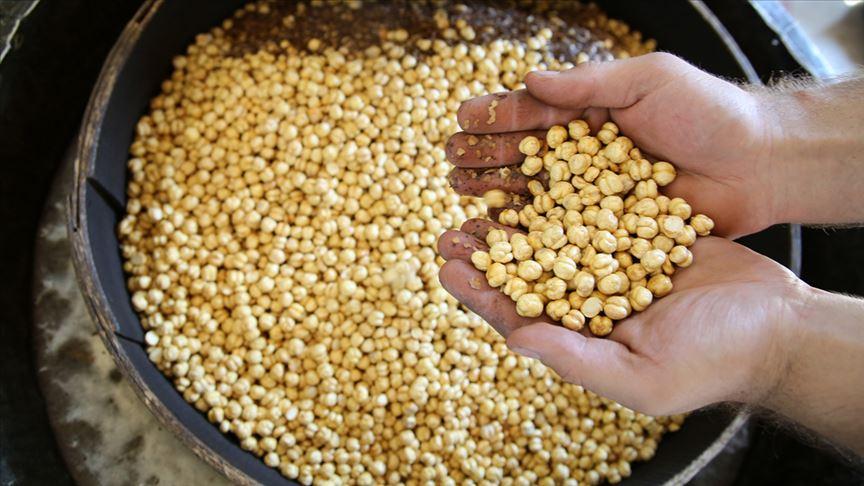
Kula Leblebisi is a traditional local food product manufactured in the district of Kula in Manisa Province using conventional methods and registered with a geographical indication. Registered on 21 June 2019 under Law No. 6769 on Industrial Property, this product is protected under geographical indication by the Salihli Chamber of Commerce and Industry.
Kula leblebisi is produced from red, white and yellow chickpeas with hairy and thick husks. Its production is based on cultural knowledge and experience passed down through generations in the region. Leblebi production has been a long-standing profession in Kula, and the product’s distinctive structure is the result of a multi-stage process carried out with skilled craftsmanship.
The physical properties of the chickpeas used in Kula leblebisi include an average seed weight of 43.58 g, length of 9–11.2 mm, thickness of 8–8.9 mm and width of 5–7.2 mm. Density ranges from 1.34 to 1.40 g/cm³, husk content from 6.76% to 9.07%, cooking time from 58.5 to 97.5 minutes, and water absorption capacity from 23.4% to 54.7%.
Chemically, moisture content ranges from 6.07% to 7.85%, ash content averages 2.53%, protein content from 24.63% to 27.08%, fat content from 4.18% to 7.92%, and starch content from 50.72% to 53.16%.
The production of Kula leblebisi involves a series of meticulous steps requiring attention and expertise. The process begins with the removal of debris and stones from the chickpeas. This is followed by the first roasting in a coal-fired oven for 25–30 minutes, then a resting period of 7–15 days in hemp sacks. After a second roasting of 20–25 minutes, the chickpeas are spread on concrete floors and left to rest for 20–40 days in a well-ventilated environment. This stage is locally known as “sergi”.
In the next step, the chickpeas are moistened in irrigation machines for 25–30 minutes and left to rest for one day. Separated by size, they are then heated for 3–5 minutes in a leblebi pan to loosen their husks. Afterward, they are stored in plastic containers with ring lids for three days. In the third roasting stage, the husks are removed using a wooden wedge called a “mafrak”, made from linden wood. The adjustment of the mafrak is a critical element that determines the product’s unique structure and requires considerable skill.
The timing and temperature of each roasting stage depend entirely on the artisan’s experience and observation. Therefore, the production process is shaped not only by technical parameters but also by local knowledge and tradition.

Kula Leblebisi (AA)
All stages of Kula leblebisi production must be carried out exclusively within the boundaries of Kula district in Manisa Province. Because the production process is deeply rooted in the region’s unique knowledge and skills, any deviation from this geographical context compromises the product’s authenticity.
Monitoring of the geographical indication usage is conducted by a minimum three-member committee composed of representatives from the Kula Municipality, Kula Chamber of Tradesmen and Artisans, Kula Chamber of Agriculture, and Kula District Directorate of Agriculture and Forestry, under the coordination of the Salihli Chamber of Commerce and Industry. Inspections are carried out at least once annually, as well as on an ad hoc basis when needed or upon complaint.
Criteria for inspection include the use of thick-husked and hairy chickpeas, suitability of hemp sacks and plastic containers, control of resting areas, and correct application of the geographical indication.
Anadolu Ajansı. "Kendir Çuvalda Tatlanan Leblebi İhracatın Gözdesi." Accessed October 19, 2025. https://www.aa.com.tr/tr/ekonomi/kendir-cuvalda-tatlanan-leblebi-ihracatin-gozdesi/1597054.
Turkish Patent and Trademark Office. "Kula Leblebisi (C2017/049)." Geographical Indications Detail Page. Registration Date: June 21, 2019. Accessed October 19, 2025. https://ci.turkpatent.gov.tr/cografi-isaretler/detay/38285.
Turkish Patent and Trademark Office. "Kula Leblebisi Mahreç İşareti Tescil Belgesi." Accessed October 19, 2025. https://ci.turkpatent.gov.tr/Files/GeographicalSigns/a3ae89ad-c067-47a7-bf27-0b92f28cdb42.pdf.

Type of Geographical İndication | Mahreç Sign | ||||||||
|---|---|---|---|---|---|---|---|---|---|
Registration Number | 434 | ||||||||
Registration Date | 21.06.2019 | ||||||||
Product / Product Group(s) | Processed and Unprocessed Fruits Vegetables and Mushrooms | ||||||||
Province(s) | Manisa | ||||||||
Applicant/Registrant(s) | Salihli Chamber of Commerce and Industry | ||||||||
Distinctive Characteristics
Physical and Chemical Properties
Production Process
Geographical Boundary and Production Conditions
Monitoring