

This article was automatically translated from the original Turkish version.
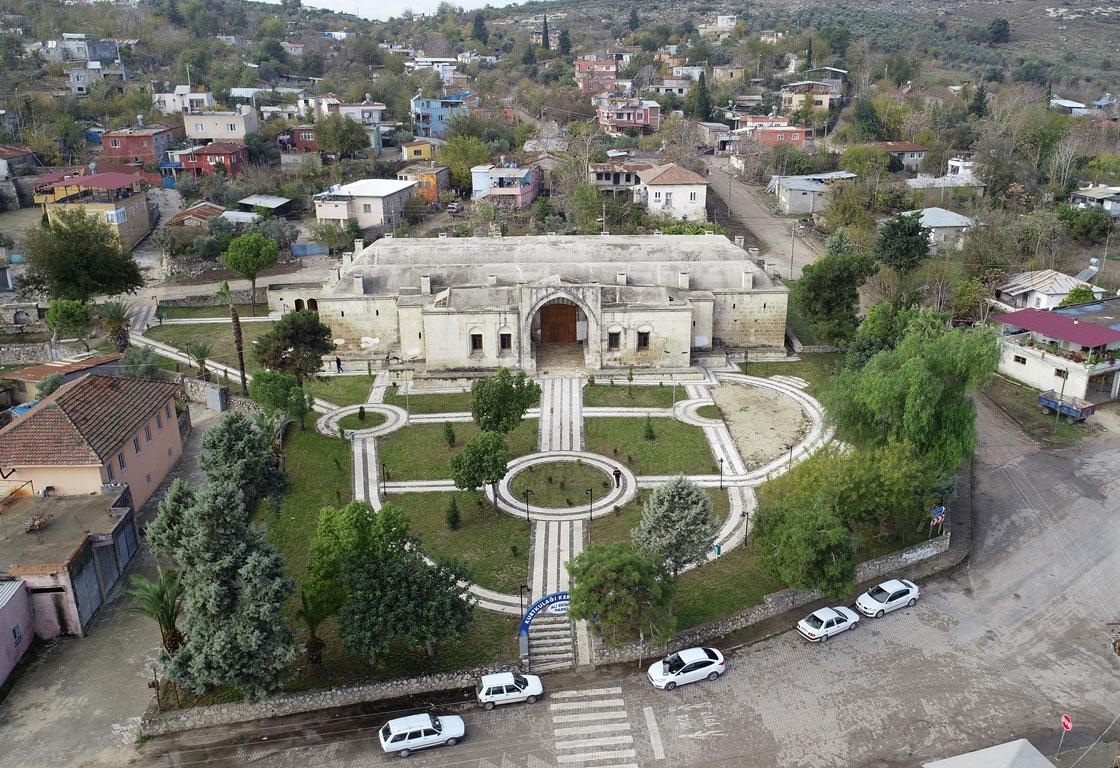
The Kurtkulağı Caravanserai is located approximately 30 km from the Ceyhan district of Adana Province, north of Kurtkulağı Village, on the ancient and continuously used Old Aleppo (Damascus) Road. This route served as a strategic resting place for armies, trade caravans, and pilgrimage convoys traveling from Anatolia to Syria.
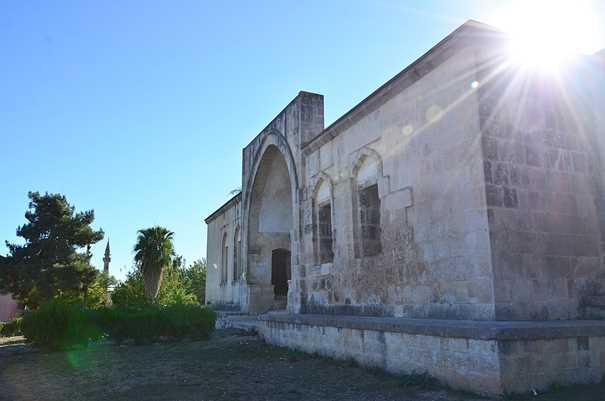
Kurtkulağı Caravanserai (Türkiye Culture Portal)
The building’s inscription has not survived; the niche for the inscription above the main portal is empty. Dating is based on a decree issued by Sultan Ahmed III dated 1116 AH / 1704 CE and the endowment deed of the Karamort Külliyesi. These documents indicate that a resting complex consisting of a fortress, caravanserai, and mosque was established in the same year to ensure the safety of pilgrims and merchants at Kurtkulağı.
The caravanserai is of the enclosed, courtyard-free type. Excluding the projections on the eastern façade, it measures 45.75 × 23.60 m. The rectangular body is divided into three naves by two rows of six stone piers each (2.15 × 1.80 m), aligned north-south; the ceiling is covered with barrel vaults. Thick cut-stone walls are reinforced externally with buttresses.
The main portal on the eastern façade is pointed-arched. Behind it, a barrel-vaulted iwan opens into two pairs of side rooms, each equipped with a hearth niche, storage alcove, and toilet; these rooms are covered with cross vaults. Adjacent to the left of the iwan is a small cistern.
Platforms (raised seating areas) along all four walls were used for accommodating travelers and their goods; in some cases, travelers could mount their animals directly from the platforms without dismounting. Hearth niches are arranged between the buttresses. Lighting is limited to the small openings (mazgals) in the upper sections of the side walls, resulting in a dim interior. Decoration is extremely restrained and limited to rounded arches above the doorways.
The plan follows the Ottoman continuation of the Anatolian Seljuk tradition of courtyard-free, three-naved enclosed caravanserais. It resembles 13th–15th century examples such as Şarapsa Han, Susuz Han, and Kınık Han and belongs to the Ottoman period category of “menzil hanı” (resting caravanserai).
The caravanserai was registered on 6 April 1976 and placed under the supervision of the General Directorate of Foundations. During the 1984 restoration, the main walls, vaults, arches, platforms, hearth niches, and mortar joints were repaired, and the roof structure was reinforced.
The Kurtkulağı Caravanserai holds a distinctive position among late examples of Ottoman caravanserai architecture due to its construction during a period in the early 18th century when such buildings were becoming less common, and because of its well-preserved condition. Its functional simplicity, robust construction, and location within the menzil system of the Old Aleppo Road confer upon it the status of an original monument documenting the historical and social fabric of the region.

No Discussion Added Yet
Start discussion for "Kurtkulağı Caravanserai" article
Construction Date and Endowment Documents
General Plan and Dimensions
Entrance Arrangement and Side Spaces
Interior Organization
Typological Position
Conservation and Restoration
Current Condition and Significance