This article was automatically translated from the original Turkish version.
+1 More
Construction Date(s) | 1207 | ||||||||
|---|---|---|---|---|---|---|---|---|---|
Patron | I. Gıyaseddin Keyhüsrev | ||||||||
Period(s) | Anatolian Seljuk | ||||||||
Architectural Type | Han (ribât) | ||||||||
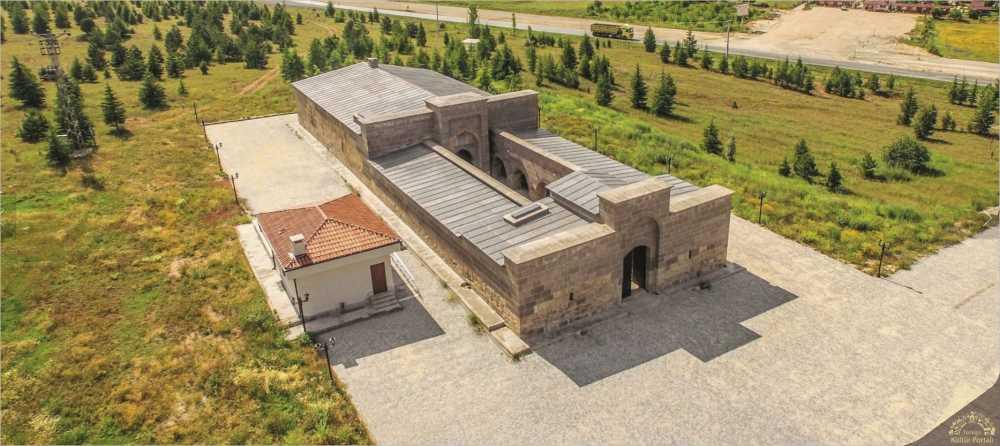
Located within the trade network established by the Anatolian Seljuk State in the 13th century, the Kuruçeşme Hanı is a caravanserai situated along the Konya–Beyşehir route. Constructed in 1207 during the reign of Sultan I. Gıyaseddin Keyhüsrev, it stands as one of the representative examples reflecting the economic, social, and architectural characteristics of its time.
Designed to meet accommodation and logistical needs through a combination of open and enclosed spaces, the structure also includes a mosque section, embodying a multifunctional architectural approach. Located within the boundaries of Kızılören Mahallesi, west of Konya city center, the Kuruçeşme Hanı constitutes an important example of Anatolian Seljuk architecture in terms of stonework, planning logic, and road security policies.
The Kuruçeşme Hanı is situated within the boundaries of Kızılören Mahallesi, part of the Meram district, west of Konya city center in Türkiye. Positioned along the historic Konya–Beyşehir caravan route, it functions as one of the strategic relay points on this route. In this context, it is evident that the caravanserai was constructed at a crucial junction for both trade and transportation. The structure is also known locally as the Kanönü Hanı.
The Kuruçeşme Hanı was constructed in 1207 during the second reign of Anatolian Seljuk Sultan I. Gıyaseddin Keyhüsrev. The foundation inscription, carved on marble and placed above the main portal, documents the building’s date of construction and the political authority behind its erection, in accordance with the traditional architectural conventions of the period. It is understood that the han was built as a “ribâd,” a fortified structure serving defensive purposes as well.
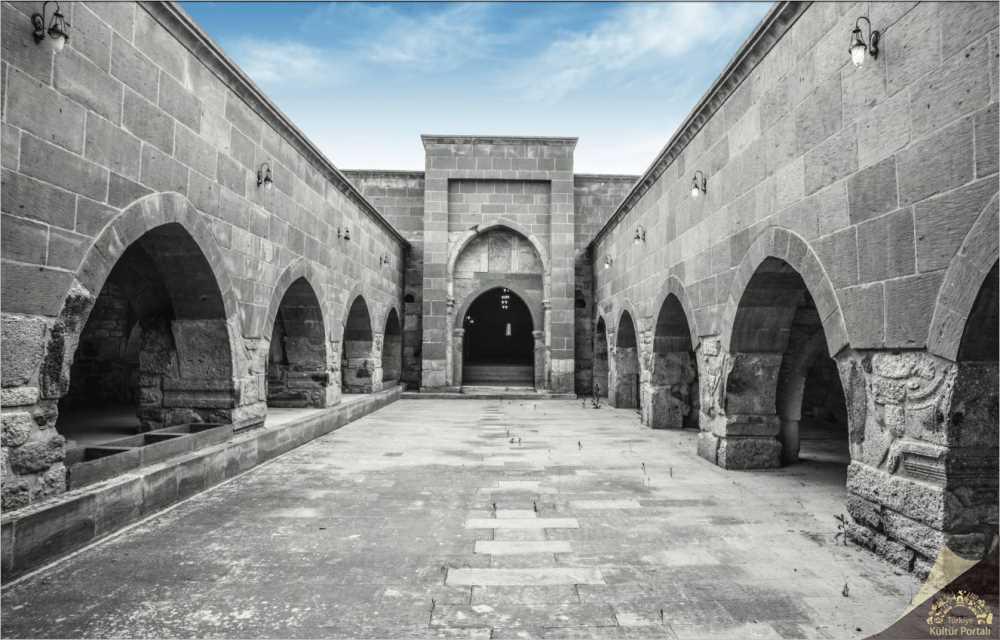
Image of the Kuruçeşme Hanı Courtyard. (Ministry of Culture and Tourism of the Republic of Türkiye)
The Kuruçeşme Hanı was constructed to provide accommodation, shelter, loading and unloading facilities, and animal care along the caravan routes of its time. The presence of separate summer and winter sections reflects an adaptive usage strategy suited to seasonal climatic variations. Additionally, the mosque located within the courtyard demonstrates that the han served not only commercial but also religious and social needs.
The Kuruçeşme Hanı is a rectangular structure oriented east-west. It consists of two main sections:
The portal on the eastern side features a pointed arch and an imposing entrance design. Access to the courtyard is provided through a vaulted passageway covered with a barrel vault.
The courtyard is planned as a rectangular space, nearly square in shape, extending from east to west. Arcades along the north and south walls are supported by square piers and connected by pointed arches. This arrangement provides shelter for both people and pack animals in the open area.
A rectangular structure along the southern wall contains a mihrab niche, indicating that this section served as a mosque.
The enclosed section is divided into three bays. The central bay is wider and taller than the side bays and is supported by ten square-sectioned piers. A pointed barrel-vault system covers this area. Stalls for animals are located inside, confirming the structure’s role as a logistical center tied to trade.

Image of the Kuruçeşme Hanı Portal and Entrance Section. (Ministry of Culture and Tourism of the Republic of Türkiye)
The structure was built using cut stone and roughly hewn stone in combination. Reused architectural elements from the ancient period were incorporated as spolia, a common practice in Seljuk architecture. Some stone fragments observed on the courtyard facades may originate from classical-era buildings.
The Kuruçeşme Hanı remained in a state of ruin for many years, with various parts deteriorating over time. Extensive restoration works carried out between 2011 and 2018 repaired the structure while largely preserving its original plan. The restoration included reinforcing stone masonry, reconfiguring the vaulted ceilings, and landscaping the surrounding area. Today, the han is open to visitors and integrated into local tourism routes.
The Kuruçeşme Hanı exhibits typical features of Anatolian Seljuk caravanserai architecture. The distinction between open and enclosed spaces, the barrel-vault system, pointed-arch arcades, and the inclusion of a mosque combine functional and symbolic elements. As a key node along the Konya–Beyşehir route, and in relation to nearby structures such as the Kızılören (Kan Demir) Hanı, it provides valuable insight into the organization of the region’s road network.
Kuruçeşme Hanı holds a prominent position among the caravanserais that strengthened the economic infrastructure of the Anatolian Seljuk State, notable for its architectural, functional, and historical significance. Its east-west orientation, pointed barrel-vault system, courtyard layout, and integrated mosque make it a representative example of 13th-century caravanserai design. By serving both commercial and social functions, it became not merely a place of lodging but also a temporary sociocultural hub for local populations and travelers. Having endured centuries of neglect, the han has been preserved in accordance with its original identity through the 2011–2018 restoration and continues to exist today as a historic site open to the public. In this regard, the Kuruçeşme Hanı retains its importance as a well-preserved and exemplary instance of Seljuk road architecture.
Kızılören Vakfı. “Kızılören'deki Tarihi Yapılar.” Kızılören Vakfı Resmî Web Sitesi. Accessed June 22, 2025. http://www.kizilorenvakfi.org.tr/vakfimiz/kiziloren-deki-tarihi-yapilar.html.
Ministry of Culture and Tourism of the Republic of Türkiye. “Tarihin Tanıkları: Hanlar.” *Kültür Portalı*. Accessed June 22, 2025. https://www.kulturportali.gov.tr/portal/tarihintaniklarihanlar.
T.C. Ministry of Culture and Tourism. "Kuruçeşme Hanı." *Kültür Portalı*. Accessed June 22, 2025. https://www.kulturportali.gov.tr/turkiye/konya/gezilecekyer/kurucesme-hani.

Construction Date(s) | 1207 | ||||||||
|---|---|---|---|---|---|---|---|---|---|
Patron | I. Gıyaseddin Keyhüsrev | ||||||||
Period(s) | Anatolian Seljuk | ||||||||
Architectural Type | Han (ribât) | ||||||||
Location and Access
History
Function and Purpose
Architectural Plan and Structural Features
General Plan
Portal and Entrance
Courtyard Section
Closed Shelter (Winter) Section
Construction Materials and Techniques
Conservation Status and Restoration Process
Architectural Significance and Position Among Seljuk Caravanserais