

This article was automatically translated from the original Turkish version.
+2 More
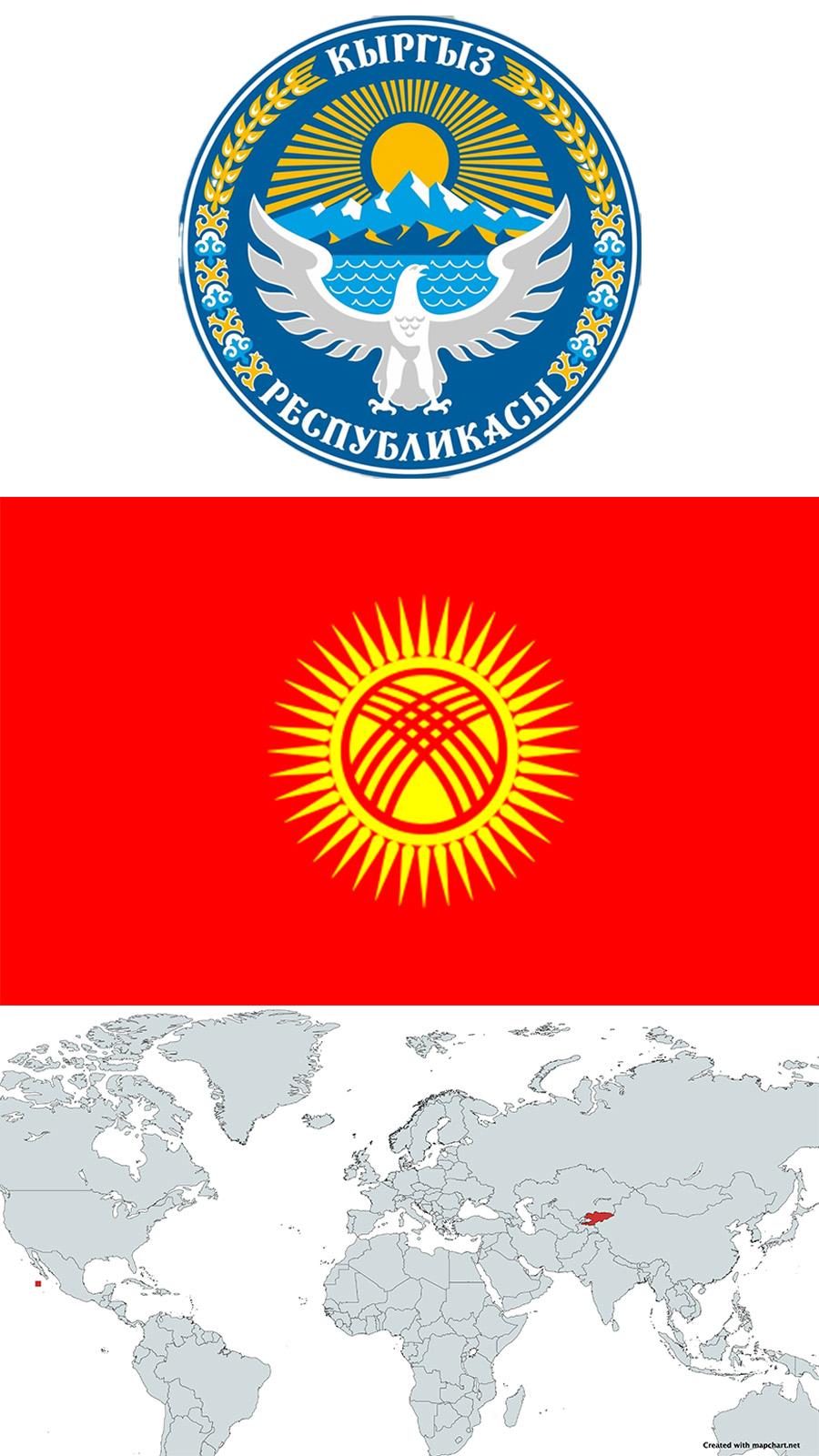
Kyrgyzstan
Currency(s) | Kyrgyzstani som (KGS) | ||||||||
|---|---|---|---|---|---|---|---|---|---|
Official Language(s) | Kyrgyz | ||||||||
Official Name(s) | Kyrgyz Republic | ||||||||
Capital(s) | Bishkek | ||||||||
Form of Government(s) | Parliamentary Republic | ||||||||
Climate(s) | Continental climate short and cool summers harsh winter conditions in high mountain areas | ||||||||
Area(s) | 199 951 km² | ||||||||
Ethnic Groups | Other 6.3% Russian 5.1% Uzbek 14.8% Kyrgyz 73.8% | ||||||||
Neighboring Countries | Tajikistan Uzbekistan People's Republic of China Kazakhstan | ||||||||
Internet Domain Code | .kg | ||||||||
Languages of Publication | Russian, Uzbek | ||||||||
Time Zone | UTC +6 (Kyrgyzstan Time) | ||||||||
Head of State | Sadyr Japarov | ||||||||
Kyrgyzstan (officially the Kyrgyz Republic) is a landlocked country located in the northeastern part of Central Asia. With an area of 199,951 km², it shares borders with Kazakhstan to the north, China to the east and southeast, Uzbekistan to the west, and Tajikistan to the southwest. Its capital is Bishkek.
Governed as a parliamentary republic, Kyrgyzstan’s official language is Kyrgyz. Its population is estimated at 7,227,000 as of 2025.【1】 The country is notable for its high-altitude mountainous terrain, natural resources, mining activities and agricultural lands. Its economy is largely based on gold exports. The national currency is the Kyrgyz som.

Bishkek (pexels)
The earliest history of the Kyrgyz people dates back to semi-nomadic communities living in the Yenisei River basin. The ancient Chinese historian Sima Qian referred to the Kyrgyz as “Ko-k’un” around 201 BCE.【2】 During this period, Kyrgyz tribes inhabited the Altai Mountains and the Yenisei River region and were considered among the early Turkic communities in terms of language and culture.
By the end of antiquity, the Kyrgyz came under the influence of large steppe empires such as the Xiongnu and the Göktürk Khaganate. In 560 CE, during the reign of Göktürk Khagan Mukhan, the Kyrgyz were incorporated into the Göktürk state but experienced brief periods of independence during times of Göktürk decline.
This people, referred to as Kyrgyz in ancient Turkic inscriptions, long preserved the Tengri belief system and maintained their name throughout history.

Kyrgyz in the Steppe, 1860 (Library of Congress)
Throughout the Middle Ages, the Kyrgyz played significant roles across the Central Asian and Siberian steppes. In 758, Uyghur Khagan Moyen-chor brought Kyrgyz territory under Uyghur control, but the Kyrgyz waged prolonged resistance against this domination. In 840, the Yenisei Kyrgyz defeated the Uyghur Khaganate and established their own khaganate centered at Ötüken. This victory elevated the Kyrgyz to a dominant position among the nomadic peoples of Central Asia at the time. However, this dominance was short-lived; by 920, the expanding Qitay (Khitan) forces conquered all of Mongolia and drove the Kyrgyz out of the Ötüken region.
Kyrgyz communities were forced to retreat back to their ancestral lands along the Yenisei, and their gradual expansion into the Tian Shan (Celestial Mountains) region occurred over centuries. In the early 13th century, Genghis Khan incorporated the Kyrgyz into his empire during his extensive conquests of Central Asia. The Kyrgyz are recorded as the first Turkic tribe to voluntarily submit to Genghis Khan in 1207.
While living under Mongol rule with relative autonomy, the Kyrgyz attempted an uprising against the Mongols in 1217, but it was suppressed the following year by Genghis Khan’s son Chagatai.
As Mongol authority weakened, the Kyrgyz continued to exist under the administration of the Chagatai Khanate and other Turkic-Mongol states in the region. During the 15th and 16th centuries, Kyrgyz tribes lived a nomadic life in the rugged areas of the Tian Shan under the influence of the Oirat (Kalmyk/Dzungar) and Kazakh khanates.
Sources from these centuries indicate that the Kyrgyz did not establish an independent state, formed alliances with the Kazakhs, and generally lived in isolated mountainous regions. Indeed, 16th-century Ottoman sources describe the Kyrgyz near Kashgar as a people “without their own rulers, living in mountainous terrain and resembling the Mongols.”【3】
By the mid-19th century, the territory inhabited by the Kyrgyz became a zone of competition between the rapidly expanding Russian Tsardom and other regional powers. Southern Kyrgyz communities remained under the control of the Kokand Khanate for a time, while some northern Kyrgyz tribes began accepting the protection of the Russian Tsardom.
From the 1850s onward, the Russian Empire advanced from the Kazakh steppes to bring Kyrgyz lands under its control. Kyrgyz leader Sadik Bey briefly aligned with Kashgar and captured it in 1862, but by 1864 he accepted Russian sovereignty. As Russian forces advanced, Kyrgyz territories were gradually occupied, and by 1876 the entire territory of modern Kyrgyzstan had been incorporated into the Russian Tsardom. Thus, the Kyrgyz were compelled to abandon their centuries-old nomadic lifestyle under the empire’s colonization policies.

Watercolor Depicting the Announcement of a Tsarist Order to the Kazakhs, 1891 (Library of Congress)
By 1914, more than two million Russian and other Slavic settlers had been relocated to the Kyrgyz steppes as colonists, seizing fertile lands and displacing Kyrgyz nomads from their traditional territories.
During the mobilization for World War I, Tsar Nicholas II issued a decree on 25 June 1916 ordering the conscription of Turkic men aged 19 to 43 from Turkestan for rear-area labor. This triggered a major uprising in Kyrgyzstan. Russian authorities suppressed the revolt with brutal force, resulting in the deaths of hundreds of thousands of Kyrgyz civilians. Tens of thousands fled to the Xinjiang region of China to escape the violence of the tsarist army and Kazakh-Kalmak militias. After the suppression of the revolt, the tsarist regime confiscated approximately four million hectares of Kyrgyz land and expelled those involved in the uprising from the Chüy and Issyk-Kul valleys.
During the Soviet era, Kyrgyzstan underwent major political, social and economic transformations. Following the Bolshevik victory, Kyrgyz territories were incorporated into the Soviet Union and reorganized under a new administrative structure. Soviet authorities drew national borders based on ethnic lines to create nation-states. In this context, the Kyrgyz were recognized for the first time as a distinct political entity. In 1924, the Kara-Kyrgyz Autonomous Oblast was established within the Russian Soviet Federative Socialist Republic, with its center in Pishpek (Bishkek).
On 5 December 1936, Kyrgyzstan became one of the equal republics of the Soviet Union and adopted the name Kyrgyz Soviet Socialist Republic (Kyrgyz SSR).
The Soviet period was marked by profound socio-economic changes. Educational campaigns were launched, literacy rates rose rapidly, and the Kyrgyz language was transformed into a written literary language first using the Latin and later the Cyrillic alphabet.
Industrialization drives were implemented nationwide, modern agriculture and sedentary lifestyles were promoted, and traditional nomadic life was largely replaced by collective farms known as kolkhozes and sovkhozes. The late 1920s and 1930s were the years when Stalin’s repressive policies were most intensely felt. Under the forced collectivization program, many Kyrgyz herders resisted by slaughtering their livestock rather than surrendering them to the state.
Chaos in agricultural policy and harsh measures led to famine in rural areas. During the political purges (repressions) of the 1930s, a large portion of Kyrgyz intellectuals were labeled “enemies of the people,” imprisoned or executed, and thousands of innocent people were sent to labor camps. Under this repression, the Kyrgyz population did not grow between 1926 and 1939, experiencing a demographic stagnation.
Additionally, tens of thousands of Kyrgyz youths fought in the ranks of the Soviet army during World War II, many losing their lives or being taken prisoner.
As the Soviet Union dissolved, the Turkic republics of Central Asia declared independence one by one. Kyrgyzstan was among those that proclaimed independence on 31 August 1991. The Kyrgyz Republic, which had been part of the Soviet Union since 1936, regained full sovereign statehood after approximately 75 years.
Scientist Askar Akayev, who had been president of the Kyrgyz SSR, was elected as the first president of independent Kyrgyzstan. In the October 2000 elections, Akayev was re-elected for a third five-year term. However, the election process was criticized by international observers for irregularities. Growing economic problems during this period fueled public discontent. In 2002, the sentencing of opposition leader Felix Kulov to seven years in prison and the subsequent arrest of Azimbek Beknazarov triggered protests in the Jalal-Abad region, resulting in the deaths of at least six people.
In the lead-up to the 2005 presidential elections, Akayev attempted constitutional amendments to allow himself to run again. This initiative sparked widespread public protests known as the “Tulip Revolution.” On 24 March 2005, demonstrators stormed state buildings in the capital Bishkek. On the same day, Akayev fled to Russia and formally resigned. Following the elections, former Prime Minister Kurmanbek Bakiyev won the July 2005 presidential election with 89 percent of the vote.【4】
Despite constitutional reform promises, Bakiyev took no steps to limit presidential powers. His brother Janyshbek Bakiyev was appointed head of the security services, and his son Maksim Bakiyev became head of the National Development Fund. These practices intensified accusations of corruption and nepotism. Mass protests were held in Bishkek and other cities between 2007 and 2009.
On 7 April 2010, public gatherings (kurultays) in Talas, Naryn and Bishkek were met with security force intervention. During the assault on the presidential palace in Bishkek, 87 people lost their lives.【5】 President Bakiyev fled to Jalal-Abad the same day and later sought refuge in Belarus. His son Maksim Bakiyev fled to London. In 2013, Kyrgyz courts sentenced Kurmanbek Bakiyev to 24 years in prison, Janyshbek Bakiyev to life imprisonment, and Maksim Bakiyev to 25 years in prison.
After the April Revolution, an interim government was formed, and Roza Otunbayeva assumed the role of interim president on 3 July 2010. However, on 10 June 2010, violent clashes erupted between ethnic Kyrgyz and Uzbeks in the cities of Osh and Jalal-Abad. Within the first three days, approximately 420 people were killed and thousands injured. Uzbek neighborhoods were destroyed, and hundreds of thousands of Uzbeks fled across the border into Uzbekistan. An international commission established after the events reported that the government failed in its duty to protect civilians and in some cases security forces participated in the attacks.
Almazbek Atambayev assumed the presidency on 11 December 2011. During his term, debates arose over constitutional changes and the judiciary. After a 2016 referendum, relations with former interim government members deteriorated. The Atambayev administration faced criticism for lawsuits against independent media and journalists, undermining press freedom. In 2017, he supported Sooronbay Jeenbekov’s presidential candidacy.
Sooronbay Jeenbekov won the 15 October 2017 elections with 54.22 percent of the vote.【6】 Allegations emerged regarding the misuse of state resources and vote-buying. In 2018, Prime Minister Sapar Isakov was removed from office on corruption charges and sentenced to 15 years in prison.
Widespread complaints of irregularities were made regarding the parliamentary elections held on 4 April 2020. On 5 April, the public staged mass protests and stormed parliament. In the early hours, former President Atambayev and other politicians were released from prison. On 6 October, the Central Election Commission annulled the election results. On 15 October 2020, Jeenbekov announced his resignation to prevent further violent clashes.
In the presidential election held on 10 January 2021, Sadyr Japarov won 79 percent of the vote and was elected president.【7】 Japarov’s rise to power was marked by his rapid ascent in the political arena during the 2020 events. Institutional reforms and foreign policy initiatives have continued since his election.
Kyrgyzstan’s national anthem was adopted on 18 December 1992. The lyrics were written by J. Usenov, M. Shamaekov and E. Amanbaev; the music was composed by N. Davlesov and K. Moldobasanov. The anthem reflects the Kyrgyz people’s feelings of freedom, patriotism and independence.
Kyrgyzstan National Anthem (Ian Berwick)
The flag of Kyrgyzstan was adopted on 3 March 1992 by a decision of the Supreme Council of the Kyrgyz Republic. The design was created by E. Aidarbekov, B. Zhaichybekov, S. Iptarov, Zh. Mataev and M. Sydykov. The flag features a red field with a golden sun in the center, and within the sun is the tunduk symbol—the crown of the traditional Kyrgyz yurt.
On 20 December 2023, amendments to the Law on State Symbols of the Kyrgyz Republic changed the shape of the sun’s rays from wavy lines to straight lines.
Kyrgyzstan is a country located in Central Asia. With a total area of 199,951 km², it ranks 85th in the world and 7th among the Commonwealth of Independent States (CIS). Kyrgyzstan is a landlocked country with a complex mountainous terrain.
Strategically situated at the center of Central Asia, a region that serves as a bridge between Europe and Asia, Kyrgyzstan lies along the historic Silk Road. This location has historically provided the country with advantages in logistics, transportation, trade, investment, tourism, cultural diversity, education and scientific advancement.
However, its mountainous topography and lack of access to the sea have created challenges for integration with the global community. Therefore, the country is taking steps to expand international cooperation, diversify trade relations, improve transportation links and strengthen the digital economy.
The capital, Bishkek, is located in the northern Chüy Region and is the country’s most populous city. Osh follows as the second-largest city. Kyrgyzstan consists of nine administrative-regional units: Chüy, Talas, Issyk-Kul, Naryn, Jalal-Abad, Osh, Batken regions, and the cities of Bishkek and Osh. Regional centers include Talas, Karakol, Naryn, Jalal-Abad, Osh and Batken.

Country Map (The World Factbook)
Kyrgyzstan is predominantly a mountainous country, with a large portion of its territory covered by high mountain ranges. The country’s geography is characterized by complex and rugged mountainous topography. This feature complicates transportation and infrastructure projects and constitutes a natural obstacle to development.
At the same time, Kyrgyzstan’s mountainous structure offers significant potential for hydropower generation. The country currently utilizes only 10 percent of this potential, whereas Norway, with similar hydropower capacity, utilizes 90 percent.【8】 Therefore, mountains are not only a physical barrier but also a vital source of energy and development.
Narrow valleys and limited plains nestled between high mountains are of great importance for agriculture and settlement. These areas determine land use, particularly in densely populated regions.
Kyrgyzstan is a country rich in water resources. Due to its mountainous terrain, numerous rivers and streams originate here and flow into neighboring countries. This feature makes Kyrgyzstan one of the key water source countries in Central Asia.
Kyrgyzstan pursues a “water-energy diplomacy” aimed at the effective and sustainable management of its water resources. This diplomacy encompasses regional cooperation on fair water sharing, joint infrastructure projects and energy production. Initiatives such as the CASA-1000 energy transmission project reflect efforts to harness the country’s water and energy potential.
One of Kyrgyzstan’s most famous lakes is Issyk-Kul, located in the north between the Kungey and Terskey mountain ranges of the Tian Shan. At an elevation of 1,608 meters above sea level, the lake is notable for its length of 182 kilometers, width of 60 kilometers and average depth of 270 meters. It is fed by approximately 80 rivers and streams and has no natural outflow.
Its crystal-clear waters, natural surroundings and biological diversity, particularly as a habitat for waterfowl, make Issyk-Kul ecologically significant. The lake’s surroundings, including the resort town of Cholpon-Ata, host numerous tourist facilities. Water sports such as boating, jet skiing, water parachuting and ringo are practiced on the lake.

Issyk-Kul (unsplash)
Kyrgyzstan has a continental climate. Winters are cold and long, while summers are short and cool throughout the country. With an average elevation of 2,750 meters, more than 94 percent of the country lies above 1,000 meters above sea level, and approximately 40 percent exceeds 3,000 meters.【9】 This results in large areas remaining snow-covered for much of the year, especially in high mountain regions.
Winters are harsher in the interior and higher elevations of the Tian Shan, while summers in these areas are also cool and dry. In the Pamir Mountains to the south, the climate is more stable with lower humidity. The Issyk-Kul region exhibits microclimatic characteristics due to the lake’s large water volume. The lake’s water remains unfrozen even in winter, providing a mild climate to its surroundings, while its cool, low-humidity structure stands out in summer.
Kyrgyzstan’s natural vegetation is rich due to its climatic diversity and elevation variations. The general vegetation consists of forests, shrublands, steppe, grassland and aquatic plants. Forested areas cover 5.3 percent of the country’s total area.【10】
Common plant species in the country include pine, walnut, pistachio, birch, poplar and aspen. Particularly, walnut forests in the southwestern Tian Shan region hold special ecological and economic importance.
Kyrgyzstan’s vegetation varies according to both climate and elevation. In low-elevation valleys and along riverbanks, wetland plants and meadows are found, while higher elevations feature coniferous forests and alpine meadows.

Kyrgyzstan (pexels)
Before independence, Kyrgyzstan’s mining sector was prominent for gold, coal, uranium and antimony production. The country has numerous gold ore deposits. Major operating gold mines include Kumtor, Ceruy, Taldy-Bulak-Levoberejnıy, Makmal, Bozumchak, Istamberdy, Unkur-Tash and Tereksay.
The Kumtor gold mine holds one of the country’s largest gold reserves, exceeding 104 tons. Located 350 kilometers southeast of the capital Bishkek and 60 kilometers from the Chinese border, the mine became operational in 1996. Since its opening, gold production has accounted for 40 percent of total industrial output.【11】 To date, approximately 304 tons of gold have been produced, and the mine is expected to remain operational until 2026.
Development in other sectors beyond gold mining has been limited. Investment deficiencies are particularly evident in coal mining, where production remains primarily state-run. Uranium mining has been halted in the Minkush, Aktuz, Kajisay and Maylysu regions due to declining productivity.
The country has limited potential for oil and natural gas resources. In 2020, daily crude oil production reached 1,000 barrels, placing Kyrgyzstan 109th among 116 countries. Natural gas production in the same year was recorded at 1 billion cubic feet. Coal and lignite production reached 2.4 million tons.
Kyrgyzstan’s economy is small and developing, largely based on gold exports. As of 2025, the country’s gross domestic product (GDP) at current prices was recorded at $20.16 billion, with per capita income at $2,790.【12】
In the same year, real GDP growth was measured at 8 percent, driven by industry, services and construction. Inflation, based on the consumer price index, stood at 5 percent, while the unemployment rate was at 4 percent.【13】
Remittances from Kyrgyz citizens working abroad play a significant role in the economy, accounting for more than 25 percent of GDP.【14】 Income from Kyrgyz workers in Russia and Kazakhstan supports domestic consumption and increases foreign exchange supply. Consequently, domestic consumption, real wage increases, expansion of consumer credit and budget expenditures contribute to growth.
The government’s total debt-to-GDP ratio was recorded at 37.5 percent as of 2024.【15】 In contrast, the current account balance as a percentage of GDP showed a significant deficit of -25.3 percent.【16】 In 2024, exports amounted to $4 billion and imports to $12 billion, resulting in a trade deficit of $8 billion.
Kyrgyzstan’s economy is largely based on mining, agriculture, construction, industry and services. The country is notable for its natural resources, particularly gold mining.
Kyrgyzstan possesses significant agricultural and livestock potential due to the extent of its arable land and mountainous geography. Fifty-four point one percent of the country’s total area consists of agricultural land. Key agricultural products include cereals, potatoes, fruits and vegetables, and fodder crops. Climatic conditions vary by region, resulting in high agricultural diversity.
Livestock farming is one of the main livelihood sources for the rural population. In addition to small and large livestock, traditional breeds such as horses and camels are raised. Due to extensive pastures and meadows, transhumance remains widespread.
Agriculture and livestock are strategic sectors for both domestic consumption and exports. Dairy products, meat and wool production play a vital role in rural development.
Kyrgyzstan’s industrial sector is largely shaped by mining, particularly gold production. Major industrial activities include gold mining, coal production, limited oil and natural gas extraction, some metal processing and light industries such as food processing.
Approximately 40 percent of industrial output comes from gold production.【17】 The Kumtor gold mine, located 350 kilometers southeast of Bishkek, has produced approximately 304 tons of gold to date and is expected to continue operations until 2026. Other significant gold deposits include Ceruy, Taldy-Bulak-Levoberejnıy, Makmal and Bozumchak.
Coal mining is still state-run, with investment deficiencies being a key concern. Uranium mining has been halted in the Minkush, Aktuz, Kajisay and Maylysu regions due to low productivity.
Oil and natural gas production is very limited compared to other Central Asian countries. According to 2020 data, Kyrgyzstan produced only 1,000 barrels of crude oil per day and 1 billion cubic feet of natural gas. Consequently, a significant portion of its energy needs is met through imports.
However, the construction sector is one of the drivers of growth. Recent years have seen increases due to public infrastructure projects and private sector investments.
The services sector has been one of the fastest-growing areas of Kyrgyzstan’s economy in recent years. Development has been observed particularly in trade, transportation and catering. The tourism sector has regional potential due to natural attractions such as the Issyk-Kul region, with domestic tourism increasing notably during summer months.
In 2024, the services sector contributed significantly to the 9 percent GDP growth. Factors supporting growth included increases in consumer credit, rising real wages in the private sector, renewed domestic consumption and higher remittances from workers abroad. Remittances from Kyrgyz citizens working in Russia and Kazakhstan, which account for more than 25 percent of GDP, have indirectly contributed to this sector’s expansion.
The financial system supports economic growth but remains underdeveloped. Following the privatization of most state institutions in the 1990s, a financial structure based on free-market mechanisms began to be established. Foreign investment has been prominent in sectors such as mining, but direct investment in the financial sector remains limited.
Worker remittances have become one of the most important elements of the national economy and foreign exchange balance. This situation increases household incomes and contributes to the expansion of consumption-oriented services.
However, the development of the financial system still faces various structural challenges, including capital shortages, lack of digitalization and vulnerability to external economic shocks. Nevertheless, membership in the Eurasian Economic Union and cooperation with international financial institutions offer potential for enhancing the system’s integration capacity.
Due to its landlocked geography and high dependence on imports, Kyrgyzstan faces structural limitations in foreign trade. However, the increase in gold exports since 1997 has facilitated the country’s access to global markets. Nevertheless, the heavy focus on gold exports has limited product diversification.
As of 2024, Kyrgyzstan’s total exports amounted to approximately $4 billion and imports to $12 billion, resulting in a trade deficit of $8 billion.
The Ministry of Economy and Trade regulates foreign trade in Kyrgyzstan. Customs procedures are managed by the State Customs Service under the Ministry of Finance. The country applies the following trade regimes:
Kyrgyzstan is a party to the 1994 Free Trade Zone Agreement and the 2011 CIS Free Trade Zone Agreement under the Commonwealth of Independent States (CIS). It also has bilateral free trade agreements with Russia, Kazakhstan, Armenia, Moldova, Ukraine, Uzbekistan, Belarus, Tajikistan and Azerbaijan.
Kyrgyzstan joined the World Trade Organization (WTO) in 1998 and applies the MFN rule, thereby expanding its trade volume and geographic diversity of trading partners.
Kyrgyzstan has been a member of the Eurasian Economic Union (EAEU) since 12 August 2015. Membership has granted access to a market of 180 million people, aiming to enhance competitiveness and diversify exports, particularly in textiles and agriculture. During this process, legal alignment with the EAEU framework has been achieved and customs infrastructure has been improved.
Kyrgyzstan’s population is approximately 7 million. With this size, it ranks 100th globally. About 1.3 million people live in Bishkek.【18】
A significant portion of the population is young. Individuals aged 0–24 constitute approximately 46 percent of the total population. As of 2024, the unemployment rate as a percentage of the labor force is estimated at 9 percent.【19】 This rate places Kyrgyzstan 16th among countries with high unemployment.
The annual population growth rate is 0.79 percent.【20】 The birth rate is 18.7 births per 1,000 people, and the death rate is 6 deaths per 1,000 people. The total fertility rate is 2.45 children.【21】
Life expectancy is 68.9 years for men and 77.2 years for women, totaling 72.9 years.【22】 The sex ratio at the total population level is 0.96 males per female.【23】

2024 Population Pyramid (The World Factbook)
Kyrgyzstan’s ethnic composition is predominantly Kyrgyz. According to 2021 data, 73.8 percent of the population is Kyrgyz, 14.8 percent is Uzbek, and 5.1 percent is Russian.【24】 The Dungan population accounts for 1.1 percent.【25】 The remaining 5.2 percent consists of other ethnic groups such as Uyghur, Tajik, Turk, Kazakh, Tatar, Ukrainian, Korean and German.【26】
This structure reflects Kyrgyzstan’s historical, geographical and cultural diversity, with a higher concentration of Uzbeks in southern regions and Russians in the north.
Kyrgyzstan’s religious structure is predominantly Islamic. According to 2017 data, approximately 90 percent of the population is Muslim, 7 percent is Christian, and the remaining 3 percent follows other faiths. The majority of Muslims adhere to the Sunni branch.【27】
Among Christians, the most common denomination is Russian Orthodoxy, comprising approximately 3 percent of the population. Other religious beliefs include Judaism, Buddhism and the Bahá’í Faith.
Kyrgyzstan’s education system, largely continuing the Soviet model, encompasses primary and secondary education. Legally, education is compulsory for nine years: children start school at age seven, complete four years of primary school (basic education) and then five years of lower secondary education, finishing compulsory education at age 15. After this basic education, students proceed to upper secondary education; traditionally, high school lasted two years (ending at grade 11). However, the education system is currently undergoing reform, and Kyrgyzstan is taking steps to extend compulsory education to 12 years.
Enrollment rates in the early stages of compulsory education are very high nationwide. Net enrollment in primary and basic secondary education (grade 9) exceeds 98 percent.【28】 This means nearly all children complete at least nine years of education. However, continuation rates drop somewhat in grades 10–11 (high school). After grade 9, some students enter vocational education or drop out. Female enrollment rates in upper secondary education are slightly higher than those of males, but dropout rates remain notable for both genders.
After secondary education, students have options for higher and vocational education. Kyrgyzstan has numerous institutions of higher education, including state universities, private universities and colleges. Key institutions include the Kyrgyz National University (Kyrgyzstan National University) and Kyrgyz-Turkish Manas University in the capital Bishkek. Technical institutes and teacher training schools inherited from the Soviet era continue to provide education at university level. The Ministry of Education and Science manages educational institutions and determines curricula. Public spending on education has recently averaged around 6 percent of GDP.【29】
Kyrgyzstan has a very high literacy rate. Thanks to the widespread education system inherited from the Soviet era, nearly the entire adult population can read and write. According to UNESCO data, the literacy rate for those aged 15 and above is 99.6 percent, with nearly equal rates for men and women.【30】
Kyrgyz literature is based on a cultural heritage shaped by oral tradition. Throughout history, the Kyrgyz people, who lost their written language, preserved and developed their literary memory through oral transmission across generations. This rich oral literary tradition played a decisive role in the formation of Kyrgyz identity. The foundation of Kyrgyz literature consists of diverse oral folk literary works, including epics, legends, fairy tales and folk stories, which have been passed down through generations and preserved their vitality.
The most important example of Kyrgyz oral literature is the Manas Epic. This epic, composed of three parts named Manas, Semetey and Seytek, has a millennium-long history. It is not merely a family saga but a comprehensive epic that addresses the Kyrgyz people’s struggle for independence, state-building efforts, lifestyle, cultural codes, educational philosophy and worldview. Entirely composed in short, syllabic and rhythmic poetry, the epic is among the unique examples of the world’s intangible cultural heritage.
The transmission of the epic is carried out by master storytellers known as akyns. These storytellers believe they receive the right to recite the epic through dreams; during recitation, they enter a trance-like state and bring the epic to life with a special tone, rhythm and gestures. The recitation of Manas has been performed in various social settings, from village gatherings to national holidays, and the storytellers have fulfilled roles of social guidance and spiritual support. The Manas Epic, along with its oral tradition, has also played an educational role in transmitting cultural identity.

Kopuz (unsplash)
Other important representatives of the oral tradition include short epic poems and folk tales, typically performed with the three-stringed Kyrgyz lute, the kopuz. Each epic narrative has its own theme, melody and style of delivery. Storytellers traveled between regions, participated in storytelling competitions and gained high esteem among the public.
The most important representative of modern Kyrgyz literature is Chinghiz Aitmatov. The writer, who wrote in both Kyrgyz and Russian, emphasized themes of love, friendship, the sufferings of war, heroism and adherence to traditional values. Aitmatov reflected his nation’s social, cultural and moral heritage in his works and narrated the hardships and values experienced by his people.
Kyrgyz literature, through its oral and written heritage, serves as a fundamental element in preserving historical memory and constructing cultural identity. In the modern era, the official recognition of the Manas Epic through monuments in central squares and the 28 June 2011 Law on the Manas Epic underscores its importance in national identity formation.
In the field of visual arts, traditional crafts stand out in Kyrgyzstan. Particularly, felt carpet making is a centuries-old craft and art form. Colorful, patterned ala-kiiyz and shirdak carpets made of felt served to insulate and decorate homes (boz üy – yurt) in nomadic life; their rich decorations and patterns form a symbolic cultural language.
Felt carpet production, traditionally passed down from generation to generation among women, is a practice that strengthens social solidarity. This craft is regarded as part of Kyrgyz cultural heritage and has been inscribed by UNESCO on the List of Intangible Cultural Heritage in Need of Urgent Safeguarding. However, due to the widespread use of synthetic carpets and declining interest among the younger generation, the ala-kiiyz and shirdak traditions are endangered; the number of master artisans is decreasing, and conservation efforts to sustain this visual art heritage are becoming increasingly important.
Throughout history, the Kyrgyz people, who maintained a nomadic lifestyle in mountains, highlands and steppes, developed a unique and functional cuisine based on animal products obtained from nature. This cuisine is centered around meat, dairy products and grains, consisting of high-calorie, nutritious and long-lasting foods.
Meat forms the foundation of Kyrgyz cuisine. Particularly sheep meat, beef and horse meat are important. Horse meat is not only a food source but also a symbol of honor and hospitality. Traditional meat dishes such as beşbarmak, kuurdak, naarın, uyurme, olobo and chüchük are among the most prominent examples of Kyrgyz cuisine. In these dishes, meat is typically boiled or fried.
Kyrgyz cuisine also features ayran, katyk, süzme, kurut, kaymak and especially kymyz (fermented mare’s milk), which are consumed for both nutrition and medicinal purposes.

Kurut (Anadolu Ajansı)
In Kyrgyz cuisine, food is not merely for satisfying hunger but is also seen as a means of social unity, hospitality and celebration. Especially on special occasions such as weddings, funerals and holidays, large feasts are prepared. Tables are served with meat dishes, dairy products and traditional beverages for guests.
Kyrgyz cuisine places importance on seasonal consumption. In summer, fermented dairy products and light grains are preferred, while in winter, high-calorie meat and dough-based dishes take precedence. Traditional methods such as drying, salting, cooking on hot stones, making dried meat and yogurt are used to preserve food for long durations.
Kyrgyzstan’s tourism is shaped by its historical heritage, UNESCO World Heritage sites and potential for nature tourism. Ancient cities such as Navekat, Suyab and Balasagun along the Silk Road; the sacred and cultural significance of Sulayman Mountain; and the high biological diversity and natural landscapes of the Tian Shan Mountains form the core elements of the country’s tourism identity. In addition, historical and archaeological sites such as the Cholpon-Ata petroglyphs, Burana Tower and Tash Rabat Caravanserai position Kyrgyzstan as a leading destination in Central Asia for cultural, religious and historical tourism.
Kyrgyzstan hosts three important UNESCO World Heritage Sites. The first is the Silk Roads: Chang’an-Tianshan Corridor (inscribed in 2014, a shared heritage of China, Kazakhstan and Kyrgyzstan), which encompasses a 5,000-kilometer historic trade route stretching from Chang’an (modern Xi’an), the capital of the Han and Tang dynasties, to the Semirechye (Jetisu) region of Central Asia. This corridor, continuously used from the 2nd century BCE to the 16th century CE, facilitated interaction among numerous civilizations in trade, religion, science, technology, culture and art.
Among the 33 components along the route are palace cities, caravanserais, Buddhist cave temples, ancient roads, postal stations, walls, tombs and places of worship. The ruins of medieval cities such as Navekat (Krasnaya Rechka), Suyab (Ak-Beshim) and Balasagun (Burana) in Kyrgyzstan are part of this serial nomination.
The second World Heritage Site is Sulayman Mountain. This rock massif rising in the center of Osh has served as a pilgrimage site for over 1,500 years. The slopes of the five-peaked Sulayman Mountain contain hundreds of caves with petroglyphs and ancient places of worship; 101 rock art sites have been cataloged, and 17 temples scattered across the mountain are still visited today.

Sulayman National History and Archaeology Museum Complex, Sulayman Mountain (flickr)
The third site is the Tian Shan Mountains, a shared natural World Heritage area with Kazakhstan and Uzbekistan. The Tian Shan Mountains, with an elevation range from 700 to 4,503 meters, host diverse ecosystems and are recognized as a globally significant gene center for many cultivated fruit species, including apples and walnuts.

Tian Shan Mountains (flickr)
Located 260 kilometers from the capital Bishkek in the Issyk-Kul region is the Cholpon-Ata Open-Air Petroglyph Museum, an open-air museum displaying prehistoric rock carvings. The museum spans 42 hectares at the entrance to the town of Cholpon-Ata.
The petroglyphs at the museum consist of images carved on rock surfaces ranging from 30 centimeters to 3 meters in size. These images depict hunting scenes, depictions of human-animal conflicts, hunter figures, symbolic lines, circles and rectangles, among other themes. The drawings provide information about the social life, belief systems and artistic understanding of the period. They are also important visual documents illuminating human history and ancient ways of life.
The petroglyphs were created by carving, engraving or eroding the rock surfaces. This technique is considered one of the world’s oldest art forms. The works at Cholpon-Ata depict representations of the region’s hunting culture and its relationship with nature.

Cholpon-Ata Open-Air Petroglyph Museum (Anadolu Ajansı)
Burana Tower is a historical structure located near the town of Tokmok, 71 kilometers east of the capital Bishkek in the Chüy Valley. This round-bodied tower is among the architectural remnants from the Karakhanid period, the first Turkic state in Central Asia to adopt Islam.
According to historical sources, the Burana Tower is one of the structures built in 840 CE by Bilge Kul Kadir Khan, the founder of the Karakhanid dynasty, in Balasagun, the first center of learning and culture. It is believed that the tower served as a minaret and watchtower adjacent to a mosque built in the 11th century in Balasagun, reflecting the religious and defensive architecture of the period.
Originally standing approximately 45–46 meters high, the tower suffered damage from natural disasters in subsequent centuries and now stands at a height of 24 meters. A narrow spiral staircase leads from the 6-meter-high entrance on the southern side to the top of the tower. Two window-like openings in the shape of a mazgal provide illumination.
Compared to other minarets built by the Karakhanids in Central Asia, the Burana Tower is considered a pioneering structure architecturally. The building is listed on UNESCO’s List of World Cultural Heritage and is under state protection.

Burana Tower (flickr)
Tash Rabat Caravanserai is a historical and architectural structure located in the At-Bashy district of Naryn Region in eastern Kyrgyzstan, approximately 520 kilometers from the capital Bishkek and 80 kilometers from the Chinese border. Situated at an elevation of 3,200 meters above sea level in the depths of the Kara-Koyun Valley surrounded by sharp rock cliffs at the foot of the Tian Shan Mountains, Tash Rabat is considered one of the oldest architectural structures in Central Asia.
Tash Rabat lies along the Central Asian section of the historic Silk Road. It is not definitively known who built the structure or when. Local sources describe it as a Buddhist temple, a Christian monastery or a caravanserai from the Karakhanid period.
It is believed that Tash Rabat was used by caravans traveling between China and Central Asia for lodging and shelter. Its protected structure made it a safe stop against harsh weather conditions such as snow and storms. Today, the structure is used as a museum.
National History Museum of the Kyrgyz Republic, is the official state museum displaying archaeological, ethnographic and documentary collections reflecting Kyrgyzstan’s history, cultural heritage and social development. Founded in 1925, the museum holds the distinction of being the most comprehensive historical museum in the country. It presents the historical process of the Kyrgyz people from ancient times to the present, along with their social structure, traditions and customs, as well as developments during the Soviet period and after independence, in chronological and thematic order as a scientific-cultural institution.
Rukh Ordo Open-Air Museum is a cultural and historical complex located in the town of Cholpon-Ata on the shore of Issyk-Kul Lake in Kyrgyzstan. Established in 2002 and opened to the public in 2007, the museum has borne the name of the world-renowned Kyrgyz writer Chinghiz Aitmatov since 2008. It is a major cultural center aiming to present Kyrgyz culture, traditions and history through visual narratives.
Spread over an area of approximately 4.5 hectares, the complex features structures representing different faiths—mosques, churches, synagogues and Buddhist temples—equally spaced to emphasize interfaith tolerance. Rukh Ordo is a symbolic museum offering domestic and foreign visitors a historical and cultural journey through statues, paintings, traditional Kyrgyz village examples and various exhibition areas.

Rukh Ordo Open-Air Museum (Anadolu Ajansı)
Kyrgyzstan has been welcoming an increasing number of international tourists in recent years, but the majority of visitors come from nearby regions. Specifically, countries in Central Asia and Russia account for more than 95 percent of foreign tourists to Kyrgyzstan.【31】
Among these countries, Uzbekistan ranks first, followed by Kazakhstan and Russia as the main source markets. Additionally, there has been a gradual increase in the number of tourists from distant regions such as Europe, Southeast Asia and the Middle East.
According to the World Travel and Tourism Council’s report, Kyrgyzstan is projected to be one of the world’s fastest-growing destinations over the next decade, with an annual tourism growth rate of 8.2 percent.【32】
Kyrgyzstan is striving to sustain this interest by improving tourism infrastructure and increasing promotional activities. Although tourist numbers declined during the 2020–2021 period due to the COVID-19 pandemic, the sector entered a rapid recovery process from 2022 onward. In 2024, the number of foreign tourists visiting the country reached approximately 8.6 million, an 11 percent increase compared to the previous year.【33】 With this number, Kyrgyzstan became the second most visited country in Central Asia after Kazakhstan. The Issyk-Kul region is the most visited area by tourists in the country. During the 2025 summer season (June–August), approximately two-thirds of the 3.53 million tourists recorded nationwide visited the shores of Issyk-Kul.
The government has recently accelerated efforts to promote winter tourism and off-season visits. Particularly, ski resorts (Karakol, Too-Ashuu, etc.), hot springs and winter festivals aim to make the country attractive during winter months. In the 2025 winter season, festivals held in Karakol and other ski facilities began attracting many domestic and foreign tourists. Overall, Kyrgyzstan’s international visibility is increasing in nature tourism, eco-tourism and adventure tourism (trekking, mountaineering, paragliding, etc.), and the profile of visitors is diversifying beyond neighboring countries.
Tourism is viewed as a strategic sector in Kyrgyzstan’s economy. As of 2023, the tourism sector contributed approximately 5 percent to the country’s GDP, including direct and indirect contributions. In the first half of 2025, tourism’s share of GDP was announced at 4.3 percent.【34】
The government aims to raise this share to 7 percent by 2030. To achieve this goal, a comprehensive development program for the sector has been implemented. The President has emphasized that the country’s future lies in industry and tourism, and tourism development has become a central focus of state policy. The government has launched a program called “40 Projects in 40 Districts” to encourage tourism investments tailored to the potential of each region. As of 2025, 63 new tourist facilities (hotels, resorts, visitor centers, etc.) have been opened under this program, with plans for 22 more to become operational by year-end.
Infrastructure investments have accelerated to spread tourism across the country and extend it to all 12 months. In recent years, airports and highways have been upgraded, and new accommodation facilities and recreation areas have been established through private sector investment. In these state-supported projects, preserving the environment and cultural heritage is a primary condition. Steps are also being taken to adopt digitalization and smart management practices in tourism. Green tourism principles have been embraced, and eco-tourism practices compatible with carrying capacity in protected natural areas have been initiated.
In the World Economic Forum’s Travel and Tourism Competitiveness Index, Kyrgyzstan has improved its score in recent years, rising to 90th place among 140 countries.
In the post-independence period, Kyrgyzstan’s foreign policy has been shaped within the framework of multilateral diplomacy, regional cooperation and security-oriented strategies. Following independence, Kyrgyzstan joined the United Nations (UN) in 1992 and the same year became a participant in NATO’s Partnership for Peace (PfP) program. During this period, foreign policy focused on gaining international recognition, securing economic assistance and establishing security relations. In 1994, membership in the Collective Security Treaty Organization (CSTO) strengthened security ties with Russia.
Kyrgyzstan has joined numerous organizations supporting regional stability and economic cooperation. The country maintains integration with multilateral structures such as the Shanghai Cooperation Organization (SCO), the Commonwealth of Independent States (CIS), the Eurasian Economic Union (EAEU), and the Economic Cooperation Organization (ECO). It also maintains membership in institutions such as the Asian Development Bank (ADB), the World Bank (IBRD, IDA), the IMF and the Organization of Islamic Cooperation (OIC).
Security holds a significant place in Kyrgyzstan’s foreign policy. The country prioritizes border security and counter-terrorism, particularly in the region where the borders of Uzbekistan and Tajikistan intersect. In this context, it maintains military cooperation with the CSTO and Russia, and hosts a Russian military base.
Following internal political developments after 2020, stability-seeking and regional alignment have come to the forefront in Kyrgyzstan’s foreign policy, in parallel with new constitutional reforms, changes in the governance system and the presidential model. As of 2025, the country’s external relations continue to be shaped around issues such as border security, climate change and economic cooperation with neighboring countries.
Diplomatic relations between Kyrgyzstan and the United States of America were established following Kyrgyzstan’s independence in 1991. Both countries maintain representation at the ambassadorial level.
Kyrgyzstan has an embassy in Washington, D.C. As of 25 February 2025, Ambassador Aibek Moldogaziev heads the diplomatic mission.
The U.S. Embassy in Bishkek operates in the capital. As of 29 December 2022, Ambassador Lesslie Viguerie leads this mission.
Relations between the two countries encompass various international programs and initiatives in areas such as health, education, security and development, in addition to diplomatic cooperation. Kyrgyzstan also maintains contact with organizations supported by the United States through multilateral frameworks.
Diplomatic relations between Kyrgyzstan and China were established in 1992. Cooperation between the two countries has developed and diversified over time. As of 2025, relations are maintained at the level of strategic partnership.
In 2025, the heads of state of both countries held talks during the second China-Central Asia Summit held in Astana, Kazakhstan. The talks addressed increasing trade and investment, expanding cooperation in emerging sectors and aligning development strategies. Both sides expressed a joint commitment to deepen financial cooperation, improve transportation infrastructure and advance the China-Kyrgyzstan-Uzbekistan railway project to a high-quality standard.
Cooperation in new sectors such as energy, green minerals and artificial intelligence has been planned, and people-oriented projects in culture, tourism, education and health are anticipated. The two sides also agreed to support each other during their respective rotating presidencies within the Shanghai Cooperation Organization.
Kyrgyzstan supports China’s core interests, adheres to the One-China principle and opposes external interference in China’s internal affairs. China, in turn, supports Kyrgyzstan’s economic development goals and diversifies cooperation in line with the principle of mutual benefit.
Concrete projects are underway in the energy sector. In January 2025, the foundation was laid for a 100-megawatt solar power plant in the Kemin district of the Chüy region in Kyrgyzstan, with an annual electricity generation capacity of 155 million kilowatt-hours. Upon completion, the plant is expected to save 50,000 tons of coal and create employment for 500 people. Additionally, construction of another 400-megawatt solar power plant began in early 2024 in the Issyk-Kul region.
Relations between Kyrgyzstan and Russia are sustained on historical ties and multifaceted cooperation. The two countries institutionalized their cooperation through various agreements signed since the 1990s. As of 2025, Kyrgyzstan-Russia relations are developing at the level of alliance and strategic partnership.
In 2025, marking the 25th anniversary of the “Declaration on Eternal Friendship, Alliance and Partnership” between the two countries, Russian Federation President Vladimir Putin made a state visit to Kyrgyzstan. During the visit, the two sides signed new documents covering cooperation in education, health, migration, security, economy and military-technical fields. With these documents, the bilateral legal framework has reached over 400 agreements.
The joint declaration adopted during the visit anticipates further deepening of alliance relations and strategic partnership. The two sides continue cooperation within multilateral platforms such as the United Nations, the Commonwealth of Independent States, the Eurasian Economic Union, the Collective Security Treaty Organization and the Shanghai Cooperation Organization.
Economic relations form one of the fundamental dimensions of bilateral cooperation. In 2024, trade volume between the two countries exceeded $4 billion, and in the first nine months of 2025, this volume increased by 17 percent.【35】
Russia is among the largest direct investors in Kyrgyzstan; approximately 1,800 Russian-capital companies operate in the country in sectors such as energy, mining, agriculture, transportation and logistics. These companies constitute one-third of all foreign enterprises in Kyrgyzstan.
The Kyrgyz-Russian Development Fund is a key component of bilateral economic relations. Since its establishment, the fund has provided over $1 billion in investment to more than 3,500 projects. These projects include 14 hydropower and renewable energy facilities.
In the energy sector, Russia supplies Kyrgyzstan with fuel duty-free and Gazprom plays a major role in natural gas distribution. Gazprom has invested $400 million to date, and gas access has reached 42 percent nationwide.【36】 The two countries are also planning the construction of a large solar power plant in the Issyk-Kul region and a new combined heat and power plant in the north. In nuclear energy, Rosatom is conducting rehabilitation of former uranium mining sites and evaluating the construction of the country’s first nuclear power plant based on small modular reactor technology.

Russia and Kyrgyzstan Meeting, 26 November 2025 (kremlin.ru)
Cultural cooperation contributes to strengthening people-to-people ties. Mutual Cultural Days events held in both countries have been well received. The planned opening of the Kyrgyz Science and Culture House in Moscow aims to further enhance cultural relations.
Diplomatic relations between Kyrgyzstan and Turkey began after Kyrgyzstan declared its independence on 31 August 1991, when Turkey recognized this independence on 16 December 1991. Diplomatic relations were formally established on 29 January 1992, and embassies were opened in Bishkek and Ankara within the same year.
Bilateral relations have developed in various fields since the 1990s. The “Declaration on Eternal Friendship and Cooperation” signed on 24 October 1997, the “Turkey and Kyrgyzstan: Together into the 21st Century” declaration of 1 July 1999, and the establishment of the High-Level Strategic Cooperation Council in 2011 are key documents guiding the strategic partnership between the two countries.
During President Recep Tayyip Erdoğan’s visit to Bishkek on 5 November 2024, a joint declaration was signed to elevate the strategic partnership between Turkey and Kyrgyzstan to the level of “comprehensive strategic partnership.” During the same visit, 19 cooperation agreements were signed in areas such as security, industry, energy, education, health and culture.

President Recep Tayyip Erdoğan’s Visit to Bishkek, 5 November 2024 (Anadolu Ajansı)
Political relations between the two countries are maintained through mutual high-level visits. In 2018, Kyrgyz President Sooronbay Jeenbekov visited Turkey; subsequently, the Turkish President participated in meetings in Kyrgyzstan for the 4th meeting of the High-Level Strategic Cooperation Council and the Turkic Council Summit. Additionally, reciprocal visits were conducted between former Turkish Parliament Speaker Binali Yıldırım and Kyrgyz Parliament Speaker Dastanbek Cumabekov. Meetings of the Joint Strategic Planning Group also support political cooperation.
In economic relations, Turkey is among the top investors in Kyrgyzstan. In 2022, Turkey ranked first in terms of foreign direct investment with a share of 28.4 percent.【37】 As of 2024, bilateral trade volume increased by 5 percent to exceed $1.5 billion; Turkey’s total investments in Kyrgyzstan reached $1.4 billion. Approximately 350 Turkish companies operate in various sectors, primarily construction, energy, transportation, tourism and mining. Meanwhile, there are 111 Kyrgyz-capital companies in Turkey.
The Turkish Cooperation and Coordination Agency (TİKA) has implemented over 1,000 projects in Kyrgyzstan since 1993. Among the projects supported by TİKA are the 72-bed Recep Tayyip Erdoğan Bishkek Kyrgyz-Turkish Friendship State Hospital, opened in 2021, a scientific innovation center and a fish production facility in Özgen.
Education is one of the priority areas of bilateral cooperation. The Kyrgyz-Turkish Manas University, established in 1995, is a symbolic institution of educational cooperation between the two countries. Since its founding, Turkey has invested approximately $400 million in the university. The university provides education to Kyrgyz and Turkish citizens as well as students from the Turkic world. Turkey has also provided over 5,000 scholarships to Kyrgyz students through the “Big Student Project” and “Turkey Scholarships.”
In the military-technical field, since 1993, more than 300 Kyrgyz students have received military education in Turkish military institutions. Additionally, Turkey regularly invites Kyrgyz teachers and students to national holiday events.
Cultural cooperation is also one of the fundamental elements of the two countries’ relations. The opening of the Yunus Emre Cultural Center and support for theological institutions in Osh are examples of cultural interaction.
Kyrgyzstan, guided by a foreign policy emphasizing multilateral cooperation, is a member of various international and regional organizations. Its main memberships include:
Through these organizations, Kyrgyzstan maintains multilateral relations in political, economic, security, cultural and technical fields.
The Armed Forces of Kyrgyzstan is the institution responsible for the country’s national defense and security. Established after the dissolution of the Soviet Union in 1991, the current armed forces consist of the Ground Forces, Air Defense Forces and National Guard units. In addition, paramilitary security elements include the Internal Troops under the Ministry of Internal Affairs and the Border Service under the State Committee for National Security. As Kyrgyzstan is a landlocked country, it has no separate naval force.
The Kyrgyz Ground Forces, the largest component of the armed forces, consist of approximately 8,500 active personnel. Army units are generally organized as motorized infantry and mountain units. Due to the mountainous terrain, the military focuses primarily on border security and maintaining internal stability. The Ground Forces possess older-generation equipment such as T-72 tanks and armored personnel carriers inherited from the Soviet era; this inventory is largely of Soviet/Russian origin.

T-72 (flickr)
The Air Defense Forces, with approximately 2,500 personnel, are responsible for safeguarding the country’s airspace. Kyrgyzstan’s air assets are limited, and its inventory primarily consists of transport aircraft, helicopters and training aircraft. Due to economic and doctrinal reasons, the country does not possess advanced fighter jets; instead, it has focused on enhancing its capabilities with low-altitude air defense systems and unmanned aerial vehicles.
In recent years, Turkish-made Bayraktar TB2 unmanned aerial vehicles have been added to the inventory and were used for reconnaissance and attack purposes during border clashes in 2022. Additionally, in early 2023, Aksungur and Anka unmanned aerial vehicles were acquired from Turkey to enhance aerial surveillance and strike capabilities. To strengthen air defense, Kyrgyzstan has acquired modernized S-125 Pechora-2BM surface-to-air missile systems from Belarus and deployed them along its borders.

Bayraktar TB2 (Anadolu Ajansı)
Kyrgyzstan’s active armed forces consist of approximately 12,000 soldiers. The majority of personnel serve in ground forces, with the remainder in air defense forces and National Guard units. The armed forces operate under a mixed personnel system; compulsory military service is mandatory for male citizens aged 18–27. The duration of compulsory service is 12 months, reduced to nine months for university graduates.
Additionally, a voluntary professional military service system exists. In recent years, steps have been taken to increase professionalism and the ratio of contract soldiers and non-commissioned officers.
In addition to conscripts, the National Guard (National Guard) is responsible for protecting the President and strategic facilities. Internal Troops (Gendarmerie-type units) support police in maintaining internal security and public order. The Border Service operates as a separate organization responsible for border security. These paramilitary units have personnel strengths in the thousands. Overall, these forces outside the military play a crucial role in maintaining internal stability and border protection in Kyrgyz security structures.
Although Kyrgyzstan’s defense expenditures are limited relative to its economic capacity, they have shown a significant increase in recent years. At the end of the 2010s, defense spending was approximately 2 percent of GDP. In 2021, military expenditures amounted to 1.7 percent of GDP (approximately $410 million).【38】
The government continues to maintain high levels of defense spending due to border security and modernization needs. Defense expenditures account for approximately 4–5 percent of the general state budget.
The Pechora-2BM air defense system acquired from Belarus in 2023 exemplifies Kyrgyzstan’s efforts to enhance its air defense capabilities. The Kyrgyz military’s logistics and equipment infrastructure largely depends on Soviet-era heritage and foreign assistance. Most weapons systems and vehicles in the inventory are of former Soviet origin; modernization and upgrades require external acquisitions.
Kyrgyzstan’s geographical conditions (mountainous terrain, limited transportation infrastructure) complicate logistics planning. The movement of heavy weapons and vehicles within the country is hampered by limited road networks and high-altitude passes. However, sufficient numbers of military depots, armories and maintenance facilities exist at strategic locations. The country’s sole military air access hub is the Kant Air Base near the capital Bishkek. Kant Air Base is located on Kyrgyz territory and is jointly used by Russia under the Collective Security Treaty Organization (CSTO) framework.
Additionally, cooperation in education, maintenance and logistics is conducted with friendly countries such as Turkey and Kazakhstan.
Since independence, the Kyrgyz military has not engaged in large-scale external wars. However, it has participated in various internal security operations and border clashes. During the ethnic clashes in southern regions in 2010, military units were deployed to restore internal security. In such incidents, the military’s primary role has been to maintain public order and protect civilians.
The most notable operational experience has been the border clashes with neighboring Tajikistan in recent years. Unresolved border demarcations and disputes over water resources have occasionally escalated into armed tensions. In April 2021, clashes in the Batken region resulted in casualties on both sides, with dozens killed and civilians evacuated.
The border clashes in September 2022 were the most intense to date. Heavy weapons were used, resulting in dozens of military and civilian deaths and the evacuation of tens of thousands of people for security reasons.
Kyrgyzstan has also made limited contributions to international peacekeeping efforts. It has deployed police and military observers to United Nations peacekeeping missions. As of 2024, approximately 20 Kyrgyz military and police personnel are serving in various UN peacekeeping operations.【39】
ASPBAE. “Kyrgyzstan.” *aspbae.org.* Accessed December 7, 2025. https://www.aspbae.org/wp-content/uploads/2022/10/AED-Kyrgyzstan.pdf
Adil Akai Tegin, Ruslan, and Moldokadyrov, Aibek. “NOMAD’S FOODS: TRADITIONAL FOODS OF THE KYRGYZ PEOPLE.” *Futuristic Trends in Agriculture Engineering & Food Sciences* 3, no. 14 (2024): 232–241. Accessed November 26, 2025. https://iipseries.org/assets/docupload/rsl202452B73D299FAC5E8.pdf
Akarslan, Zeynep. “Bağımsızlık Dönemi Kırgız Tarih Yazımına Kısa Bir Bakış.” *Avrasya İncelemeleri Dergisi* 9, no. 1 (2020): 95–108. Accessed November 26, 2025.
Akkan, Erdoğan. “Kırgızistan.” *TDV İslam Ansiklopedisi.* Accessed November 26, 2025. https://islamansiklopedisi.org.tr/kirgizistan
Allen, Richard. “190 - T-72 M1.” *flickr.* Accessed December 15, 2025. https://flic.kr/p/GPFvbz
Anadolu Ajansı. "Putin hints at constructing Kyrgyzstan's 1st nuclear power plant." Accessed December 15, 2025. https://www.aa.com.tr/en/asia-pacific/putin-hints-at-constructing-kyrgyzstans-1st-nuclear-power-plant/3754425
Anadolu Ajansı. “Kırgızistan 34 yaşında.” Accessed November 26, 2025. https://www.aa.com.tr/tr/dunya/kirgizistan-34-yasinda/3674220
Anadolu Ajansı. “Kırgızistan Meclisi, ülke bayrağında değişiklik öngören tasarıyı oyladı.” Accessed November 26, 2025. https://www.aa.com.tr/tr/dunya/kirgizistan-meclisi-ulke-bayraginda-degisiklik-ongoren-tasariyi-oyladi/3067619
Anadolu Ajansı. “Kırgızistan Türkiye'den SİHA alacak.” Accessed December 15, 2025. https://www.aa.com.tr/tr/dunya/kirgizistan-turkiyeden-siha-alacak/2399442
Anadolu Ajansı. “Kırgızistan'da popülerliği artan el yapımı yiyecek: Kurut.” Accessed December 6, 2025. https://www.aa.com.tr/tr/kultur/kirgizistanda-populerligi-artan-el-yapimi-yiyecek-kurut/3289136
Anadolu Ajansı. “Kırgızistan'ın doğusunda gizemli kervansaray: Taş Rabat.” Accessed December 6, 2025. https://www.aa.com.tr/tr/dunya/kirgizistanin-dogusunda-gizemli-kervansaray-tas-rabat-/1578617
Anadolu Ajansı. “Kırgızistan'ın kuzeyinde gizemini koruyan yuvarlak gövdeli kule: Burana.” Accessed December 6, 2025. https://www.aa.com.tr/tr/kultur-sanat/kirgizistanin-kuzeyinde-gizemini-koruyan-yuvarlak-govdeli-kule-burana/2597004
Anadolu Ajansı. “Kırgızistan'ın zirvelerdeki incisi: Issık Göl.” Accessed November 26, 2025. https://www.aa.com.tr/tr/dunya/kirgizistanin-zirvelerdeki-incisi-issik-gol/2337843
Anadolu Ajansı. “Kırgızistan, yeryüzündeki en eski sanat eseri olarak kabul edilen petrogliflere ev sahipliği yapıyor.” Accessed December 6, 2025. https://www.aa.com.tr/tr/kultur-sanat/kirgizistan-yeryuzundeki-en-eski-sanat-eseri-olarak-kabul-edilen-petrogliflere-ev-sahipligi-yapiyor/2342627
Anadolu Ajansı. “Kırgızistan-Türkiye diplomatik ilişkilerinin 33. yılı.” Accessed November 26, 2025. https://www.aa.com.tr/tr/gundem/kirgizistan-turkiye-diplomatik-iliskilerinin-33-yili/3465227
Anadolu Ajansı. “Orta Asya ülkesi Kırgızistan Cumhuriyeti 30 yaşında.” Accessed December 6, 2025. https://www.aa.com.tr/tr/dunya/orta-asya-ulkesi-kirgizistan-cumhuriyeti-30-yasinda/2351402
Anadolu Ajansı. “Çin, Kırgızistan'da 100 megavat kapasiteli güneş enerjisi santrali inşa edecek.” Accessed December 15, 2025. https://www.aa.com.tr/tr/ekonomi/cin-kirgizistanda-100-megavat-kapasiteli-gunes-enerjisi-santrali-insa-edecek/3457180
Anadolu Ajansı. “Музей под открытым небом «Рух Ордо»: путешествие в историю Кыргызстана.” Accessed December 6, 2025. Accessed Adresi
Anadolu Mektebi. “Cengiz AYTMATOV.” Anadolu Mektebi. Accessed December 6, 2025. https://www.anadolumektebi.org/tr/icerik/cengiz-aytmatov/154209735731
Batashvili, David. “RUSSIA’S MILITARY POSITION IN CENTRAL ASIA.” Rondeli Foundation. Accessed December 15, 2025. https://gfsis.org/wp-content/uploads/2025/04/Russias-Military-Position-in-Central-Asia.pdf
Ceylan, Alpaslan. “3 MART DEVLET BAYRAK GÜNÜMÜZ KUTLU OLSUN.” *manas.edu.kg.* Accessed November 26, 2025. https://www.manas.edu.kg/tr/news/4983
Collab Media. “Bishkek, Bishkek City, Kyrgyzstan JPG.” Pexels. Accessed November 26, 2025. https://www.pexels.com/tr-tr/fotograf/kent-sehir-kentsel-sehir-manzarasi-16993090/
Collab Media. “Bishkek, Bishkek City, Kyrgyzstan JPG.” Pexels. Accessed November 26, 2025. https://www.pexels.com/tr-tr/fotograf/kent-sehir-kentsel-sehir-manzarasi-16993090/
Crossroads. "The April 2021 Kyrgyz-Tajik border dispute: historical and causal context." Central Asia. Accessed December 15, 2025. https://crossroads-ca.org/the-april-2021-kyrgyz-tajik-border-dispute-historical-and-causal-context/
Depenbusch, Thomas. “Kyrgyzstan JPG.” *flickr.* Accessed December 3, 2025. https://flic.kr/p/X7iXJ6
Depenbusch, Thomas. “Kyrgyzstan JPG.” Flickr. Accessed December 3, 2025. https://flic.kr/p/X7iXJ6
Depenbusch, Thomas. “Tianshan Mountains, Kyrgyzstan JPG.” *flickr.* Accessed December 3, 2025. https://flic.kr/p/ab1xnQ
Depenbusch, Thomas. “Tianshan Mountains, Kyrgyzstan JPG.” *flickr.* Accessed December 3, 2025. https://flic.kr/p/ab1xnQ
EPDC. "Kyrgyzstan." epdc.org. Accessed December 7, 2025. https://www.epdc.org/sites/default/files/documents/EPDC_NEP_2018_Kyrgyzstan.pdf#:~:text=Primary%20school%20,17
Eraslan, Derviş Ulaşhan. “Bağımsızlığının 30. Yılında Kırgızistan’ın Çin Halk Cumhuriyeti ile Siyasi, Sosyal ve Ekonomik Sorun Alanlarına Genel Bir Bakış.” *Doğu Asya Araştırmaları Dergisi* 4, no. 8 (2021): 130–148. Accessed November 26, 2025. https://dergipark.org.tr/tr/pub/dasad/issue/62859/954064
Eurasianet. "Perspectives: Kyrgyzstan and Tajikistan building up for another potential round of fighting." Accessed December 15, 2025. https://eurasianet.org/perspectives-kyrgyzstan-and-tajikistan-building-up-for-another-potential-round-of-fighting
Ian Berwick. "National Anthem: Kyrgyzstan - Кыргыз Республикасынын Мамлекеттик Гимни." YouTube, 3:02. Accessed November 26, 2025. https://www.youtube.com/watch?v=b-x47JRtf0M&list=RDb-x47JRtf0M&start_radio=1
Ivanov, Vladimir. “Kyrgyzstan Land Sea Plant JPG.” *Unsplash.* Accessed November 26, 2025. https://unsplash.com/photos/body-of-water-near-grass-field-and-mountain-at-daytime-xT2N4z9VcsQ
KABAR. “Kırgızistan'da yıl boyu turizm için koşullar yaratılıyor.” KABAR Kırgız Ulusal Haber Ajansı. Accessed December 5, 2025. https://tr.kabar.kg/news/kirgizistanda-yil-boyu-turizm-icin-kosullar-yaratiliyor/
KABAR. “Over 95% of tourists come to Kyrgyzstan from Central Asian countries.” KABAR Kyrgyz National News Agency. Accessed December 5, 2025. https://en.kabar.kg/news/over-95-of-tourists-come-to-kyrgyzstan-from-central-asian-countries/
Library of Congress. “Obʺİasachenie Srednei kirgizʺ-kaisatskoi ordy. Tsarskii ukaz.” loc.gov. Accessed December 3, 2025. https://www.loc.gov/item/2018693669/
Library of Congress. “Syr-Dar'inskaia oblast'. Kibitka zhilishche Kirgiza digital file from original photo.” Accessed December 3, 2025. https://www.loc.gov/resource/ppmsca.12191/
Malik, Tomas. Kyrgyzstan. Accessed December 15, 2025. https://www.pexels.com/tr-tr/fotograf/peyzaj-manzara-daglar-doga-24778685/
Ministry of Communication of the Republic of Turkey. “Trade Volume Between Turkey and Kyrgyzstan Exceeded $1.5 Billion (Fars Haber Agency).” *iletisim.gov.tr*. Accessed November 26, 2025. https://www.iletisim.gov.tr/turkce/dis_basinda_turkiye/detay/turkiye-ile-kirgizistan-arasindaki-ticaret-hacmi-15-milyar-dolari-asti-fars-haber-ajansi
Ministry of Foreign Affairs People’s Republic of China. “The First China-Kyrgyzstan Foreign Ministers' Strategic Dialogue Held Successfully in Bishkek.” fmprc.gov.cn. Accessed November 26, 2025. https://www.fmprc.gov.cn/eng/wjbzhd/202511/t20251121_11757707.html
Ministry of Foreign Affairs People’s Republic of China. “Xi says China-Kyrgyzstan cooperation holds great potential.” fmprc.gov.cn. Accessed December 15, 2025. https://www.fmprc.gov.cn/eng/wjbzhd/202511/t20251121_11757707.html
Ministry of Foreign Affairs of the Republic of Turkey. "Turkey - Kyrgyzstan Political Relations." mfa.gov.tr. Accessed November 26, 2025. https://www.mfa.gov.tr/turkiye-kirgizistan-cumhuriyeti-siyasi-iliskileri.tr.mfa
Ministry of Foreign Affairs of the Republic of Türkiye. "Kırgızistan'ın Siyasi Görünümü." *mfa.gov.tr.* Accessed November 26, 2025. https://www.mfa.gov.tr/kirgizistan-siyasi-gorunumu.tr.mfa
Ministry of Trade of the Republic of Turkey. "Kırgızistan Ülke Profili." ticaret.gov.tr. Accessed November 26, 2025. https://ticaret.gov.tr/data/5ed8e6c613b876d8ec73d58f/K%C4%B1rg%C4%B1zistan_2025.pdf
Ministry of Trade of the Republic of Türkiye. “Kırgızistan Pazar Bilgileri.” *ticaret.gov.tr.* Accessed November 26, 2025. https://ticaret.gov.tr/data/5ed8e9ce13b876d8ec73d59d/K%C4%B1zg%C4%B1zistan%20Pazar%20Bilgileri_2025.pdf
National Museum of the Kyrgyz Republic. "ТАРЫХ." historymuseum.kg. Accessed December 6, 2025. https://historymuseum.kg/%d1%82%d0%b0%d1%80%d1%8b%d1%85/
National Statistical Committee of the Kyrgyz Republic. “Total population by nationality.” *stat.gov.kg.* Accessed November 26, 2025. https://www.stat.gov.kg/en/opendata/category/312/
President of Kyrgyz Republic. "State Symbols." *president.kg.* Accessed November 26, 2025. https://president.kg/en/about/symbol
President of Kyrgyz Republic. “Burana.” *president.kg.* Accessed November 26, 2025. https://president.kg/en/about/sight/33
President of Kyrgyz Republic. “Lake Issyk-Kul.” *president.kg.* Accessed November 26, 2025. https://president.kg/en/about/sight/14
President of Kyrgyz Republic. “Tash-Rabat.” *president.kg.* Accessed November 26, 2025. https://president.kg/en/about/sight/34
President of Kyrgyz Republic. “The unique heroic epic 'Manas'.” *president.kg.* Accessed November 26, 2025. https://president.kg/en/about/manas
President of Russia. “Press statements by President of Russia and President of Kyrgyzstan.” *en.kremlin.ru.* Accessed December 5, 2025. http://en.kremlin.ru/events/president/transcripts/78559
President ofKyrgyz Preublics. “Kyrgyz Republic.” Accessed November 26, 2025. https://president.kg/en/about
RFEL. “Top Kyrgyz Official Says Russian Military Base Granted 15-Year Extension.” rferl.org. Accessed December 15, 2025. https://www.rferl.org/a/kyrgyzstan-gives-russian-base-extension/24678971.html
STORE NORSKE LEKSIKON. "Kirgisistan." snl.no. Accessed November 26, 2025. https://snl.no/Kirgisistan
Sembrat, Spenser. “Man in traditional hat plays instrument outdoors JPG.” Unsplash. Accessed December 3, 2025. https://unsplash.com/photos/man-in-traditional-hat-plays-instrument-outdoors-WlRDNUJ06fc
Silva, Xiquinho. “Kyrgyzstan JPG.” Flickr. Accessed December 3, 2025. https://flic.kr/p/2r3R88T
Store Norske Leksikon. "Kirgisistans samtidshistorie." Accessed November 26, 2025. https://snl.no/Kirgisistans_samtidshistorie
T.C. Ministry of Trade. “Kırgızistan.” *ticaret.gov.tr.* Accessed November 26, 2025. https://ticaret.gov.tr/yurtdisi-teskilati/orta-asya/kirgizistan/genel-bilgiler
The Ministry of Foreign Affairs of the Kyrgyz Republic. “Концепция внешней политики Кыргызской Республики.” mfa.gov.kg. Accessed November 26, 2025. https://mfa.gov.kg/en/main/page?page_id=31418
The World Factbook. "Kyrgyzstan." CIA.gov. Accessed November 26, 2025. https://www.cia.gov/the-world-factbook/countries/kyrgyzstan/
Türkoğlu, İsmail. “Kırgızlar.” *TDV İslam Ansiklopedisi.* Accessed November 27, 2025. https://islamansiklopedisi.org.tr/kirgizlar
Türksam. "28.6 MİLLİON TOURİSTS VİSİTED CENTRAL ASİA İN 2024." *Türk Dünyası Stratejik Araştırmalar Merkezi.* Accessed December 5, 2025. https://turksam.manas.edu.kg/index.php/en/kirgizistan-2/9236-28-6-mi-lli-on-touri-sts-vi-si-ted-central-asi-a-i-n-2024
U.S. DEPARTMENT OF STATE. “U.S. Kyrgyzstan Relations.” 2021-2025.state.gov. Accessed November 26, 2025. https://2021-2025.state.gov/countries-areas/kyrgyzstan/
UNESCO. "Sulaiman-Too Sacred Mountain." UNESCO World Heritage Convention. Accessed November 26, 2025. https://whc.unesco.org/en/list/1230
UNESCO. “Art of Akyns, Kyrgyz epic tellers.” *Intangible Cultural Heritage.* Accessed December 6, 2025. https://ich.unesco.org/en/RL/art-of-akyns-kyrgyz-epic-tellers-00065
UNESCO. “Kyrgyz epic trilogy: Manas, Semetey, Seytek.” Intangible Cultural Heritage. Accessed December 6, 2025. https://ich.unesco.org/en/RL/kyrgyz-epic-trilogy-manas-semetey-seytek-00876
UNESCO. “Kyrgyzstan.” *UNESCO World Heritage Convention.* Accessed November 26, 2025. https://whc.unesco.org/en/statesparties/kg/
UNESCO. “Kyrgyzstan.” Institute for Statistics. Accessed December 7, 2025. https://download.uis.unesco.org/SDG4/SDG4-Profile-Kyrgyzstan.pdf
UNESCO. “Silk Roads: the Routes Network of Chang'an-Tianshan Corridor.” *UNESCO World Heritage Convention.* Accessed November 26, 2025. https://whc.unesco.org/en/list/1442
UNESCO. “Western Tien-Shan.” UNESCO World Heritage Convention. Accessed November 26, 2025. https://whc.unesco.org/en/list/1490
UNICEF. "Strengthening the Education System." UNICEF Kyrgyzstan. Accessed December 7, 2025. https://www.unicef.org/kyrgyzstan/strengthening-education-system
United Nations. “MINURSO’S PEACEKEEPERS: NATIONAL DAY OF KYRGYZSTAN.” Peacekeeping. Accessed December 15, 2025. https://peacekeeping.un.org/en/minursos-peacekeepers-national-day-of-kyrgyzstan
İnce, Cemal, Gök, Tolga, Samatova, Gülmira, Turganbayeva, Nadira, and İsakova, Dinara. “KIRGIZİSTAN GASTRONOMİ HARİTASI.” *Safran Kültür ve Turizm Araştırmaları Dergisi* 3, no. 3 (2020): 360–382. Accessed November 26, 2025. https://dergipark.org.tr/tr/pub/saktad/issue/59328/830557
[1]
T.C. Ministry of Trade, “Kyrgyzstan,” ticaret.gov.tr, Last Access: 26 November 2025, https://ticaret.gov.tr/yurtdisi-teskilati/orta-asya/kirgizistan/genel-bilgiler
[2]
Ismail Turkglu, “Kyrgyz,” TDV Islamic Encyclopedia, Last Access: 27 November 2025, https://islamansiklopedisi.org.tr/kirgizlar
[3]
Ismail Turkglu, “Kyrgyz,” TDV Islamic Encyclopedia, Last Access: 27 November 2025,
[4]
STORE NORSKE LEKSIKON, “Kirgisistans samtidshistorie,” snl.no, Last Access: 26 November 2025, https://snl.no/Kirgisistans_samtidshistorie
[5]
STORE NORSKE LEKSIKON, “Kirgisistans samtidshistorie,” snl.no, Last Access: 26 November 2025,
[6]
STORE NORSKE LEKSIKON, “Kirgisistans samtidshistorie,” snl.no, Last Access: 26 November 2025,
[7]
STORE NORSKE LEKSIKON, “Kirgisistans samtidshistorie,” snl.no, Last Access: 26 November 2025,
[8]
STORE NORSKE LEKSIKON, “Kirgisistans samtidshistorie,” snl.no. Last Access: 26 November 2025,
[9]
T.C. Ministry of Trade, “Kyrgyzstan Country Profile,” ticaret.gov.tr, p. 3, https://ticaret.gov.tr/data/5ed8e6c613b876d8ec73d58f/K%C4%B1rg%C4%B1zistan_2025.pdf
[10]
T.C. Ministry of Trade, “Kyrgyzstan Country Profile,” ticaret.gov.tr, p. 3,
[11]
T.C. Ministry of Trade, “Kyrgyzstan Country Profile,” ticaret.gov.tr, p. 6,
[12]
T.C. Ministry of Trade, “Kyrgyzstan Country Profile,” ticaret.gov.tr, p. 7,
[13]
T.C. Ministry of Trade, “Kyrgyzstan Country Profile,” ticaret.gov.tr, p. 7,
[14]
T.C. Ministry of Trade, “Kyrgyzstan Country Profile,” ticaret.gov.tr, p. 7,
[15]
T.C. Ministry of Trade, “Kyrgyzstan Country Profile,” ticaret.gov.tr, p. 7,
[16]
T.C. Ministry of Trade, “Kyrgyzstan Country Profile,” ticaret.gov.tr, p. 7,
[17]
T.C. Ministry of Trade, “Kyrgyzstan Country Profile,” ticaret.gov.tr, p. 6,
[18]
T.C. Ministry of Trade, “Kyrgyzstan Country Profile,” ticaret.gov.tr, p. 5,
[19]
T.C. Ministry of Trade, “Kyrgyzstan Country Profile,” ticaret.gov.tr, p. 5,
[20]
The World Factbook, “Kyrgyzstan,” CIA.gov, Last Access: 26 November 2025, https://www.cia.gov/the-world-factbook/countries/kyrgyzstan/
[21]
The World Factbook, “Kyrgyzstan,” CIA.gov, Last Access: 26 November 2025,
[22]
The World Factbook, “Kyrgyzstan,” CIA.gov, Last Access: 26 November 2025,
[23]
The World Factbook, “Kyrgyzstan,” CIA.gov, Last Access: 26 November 2025,
[24]
The World Factbook, “Kyrgyzstan,” CIA.gov, Last Access: 26 November 2025,
[25]
The World Factbook, “Kyrgyzstan,” CIA.gov, Last Access: 26 November 2025,
[26]
The World Factbook, “Kyrgyzstan,” CIA.gov, Last Access: 26 November 2025,
[27]
The World Factbook, “Kyrgyzstan,” CIA.gov, Last Access: 26 November 2025,
[28]
UNICEF, “Strengthening the Education System,” UNICEF Kyrgyzstan, Last Access: 7 December 2025, https://www.unicef.org/kyrgyzstan/strengthening-education-system
[29]
UNESCO, “Strengthening the Education System,” Institute for Statistics, Last Access: 7 December 2025, https://download.uis.unesco.org/SDG4/SDG4-Profile-Kyrgyzstan.pdf
[30]
ASPBAE, “Kyrgyzstan,” aspbae.org, Last Access: 7 December 2025, https://www.aspbae.org/wp-content/uploads/2022/10/AED-Kyrgyzstan.pdf
[31]
KABAR, “Over 95% of tourists come to Kyrgyzstan from Central Asian countries,” KABAR Kyrgyz National News Agency, Last Access: 5 December 2025, https://en.kabar.kg/news/over-95-of-tourists-come-to-kyrgyzstan-from-central-asian-countries/
[32]
KABAR, “Over 95% of tourists come to Kyrgyzstan from Central Asian countries,” KABAR Kyrgyz National News Agency, Last Access: 5 December 2025,
[33]
Türksam, “28.6 MİLLİON TOURİSTS VİSİTED CENTRAL ASİA İN 2024,” Türk Dünyası Stratejik Araştırmalar Merkezi, Last Access: 5 December 2025, https://turksam.manas.edu.kg/index.php/en/kirgizistan-2/9236-28-6-mi-lli-on-touri-sts-vi-si-ted-central-asi-a-i-n-2024
[34]
KABAR, “Kırgızistan'da yıl boyu turizm için koşullar yaratılıyor,” KABAR Kırgız Ulusal Haber Ajansı, Son Erişim: 5 Aralık 2025, https://tr.kabar.kg/news/kirgizistanda-yil-boyu-turizm-icin-kosullar-yaratiliyor/
[35]
President of Russia, “Press statements by President of Russia and President of Kyrgyzstan,” en.kremlin.ru, Last Access: 5 December 2025, http://en.kremlin.ru/events/president/transcripts/78559
[36]
President of Russia, “Press statements by President of Russia and President of Kyrgyzstan,” en.kremlin.ru, Last Access: 5 December 2025,
[37]
Anadolu Ajansı, “Kırgızistan-Türkiye diplomatik ilişkilerinin 33. yılı,” Anadolu Ajansı, Last Access: 26 November 2025, https://www.aa.com.tr/tr/gundem/kirgizistan-turkiye-diplomatik-iliskilerinin-33-yili/3465227
[38]
The World Factbook, “Kyrgyzstan,” CIA.gov, Last Access: 26 November 2025, https://www.cia.gov/the-world-factbook/countries/kyrgyzstan/
[39]
United Nations, “MINURSO’S PEACEKEEPERS: NATIONAL DAY OF KYRGYZSTAN,” Peacekeeping, Last Access: 15 December 2025, https://peacekeeping.un.org/en/minursos-peacekeepers-national-day-of-kyrgyzstan


Kyrgyzstan
Currency(s) | Kyrgyzstani som (KGS) | ||||||||
|---|---|---|---|---|---|---|---|---|---|
Official Language(s) | Kyrgyz | ||||||||
Official Name(s) | Kyrgyz Republic | ||||||||
Capital(s) | Bishkek | ||||||||
Form of Government(s) | Parliamentary Republic | ||||||||
Climate(s) | Continental climate short and cool summers harsh winter conditions in high mountain areas | ||||||||
Area(s) | 199 951 km² | ||||||||
Ethnic Groups | Other 6.3% Russian 5.1% Uzbek 14.8% Kyrgyz 73.8% | ||||||||
Neighboring Countries | Tajikistan Uzbekistan People's Republic of China Kazakhstan | ||||||||
Internet Domain Code | .kg | ||||||||
Languages of Publication | Russian, Uzbek | ||||||||
Time Zone | UTC +6 (Kyrgyzstan Time) | ||||||||
Head of State | Sadyr Japarov | ||||||||
No Discussion Added Yet
Start discussion for "Kyrgyzstan (Kyrgyz Republic)" article
History
Ancient and Medieval Period
Russian Empire Period
Soviet Union Period (1924–1991)
Post-Independence (1991–Present)
Askar Akayev Era and the Tulip Revolution (1991–2005)
Kurmanbek Bakiyev Era and the April Revolution (2005–2010)
Interim Government and June 2010 Events
Almazbek Atambayev Era (2011–2017)
Sooronbay Jeenbekov Era and the 2020 Crisis (2017–2020)
Sadyr Japarov Era (2021–Present)
National Anthem
Flag
Geography
Geographical Location
Landforms
Mountains
Plains and Valleys
Rivers and Lakes
Climate and Vegetation
Natural Resources
Economy
Key Economic Indicators
Sectoral Distribution
Agriculture and Livestock
Industry
Services Sector and Financial System
Foreign Trade
Demography and Education
Key Demographic Indicators
Ethnic Composition
Religious Distribution
Education
Educational Institutions
Literacy Rate
Culture
Literature
Visual Arts
Cuisine
Food Preparation and Consumption Tradition
Seasonal Consumption and Preservation Methods
Tourism
Tourist Regions and Attractions
UNESCO World Heritage Sites
Historical Cities, Structures and Archaeological Sites
Museums and Cultural Institutions
Tourism Policy
Tourist Profile
Tourism’s Share in the Economy
Foreign Policy and Security
Bilateral Relations
United States of America
China
Russia
Turkey
International Organizations
Military and Defense Capacity
Land, Air and Sea Components
Ground Forces
Air Components
Defense Industry
Personnel Status
Defense Budget
Logistics Infrastructure
Operational History