

This article was automatically translated from the original Turkish version.
+1 More
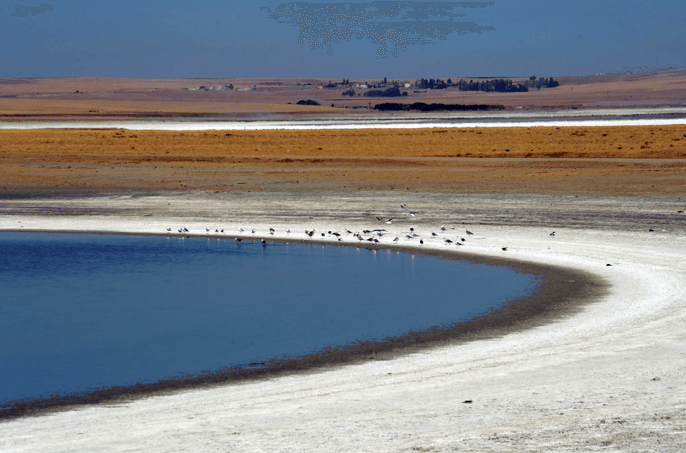
Salt Lake is a large lake located within a closed basin in Türkiye’s Central Anatolia Region, within the boundaries of Ankara, Konya and Aksaray provinces. Lake is bordered by the Kızılırmak Massif to the east, Obruk to the south, Cihanbeyli to the west, and Haymana plateaus to the north. Tuz Gölü is Türkiye’s second largest lake and, after Lake Van, has the largest surface area. The lake covers an area of 7,414 km² and its depth rarely exceeds 0.5 meters in most places. During the spring months when water levels are high, the lake’s area can reach 164,200 hectares, but during write months, intense evaporation causes most of the lake to dry up, leaving behind salt crusts up to 30 cm thick.
Tuz Gölü lies in a depression of tectonic origin and is a remnant of lakes from the Neogene period. The lake is contained within a closed basin with no outflow, and its waters are primarily fed by groundwater and several small rivers. However, during summer months, declining water levels and extreme evaporation lead to significant salt accumulation. The salinity of the lake’s water is exceptionally high at 32.4% such as, with water density ranging between 1.022 and 1.225 g/cm³.
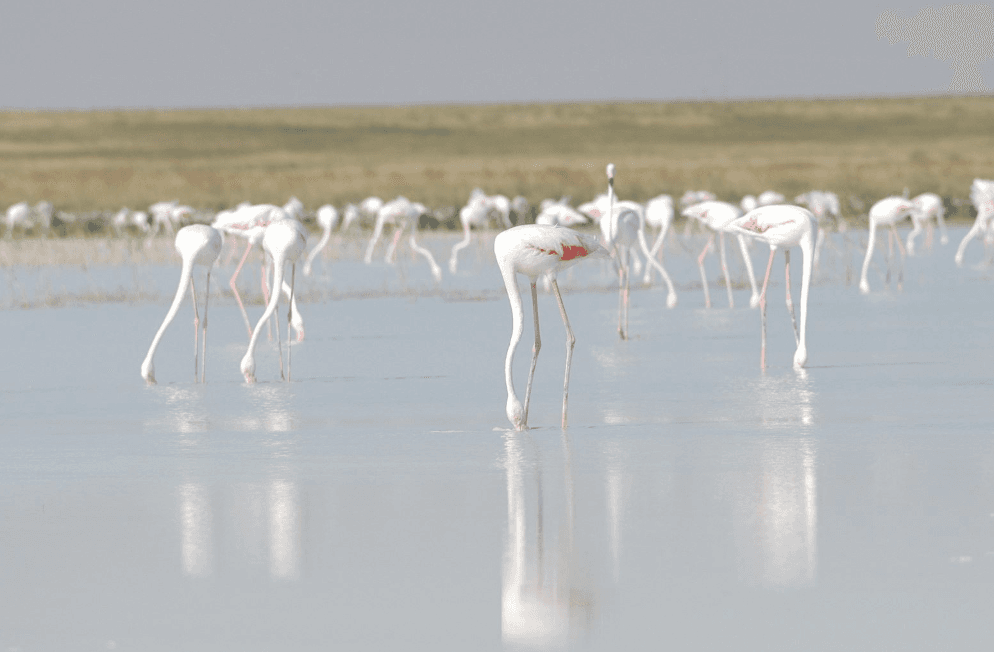
Tuz Gölü is a wetland of international importance, supporting 85 bird species, four endemic insect species, and 38 endemic plant species. Additionally, salt-tolerant plants and endemic species thrive in the saline steppe areas surrounding the lake. The lake serves as a vital wintering ground for waterbirds, providing essential habitat for flamingos, avocets, stilts, and other migrant birds for shelter, feeding, and nesting. The area around the lake exhibits rich diversity of drought-resistant and salt-tolerant halophytic plants. Tuz Gölü is Türkiye’s most important breeding site for flamingos and hosts large nesting colonies.
Tuz Gölü is a major source of Türkiye’s salt supply. Salt production is carried out through evaporation. Under the lake’s surface, water is evaporated in a pond system, causing salt to crystallize. The Kaldırım, Kayacık and Yavşan Saltworks, operated by the Monopoly General Directorate, are the primary facilities producing salt from Tuz Gölü. Additionally, irrigated agriculture is practiced around the lake, particularly in sugar beet production.
In 2000, Tuz Gölü was declared the “Tuz Gölü Special Protection Area” by a Council of Ministers Decision, a designation of great significance for the conservation of biological diversity. The lake has also been registered as a I. Degree Natural Seating area. However, the lake’s ecosystem is under threat due to declining water levels and excessive groundwater extraction. Agricultural activities, waste discharge, and planned development projects in the region further contribute to environmental pressures. WWF Türkiye and other environmental organizations are implementing various conservation projects to address these threats.
Doğa Derneği. "Tuz Gölü." Accessed February 21, 2025. https://dogadernegi.org/tuz-golu/.
Koday, Saliha. Tuz Gölü Tuzlaları (The Salt Pans of Salt Lake).
Ministry of Culture and Tourism. "Tuz Gölü." Accessed February 21, 2025. https://kvmgm.ktb.gov.tr/TR-51375/tuz-golu-ozel-cevre-koruma-alani.html.
Ministry of Culture and Tourism. "Tuz Gölü." Accessed February 21, 2025. https://www.kulturportali.gov.tr/turkiye/aksaray/gezilecekyer/tuz-golu.
Ministry of Environment, Urbanization and Climate Change. "Tuz Gölü." Accessed February 21, 2025. https://tvk.csb.gov.tr/tuz-golu-i-400.

Geological and Hydrographic Features
Flora and Fauna
Economic Importance
Conservation and Threats