


This article was automatically translated from the original Turkish version.
+2 More
Lapseki Chestnut
Type of Geographical Indication | Mahreç Sign | ||||||||
|---|---|---|---|---|---|---|---|---|---|
File Number | C2021/000257 | ||||||||
Application Date | 2021-06-25 | ||||||||
Registration Number | 1101 | ||||||||
Registration Date | 2022-05-10 | ||||||||
Product / Product Group(s) | Processed and unprocessed fruits vegetables and mushrooms | ||||||||
Province(s) | Çanakkale | ||||||||
Applicant/Registrant(s) | Lapseki Chamber of Agriculture | ||||||||
Status | Registered | ||||||||
Lapseki Peach is a geographical indication fruit grown in the Lapseki district of Çanakkale, distinguished by its aroma, firmness, and sweetness. Harvested from June to October in various cultivars, this peach is produced under unique climatic and soil conditions. Lapseki Peach encompasses the following cultivars grown in Lapseki: Isabella, Merril Gem Free, Royal Glory, Royal Gem, Extreme Glow, Summer Red, Glohaven, Crest Haven, Extreme July, Red Elegant, J. H. Hale, Extreme 486, Extreme 568, Royal Jim, Black Abdos, and Sırrı. Cultivation of these varieties begins in mid-season and continues until late season.

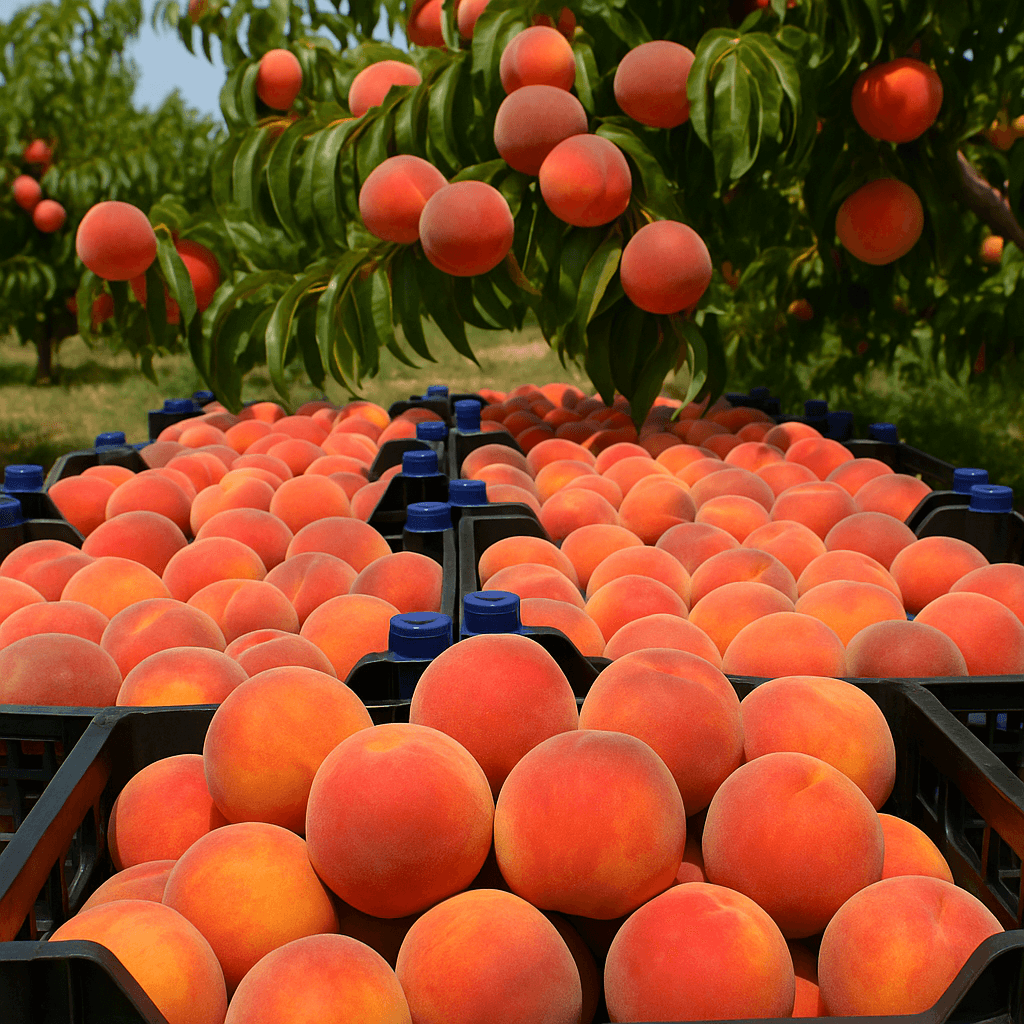
Lapseki Peach (Generated by Artificial Intelligence)
The Lapseki district has a moderate Mediterranean climate with transitional features between the Mediterranean and Black Sea climates. Summer temperatures and relative humidity do not reach the high levels typical of the Mediterranean and Aegean regions. Snowfall is very rare near the coastline and occurs only in limited amounts at higher elevations. Precipitation occurs mostly as rain during winter and spring. The district’s geographical exposure to the north of the Sea of Marmara, its proximity to the Aegean Sea, and year-round winds of varying intensity and direction positively influence its quality attributes. The annual average temperature in Lapseki is 15.1 °C, with no month averaging below 5 °C. The average winter temperature is 5.8 °C, while the summer average is 23 °C. The coldest month is January (6.2 °C), and the hottest is August (24.9 °C). The annual average rainfall is 616 mm. During the dry period, the average monthly rainfall is 10.97 mm, while in winter months it reaches 89 mm. Of the total annual precipitation, 43% falls in winter, 28% in autumn, 22% in spring, and 7% in summer.
The soil structure of the geographical area generally has a slope of around 6%. Up to a depth of one meter, the soil is clay-silt (20–30% clay, 30–40% silt); below one meter, it becomes clay-sand (40–60% sand, 20–40% clay). The soil pH ranges between 7.11 and 7.79. The aforementioned climate and soil composition impart intense aroma, sweetness, and firmness to the Lapseki Peach. Pomological characteristics of Lapseki Peach—such as fruit width, length, weight, skin color/luster/vitality, soluble solids content, acidity, pH, firmness, and flesh ratio—have been documented according to the cultivars used in production.
The specified cultivars are used in Lapseki Peach production. The density of peach trees in orchards must not exceed 45 trees per decares. Peach orchards must be located away from sources of contamination. Most peach cultivars are self-fertile. However, the J. H. Hale variety, widely cultivated in the geographical area, is physiologically male-sterile and requires pollination from any other cultivar. Fertilization is carried out using both organic and mineral fertilizers. A complete soil analysis is conducted at least every two years to monitor nutrient balance and determine necessary minerals. Annual leaf analysis is also recommended. The quantity and timing of fertilizer application are recorded. Fertilization is applied either to the soil or the leaves.
Plant protection practices are designed to preserve biodiversity, encourage natural predators of pests, and minimize the use of chemical pesticides. Preventive measures such as trap usage are prioritized. In cases of severe pest or disease outbreaks, authorized chemical pesticides must be applied at dosages recommended by the Ministry of Agriculture and Forestry. The quantity, timing of application, and pre-harvest interval of all pesticides used are recorded.
The soil is regularly tilled for weed control. It is recommended to protect the soil throughout the production process by covering it with vegetation cover or mulch rather than using mechanical tillage equipment. Irrigation is carried out using drip irrigation or under-canopy sprinkling techniques, based on orchard age, yield volume, and tree requirements. Flood irrigation, which causes excessive water consumption and nutrient loss, is prohibited. The optimal irrigation period is between June and September, but over-irrigation must be avoided as it may compromise fruit quality. Annual pruning is performed to ensure proper air circulation and healthy branch development. The most suitable months for pruning are November to April. Pruning involves removing dead, broken, competing, and diseased branches to open the canopy and ensure optimal sunlight exposure to the fruits. Pruned branches are removed from the orchard.
When fruits reach approximately 1 cm in size, excess fruits are thinned evenly across the tree in a process called thinning. This can be done manually or chemically. Thinning begins in early May and continues until mid-June under normal climatic conditions in Lapseki, before the fruit stones harden.
Harvesting occurs at different times depending on the cultivar, ranging from mid-June to early October. Fruit maturity is determined by the onset of color development and firmness. Harvesting must be conducted early in the morning (before 11:00) to avoid fruit damage, using clean collection containers and crates. Workers must wear gloves or clean their hands, and fruits in contact with soil must be separated. Classification and grading must be performed. If harvested peaches are not immediately sent to market, they are stored in cold storage at temperatures between +0.5 °C and +1 °C. Packaging involves presenting Lapseki Peaches to consumers in cardboard, wooden, or plastic containers. Peaches are arranged in single rows without touching each other.
Inspections are carried out by an inspection body composed of experts from the Lapseki Chamber of Agriculture, Lapseki District Governorship, Lapseki District Directorate of Agriculture and Forestry, Lapseki Municipality, and the Department of Horticultural Crops at Çanakkale Onsekiz Mart University Faculty of Agriculture. Inspections are conducted twice annually during the production and harvest seasons. Additional inspections may be carried out upon request or in response to complaints. Key inspection criteria include compliance with cultural practices during cultivation (nursery supply, planting, pruning, irrigation, fertilization, plant protection, thinning, harvesting), compliance with post-harvest procedures (maturity status, classification, storage, packaging), conformity of fruit pomological characteristics, and proper use of geographical indication labels and logos.
Lapseki Belediyesi. "Lapseki Şeftalisi." *lapseki.bel.tr*. Accessed May 25, 2025. https://www.lapseki.bel.tr/icerik/lapseki-seftalisi
T.C. Çanakkale Valiliği. “Lapseki Şeftalisi.” *canakkale.gov.tr*. Accessed May 25, 2025. http://www.canakkale.gov.tr/lapseki-seftalisi
Turk Patent and Trademark Office. "Lapseki Şeftalisi - Tescil Belgesi." Accessed May 25, 2025. https://ci.turkpatent.gov.tr/Files/GeographicalSigns/b4a62e25-788e-46c9-b461-f200e07fee13.pdf
Turk Patent and Trademark Office. "Lapseki Şeftalisi." *Geographical Indications Information System*. Accessed May 25, 2025. https://ci.turkpatent.gov.tr/cografi-isaretler/detay/4544

Lapseki Chestnut
Type of Geographical Indication | Mahreç Sign | ||||||||
|---|---|---|---|---|---|---|---|---|---|
File Number | C2021/000257 | ||||||||
Application Date | 2021-06-25 | ||||||||
Registration Number | 1101 | ||||||||
Registration Date | 2022-05-10 | ||||||||
Product / Product Group(s) | Processed and unprocessed fruits vegetables and mushrooms | ||||||||
Province(s) | Çanakkale | ||||||||
Applicant/Registrant(s) | Lapseki Chamber of Agriculture | ||||||||
Status | Registered | ||||||||
Definition and Distinguishing Characteristics
Production Method
Inspection