


This article was automatically translated from the original Turkish version.
Life Cycle Assessment (LCA), also known as Yaşam Döngü Analizi (YDA), is a systematic method used to determine and evaluate the environmental impacts of a product, process, or service throughout its entire life cycle—from raw material extraction through production, use, and final disposal or recycling. This analysis takes a holistic approach to environmental impacts, using either a "cradle-to-grave" or "cradle-to-gate" framework.
The concept of Life Cycle Assessment began to develop in the late 1960s, when it became clear that environmental impacts were not limited to production processes alone. Initial studies focused on reducing energy consumption and material use, and over time expanded into a fully developed methodology now standardized internationally under frameworks such as the ISO 14040 series.
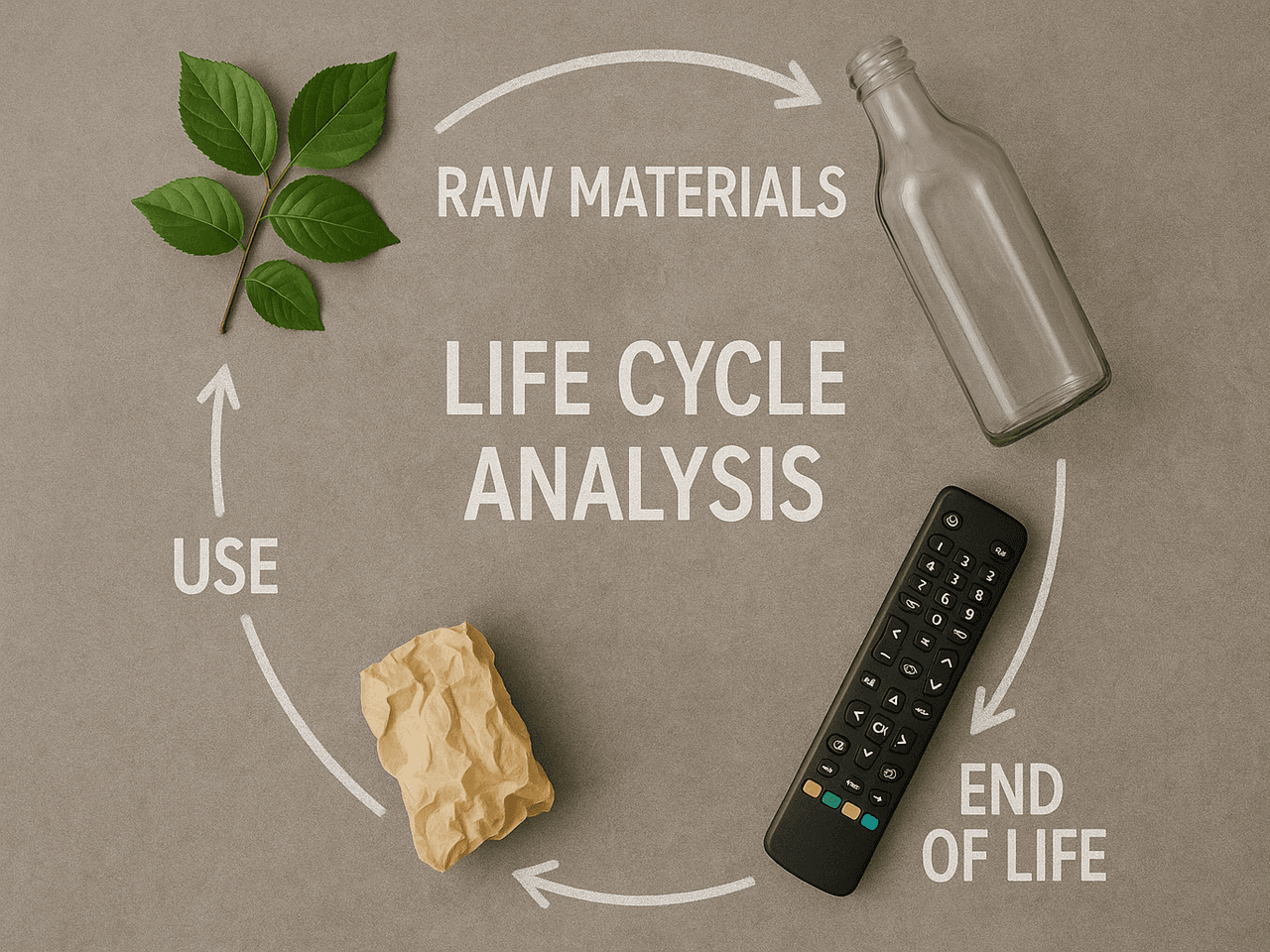
Schematic Illustration of the Key Steps in Life Cycle Assessment. (Generated by Artificial Intelligence.)
In this stage, the purpose of the study, its scope, system boundaries, and level of detail are defined. A functional unit is established, and all data collection and analysis activities are structured around this unit.
Environmental inputs and outputs such as energy, water, raw material use, and emissions are collected. The gathered data are evaluated within the defined system boundaries, and all flows are linked to the functional unit.
Based on the data from the inventory analysis, potential impacts on human health, ecosystems, and natural resources are identified. This stage involves categorization, characterization, and weighting of impacts.
In the interpretation phase, results from the inventory and impact assessment are analyzed to determine the most environmentally preferable product, process, or service. Assumptions and uncertainties made during the analysis are clearly stated.
Today, software tools such as SimaPro and GaBi are commonly used in LCA applications. These tools enable the modeling and evaluation of environmental impacts across different stages of a product or process.
Life Cycle Assessment contributes to the development of more sustainable production and consumption systems by comprehensively evaluating environmental impacts across the entire life of a product—not just during production. It also supports more efficient resource use and helps reduce waste generation.
LCA studies may encounter challenges such as data gaps, uncertainties, and difficulties in accurately defining system boundaries. Additionally, the analysis process can be costly and time-intensive. Therefore, results must be interpreted with care, and all potential assumptions must be clearly documented.
Dikbaş, Fevzi, and Serin Mezarcıöz. “Tekstilde Yaşam Döngüsü Analizi.” *Çukurova Üniversitesi Fen ve Mühendislik Bilimleri Dergisi* 38, no. 3 (2019): 106–110. .
Doğan, Seçil Kırşen. "Life Cycle Assessment of PET Bottle." Master's thesis, Dokuz Eylül University, Graduate School of Natural and Applied Sciences, 2008. https://tez.yok.gov.tr/UlusalTezMerkezi/TezGoster?key=CwVIqqBuz1VkysVpueogAX18YNurkmzEPTuXu8jlEgLmUt6m17MIssbNlm3U3Ohn.
Taşkın, Akif. *Rüzgar Enerjisinden Elektrik Üretiminin Yaşam Döngü Analizi.* Master's thesis, Erciyes University, Graduate School of Natural and Applied Sciences, 2013. https://tez.yok.gov.tr/UlusalTezMerkezi/TezGoster?key=vVNzTGHHhjH-u3WMToxQ-vWPsSuRcHDq38cLUHad7E8pmTpK13LRUtOjatNQtWir.
Çokaygil, Zerrin. *Atık Yönetimi Planlamasında Yaşam Döngüsü Analizi.* Master's thesis, Anadolu University, Graduate School of Sciences, 2005. https://www.proquest.com/docview/2600706414?fromopenview=true&pq-origsite=gscholar&sourcetype=Dissertations%20&%20Theses.

No Discussion Added Yet
Start discussion for "Life Cycle Assessment (LCA)" article
History
Core Concepts
Cradle-to-Grave and Cradle-to-Cradle Approaches
Stages of Life Cycle Assessment
Goal and Scope Definition
Life Cycle Inventory (LCI)
Life Cycle Impact Assessment (LCIA)
Interpretation
Applications
Life Cycle Assessment Software
Example Applications
Importance and Advantages
Limitations