


This article was automatically translated from the original Turkish version.
Lorelei (pronounced: Lorelay) is one of the most famous folk legends associated with the Rhine River in Germany. Near St. Goarshausen, a steep cliff 132 meters high rises along the Rhine’s narrow bends: the Lorelei. This rock has been dangerous for sailors throughout history due to its strong currents and narrow passages. For centuries, this cliff has been known both for its geographical peril and its mythic allure, serving as the setting for one of the most compelling myths in German Romantic literature.
According to the legend, Lorelei is a stunningly beautiful young woman seated atop the rock. As she combs her golden hair, she sings an enchanting song. The song is so mesmerizing that sailors on the Rhine cannot look away; they become entranced, lose control of their vessels, and crash into the rocks, drowning in the process. Thus, Lorelei is portrayed as both alluring and deadly—a water spirit or siren.
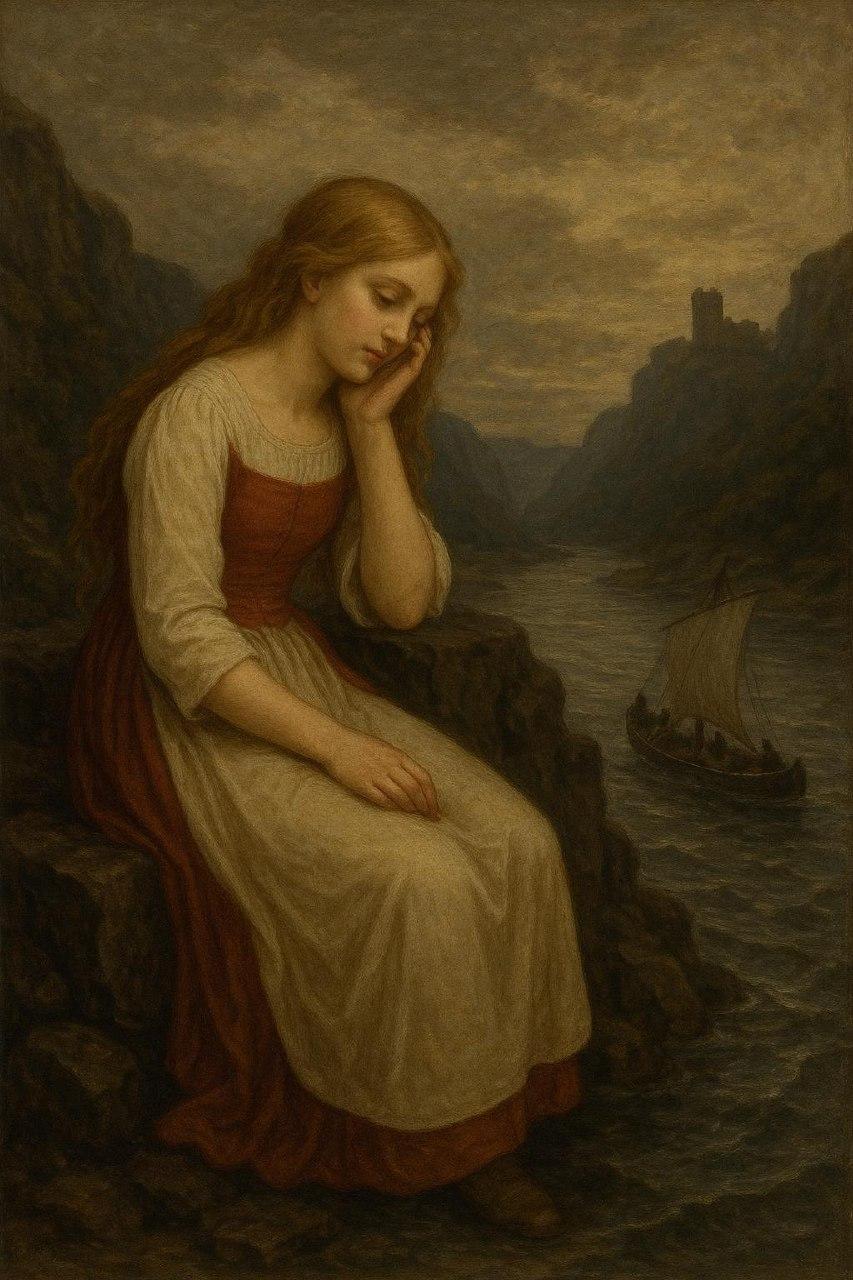
A Visual Representation of Lorelei (Generated by Artificial Intelligence)
During the Middle Ages, the echo of the Lorelei rock was attributed to forest spirits or water nymphs. However, the modern figure of “Lorelei” first appeared in 1801 in Clemens Brentano’s novel Godwi. Here, Lore Lei is a sorceress whose beauty seduces men but who is also feared for her magic. In Brentano’s verses, Lore Lei appears as a tragic figure cursed by love and ultimately drowned in the waters of the Rhine.
Following Brentano, Joseph von Eichendorff portrayed Lorelei as a “forest witch” in his poem Waldgespräch. Eichendorff’s Lorelei is a dual entity: a personification of nature that can be both enchanting through its allure and deadly in its consequences.
The most famous version, however, belongs to Heinrich Heine. His 1824 poem Die Lorelei is now regarded almost as a German folk song. The image of a beautiful maiden singing while combing her golden hair, enchanting sailors who then crash and die on the rocks, has become iconic. Heine’s verses serve both as a farewell to Romanticism and as a motif deeply embedded in the collective national memory. The poem was quickly set to music, spread like a folk song, and ensured the worldwide recognition of the Lorelei figure.
Lorelei quickly transcended national boundaries and spread beyond Europe. In the 19th century, American writer Caroline M. Sawyer reinterpreted the myth in her poem The Lady of Lurlei, which was later set to music and included in German anthologies. Today, Lorelei endures both as a symbol of tourism and as a recurring motif reimagined across various art forms.
Born from the cliffs of the Rhine and nurtured by Romantic literature, Lorelei has become a symbol of both “dangerous allure” and the destructive beauty of nature.
Lawrie, Bianca Simone. *Lorelei and the Beautiful Lau: The Portrayal of Water Nymphs in Seminal Works of 19th Century German Literature*. Master's thesis, The University of Waikato, 2017. Accessed October 8, 2025. https://researchcommons.waikato.ac.nz/server/api/core/bitstreams/70c9260c-244f-4065-901d-2d74e63d1d44/content
Porterfield, Allen Wilson. "Graf von Loeben and the Legend of Lorelei." Modern Philology Volume 13, no. 6 (October 1915): 66-92 (305-332). Accessed October 8, 2025. https://www.journals.uchicago.edu/doi/pdf/10.1086/387010
The Legend
The Origin of the Legend
The Spread of the Legend
