


This article was automatically translated from the original Turkish version.
+2 More
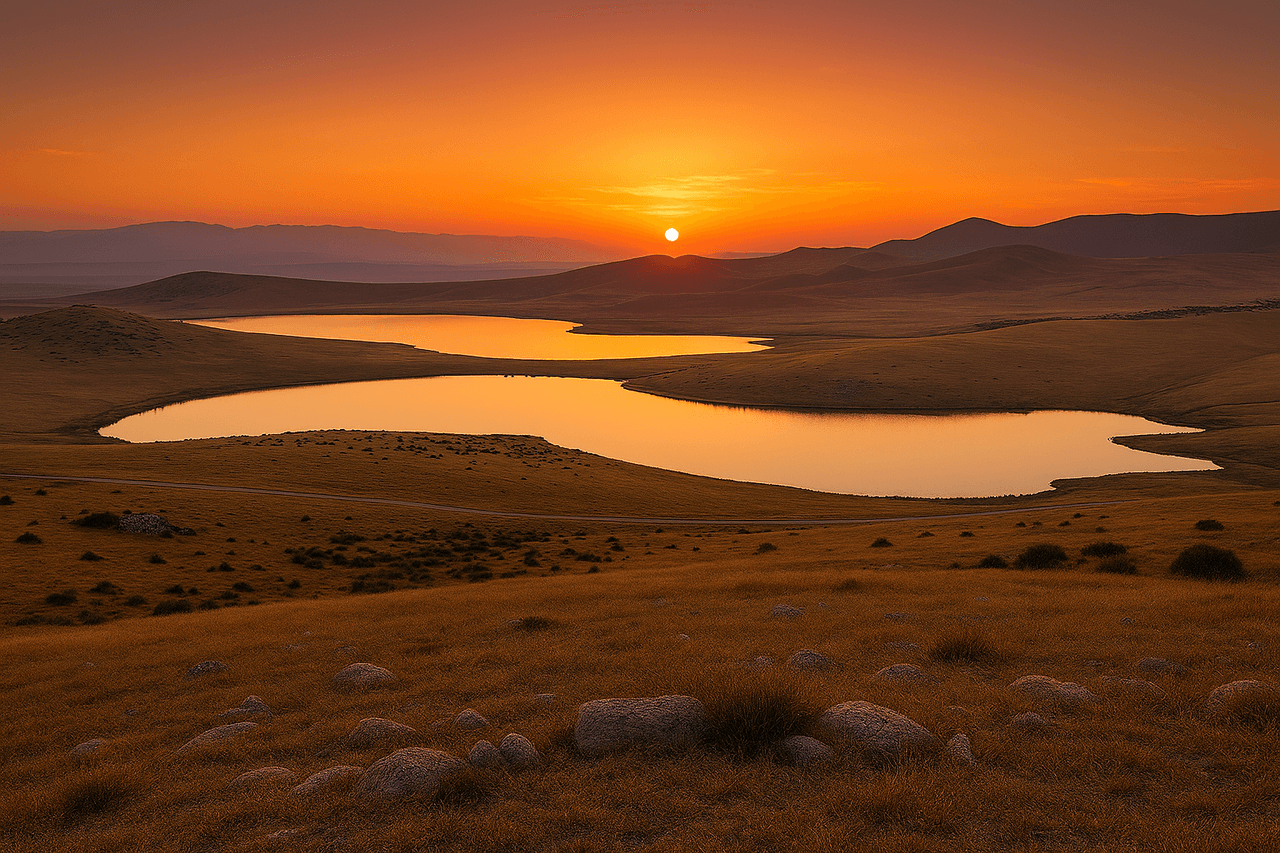
Generated with YZ.
Lota Lakes (Sivas)
Location | Hafik District Sivas Province | ||||||||
|---|---|---|---|---|---|---|---|---|---|
Tourism/Recreation | Angling, camping, picnicking, birdwatching, nature walking | ||||||||
Fauna | Carp and other freshwater fish, migratory birds | ||||||||
Biodiversity (Flora) | 256 taxa belonging to 41 families; 59 endemic species | ||||||||
Source | Groundwater sources from below and precipitation | ||||||||
Lota Lakes are a group of karstic lakes located within the boundaries of the Hafik district in Sivas Province. Situated approximately 3 km east of the district center and north of the Sivas-Erzurum highway, the lakes are 45 km from the city center of Sivas.
The Lota Lakes are one of the most prominent examples of the gypsum (plaster stone) karst morphology in the region. The lakes formed in karstic depressions (uvalas and dolines) filled by groundwater emerging to the surface. This system consists of two main lakes, each roughly 250 meters in diameter, arranged in circular shapes. Due to ongoing dissolution, the lakes have a continuously deepening structure. The larger lake reaches a maximum depth of 35 meters, while the maximum depth of the Small Lota Lake is around 18 meters.【1】
The most striking feature of the lakes is their seasonal variation. During spring, increased rainfall and melting snow cause the lakes to swell and merge into a single large water body; in summer, falling water levels cause them to separate once again. It is also known that the lakes are connected to the Kızılırmak River via groundwater and exhibit characteristics of an open basin.
The chemical composition of the Lota Lakes is directly influenced by the region’s gypsum geology (limestone, marl, and mudstone). Research has shown that the lake waters are particularly rich in calcium and sulfate.
Large Lota Lake: Hosts 78 phytoplankton taxa and exhibits an oligo-mesotrophic biological-chemical character. According to continental water resource classification, it has Class I and II water quality.【2】
Small Lota Lake: Has been found to contain 119 phytoplankton taxa and exhibits an oligotrophic (nutrient-poor, clean) character.【3】
The region’s flora is also highly diverse. Studies conducted in and around the lakes have recorded 256 taxa belonging to 41 families, of which 59 are endemic to Türkiye. Phytogeographically, the Irano-Turanian element dominates the region.【4】
Fed by spring sources from below and possessing a deep structure, the lakes harbor various freshwater fish species, primarily carp. This makes them a popular destination for recreational angling. Additionally, due to their role as stopover sites for migratory birds, especially during spring and autumn, they offer an ideal environment for birdwatching.

Sivas Loka Lakes (generated by artificial intelligence.)
The Lota Lakes possess significant potential for nature tourism and recreational activities such as camping, picnicking, hiking, and photography, thanks to their tranquil atmosphere, clear waters, and natural beauty. However, due to the absence of safe, open swimming areas along the shores and their abrupt depth changes, swimming is considered dangerous. Access to the lakes is easily available via private vehicles or Hafik minibuses along the Sivas-Erzincan highway.
Akpulat, Hüseyin Aşkın. “Lota gölleri (Sivas, Türkiye) ve çevresinin florası.” Sivas Cumhuriyet Üniversitesi, Eğitim Fakültesi Dergisi, 1, no. 1 (2018): 24-33. https://dergipark.org.tr/tr/pub/biodiversity/article/503698
Akpınar, Erdal, and Gülpınar Akbulut. “Hafik Gölü ve Yakın Çevresinin Turizm Olanakları.” Erzincan Üniversitesi Eğitim Fakültesi Dergisi, 9, no. 1 (2007): 1-24. https://dergipark.org.tr/tr/pub/erziefd/article/80076
Kasaka, Ergün. “Büyük Lota Gölü (Hafik/SİVAS)’nün Fitoplankton Toplulukları ve Su Kalitesi.” Cumhuriyet Üniversitesi Fen Edebiyat Fakültesi Fen Bilimleri Dergisi, 36, no. 2 (2015): 52–62. https://dergipark.org.tr/en/pub/cumuscij/article/58010
Kasaka, Ergün. “Küçük Lota Gölünün (Hafik/SİVAS) Fiziksel-Kimyasal Özellikleri ve Fitoplankton Toplulukları.” Cumhuriyet Üniversitesi Fen Fakültesi Fen Bilimleri Dergisi, 35(2), (2014): 1300–1949. Accessed February 7, 2026.
Saran, A. Esin. “Sivas Gezilecek Yerler: Hafik’in Saklı Cenneti Lota Gölleri.” Türkiye İlleri. 2 Ocak 2026. Erişim tarihi: 7 Şubat 2026. https://www.turkiyeilleri.com/sivas-gezilecek-yerler-hafikin-sakli-cenneti-lota-golleri/
Sivas İl Directorate of Culture and Tourism. "Lota Gölleri - Sivas." Kültür Portalı. Accessed February 7, 2026. https://www.kulturportali.gov.tr/turkiye/sivas/gezilecekyer/lota-goller
T.C.Hafik Kaymakamlığı Governorship. "Lota Gölü." Accessed February 7, 2026. https://www.hafik.gov.tr/lota-golu
[1]
Akpınar, Erdal ve Gülpınar Akbulut. “Hafik Gölü ve Yakın Çevresinin Turizm Olanakları.” Yayınlanma tarihi: 1 Haziran 2007. Erişim tarihi: 7 Şubat 2026. https://dergipark.org.tr/tr/pub/erziefd/article/80076
[2]
Kasaka, Ergün. “Büyük Lota Gölü (Hafik/SİVAS)’nün Fitoplankton Toplulukları ve Su Kalitesi.” Yayınlanma tarihi: 17 Ocak 2015. Erişim tarihi: 7 Şubat 2026. https://dergipark.org.tr/en/pub/cumuscij/article/58010
[3]
Kasaka, Ergün. “Küçük Lota Gölünün (Hafik/SİVAS) Fiziksel-Kimyasal Özellikleri ve Fitoplankton Toplulukları.” Yayınlanma tarihi: 2014. Erişim tarihi: 7 Şubat 2026. https://dergipark.org.tr/tr/download/article-file/48884
[4]
Akpulat, Hüseyin Aşkın. “Lota gölleri (Sivas, Türkiye) ve çevresinin florası.” Yayınlanma tarihi: 30 Aralık 2018. Erişim tarihi: 7 Şubat 2026. https://dergipark.org.tr/tr/pub/biodiversity/article/503698

Generated with YZ.
Lota Lakes (Sivas)
Location | Hafik District Sivas Province | ||||||||
|---|---|---|---|---|---|---|---|---|---|
Tourism/Recreation | Angling, camping, picnicking, birdwatching, nature walking | ||||||||
Fauna | Carp and other freshwater fish, migratory birds | ||||||||
Biodiversity (Flora) | 256 taxa belonging to 41 families; 59 endemic species | ||||||||
Source | Groundwater sources from below and precipitation | ||||||||
Geological Structure and Formation
Water Quality and Biological Diversity
Fauna and Tourism Potential