
This article was automatically translated from the original Turkish version.
Lucy space vehicle
Developer(s) | NASA Goddard | ||||||||
|---|---|---|---|---|---|---|---|---|---|
Website(s) | lucy.swri.edu | ||||||||
Mission Duration | 12 Years (Planned) | ||||||||
Producer(s) | Lockheed Martin | ||||||||
Launch Date | 2021-10-16 | ||||||||
Launch Site | Cape Canaveral | ||||||||
Lucy is a robotic space mission developed and managed by NASA. Designed to investigate the Trojan asteroids orbiting Jupiter, the mission aims to shed light on the early history of the Solar System. As the first spacecraft to visit such asteroids, Lucy seeks to provide critical insights into planetary formation processes. Named after the famous hominin fossil “Lucy,” discovered in Ethiopia in 1974, the mission aims to illuminate both biological and cosmic evolutionary processes.

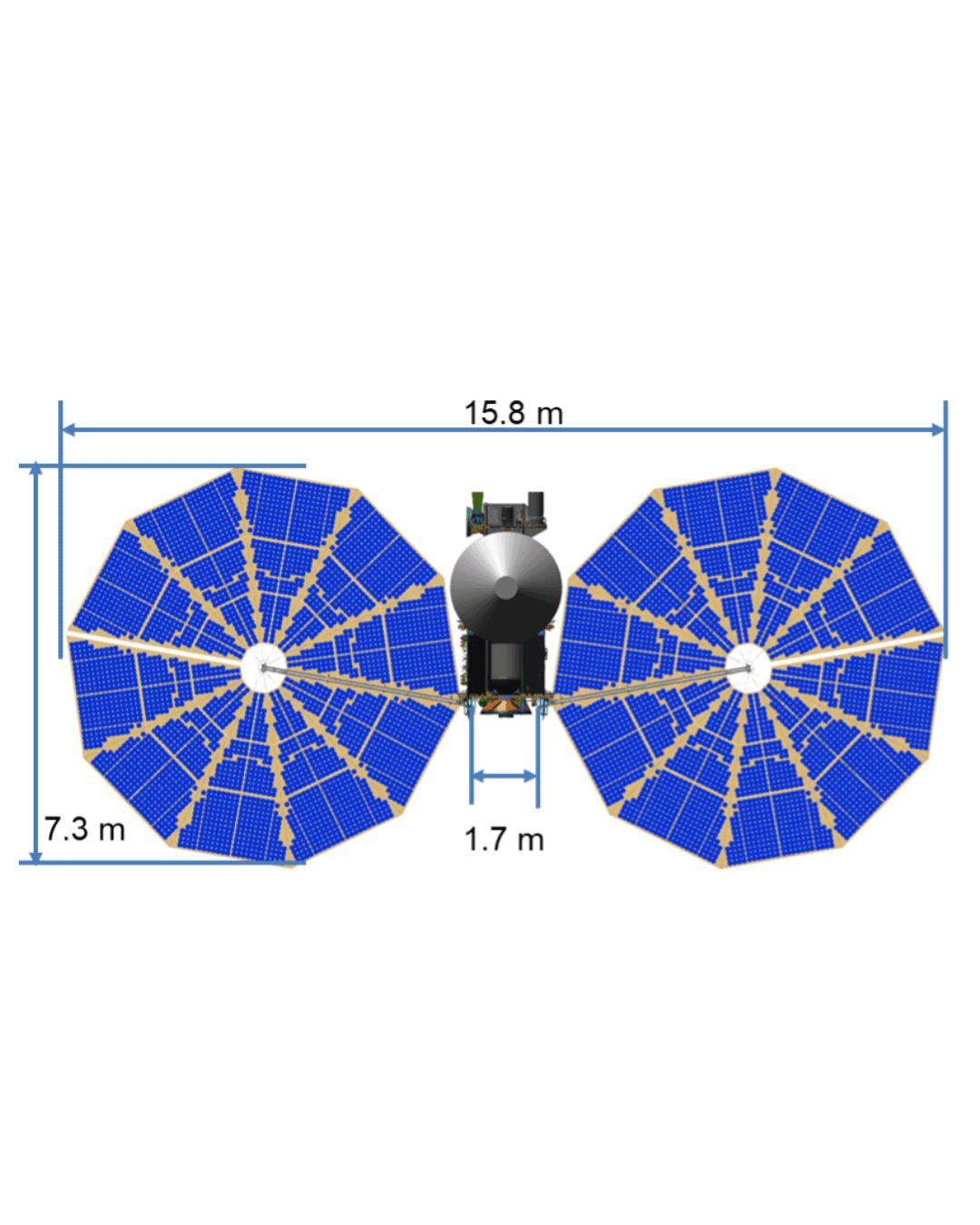
Lucy Spacecraft - (Anadolu Agency)
Lucy was launched on 16 October 2021 from Cape Canaveral Space Force Station in Florida aboard an Atlas V 401 rocket provided by United Launch Alliance. The mission is planned to last a total of 12 years. During this time, Lucy will visit eight distinct celestial bodies: one in the main asteroid belt and seven among the Jupiter Trojan asteroids. Lucy is the first spacecraft designed to use multiple gravity-assist maneuvers to reach seven different targets.
The scientific goals of the Lucy mission are to understand the formation processes of the Solar System by thoroughly examining the physical and chemical properties of the Jupiter Trojan asteroids. Specific objectives include:
Lucy carries three primary scientific instruments:
In addition, Lucy includes a radio science experiment (RSI) to determine the masses of the asteroids.
Lucy is designed to visit Trojan asteroids from both the Greek and Trojan camps. The targets are:
This broad range of targets will allow Lucy to compare the diversity and evolutionary differences among asteroids.
After launch, Lucy will perform gravity-assist flybys of Earth in 2022 and 2024. Its first asteroid encounter will be with Donaldjohanson in 2025. Subsequently, the Trojan asteroids will be visited in sequence. Each target encounter will last several days, during which intensive scientific data will be collected.
The mission will conclude in 2033 with the arrival at the Patroclus and Menoetius binary asteroid system.
The Lucy mission is the first to conduct a detailed investigation of the Trojan asteroids orbiting Jupiter. These asteroids are believed to be remnants from the early Solar System. Therefore, the mission will provide crucial information about planetary formation and migration. Lucy’s design to visit multiple targets will enable comparative analysis of asteroid diversity.
As part of NASA’s Discovery Program, Lucy is one of the low-cost, high-scientific-return missions and represents a significant step forward for future deep space exploration.
Anadolu Ajansı. "Asteroitleri kovalayan NASA uzay aracı Lucy'nin güneş panelinin tamiri sürüyor." Accessed July 1, 2025. http://aa.com.tr/tr/bilim-teknoloji/asteroitleri-kovalayan-nasa-uzay-araci-lucynin-gunes-panelinin-tamiri-suruyor/2610423
NASA Science. "Lucy Instrumentation." Accessed July 1, 2025. https://science.nasa.gov/mission/lucy/
NASA. "Lucy: The First Mission to the Trojan Asteroids." Accessed July 1, 2025. https://www.nasa.gov/lucy.
United Launch Alliance. “Atlas V Launch Lucy.” Accessed July 1, 2025. https://www.ulalaunch.com/missions/archived-launched/atlas-v-lucy

Lucy space vehicle
Developer(s) | NASA Goddard | ||||||||
|---|---|---|---|---|---|---|---|---|---|
Website(s) | lucy.swri.edu | ||||||||
Mission Duration | 12 Years (Planned) | ||||||||
Producer(s) | Lockheed Martin | ||||||||
Launch Date | 2021-10-16 | ||||||||
Launch Site | Cape Canaveral | ||||||||
Mission Summary
Scientific Objectives and Goals
Technical Specifications
Scientific Instruments
Target Asteroids
Mission Timeline and Progress
Significance and Scientific Contribution