

This article was automatically translated from the original Turkish version.
Moon occurs when World passes between Sun and the Moon, causing the Moon to be completely or partially obscured in darkness. This astronomical event is closely observed by people due to its often striking and visually captivating appearance. Lunar eclipses also provide people of science with opportunities to better understand the motions of celestial sky.
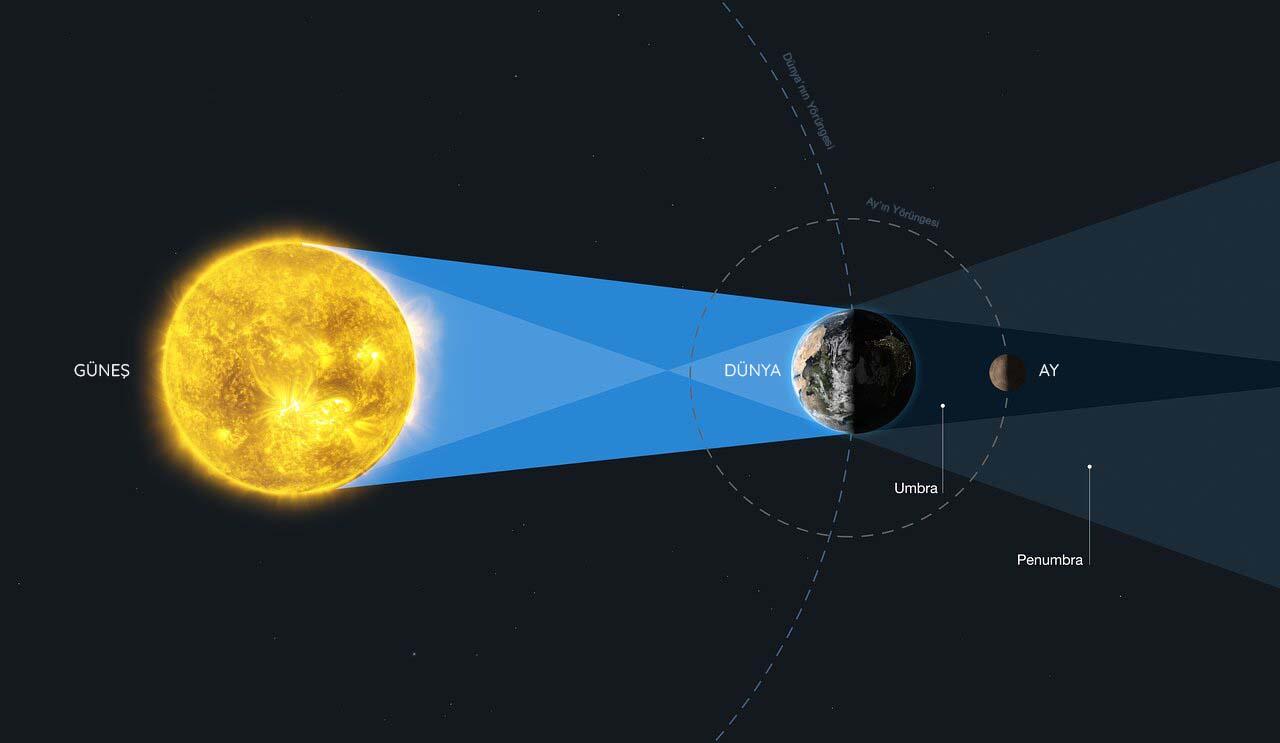
A lunar eclipse is an astronomical event that occurs when the Sun, Earth, and Moon align closely or approximately in a straight line, causing Earth to block sunlight from reaching the Moon partially or entirely. Scientifically, this phenomenon happens when the Moon enters Earth’s shadow shadow, particularly the umbra region. A lunar eclipse can occur only during the full moon phase.
How Is a Lunar Eclipse Formed?, NASA Video
A lunar eclipse occurs when the Sun, Earth, and Moon align in a straight line. Sunlight is blocked by Earth’s shadow, causing the Moon to darken. Earth’s shadow is divided into two regions: the penumbra (partial shadow) and the umbra (full shadow). The type of lunar eclipse depends on which of these shadow regions the Moon passes through:
【1】
Lunar eclipses occur when the Sun, Earth, and Moon align, and this alignment can happen several times each year.
The Moon’s orbit is tilted by approximately 5° relative to Earth’s orbit. Therefore, an eclipse does not occur at every full moon; it only happens when the Moon passes through a point near enough to Earth’s shadow cone.

【2】
Lunar eclipses have provided astronomers throughout history with valuable important observation opportunities. In ancient times, celestial events were used in mythology and calendar calculations. In modern astronomy, lunar eclipses play a significant importance role in studying Earth’s atmospheric composition, observing changes on the lunar surface, and refining our understanding of motions within the Solar System to understand.
Throughout history, lunar eclipses have produced both psychological and cultural effects on people. In ancient civilizations, eclipses were interpreted as divine warnings or harbingers of disaster.
Cajochen, C., S. Altanay-Ekici, M. Münch, S. Frey, V. Knoblauch, and A. Wirz-Justice. "Evidence That the Lunar Cycle Influences Human Sleep." Current Biology 23, no. 15 (2013): 1485–1488.
Cermak, Alicia, and NASA Moon Team. "Eclipses and the Moon - NASA Science." NASA Science. February 14, 2025. https://science.nasa.gov/moon/eclipses/.
Espenak, Fred. "Lunar Eclipses for Beginners." Accessed March 22, 2025. https://www.mreclipse.com/Special/LEprimer.html.
Foster, R. G., and T. Roenneberg. "Human Responses to the Geophysical Daily, Annual and Lunar Cycles." Current Biology 18, no. 17 (2008): R784–R794.
Karttunen, H., P. Kröger, H. Oja, M. Poutanen, and K. J. Donner. Fundamental Astronomy. New York: Springer Science & Business Media, 2007.
NASA Eclipse Web Site. Accessed March 22, 2025. https://eclipse.gsfc.nasa.gov/.
NASA Video. "How Does a Lunar Eclipse Work?" YouTube, May 14, 2013. https://www.youtube.com/watch?v=mbT50-rppaU.
Topal, Selçuk. "Güneş ve Ay Tutulmaları Nasıl Gerçekleşir?" Bilim Genç. November 8, 2022. https://bilimgenc.tubitak.gov.tr/makale/gunes-ve-ay-tutulmalari-nasil-gerceklesir.
[1]
Author: Ögetay Kayalı. “What Is a Lunar Eclipse? When Does It Occur? 2021 List – Evrim Ağacı.” Evrim Ağacı, March 31, 2021. https://evrimagaci.org/ay-tutulmasi-nedir-ne-zaman-olur-2021-listesi-12966.
[2]
“Lunar Eclipses for Beginners.” Fred Espenak, n.d. https://www.mreclipse.com/Special/LEprimer.html.

What Is a Lunar Eclipse?
How Is a Lunar Eclipse Formed?
How Often Do Lunar Eclipses Occur?
Scientific Significance of Lunar Eclipses
Impact of Lunar Eclipses on Humans