


This article was automatically translated from the original Turkish version.
+2 More
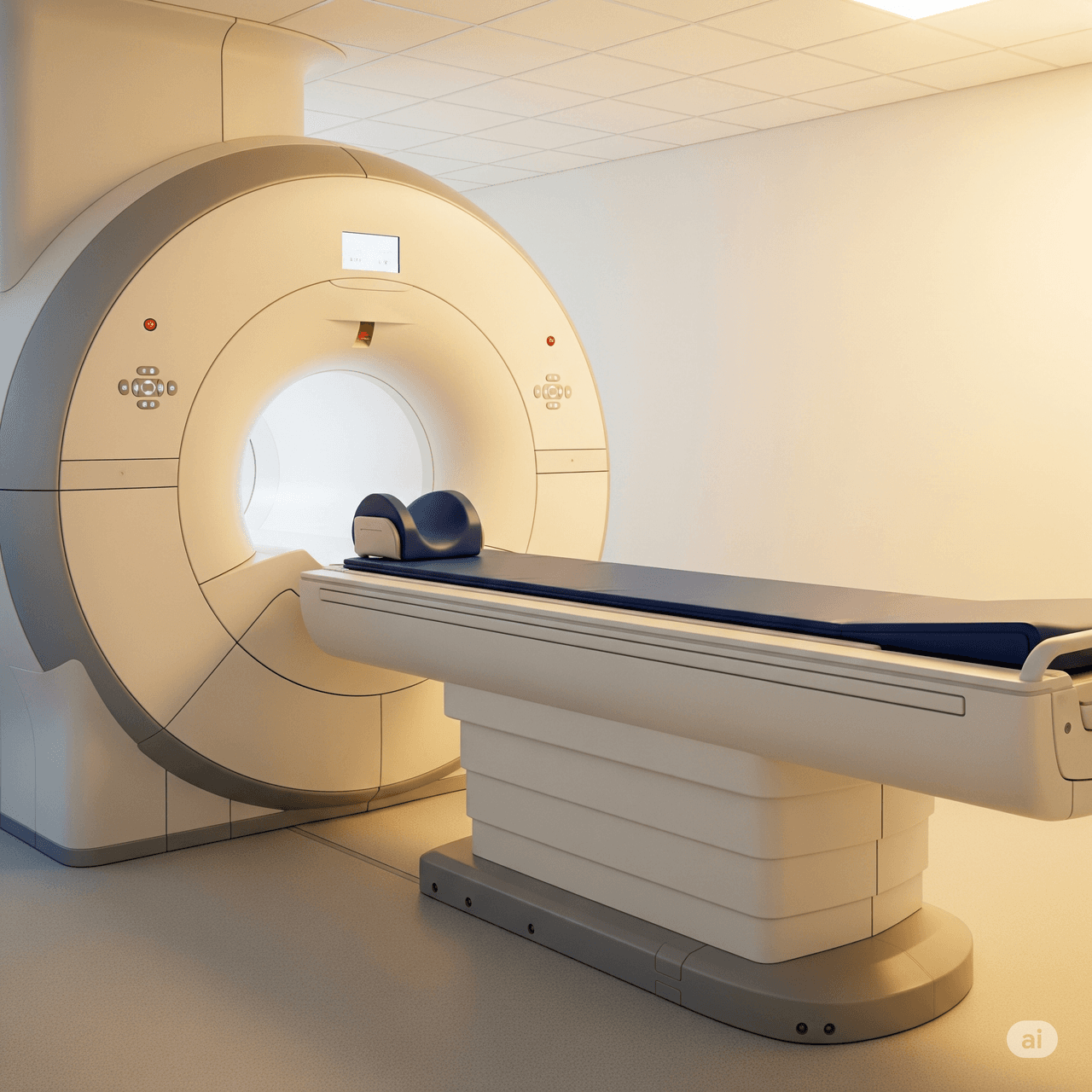
MR device (Generated with Artificial Intelligence.)
Principle(s) of Operation | Signal Detection Magnetic Field Radio Waves (RF) | ||||||||
|---|---|---|---|---|---|---|---|---|---|
Field of Use | Internal Organs Brain and Spinal Cord Other Musculoskeletal System | ||||||||
Safety and Precautions | Metal Objects Pregnancy Metal Implants Contrast Agent | ||||||||
Magnetic Resonance Imaging (MRI) is an advanced medical imaging technique that produces detailed images of organs and tissues in the body without using ionizing radiation. MRI generates high-resolution images of soft tissues by analyzing the behavior of hydrogen atoms through strong magnetic fields and radio waves.
These systems consist primarily of three key components: a magnet that generates a strong magnetic field (typically 1.5T or 3T strength), radiofrequency (RF) coils, and computer systems that collect and process image data. Hydrogen atoms in body tissues align under the influence of the magnetic field. RF waves excite these aligned protons. When the excitation is stopped, the protons return to their original state, emitting RF signals that are detected and converted into images by the computer.

MR Cihazını Tasvir Eden Bir Görsel (Yapay Zeka İle Oluşturulmuştur.)
MRI is widely used to examine numerous areas including the brain, spinal cord, musculoskeletal system, liver, heart, blood vessels, and internal organs. It is preferred in neuroradiology, cardiac imaging, oncological screening, and orthopedic assessments. Additionally, specialized techniques such as functional MRI (fMRI) enable the analysis of brain activity.
These imaging systems provide a safe imaging method for patients because they do not involve ionizing radiation. They offer high contrast resolution between soft tissues, allowing detailed examination of subtle structural differences in organs and tissues. Furthermore, the ability to acquire multiplanar sections of the body enables a more comprehensive evaluation of pathological changes. MRI demonstrates high sensitivity in detecting early-stage diseases, making significant contributions to clinical diagnostic processes. Its technically flexible structure also facilitates the application of advanced imaging techniques such as functional and metabolic studies.
The high cost and complex technological structure of MRI machines limit their accessibility in healthcare institutions. Long imaging times make the procedure more challenging for patients who require immobilization, particularly children, often necessitating multiple scans to obtain accurate results. Additionally, the confined and restricted space of closed MRI systems can induce claustrophobia in some patients, preventing the procedure from being performed. Imaging with open MRI systems, used to address this issue, generally yields lower image quality. Patients with metal implants or devices cannot benefit from this system.
These imaging systems are generally safe, but certain special conditions must be considered. Metallic implants placed in the body (such as cardiac pacemakers, cochlear implants, or metal prostheses) may interact with the magnetic field, making pre-procedural evaluation essential for patient safety. Patients must also not enter the MRI room with any metal-containing objects (such as magnets, watches, or credit cards). Careful screening must be conducted before entering the MRI suite.
MRI scanning is possible for children and pregnant women, but in pregnant women, especially during the first trimester, it should be used only when medically necessary. When contrast agents (gadolinium) are used, kidney function must be evaluated.
Modern MRI machines are equipped with numerous technological innovations that reduce imaging time and enhance patient comfort. Parallel imaging techniques, multi-channel coil systems, and artificial intelligence-assisted analysis software are examples of such advancements. Open MRI systems are also used as an alternative for patients suffering from claustrophobia.
GE Healthcare. "Elevating Radiology with Intelligent MR" GE Healthcare Web Sitesi. Accessed July 19, 2025.
NIH. "Magnetic Resonance Imaging (MRI)" National Institute of Biomedical Imaging and Bioengineering. Accessed July 19, 2025.
Sakarya Üniversitesi. "Manyetik Rezonans (MR) Cihazı" ozhan.sakarya.edu.tr. Accessed July 19, 2025.
Türk Radyoloji Derneği. "MR Güvenlik Kılavuzu" turkrad.org. Accessed July 19, 2025.

MR device (Generated with Artificial Intelligence.)
Principle(s) of Operation | Signal Detection Magnetic Field Radio Waves (RF) | ||||||||
|---|---|---|---|---|---|---|---|---|---|
Field of Use | Internal Organs Brain and Spinal Cord Other Musculoskeletal System | ||||||||
Safety and Precautions | Metal Objects Pregnancy Metal Implants Contrast Agent | ||||||||
No Discussion Added Yet
Start discussion for "Magnetic Resonance Imaging (MRI)" article
Principle of Operation
Applications
Advantages
Disadvantages
Safety
Technical Advancements