


This article was automatically translated from the original Turkish version.
+1 More
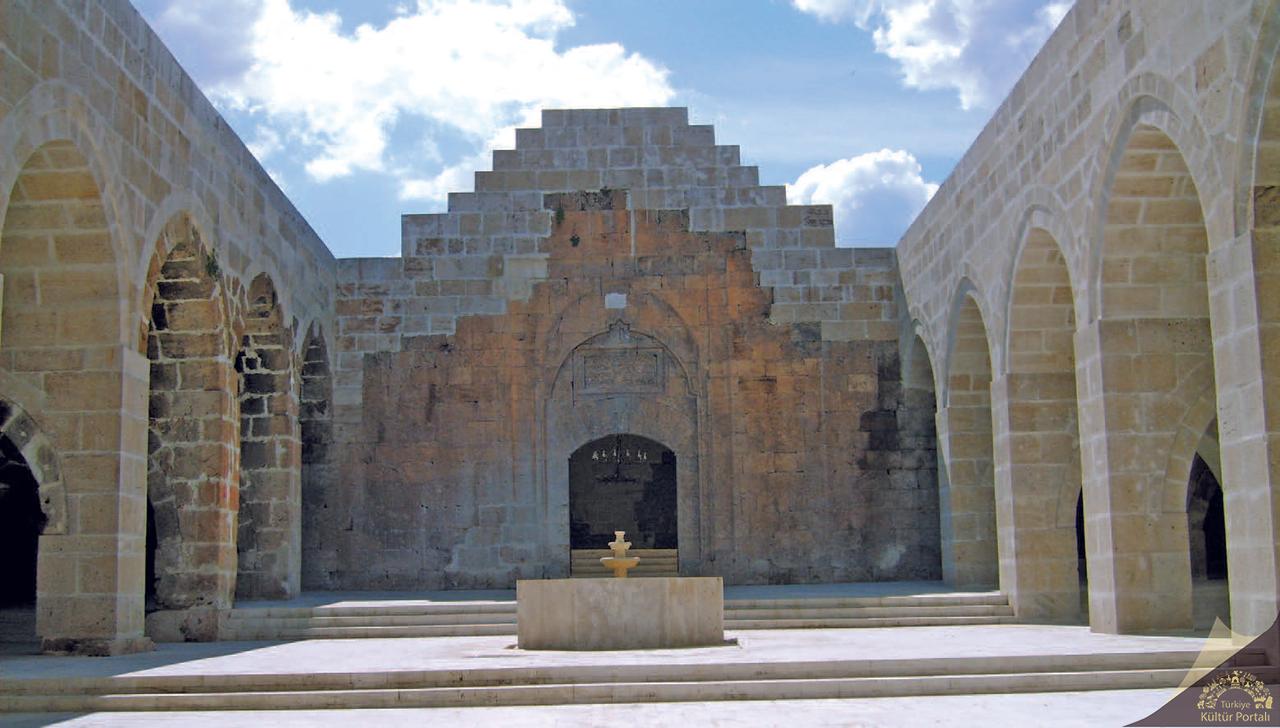
Mahperi Hatun Caravanserai
Location | Tokat Pazar | ||||||||
|---|---|---|---|---|---|---|---|---|---|
Construction Date(s) | 1238 | ||||||||
Patron | Mahperi Hatun | ||||||||
Period(s) | Anatolian Seljuk | ||||||||
The Mahperi Hatun Caravanserai, located in the Pazar district of Tokat, is a caravanserai built during the 13th century under the Anatolian Seljuk State. The structure occupies a critical position along the trade routes of its time. It was commissioned in 1238 by Mahperi Hatun, wife of Sultan I. Alaeddin Keykubad and mother of II. Gıyaseddin Keyhüsrev. The building reflects both the functional and aesthetic characteristics of Seljuk architecture and exemplifies the civil architectural understanding of the period.
The caravanserai consists of two distinct sections characteristic of the Seljuk period: a summer section and a winter section. The summer section follows an open courtyard plan, with a mosque believed to have been located at its center. The courtyard is surrounded by arcades. The winter section is entirely enclosed and was used for accommodation during cold seasons. Both sections are supported from the exterior by buttresses and constructed of cut stone. Although the entrance portal lacks the ornamental decorations typical of Seljuk architecture, its monumental appearance draws attention. Inscriptions are present on both the enclosed and open portals, written in thuluth script. The inscriptions clearly mention the name of Mahperi Hatun and date the structure to 635 AH / 1238 CE.

Mahperi Hatun Caravanserai - Pazar Subdistrict Office
Structures of this type were built to secure trade routes across Anatolia and meet the accommodation needs of merchants, and they also formed an integral part of Seljuk social and economic life. The Mahperi Hatun Caravanserai continued the tradition of waqf endowments and stands among the rare examples commissioned by a female patron. It serves as an important example of women’s contributions to Anatolian architecture.
The structure, having remained unused for a long period and fallen into ruin, was restored in 1999 by the Ministry of Culture and Tourism. During restoration, the original wall fabric was preserved as much as possible, while the roof covering was completed using modern materials. Today, it is open to visitors and is used to a limited extent for cultural events.
Culture Inventory. "Mahperi Hatun Kervansarayı." Culture Inventory. Accessed June 1, 2025. https://kulturenvanteri.com/yer/mahperi-hatun-kervansarayi/#17.1/40.281535/36.290862
T.C. Kültür ve Turizm Bakanlığı. "Mahperi Hatun (Pazar) Hanı." Kültür Portalı. Accessed June 1, 2025. https://www.kulturportali.gov.tr/turkiye/tokat/gezilecekyer/mahperi-hatun–pazar–hani
T.C. Tokat Valiliği İl Kültür ve Turizm Müdürlüğü. "Pazar." Accessed June 1, 2025. https://tokat.ktb.gov.tr/TR-141050/pazar.html
Tokat Pazar Kaymakamlığı. "Değirmen." Accessed June 1, 2025. http://www.tokatpazar.gov.tr/degirmen

Mahperi Hatun Caravanserai
Location | Tokat Pazar | ||||||||
|---|---|---|---|---|---|---|---|---|---|
Construction Date(s) | 1238 | ||||||||
Patron | Mahperi Hatun | ||||||||
Period(s) | Anatolian Seljuk | ||||||||
No Discussion Added Yet
Start discussion for "Mahperi Hatun Caravanserai" article
Architectural Structure and Plan Features
Historical and Functional Significance
Conservation and Restoration Process