


This article was automatically translated from the original Turkish version.
+1 More
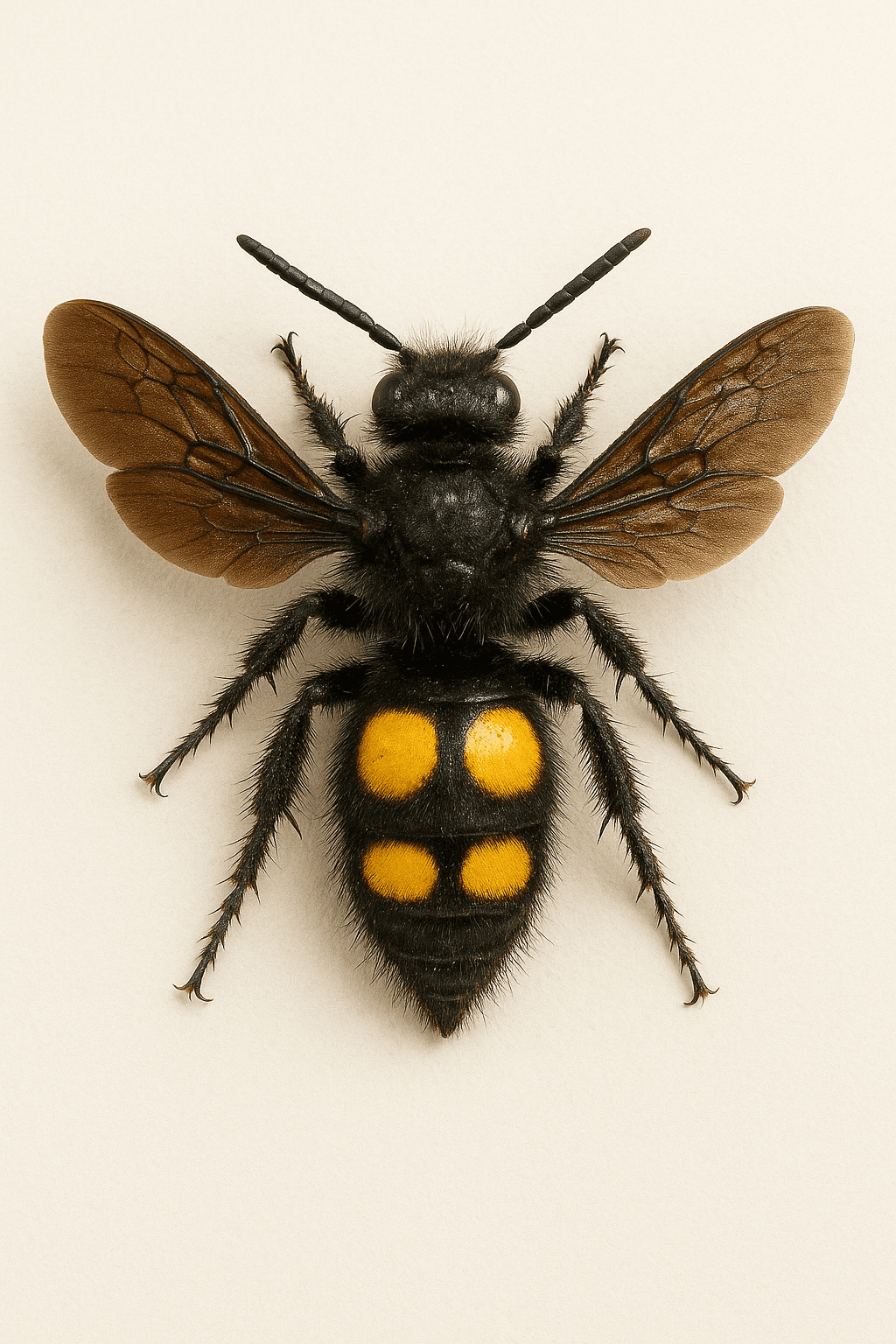
Mammoth Wild Bee (Megascolia maculata)
Team(s) | Hymenoptera | ||||||||
|---|---|---|---|---|---|---|---|---|---|
Family | Scoliidae | ||||||||
Gender | Megascolia | ||||||||
The order Hymenoptera is a taxonomic group that includes wasps, bees, and ants. The family Scoliidae encompasses species that develop as parasitoids on the larvae of soil-dwelling beetles. Megascolia maculata is one of the largest wild wasps in Europe and attracts attention due to its morphological characteristics and its capacity for biological control.

Prepared for entomological study by Emine Nur Demir
Megascolia maculata is classified within the kingdom Animalia, phylum Arthropoda, class Insecta, order Hymenoptera, family Scoliidae, and genus Megascolia. This species was first described by Drury in 1773 and is among the largest Hymenoptera species in Europe. The subspecies Megascolia maculata flavifrons (Fabricius, 1775) is also recognized in the literature. This taxonomic placement clarifies the species’ systematic position based on its morphological and ecological distinctions.
Megascolia maculata is notable for its large body size, ranging from 40 to 60 mm in length. Females are distinctly larger than males. The head is broad, with segmented and curved antennae. Powerful mandibles serve functions in defense, host detection, and nest excavation. The thorax is densely covered with hairs and possesses a robust muscular structure adapted for flight. The abdomen is glossy black with two or more yellowish spotted markings on the dorsal surface; these spots are key diagnostic features for species identification. The wings are dark brown and exhibit iridescent reflections. This coloration indicates aposematic (warning) coloration, suggesting a deterrent effect against potential predators.
The physiological traits of Megascolia maculata reflect its adaptation to high mobility and a subterranean parasitoid lifestyle. Well-developed flight muscles enable it to fly long distances despite its large body size. Its respiratory system, characterized by expanded tracheal structures, supports high metabolic activity. This species is active during summer months and demonstrates tolerance to high temperatures. The dense body hair provides both thermoregulation and protection against physical environmental stressors. Additionally, numerous sensory receptors (chemoreceptors and mechanoreceptors) in the antennae support behaviors such as host detection and navigation. During oviposition, this sensory system is actively used to locate hosts belonging to the family Scarabaeidae.
Megascolia maculata is an important parasitoid species in ecosystems. Females locate beetle larvae living underground and lay their eggs directly on or near them. The emerging larva develops by consuming the host from within, completing its life cycle. Through this biological cycle, natural population control of Scarabaeidae larvae—often considered pests in agricultural areas—is achieved.
Adult individuals feed on floral nectar, contributing to pollination processes. In this way, they play an active role in biotic interactions and provide ecosystem services. M. maculata is valued as a species capable of maintaining natural balance without human intervention and is proposed as a potential biological control agent in integrated pest management (IPM) approaches.
Populations of Megascolia maculata are negatively affected by habitat loss, pesticide use, and intensive agricultural activities. In areas where subterranean beetle larvae have declined, the continuation of the parasitoid life cycle becomes difficult. Moreover, indiscriminate pesticide application threatens both adult wasps and their host organisms.
Given the ecological importance of this species, conservation of its habitats, implementation of biodiversity-sensitive agricultural policies, and increased entomological monitoring efforts are of critical importance.
Megascolia maculata is a species of significant interest in entomological research due to its morphological grandeur, physiological resilience, and ecological functionality. Its distribution across various regions of Türkiye demonstrates its role as part of the country’s rich entomofauna. Its parasitoid life cycle contributes to the natural control of pest insects, making its conservation essential for sustainable ecosystem management. Future taxonomic and molecular studies will further clarify the population dynamics of this species.
GBIF. "Megascolia Maculata (Drury, 1773)." Global Biodiversity Information Facility. Accessed June 8, 2025. https://www.gbif.org/species/4505917.
Naturhistorisches Museum Wien. "Mammoth Wasp." Naturhistorisches Museum Wien. Accessed June 8, 2025. https://www.nhm-wien.ac.at/forschung/2_zoologie_insekten/sammlungen/hymenoptera/mammoth_wasp.
Tezcan, Serdar. “Balıkesir’den 1030 Böcek Türü / 1030 Insect Species from Balıkesir (Turkey).” ResearchGate, February 2024. https://www.researchgate.net/publication/378143652_BALIKESIR'DEN_1030_BOCEK_TURU_1030_INSECT_SPECIES_FROM_BALIKESIR_TURKEY.
Tezcan, Serdar. “Muğla’dan 1560 Böcek Türü / 1560 Insect Species from Muğla (Turkey).” ResearchGate, December 2023. https://www.researchgate.net/publication/376788021_MUGLA'DAN_1560_BOCEK_TURU_1560_Insect_species_from_Mugla_Turkey.
Tüzün, Ayla, and Samet Eray Yalnız. “Türkiye Scoliid (Hymenoptera: Scoliidae) Türleri Üzerine Bir Derleme.” *Düzce Üniversitesi Bilim ve Teknoloji Dergisi* 8, no. 3 (2020): 1690–1703. https://dergipark.org.tr/tr/download/article-file/1181613.

Mammoth Wild Bee (Megascolia maculata)
Team(s) | Hymenoptera | ||||||||
|---|---|---|---|---|---|---|---|---|---|
Family | Scoliidae | ||||||||
Gender | Megascolia | ||||||||
No Discussion Added Yet
Start discussion for "Mammoth Wild Bee (Megascolia maculata)" article
Taxonomic Classification
Morphological Characteristics
Physiological Characteristics
Ecological Role and Importance
Conservation Needs and Threats