

This article was automatically translated from the original Turkish version.
+1 More
Maned wolf (Chrysocyon brachyurus) is a monotypic species endemic to South America within the order Carnivora and family Canidae. This animal is the only living representative of the genus Chrysocyon and, according to genetic studies, is neither a true wolf nor a fox; rather, it possesses a unique evolutionary lineage distinct from other canids. The taxonomic naming of the species dates back to the early 19th century, with the current combination Chrysocyon brachyurus first used in 1919. Although the species shows phylogenetic proximity to genera such as Canis, Lycaon, and Speothos, it differs from them in the mobility of its transferrin complex globulin components.
Morphological Features of the Maned Wolf (Generated by Artificial Intelligence)" image-element-format="right" image-height="3019" image-source="https://cdn.t3pedia.org/media/uploads/2026/02/11/CZZVzfc55erdLvEk3zA008eVeaJCNuOR.png" image-width="6000">
The maned wolf is described as the largest canid species in South America. An adult individual reaches a shoulder height of approximately 90 centimeters and an average body weight of 23 kilograms. With a tail length of about 45 centimeters, the total body length is around 147 centimeters.
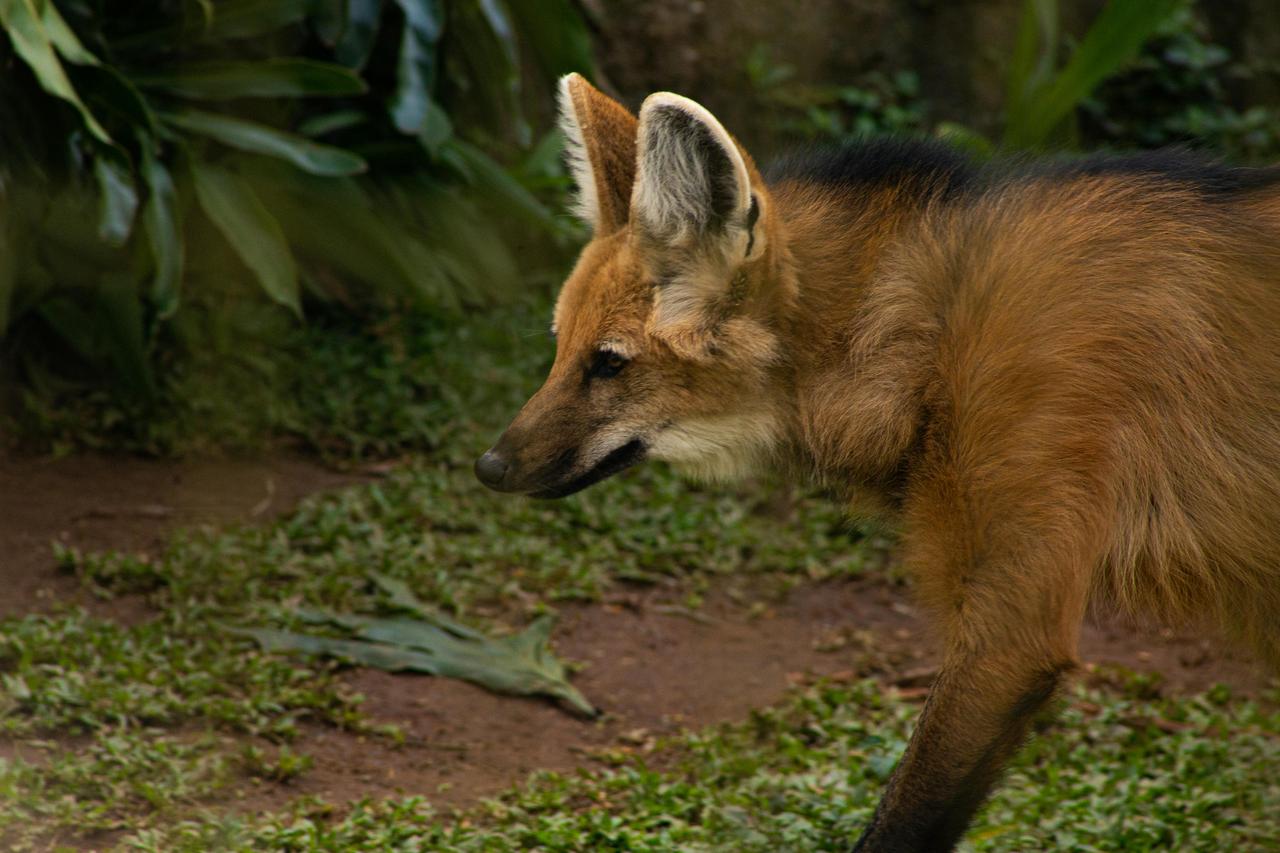
Among its most distinctive physical features are its golden-red coat and the dark fur forming a black mane extending from the nape down the back. White markings are present on the inner ears, beneath the jaw, and at the tip of the tail. Its long legs are considered an adaptation for improved visibility and mobility in tall grass savannas. The skull is characterized by a narrow rostrum and palatine bones, giving it a resemblance to coyotes (Canis latrans) rather than wolves.

class=\
The species is primarily distributed across central and eastern South America, including Brazil, Paraguay, Bolivia, northern Argentina, and southern Peru. It prefers the Cerrado biome, the largest in South America, which consists of moist and dry forests, grasslands, savannas, and wetlands.
Natural Habitat of the Maned Wolf (Generated by Artificial Intelligence)" image-element-format="left" image-height="649" image-source="https://cdn.t3pedia.org/media/uploads/2026/02/11/gfktmU70HoPhZPgrU4apnq3HOM5IHUOL.png" image-width="562">
Historically recorded in Uruguay and southern Argentina, the species’ range has contracted at its southern limits due to anthropogenic pressures and agricultural expansion, while expanding eastward in Brazil into newly cleared grasslands resulting from deforestation. Maned wolves prefer open vegetation in flat areas rather than dense forested regions.
The maned wolf (Chrysocyon brachyurus) is a highly flexible omnivorous and opportunistic species. Its diet consists of approximately equal proportions of plant and animal protein sources; this balance varies according to seasonal conditions, habitat type, and prey availability. Particularly in the South American savannas, where food resources fluctuate throughout the year, the species has adapted to a broad dietary range. This adaptive strategy is one of the key reasons for its ability to survive in diverse environmental conditions.
One of the most important plant components in its diet is Solanum lycocarpum, locally known as “wolf fruit.” This fruit not only serves as an energy source but is also believed to contain bioactive compounds that help reduce parasite load. During dry seasons when animal prey becomes scarce, this plant assumes a primary dietary role. By consuming the fruit and dispersing its seeds through feces, maned wolves also act as seed dispersers, contributing to the regeneration of plant communities.
Hunting Strategies of the Maned Wolf (Generated by Artificial Intelligence)" image-element-format="right" image-height="467" image-source="https://cdn.t3pedia.org/media/uploads/2026/02/11/kc2CeMUJMpYpAhJ8wG4N0cc22m815tiu.png" image-width="1304">
Animal prey includes rodents, small rabbits, armadillos, ground birds, reptiles, amphibians, and large insects. Unlike wolves that hunt in packs, the maned wolf hunts solitarily. Its large, upright, and highly mobile ears allow it to detect even the faintest rustling in tall grass. Upon detecting prey, it pounces suddenly or digs with its forepaws to uncover hidden animals. Its ability to leap vertically to catch small birds is a striking demonstration of the species’ agility and reflex speed.
This dietary flexibility and diverse hunting techniques expand the maned wolf’s ecological niche and enable it to persist across various habitat types. Thus, the species fulfills a multifaceted role in its ecosystem, functioning both as a predator and as a seed disperser.
Socially, maned wolves live in monogamous pairs defending territories of approximately 26–27 square kilometers. However, outside the breeding season, pairs typically move separately and mark their territories with strong-smelling urine and feces.
Reproductive Schema of the Maned Wolf (Generated by Artificial Intelligence)" image-element-format="left" image-height="416" image-source="https://cdn.t3pedia.org/media/uploads/2026/02/11/e2VBahV1cR6AsUgDhMoIvCMdXc1Lkn9Y.png" image-width="1331">
Females are monestrous, entering one reproductive cycle per year. The mating season occurs between August and October in the Southern Hemisphere, while in captivity in the Northern Hemisphere it shifts to October–February. After a gestation period of about 65 days, an average of 2.5 pups are born. 【1】Pups are born black and begin to develop adult coat coloration after approximately 10 weeks. While maternal care is primarily provided by the female, observations in captivity and some wild populations indicate that males also contribute food.

Maned Wolf Walking in the Savanna (Pixabay)
The species is primarily crepuscular and nocturnal. Unlike other canids, it does not howl; instead, it communicates with mates or warns rivals using loud, rhythmic barks and roars. Olfactory marking plays a vital role in communication; the distinctive and pungent odor of its urine is used to delineate territorial boundaries. Maned wolves mark elevated features such as termite mounds or small hills to establish visual and olfactory borders.
Although generally robust in the wild, the maned wolf can become vulnerable to various pathogens and physiological issues in areas heavily impacted by human activity. The encroachment of human settlements into its natural habitat increases contact with domestic dogs, significantly elevating the risk of infectious diseases. Field studies have identified canine distemper, parvovirus infection, rabies, and adenovirus as major threats to population health. These pathogens can be fatal, especially in individuals with weakened immune systems, and may cause sudden declines in local populations.
Parasitic infections are also significant factors affecting the species’ health. The most prominent is Dioctophyme renale, commonly known as the “giant kidney worm.” This nematode typically colonizes the right kidney, causing organ dysfunction; infection often forces the animal to survive with a single kidney and may lead to systemic complications in advanced cases. Since the parasite’s life cycle involves intermediate hosts, individuals living near wetland habitats face higher infection risks.
In captivity, maned wolves exhibit certain hereditary and chronic health issues not commonly seen in wild populations. Notably, a genetic disorder called cystinuria, related to amino acid metabolism, can lead to urinary stone formation. Dental gum hyperplasia and other oral health problems are also observed. These conditions are associated with the effects of limited gene pools and controlled breeding programs.
Recent microbiological studies have revealed the presence of entodiniomorph ciliates in the maned wolf’s digestive system—microorganisms typically found in herbivorous mammals. This unusual finding is interpreted as an adaptive trait linked to the digestion of the fruit and plant material that constitute a major part of its diet. Thus, despite belonging to the order Carnivora, the maned wolf exhibits a fascinating biological profile with partial omnivorous physiological and microbial characteristics.
The maned wolf is classified by the International Union for Conservation of Nature (IUCN) as “Near Threatened”. Its fragmented distribution, low population density, and large habitat requirements increase its sensitivity to environmental changes. The Cerrado biome, which constitutes the species’ primary habitat, has suffered severe degradation over the past decade due to intensive agricultural activities, soy and corn cultivation, cattle ranching, and large-scale land conversion. Not only has the habitat shrunk, but its fragmentation by roads, settlements, and farmland has led to genetic isolation, threatening the long-term viability of populations.
Human-wildlife conflict is another significant risk factor. Although maned wolves primarily feed on small mammals, fruits, and insects, they are occasionally perceived as pests for preying on poultry, leading to targeted killings in some regions. Additionally, increasing road networks have made vehicle collisions a major cause of mortality, especially among young individuals. Infectious diseases such as rabies, distemper, and parvovirus transmitted from domestic dogs represent biological threats capable of causing sudden declines in wild populations.
Conservation efforts have led to legal protection of the species in countries such as Brazil, Paraguay, Argentina, and Bolivia, with the establishment of national parks, biosphere reserves, and ecological corridors. Current conservation strategies focus not only on increasing population numbers but also on ensuring habitat connectivity, creating wildlife corridors at road crossings, and raising public awareness. Monitoring genetic diversity, disease screening, and satellite tracking studies contribute to a better understanding of the species’ ecology and the development of effective conservation plans. These multifaceted approaches are critical for the long-term survival of the maned wolf in its natural habitats.
The maned wolf is a species with a natural distribution restricted to South America and is not native to or naturally occurring in Türkiye’s fauna. Therefore, there are no wild populations in the country, and it is not considered a component of Türkiye’s natural biological diversity. Its presence in Türkiye is limited to a small number of individuals in zoological collections, zoos, and scientific research centers. These individuals are typically brought in under international species conservation and controlled breeding programs.
Legally, as the species is listed under the Convention on International Trade in Endangered Species of Wild Fauna and Flora (CITES), its import, export, and possession in Türkiye are subject to strict permitting procedures. Under this framework, private ownership or commercial keeping of maned wolves is not permitted; only authorized institutions may house the species for scientific, educational, or conservation purposes.
[1]
Smithsonian’s National Zoo and Conservation Biology Institute. “Maned Wolf.” National Zoo. Accessed February 10, 2026. https://nationalzoo.si.edu/animals/maned-wolf


No Discussion Added Yet
Start discussion for "Maned wolf (Chrysocyon brachyurus)" article
Morphological Characteristics and Physical Description
Natural Habitat and Geographic Distribution
Feeding Ecology and Hunting Strategies
Reproductive Biology and Social Structure
Behavior and Communication
Health Status and Diseases
Conservation Status and Threats
Status in Türkiye