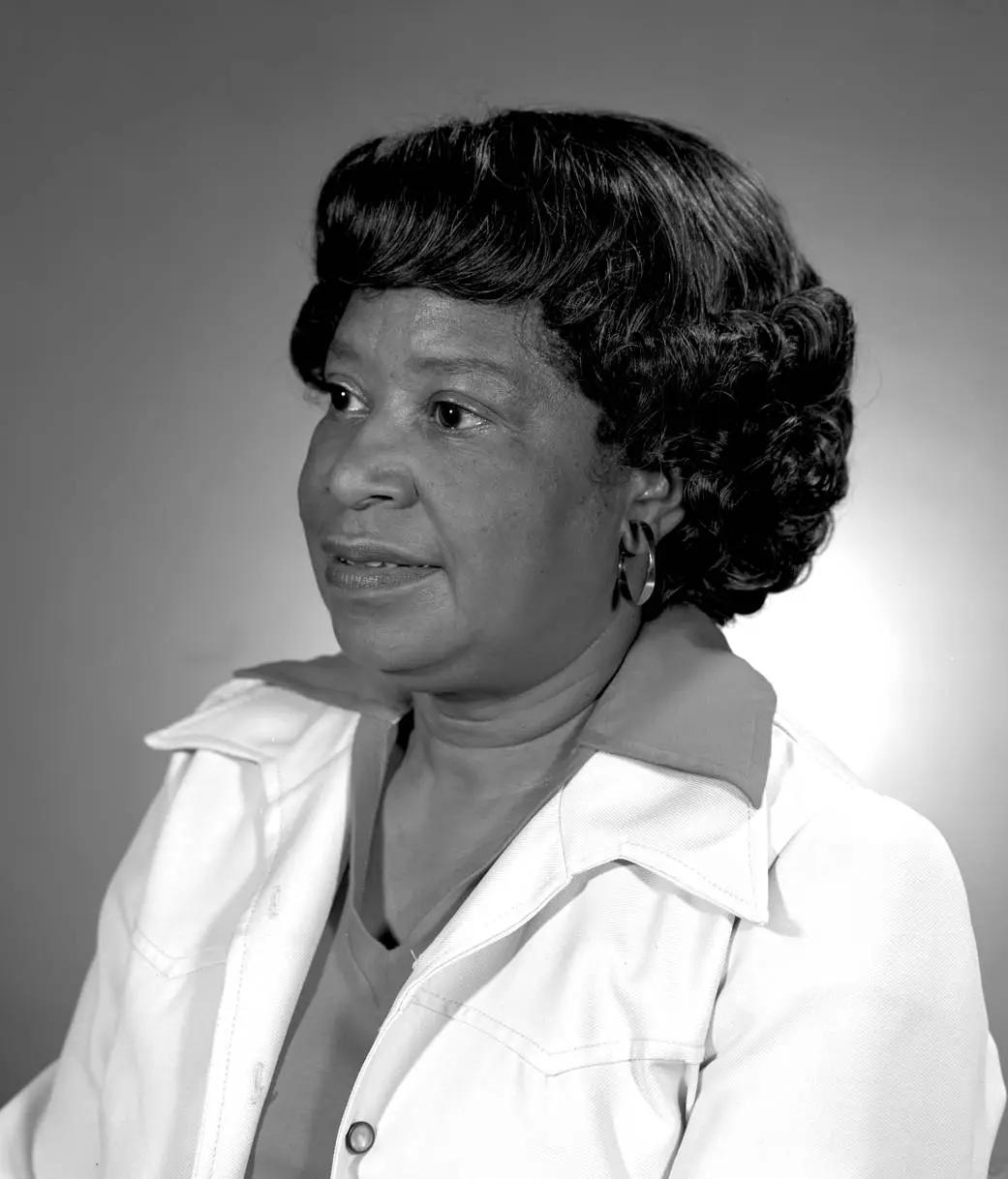


Mary W. Jackson (1921–2005) was an American mathematician and aerospace engineer and the first African American woman to earn the title of engineer at the National Aeronautics and Space Administration (NASA). She held administrative roles within NASA focused on women and minority groups, based on her work in aerodynamic research.
Mary Winston Jackson was born on 9 April 1921 in Hampton, Virginia, United States of America. She completed her primary and secondary education in this region. Due to her academic achievements, she pursued higher education at Hampton Institute and graduated in 1942 with a bachelor’s degree in mathematics and physics. After completing her undergraduate studies, she began her professional career as a mathematics teacher. In subsequent years, she held administrative positions in various public institutions.
In 1951, Mary W. Jackson began her career as a mathematician at the Langley Memorial Aeronautical Laboratory within the National Advisory Committee for Aeronautics (NACA). At the time, NACA was the primary federal agency conducting aeronautical research in the United States.
Jackson worked in the West Area Computing unit at Langley, where racial segregation was institutionally maintained. Mathematicians in this unit performed technical tasks such as calculating and analyzing data from flight tests and wind tunnel experiments. Jackson took on responsibilities for evaluating experimental data and providing numerical support to engineering teams. In these roles, she participated in technical analysis and computation processes related to aerodynamic research.
Mary W. Jackson’s transition into engineering began when she joined a team led by engineer Kazimierz Czarnecki working on supersonic wind tunnel studies at the Langley Research Center. During these projects, Jackson engaged in applied work in experimental aerodynamics.
To qualify for the title of engineer, she needed to complete advanced courses in mathematics and physics. Due to the educational restrictions of the era, she requested special permission to attend these classes, which were held at a segregated high school, and successfully completed the required coursework. Following this, in 1958, Jackson earned the official title of aerospace engineer within NASA.
Mary W. Jackson’s engineering work at NASA’s Langley Research Center focused on analyzing airflow behavior at supersonic speeds. She participated in the analysis and evaluation of measurement data obtained from wind tunnel experiments.
Jackson contributed to the technical assessment of data related to boundary layer transitions and high-speed flow conditions during aerodynamic experiments. Her work included preparing technical reports and documenting research findings. Throughout her engineering career, she collaborated with various research teams and participated in experimental studies under aerodynamic research programs.
In 1979, Mary W. Jackson was appointed Federal Women’s Program Manager at NASA’s Langley Research Center. In this role, she contributed to the implementation of professional development programs for women and minority groups within the organization.
During her administrative tenure, Jackson focused on practices related to employee training, career advancement, and promotion. She played a role in implementing equality and opportunity programs at NASA’s Langley Research Center. She applied the technical knowledge and institutional experience she had gained during her engineering career to administrative processes and remained active in NASA’s equity-based programs until the end of her service.
Mary W. Jackson retired from NASA in 1985. After retirement, she continued to live in Virginia. She passed away on 11 February 2005.
Mary W. Jackson is recorded in history as the first African American woman to become an engineer at NASA. Her aerodynamic research and engineering activities based on supersonic wind tunnel experiments are part of NASA’s technical contributions to aeronautical research. In the later stages of her career, her administrative roles contributed to programs designed to advance the professional development of women and minority groups within NASA.
NASA. "Mary W. Jackson Biography." Accessed January 27, 2026.
Perot Museum of Nature and Science. "Mary Winston Jackson." Accessed January 27, 2026. https://www.perotmuseum.org/events/children-and-families/stemleaders/mary-winston-jackson/
UNESCO. "Mary Jackson – Women in Science." Accessed January 27, 2026. https://www.unesco.org/en/virtual-science-museum/women-science/mary-jackson

Life and Education
NACA Era
Transition to Engineering
Engineering Work
Administrative Roles
Later Years
Place in the History of Science