This article was automatically translated from the original Turkish version.
+1 More
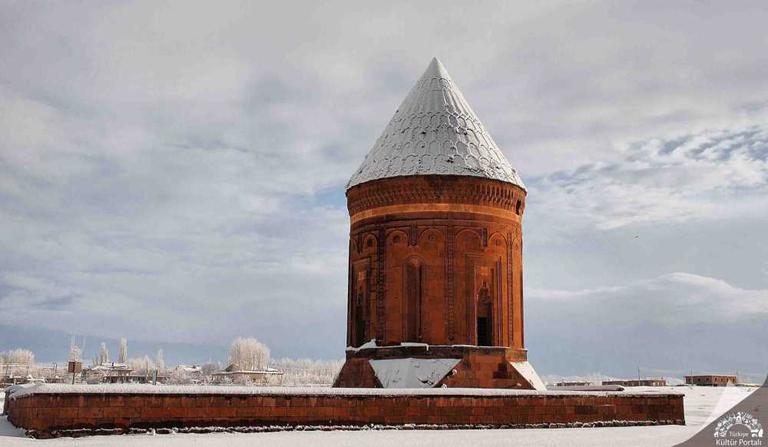
The Usta Şagirt Kümbeti, located in the Ahlat district of Bitlis province, is the largest example of Seljuk-era tombs in the region and is also commonly known among the local population as “Ulu Kümbet.” The structure was built in the İyiler (Eyiler) locality of Ahlat’s İki Kubbe Mahallesi, near the Seljuk Cemetery and close to Lake Van.
No inscription identifying the construction date or the founder has been found on the tomb. Due to this absence, the exact date of construction remains uncertain; however, various dating proposals have been made based on architectural style and decorative features. The general consensus places its construction around the year 1285, taking into account its modern and ornamental elements.
Another piece of evidence regarding the identity of the structure is its spatial and architectural proximity to the Sadi Aka Kümbeti, whose fragments have been found and whose inscription dates to 1300. This proximity necessitates a comparative evaluation of the two structures in terms of their construction process and patronage relationships.
Additionally, during the Ilkhanid period, Küçük Şeyh Hasan, who ascended to the principality in 1340, commissioned a mosque in Tabriz under the name “Usta Şagirt.” Since Ahlat was under his administration during the same period, this strengthens the possibility that the tomb in question was commissioned by this circle. These findings require a reassessment of the tomb’s patron and identity.

Usta Şagirt Kümbeti (Kültür Portalı)
The Usta Şagirt Kümbeti is a two-story structure consistent with classical Seljuk tomb architecture. The entire building is constructed using Ahlat-specific volcanic tuff (cut stone).
The structure features a cylindrical body with a conical roof resting on a square base.
The exterior architecture draws attention through rich craftsmanship and geometric arrangements. The cylindrical body is divided into regular panels and animated by a sequence of niches. The entrance door and niches are framed by muqarnas arches and two distinct borders; the outer border features curled branches and rumi motifs, while the inner border favors geometric interlacing. At the upper section of the body, three distinct bands encircle the structure:
The conical roof covering the tomb exhibits highly detailed craftsmanship. The roof is divided into nine tiers that narrow toward the apex. Each tier contains raised panels carved in different patterns, creating visual depth within the structure.
The Usta Şagirt Kümbeti is a registered cultural heritage site under the ownership and maintenance of the General Directorate of Foundations. The structure is open to visitors and accessible. Although it has undergone various restoration efforts throughout its history, the majority of its original architectural elements and features have been preserved.
No Discussion Added Yet
Start discussion for "Master and Apprentice Mausoleum" article
History and Period Classification
Architectural Structure and Design Features
Plan Scheme and Floor Layout
Exterior Design and Decorative Program
Roofing System
Current Condition and Conservation