

This article was automatically translated from the original Turkish version.
+2 More
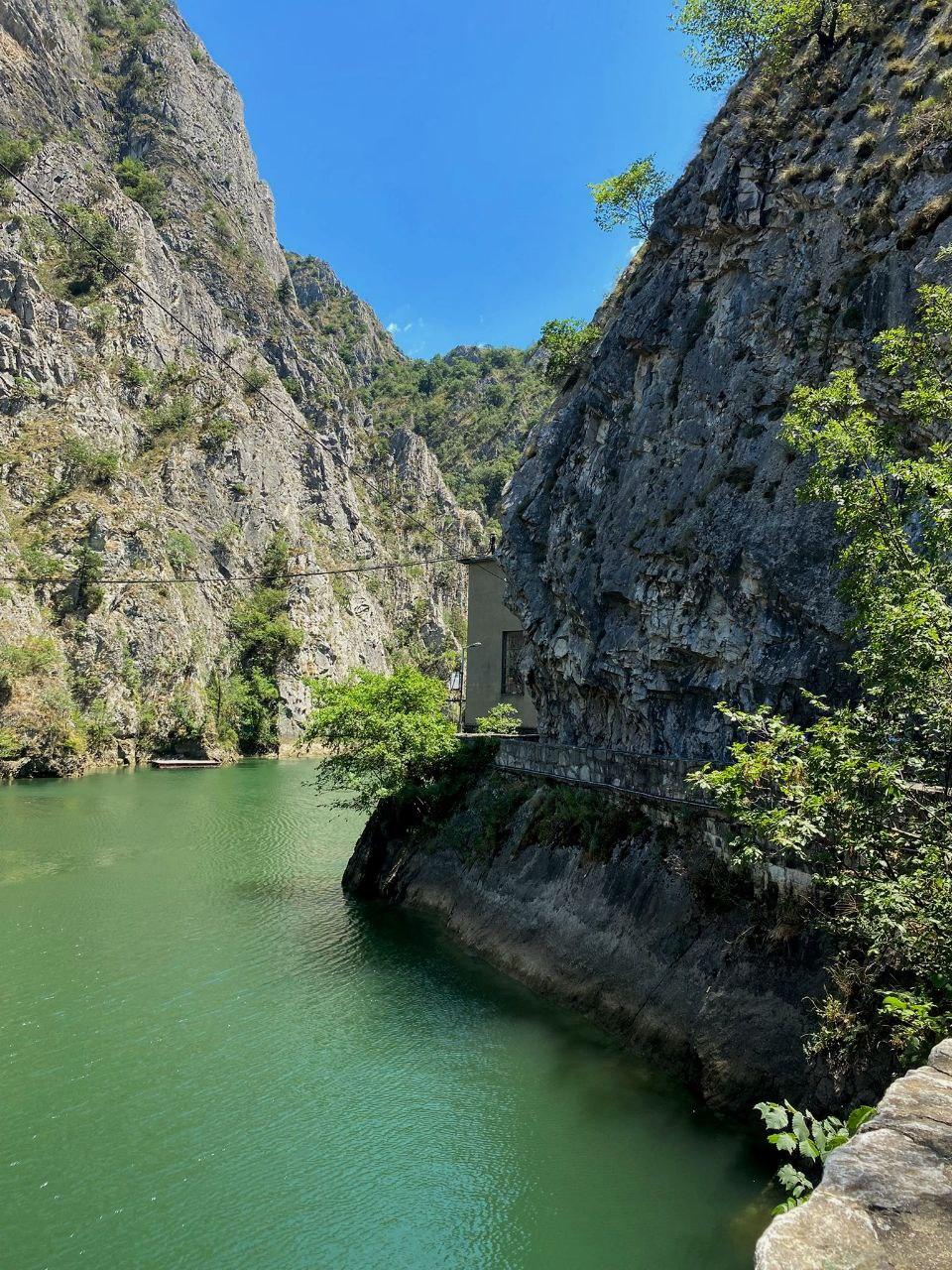
Matka Canyon (Photo: İlayda Seray Canbaz)
Location | on the Treska River west of Skopje North Macedonia | ||||||||
|---|---|---|---|---|---|---|---|---|---|
Area(s) | Approximately 5 000 hectares | ||||||||
Monasteries | etc. Saint Nikola Šiševski (17th century sources) Matka Monastery (14th century) Saint Andrew (1389) | ||||||||
Lake | Matka Lake | ||||||||
Flora | 20% of which are endemic or relict 000 plant species Approximately 1 | ||||||||
Fauna | Horned viper (Vipera ammodytes) bat colonies 259 butterfly species (77 of which are endemic) | ||||||||
Activities | boat tours fishing rafting canoeing sport climbing mountaineering Hiking | ||||||||
Matka Canyon is a natural geomorphological formation located west of Skopje, the capital of North Macedonia, spanning approximately 5,000 hectares along the Treska River. Renowned for its steep cliffs, artificial lake, caves, rich biodiversity, and medieval monasteries, it is among the country’s leading natural and cultural sites. Due to its proximity to Skopje, it has become a popular outdoor destination for both local residents and international visitors.

Matka Canyon (Photo: İlayda Seray Canbaz)
The canyon lies approximately 15–25 kilometers from the center of Skopje, along the Treska River, a tributary of the Vardar River. Geomorphologically, it features a deep rift valley formed over millions of years by vertical erosion processes. Its characteristic appearance is defined by cliffs reaching nearly one thousand meters in height and limestone rock formations.
In 1938, the construction of a dam on the Treska River created Matka Lake, an artificial lake within the canyon. This is the oldest artificial lake in North Macedonia and extends for about seven kilometers. Matka Lake is used not only for hydroelectric power generation but also for irrigating surrounding agricultural lands. The water temperature remains between 7–9 °C even during summer months, making the lake both a natural coolant and an ecologically significant water source.

Matka Canyon (Photo: İlayda Seray Canbaz)
Matka Canyon is one of the most important centers of biological diversity in the Balkans. During the Ice Age, it served as a refuge for numerous species, preserving a wide array of relict and endemic species to the present day. Approximately 20 percent of the nearly 1,000 plant species found here are endemic to the region, with notable examples including Viola kosaninii and Ramonda nathaliae.
The canyon is also rich in animal diversity. A total of 259 butterfly species have been recorded, including 119 diurnal and 140 nocturnal species, 77 of which are endemic to the Balkans. Additionally, 18 previously unknown butterfly species have been identified in the region. The canyon hosts extensive bat colonies and is home to the horned viper (Vipera ammodytes), one of Europe’s most venomous snakes.
Zoological surveys in the area have also led to the discovery of new species of spiders and scorpions. These findings demonstrate that Matka Canyon is not merely a tourist attraction but also a vital center for scientific research.
Ten caves with lengths ranging from 20 to 176 meters, as well as two vertical shafts approximately 35 meters deep, are located within the canyon. The most notable among them is Vrelo Cave.
Vrelo Cave contains two lakes, numerous stalactites and stalagmites. Its most prominent feature is a large cone-shaped stalagmite estimated to have formed over 2,700 years. The deepest point of the smaller lake is 14–15 meters, while the larger lake reaches a depth of approximately 18 meters. Although the total depth of Vrelo Cave has not been precisely determined, measurements indicate it exceeds 200 meters. As a result, Vrelo is recognized as the deepest underwater cave in the Balkans and the second deepest cave in Europe.
Other caves in the canyon include Ubava, Krstalna, and Podrevlo. The region is one of the most significant for speleological research in the Balkans.

Matka Canyon (Photo: İlayda Seray Canbaz)
Matka Canyon is distinguished not only by its natural beauty but also by its historical structures. Since the Middle Ages, the canyon has served as a retreat for Christian monks, during which time numerous monasteries were built.
Other religious structures dedicated to St. John Chrysostom, St. Petka, St. Athanasius, and St. Nedela are also scattered throughout the region. Due to this dense concentration of religious buildings, Matka Canyon has been nicknamed “Little Aynaroz.”

Matka Canyon (Photo: İlayda Seray Canbaz)
Due to its proximity to Skopje, Matka Canyon is a popular destination for weekend excursions. The area offers a wide range of activities including hiking, mountaineering, rock climbing, canoeing, rafting, swimming, and fishing.
Access to the area is available by bus or private vehicle from the city center, with a journey time of approximately 30–45 minutes.
Matka Canyon is one of North Macedonia’s most significant natural and cultural heritage sites. Shaped by the Treska River, it holds an artificial lake, endemic flora and fauna, deep underwater caves, and medieval monasteries, making it valuable for both scientific research and tourism. Today, Matka has become one of Skopje’s most popular attractions, situated at the intersection of the Balkans’ natural and cultural heritage.
Anadolu Ajansı. “Kuzey Makedonya’da Gri ve Yeşilin Buluştuğu Doğa Harikası: Matka Kanyonu.” Anadolu Ajansı. Accessed October 2, 2025. https://www.aa.com.tr/tr/yasam/kuzey-makedonya-da-gri-ve-yesilin-bulustugu-doga-harikasi-matka-kanyonu/3643277.
Macedonia Timeless. “Matka - a piece of untouched nature.” Accessed October 2, 2025. https://macedonia-timeless.com/search/?search-string=MATKA
Macedonia Timeless. “Matka Canyon.” Accessed October 2, 2025. https://macedonia-timeless.com/eng/about/about/did-you-know/canyon-matka#:~:text=Matka%20Canyon%20is%20a%20canyon,special%20attention%20in%20this%20area
Macedonia Timeless. “Matka Lake & Canyon.” Accessed October 2, 2025. https://macedonia-timeless.com/eng/things_to_do/senses/sight/lakes/matka-lake-canyon/.
Milliyet. "Matka Kanyonu Nerede, Hangi Ülkede, Nasıl Gidilir? Giriş Ücretli Midir?" Accessed October 2, 2025. https://www.milliyet.com.tr/tatil/matka-kanyonu-nerede-hangi-ulkede-nasil-gidilir-giris-ucretli-midir-6315447
Skyroad. "Vizesiz Gidilebilecek Gizli Cennet: Matka Kanyonunda Neler Var?" GZT. Accessed October 2, 2025. https://www.gzt.com/skyroad/vizesiz-gidilebilecek-gizli-cennet-matka-kanyonunda-neler-var-3530044
Şengelen, Özge. “Matka Canyon: Hidden paradise in heart of Balkans' darling Skopje.” Daily Sabah. Accessed October 2, 2025. https://www.dailysabah.com/life/travel/matka-canyon-hidden-paradise-in-heart-of-balkans-darling-skopje

Matka Canyon (Photo: İlayda Seray Canbaz)
Location | on the Treska River west of Skopje North Macedonia | ||||||||
|---|---|---|---|---|---|---|---|---|---|
Area(s) | Approximately 5 000 hectares | ||||||||
Monasteries | etc. Saint Nikola Šiševski (17th century sources) Matka Monastery (14th century) Saint Andrew (1389) | ||||||||
Lake | Matka Lake | ||||||||
Flora | 20% of which are endemic or relict 000 plant species Approximately 1 | ||||||||
Fauna | Horned viper (Vipera ammodytes) bat colonies 259 butterfly species (77 of which are endemic) | ||||||||
Activities | boat tours fishing rafting canoeing sport climbing mountaineering Hiking | ||||||||
Geographical Location and Formation
Natural Features
Flora and Fauna
Caves
Cultural and Historical Elements
Tourism and Recreation