

This article was automatically translated from the original Turkish version.
+1 More
Range(s) | 100–120+ km | ||||||||
|---|---|---|---|---|---|---|---|---|---|
Weight(s) | ~190 kg | ||||||||
Developer(s) | MBDA | ||||||||
Integrable Platforms | F-35A/B Lightning II Eurofighter Typhoon Dassault Rafale Saab JAS 39 Gripen (C/D/E) | ||||||||
Propulsion System | Solid-fueled, variable-flow ramjet | ||||||||
Escape Range | 60+ km | ||||||||
Maximum Speed | Mach 4+ | ||||||||
Class | Beyond Visual Range Air-to-Air Missile (BVRAAM) | ||||||||
Full Name | Meteor | ||||||||
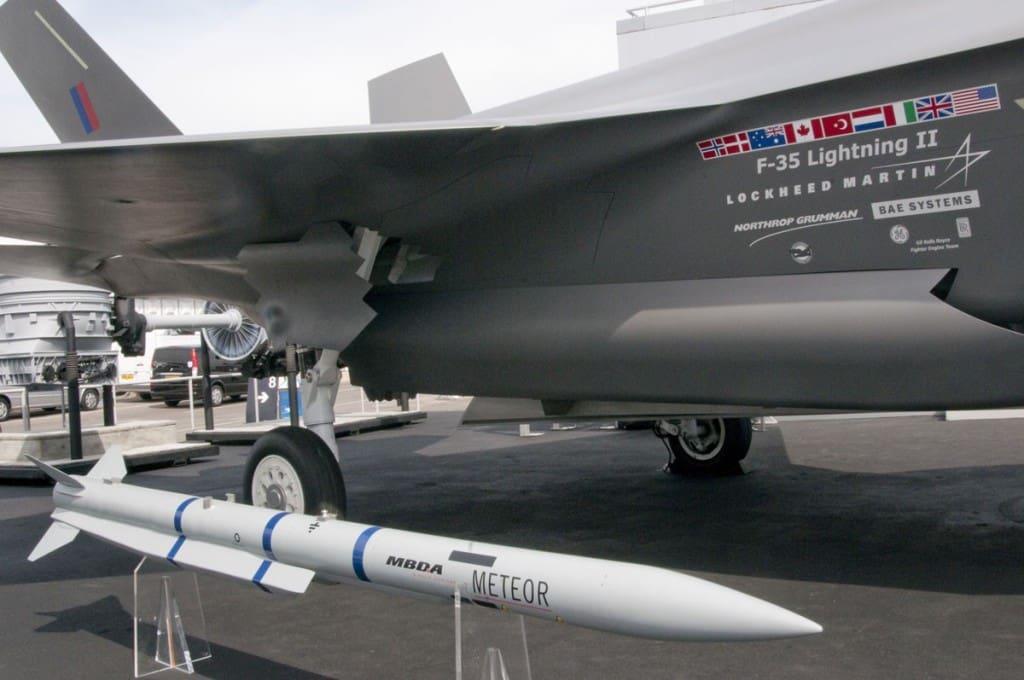
MBDA Meteor Missile is a beyond-visual-range air-to-air missile (BVRAAM) equipped with an active radar seeker head. Designed to establish air superiority, the munition is optimized for long-range engagements against highly maneuverable fighter aircraft, cruise missiles, and UAVs. It is the product of a multinational European program developed to meet the joint requirements of the United Kingdom, Germany, France, Italy, Spain, and Sweden. The prime contractor is MBDA UK.
The program was initially launched to integrate the missile onto European combat platforms such as the Gripen, Rafale, and Eurofighter Typhoon, and later expanded to include the F-35 Lightning II and other next-generation fighter aircraft. In 2016, the Swedish Air Force became the first operational user by introducing the missile into service on its JAS 39 Gripen aircraft under the designation Rb 101.
The Meteor measures 3.7 meters in length, has a diameter of 178 millimeters, and weighs 190 kilograms. Its range exceeds 100 kilometers and its maximum speed surpasses Mach 4. The missile carries a high-explosive fragmentation warhead fitted with both radar proximity fuze and impact sensor. The system provides a significantly wider no-escape zone compared to current AMRAAM-class missiles and maintains high kinetic energy throughout its flight thanks to its ramjet propulsion system.
The Meteor’s defining feature is its solid-fueled, variable-flow ramjet propulsion system. Upon launch, a booster rocket motor accelerates the missile to the speed required for the ramjet to activate. Once engaged, the ramjet provides continuous thrust through controlled fuel feeding throughout the flight. Unlike conventional single-stage rocket motors, this design prevents energy depletion over long distances and preserves maneuverability even during the terminal phase of flight.
The guidance architecture combines inertial navigation, mid-course data link updates, and an active radar seeker in the terminal phase. A two-way data link enables the launching aircraft or third-party sensors to provide real-time target updates and re-targeting during flight. The Saab-produced radar seeker, equipped with jamming-resistant technology and electronic counter-countermeasures, ensures mission effectiveness in dense electronic warfare environments.
The Meteor is fully integrated with the Eurofighter Typhoon, Dassault Rafale, and Saab JAS 39 Gripen and is among the primary weapon candidates for the fifth-generation fighter aircraft F-35 Lightning II. To preserve the aircraft’s low-observable stealth profile, integration efforts have focused on internal weapons bays. As of 2025, vibration and internal compartment compatibility tests have been completed on the F-35A variant.【1】Flight testing for the F-35B variant is being conducted under UK leadership.
The Meteor serves as a beyond-visual-range air superiority weapon. Its ramjet kinematics, wide no-escape zone, and network-centric warfare capabilities provide a decisive engagement advantage against maneuvering aerial targets. With integration efforts nearing completion, the system is expected to enhance the strategic and tactical capabilities of NATO and European air forces.
Daily Sabah. "Türkiye plans to procure Meteor missiles along Eurofighter jets." Accessed December 6, 2025. https://www.dailysabah.com/business/defense/turkiye-plans-to-procure-meteor-missiles-along-eurofighter-jets.
Hoyle, Craig. “MBDA Meteor Missile Integration Nears Flight Test Phase with Stealthy F-35A.” FlightGlobal News. Accessed December 6, 2025. https://www.flightglobal.com/mbda-meteor-missile-integration-nears-flight-test-phase-with-stealthy-f-35a/165573.article
Kajal, Kapil. “U.S. F-35A to Gain European Beyond-Visual-Range Meteor Missile.” *Interesting Engineering*. Accessed December 6, 2025. https://interestingengineering.com/military/us-f35a-europe-beyond-visual-range-missile
Lockheed Martin. “Ground Test Success: Meteor and F-35A Achieve Critical Integration Milestone.” F-35.com. Accessed December 6, 2025. https://www.f35.com/f35/news-and-features/Ground_Test_Success_Meteor_and_F35A_Achieve_Critical_Integration_Milestone.html.
MBDA Inc. "Meteor Product Page." MBDA Inc. Accessed December 6, 2025. https://mbdainc.com/products/meteor/.
MBDA. "Meteor – Air Dominance." MBDA Systems. Accessed December 6, 2025. https://www.mbda-systems.com/products/air-dominance/meteor.
Saab. "Meteor." SAAB Official Website. Accessed December 6, 2025. https://www.saab.com/products/meteor.
[1]
Craig Hoyle. “MBDA Meteor Missile Integration Nears Flight Test Phase with Stealthy F-35A.” FlightGlobal News. Access date: 6 December 2025. https://www.flightglobal.com/mbda-meteor-missile-integration-nears-flight-test-phase-with-stealthy-f-35a/165573.article.

Range(s) | 100–120+ km | ||||||||
|---|---|---|---|---|---|---|---|---|---|
Weight(s) | ~190 kg | ||||||||
Developer(s) | MBDA | ||||||||
Integrable Platforms | F-35A/B Lightning II Eurofighter Typhoon Dassault Rafale Saab JAS 39 Gripen (C/D/E) | ||||||||
Propulsion System | Solid-fueled, variable-flow ramjet | ||||||||
Escape Range | 60+ km | ||||||||
Maximum Speed | Mach 4+ | ||||||||
Class | Beyond Visual Range Air-to-Air Missile (BVRAAM) | ||||||||
Full Name | Meteor | ||||||||
No Discussion Added Yet
Start discussion for "MBDA Meteor Missile" article
Development and User Countries
Technical Specifications
Propulsion System: Ramjet (Ducted Rocket)
Guidance, Data Link, and Electronic Countermeasure Resistance
Platform Integrations and F-35 Development
Operational Role and Significance